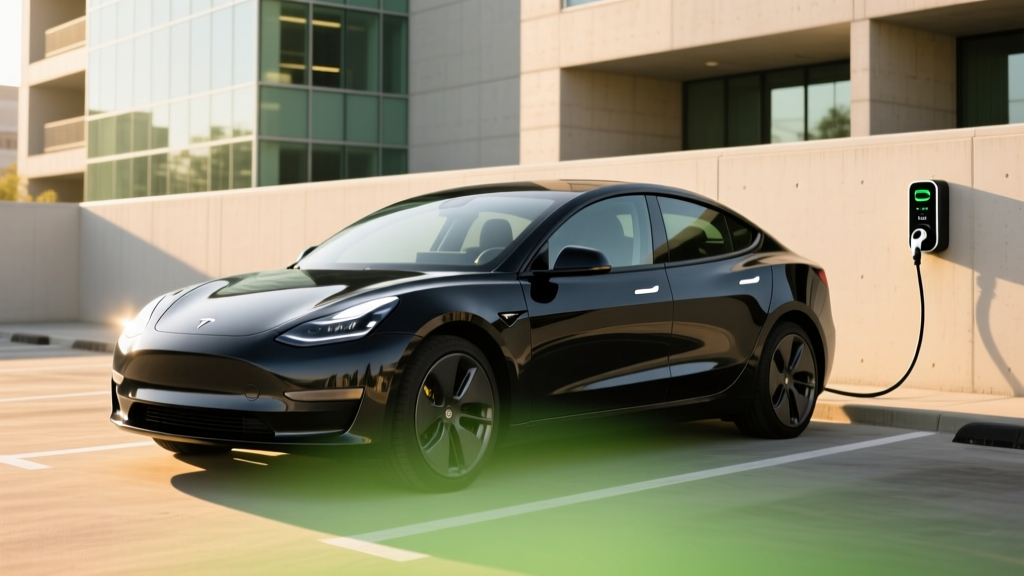
The Tesla Model 3 remains one of the most popular electric sedans on the road, but buyers researching specs often land on a surprisingly common question: how much does the Tesla Model 3 weigh, and does that mass affect real-world range, efficiency, and tire wear? Weight is one of the most underappreciated variables in EV ownership. It influences everything from highway energy consumption to braking distances to how quickly the car can extract range from a DC fast charger.
In this 2026 profile, we'll anchor on the Model 3's curb weight across trims, then translate that number into the specs that actually matter at purchase time — EPA range, charging curves, efficiency, interior space, and tax-credit-adjusted pricing.
Tesla Model 3 Weight by Trim: Why It Matters
Not all Model 3s weigh the same. Battery chemistry, motor count, and glass roof hardware all shift the curb weight by hundreds of pounds. Here's how the current 2026 lineup stacks up:
| Trim | Drivetrain | Curb Weight (lbs) | Battery Chemistry |
|---|---|---|---|
| Model 3 RWD | Rear-Wheel Drive | ~3,862 lbs | LFP (CATL) |
| Model 3 Long Range AWD | Dual Motor AWD | ~4,034 lbs | NMC |
| Model 3 Performance | Dual Motor AWD | ~4,065 lbs | NMC |
For context, a Honda Accord Hybrid tips the scales around 3,400 lbs, while the BMW i4 eDrive40 sits near 4,680 lbs. The Model 3 occupies a middle ground — light enough to deliver strong efficiency, heavy enough to feel planted at highway speed.
How Weight Affects Your Real-World Range
Every additional pound requires more energy to accelerate and sustain at speed. The ~170-lb difference between the RWD and Long Range trims is more than offset by the Long Range's larger NMC pack, which is why the heavier car still achieves more EPA range. But weight shows up in efficiency (Wh/mile): expect the RWD to return slightly better city efficiency due to lower mass and regenerative braking recapturing more energy at lower speeds, while the Long Range wins on highway cruising thanks to its larger buffer.
EPA Range vs. Real-World Expectations
- Model 3 RWD: EPA 272 mi — expect ~245 mi highway, ~215 mi in sub-30°F weather
- Model 3 Long Range AWD: EPA 363 mi — expect ~310 mi highway, ~270 mi in sub-30°F weather
- Model 3 Performance: EPA 315 mi — expect ~270 mi highway, ~235 mi in sub-30°F weather
Cold weather reduces range 15-25% due to battery resistance and cabin heating. Highway speeds above 70 mph reduce range 10-15% vs. EPA combined cycles. Source: EPA fueleconomy.gov
The Long Range AWD is the efficiency sweet spot for road-trippers. Its NMC pack delivers enough buffer to absorb real-world losses without frequent charging stops. The RWD's LFP battery, meanwhile, is ideal for daily commuters who charge at home nightly and rarely exceed 200 miles in a day.
Battery Capacity, Chemistry, and Longevity
Tesla uses two distinct battery chemistries in the Model 3 lineup, and understanding the difference is critical to long-term ownership satisfaction.
| Spec | RWD (LFP) | Long Range / Performance (NMC) |
|---|---|---|
| Usable Capacity | ~57.5 kWh | ~75 kWh |
| Chemistry | Lithium Iron Phosphate (LFP) | Nickel Manganese Cobalt (NMC) |
| Daily Charge Recommendation | 100% OK daily | 80% daily; 100% for trips |
| Cycle Life | Higher (~3,000+ cycles) | Moderate (~1,500-2,000 cycles) |
| Cold-Weather Performance | More range loss in cold | Better cold-weather retention |
LFP (RWD): Tesla recommends charging LFP batteries to 100% regularly — in fact, the BMS requires periodic full charges for accurate state-of-charge calibration. LFP degrades more slowly over thousands of cycles and contains no cobalt, but its lower energy density means a smaller pack and less range. It also suffers more range loss in freezing temperatures due to higher internal resistance.
NMC (Long Range/Performance): Higher energy density delivers more range in a similar physical footprint. Tesla recommends 80% daily charge for longevity, reserving 100% for road trips. NMC handles cold weather better but degrades slightly faster over the battery's lifetime.
Charging Speed: DC Fast, Level 2, and the Curve Reality
Charging speed is where Model 3 weight and battery chemistry intersect. Heavier packs with larger capacity can absorb higher peak power, but the charge curve — how quickly power tapers as the battery fills — is what determines actual charging time.
| Charge Type | RWD (LFP) | Long Range / Performance (NMC) |
|---|---|---|
| Max DC Fast Charge | 170 kW peak | 250 kW peak |
| 10-80% DCFC Time | ~25 min | ~18 min |
| Level 2 (240V/48A) | 11.5 kW / ~37 mi/hr | 11.5 kW / ~37 mi/hr |
| Level 1 (120V) | ~1.4 kW / ~4 mi/hr | ~1.4 kW / ~4 mi/hr |
| Connector | NACS (native) | NACS (native) |
The charge curve reality: The Long Range peaks at 250 kW only between roughly 10-30% state of charge. From 30-60%, it sustains around 150-180 kW. Above 80%, power drops sharply to protect the battery — expect 30-40 kW. This is why Tesla and the Supercharger network recommend charging to 80% on road trips; the last 20% can take as long as the first 60%.
At home on a Level 2 wall connector (48 amps / 11.5 kW), any Model 3 gains roughly 37 miles of range per hour of charging. A full overnight session (8-10 hours) replenishes 300+ miles — more than enough for daily driving.
Performance and Efficiency
| Spec | RWD | Long Range AWD | Performance |
|---|---|---|---|
| Horsepower | 271 hp | 346 hp | 510 hp |
| 0-60 mph | 5.8 sec | 4.2 sec | 2.9 sec |
| Top Speed | 125 mph | 125 mph | 163 mph |
| MPGe (combined) | 132 MPGe | 131 MPGe | 119 MPGe |
| kWh/100 mi | 25 kWh | 26 kWh | 28 kWh |
The RWD's 132 MPGe combined makes it one of the most efficient EVs sold in the U.S., per fueleconomy.gov. At the national average electricity rate of $0.17/kWh, that translates to roughly $4.25 per 100 miles — about one-third the fuel cost of a 30-MPG gas sedan at $3.50/gallon.
The Performance trim's 2.9-second 0-60 time places it in supercar territory, but the efficiency penalty is real: 119 MPGe combined and higher tire wear from the heavier, more powerful dual-motor setup.
Interior Space, Cargo, and Daily Practicality
The Model 3's curb weight is distributed across a compact sedan footprint. Interior space is adequate for four adults but tighter than rivals like the Hyundai Ioniq 6 or BMW i4.
- Front legroom: 42.7 inches
- Rear legroom: 35.2 inches
- Cargo (trunk): 21.0 cu ft
- Frunk (front trunk): 3.1 cu ft
- Total cargo: 24.1 cu ft
The glass roof creates an airy cabin but reduces headroom for taller rear passengers. The minimalist interior (no instrument cluster, all controls on the 15.4-inch center touchscreen) remains polarizing — some buyers love the simplicity, others miss physical buttons for climate and mirrors.
Pricing, Tax Credits, and Total Cost
| Trim | Base MSRP | Est. Federal Credit (§30D) | Effective Price |
|---|---|---|---|
| RWD | $38,990 | Up to $7,500* | ~$31,490 |
| Long Range AWD | $45,740 | Up to $7,500* | ~$38,240 |
| Performance | $52,990 | Up to $7,500* | ~$45,490 |
*§30D Federal Tax Credit eligibility requires:
- Buyer AGI under $150,000 (single) / $300,000 (joint) — per IRS.gov
- Vehicle MSRP under $55,000 (sedans) — all Model 3 trims qualify
- Battery critical minerals and components must meet North American sourcing thresholds (phased in annually through 2030)
- Credit can be transferred to the dealer at point of sale for an instant price reduction
The RWD trim's LFP battery sourcing from CATL has historically complicated full credit eligibility in prior years. Always verify current-year battery component and critical mineral compliance on the fueleconomy.gov tax credit lookup before purchasing. Rules change annually.
Warranty and Long-Term Ownership
- Basic vehicle: 4 years / 50,000 miles
- Battery & drive unit (RWD): 8 years / 100,000 miles (70% minimum retention)
- Battery & drive unit (Long Range/Performance): 8 years / 120,000 miles (70% minimum retention)
Tesla's battery warranty guarantees at least 70% capacity retention over the warranty period. In practice, Model 3 batteries have shown strong longevity — most owners report 5-8% degradation at 100,000 miles based on fleet data aggregated by EV tracking services. The LFP pack in the RWD is expected to degrade even more slowly due to its superior cycle life.
Driver Assistance: Autopilot and FSD Supervised
Tesla Autopilot and Full Self-Driving (Supervised) are Level 2 driver-assistance systems. The driver must remain fully engaged, hands on the wheel (or torque-applied), and eyes on the road at all times. These are NOT autonomous or self-driving systems. Only Level 4 services like Waymo operate without a human driver in geofenced areas.
Included (Basic Autopilot): Traffic-aware cruise control, lane-centering assist, automatic emergency braking, blind-spot monitoring.
FSD (Supervised) — $8,000 or $99/month: Adds automatic lane changes, navigate-on-autopilot for highway exits, traffic light and stop sign recognition, and enhanced city-street driving. Despite the name, FSD requires constant supervision and does not make the vehicle self-driving.
Pros, Cons, and Who Should Buy
Pros
- Class-leading efficiency (132 MPGe RWD)
- Access to Tesla Supercharger network (17,000+ stalls in North America)
- Strong resale value relative to EV competitors
- Over-the-air updates continuously add features
- LFP battery in RWD offers exceptional cycle life
- Native NACS connector — no adapter needed at Superchargers
Cons
- Minimalist interior not for everyone (no stalks, no instrument cluster)
- Rear seat space tighter than Hyundai Ioniq 6 or BMW i4
- FSD (Supervised) is expensive and still requires full driver attention
- Ride quality firm on Performance trim with 20" wheels
- LFP RWD battery loses more range in extreme cold
- No Apple CarPlay or Android Auto
Who Should Buy the Model 3?
Choose the RWD if: You commute under 50 miles daily, charge at home, live in a moderate climate, and want the lowest entry price with maximum battery longevity.
Choose the Long Range AWD if: You take regular road trips over 250 miles, live in a cold-weather state, or want dual-motor traction for snow and rain.
Choose the Performance if: Acceleration and handling are priorities, you accept the efficiency trade-off, and you rarely exceed 250 miles between charges.
Look elsewhere if: You need rear-seat space for tall adults or car seats (consider Model Y or Ioniq 6), want physical buttons and Apple CarPlay, or prefer a traditional dealer service experience.
Frequently Asked Questions
What is the Tesla Model 3's curb weight?
The 2026 Model 3 ranges from approximately 3,862 lbs (RWD with LFP battery) to 4,065 lbs (Performance with NMC battery). The Long Range AWD sits at roughly 4,034 lbs. All trims are lighter than many competing electric sedans, contributing to the Model 3's strong efficiency ratings.
What is the real-world range of the Tesla Model 3?
The EPA rates the RWD at 272 miles, Long Range AWD at 363 miles, and Performance at 315 miles. In real-world highway driving at 70-75 mph, expect roughly 10-15% less. In freezing temperatures (below 30°F), range drops 15-25% across all trims due to battery resistance and cabin heating demands. The Long Range AWD is the most road-trip-capable trim.
How fast does the Model 3 charge?
On a DC fast charger, the Long Range and Performance peak at 250 kW, achieving a 10-80% charge in about 18 minutes. The RWD peaks at 170 kW with a 10-80% time of roughly 25 minutes. At home on a Level 2 wall connector (11.5 kW), all trims gain about 37 miles of range per hour. All 2026 Model 3s use the native NACS connector — no adapter needed at Tesla Superchargers.
Does the Model 3 qualify for the federal EV tax credit?
All Model 3 trims fall under the $55,000 MSRP cap for sedans under IRS §30D rules. However, full $7,500 credit eligibility depends on battery critical mineral and component sourcing requirements, which change annually. Buyer income must be under $150,000 (single) or $300,000 (joint filing). The credit can be transferred at point of sale for an instant discount. Verify current-year eligibility at fueleconomy.gov before purchasing.
Is the Model 3 worth buying vs. competitors?
The Model 3 competes with the Hyundai Ioniq 6, BMW i4, and Polestar 2. The Model 3 wins on Supercharger network access, efficiency (MPGe), and over-the-air updates. The Ioniq 6 offers more rear-seat room and 800V ultra-fast charging. The BMW i4 offers a more traditional luxury interior. For buyers prioritizing charging infrastructure, efficiency, and software, the Model 3 remains the benchmark. For those wanting more space or traditional controls, competitors deserve a test drive.
How does weight affect Model 3 tire wear and maintenance?
EVs are heavier than comparable gas cars due to battery mass, and the Model 3's ~3,900-4,065 lb curb weight accelerates tire wear compared to lighter sedans. Expect tire replacement every 25,000-35,000 miles depending on driving style and trim (Performance models wear tires faster due to higher torque and stickier compounds). Rotation every 6,250 miles is critical. Beyond tires, EV maintenance is minimal — no oil changes, no transmission fluid, and regenerative braking extends brake pad life significantly.