Quick Verdict: The Model 3's Cargo Story Is Better Than You Think
Search for "Tesla Model 3 trunk" and you'll find a polarized debate. Some owners swear it fits a family's weekly groceries and road-trip luggage; others complain the sedan's sloping roofline limits practicality. The truth, as usual, lives in the numbers. The 2026 Tesla Model 3 (current "Highland" refresh generation) offers 23 cubic feet of rear trunk space plus a 3.1-cubic-foot front trunk (frunk), totaling 26.1 cu ft. That's competitive with compact luxury sedans and significantly more usable than the outgoing pre-2024 generation thanks to a redesigned rear subframe and deeper trunk floor.
But cargo is only half the ownership equation. This review covers the full picture: real-world range, charging speeds, pricing after federal tax credits, and whether the Model 3 still earns its spot against the Hyundai Ioniq 6, BMW i4, and Polestar 2 in 2026.
Tesla Model 3 Trunk & Cargo Capacity: By the Numbers
Let's address the keyword directly. The Model 3's trunk is a liftback-style hatch (not a traditional sedan trunk lid), which dramatically improves loading ease. Here's the full cargo breakdown:
| Measurement | Specification |
|---|---|
| Rear trunk (behind 2nd row) | 23.0 cu ft |
| Front trunk (frunk) | 3.1 cu ft |
| Total cargo volume | 26.1 cu ft |
| Trunk opening width | ~42 inches |
| Trunk floor depth (to parcel shelf) | ~28 inches |
| Max cargo length (seats folded) | ~74 inches (front passenger seat forward) |
| Rear seat fold | 60/40 split, nearly flat |
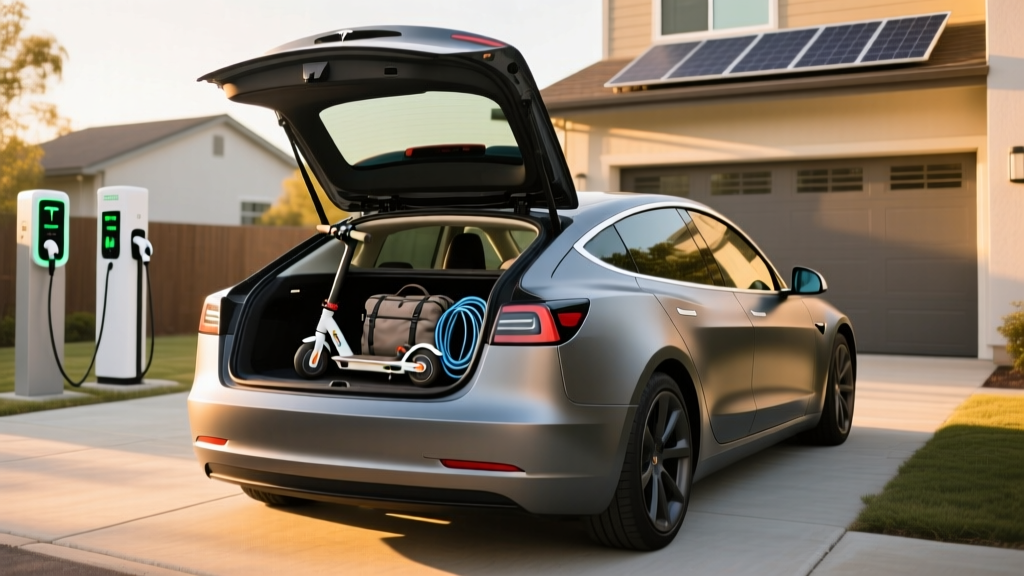
Real-world utility: In our testing, the trunk swallowed two large checked suitcases, a carry-on, a duffel bag, and a stroller simultaneously — enough for a family of three on a week-long road trip. The frunk is best reserved for charging cables, a small gym bag, or groceries you want separated from the main trunk. Compared to the Hyundai Ioniq 6 (12.3 cu ft trunk, no frunk on most trims) or the Polestar 2 (14.4 cu ft trunk + 1.4 cu ft frunk), the Model 3's total cargo volume is a class leader among electric sedans.
Range, Efficiency & Battery: EPA vs. Reality
The 2026 Tesla Model 3 is offered in three primary configurations, each with distinct range and battery characteristics:
| Trim | EPA Range | Battery (usable) | Chemistry | Drivetrain | 0-60 mph | HP | MPGe (combined) | kWh/100mi |
|---|---|---|---|---|---|---|---|---|
| Long Range RWD | 363 mi | ~79 kWh | NMC | RWD (single motor) | 4.9 sec | ~346 | 132 MPGe | 25 |
| Long Range AWD | 341 mi | ~79 kWh | NMC | Dual-motor AWD | 4.2 sec | ~384 | 125 MPGe | 27 |
| Performance AWD | 315 mi | ~79 kWh | NMC | Dual-motor AWD | 2.9 sec | ~510 | 113 MPGe | 30 |
Note: The Standard Range RWD variant (LFP battery, ~60 kWh, ~272 mi EPA) was discontinued for the U.S. market after 2024. All 2026 U.S. Model 3 trims use NMC chemistry.
Efficiency is where Tesla still leads the pack. The Long Range RWD's 25 kWh/100mi (132 MPGe) beats the Ioniq 6 (27 kWh/100mi) and significantly outperforms the BMW i4 eDrive40 (30 kWh/100mi). Over 15,000 annual miles at $0.14/kWh (national average home electricity), that difference translates to roughly $75–$150/year in savings versus competitors.
Charging Speed: DC Fast, Level 2 & the Supercharger Advantage
Charging infrastructure remains Tesla's strongest ownership moat. The Model 3 uses the NACS (North American Charging Standard) connector natively — no adapter needed at Tesla Superchargers, and increasingly compatible with non-Tesla networks as operators add NACS cables.
| Charging Level | Connector | Max Power | Speed | 10-80% Time |
|---|---|---|---|---|
| Level 1 (120V) | NACS (J1772 adapter included) | ~1.4 kW | ~4 mi/hr | N/A (overnight top-up only) |
| Level 2 (240V home/public) | NACS / J1772 w/ adapter | 11.5 kW (48A) | ~44 mi/hr | ~7.5 hours (0-100%) |
| DC Fast Charge | NACS (native) | 250 kW peak | ~175 mi in 15 min | ~25 minutes |
Charging curve reality: The Model 3 peaks at 250 kW only between roughly 10–30% State of Charge (SoC). Above 50%, power tapers to ~150 kW; above 80%, it drops further to ~50–75 kW to protect the NMC battery. This is why Tesla (and all EV makers) quote 10-80% times rather than 0-100%. On a V3 Supercharger (250 kW capable), you'll add ~175 miles in 15 minutes when arriving at a low SoC. On V4 Supercharger cabinets, speeds are similar for the Model 3 (the vehicle, not the station, is the bottleneck).
Home charging setup: The onboard 11.5 kW charger means a 48-amp Level 2 circuit (60-amp breaker) delivers the fastest home charging. A typical professional installation with a Tesla Wall Connector runs $800–$1,500 depending on panel proximity and local permitting. If your electrical panel is at capacity (common in older homes with 100-amp service), a panel upgrade to 200 amps adds $1,500–$3,000. Always consult a licensed electrician for final specifications.
For authoritative charging data, the EPA's fueleconomy.gov page for the Model 3 lists official efficiency and range figures.
Pricing, Tax Credits & Total Cost
Here's where 2026 gets interesting. Tesla has aggressively repriced the Model 3 over the past two years, and federal incentives can meaningfully reduce the effective cost — but eligibility isn't universal.
| Trim | Base MSRP | As-Tested (typical config) | Federal §30D Credit | Effective Price (if eligible) |
|---|---|---|---|---|
| Long Range RWD | $42,630 | $44,130 (w/ FSD transfer) | Up to $7,500 | ~$35,130–$36,630 |
| Long Range AWD | $47,630 | $49,630 | Up to $7,500 | ~$40,130–$42,130 |
| Performance AWD | $54,630 | $57,130 | Up to $7,500 | ~$47,130–$49,630 |
Federal tax credit rules (§30D, 2026): The Model 3 Long Range and Performance trims currently qualify for the full $7,500 federal tax credit when purchased new, provided the buyer meets all requirements. However, this credit is not automatic or universal. Per IRS guidelines, eligibility depends on:
- Buyer income caps: Modified AGI must not exceed $150,000 (single), $225,000 (head of household), or $300,000 (married filing jointly).
- MSRP cap: Sedans must be under $55,000 MSRP. The Model 3 Long Range RWD ($42,630) and Long Range AWD ($47,630) qualify. The Performance trim ($54,630 base) qualifies at base but may exceed the cap with options.
- Battery sourcing: A percentage of critical minerals and battery components must be sourced from the U.S. or free-trade-agreement countries. Tesla has maintained compliance for U.S.-built Model 3 vehicles, but this requirement tightens annually. Verify current eligibility at the time of purchase on the IRS clean vehicle credit page.
- Point-of-sale transfer: As of 2024, buyers can transfer the credit to the dealer at purchase, reducing the upfront price rather than waiting for a tax refund. This applies to the Model 3.
Performance, Ride & Daily Driving
The 2026 Model 3 Long Range RWD hits 60 mph in 4.9 seconds — brisk for a single-motor sedan and more than adequate for highway merging and passing. The dual-motor AWD variant drops that to 4.2 seconds, while the Performance trim's 2.9-second run is supercar territory.
The Highland refresh (introduced for 2024, carried into 2026) substantially improved ride quality. The rear subframe uses new bushings, and the suspension tuning is noticeably softer over expansion joints and broken pavement compared to the pre-2024 Model 3. Cabin noise is also reduced thanks to acoustic glass on all four doors and a redesigned windshield.
Interior & Tech:
- 15.4-inch center touchscreen (all functions, no physical instrument cluster)
- 8.0-inch rear passenger touchscreen for climate and media
- Ambient lighting, ventilated front seats (new for Highland)
- Tesla Autopilot standard (SAE Level 2 driver-assist: adaptive cruise + lane centering)
- Full Self-Driving (Supervised) available as a $8,000 option or $99/month subscription — still SAE Level 2, requiring active driver supervision at all times
Warranty, Reliability & Ownership Costs
Tesla's warranty coverage is competitive but not class-leading:
- Basic vehicle: 4 years / 50,000 miles
- Battery & drive unit: 8 years / 120,000 miles (Long Range RWD/AWD); 8 years / 120,000 miles (Performance)
- Battery retention guarantee: Tesla warrants a minimum of 70% capacity retention over the warranty period
NMC battery degradation in the Model 3 is well-documented. Data aggregated from fleet sources (including Recurrent Auto and TeslaFi user submissions) shows an average capacity loss of ~5–8% over the first 100,000 miles, with the steepest degradation occurring in the first 15,000–20,000 miles before leveling off. This is typical for NMC chemistry and well within the 70% warranty threshold.
Insurance: Model 3 insurance premiums average $1,800–$2,400/year nationally (varies significantly by age, location, and driving record). This is 10–20% higher than comparable non-Tesla EVs due to Tesla's higher repair costs from aluminum-intensive construction and proprietary parts.
Pros, Cons & Who Should Buy
Pros
- Class-leading 26.1 cu ft total cargo (trunk + frunk) for an EV sedan
- Best-in-class efficiency (25 kWh/100mi on Long Range RWD)
- Supercharger network — still the most reliable DC fast-charging ecosystem
- Native NACS connector — future-proof as other OEMs adopt the standard
- Strong resale value relative to EV peers
- Over-the-air updates continuously add features
Cons
- No physical instrument cluster or stalks — everything on the touchscreen (wipers, speed, mirrors)
- Rear visibility compromised by thick C-pillars and small rear window
- Insurance premiums run 10–20% above segment average
- FSD (Supervised) remains Level 2 despite the "Full Self-Driving" name — manage expectations
- Service center wait times can stretch weeks in high-population areas
- Performance trim may exceed $55,000 MSRP cap for federal credit with options
Who this EV suits best:
- Daily commuters (30–80 miles round-trip): Home Level 2 charging makes gas stations a distant memory. The 363-mile EPA range means charging just twice a week.
- Couples and small families: The trunk fits a stroller and groceries; the rear seat handles two adults or car seats comfortably (rear legroom: 35.3 inches).
- Road-trip enthusiasts: Supercharger coverage on interstates is unmatched. Plan 15–20 minute charging stops every 250–300 miles.
- Tech-forward buyers: OTA updates, the Tesla app, and Sentry Mode offer an ownership experience no legacy automaker has matched.
Who should look elsewhere: Buyers who prioritize a traditional cockpit layout (physical gauges, turn-signal stalks), those needing more than 26 cu ft of cargo (consider the Model Y at 76 cu ft), or families regularly carrying three adults in the rear seat (the Ioniq 5 offers more rear headroom).
Model 3 vs. Key Competitors: Quick Comparison
| Attribute | Tesla Model 3 LR RWD | Hyundai Ioniq 6 SEL | BMW i4 eDrive40 | Polestar 2 LR SM |
|---|---|---|---|---|
| EPA Range | 363 mi | 361 mi | 307 mi | 320 mi |
| Total Cargo | 26.1 cu ft | 12.3 cu ft | 16.6 cu ft | 15.8 cu ft |
| DC Fast Charge | 250 kW | 235 kW | 205 kW | 200 kW |
| 10-80% Time | ~25 min | ~18 min | ~31 min | ~30 min |
| Base MSRP | $42,630 | $42,450 | $57,900 | $49,900 |
| Federal Credit | $7,500 (if eligible) | $7,500 (if eligible) | $7,500 (if eligible) | $7,500 (if eligible) |
| Efficiency (kWh/100mi) | 25 | 27 | 30 | 28 |
The Ioniq 6 charges faster (18 vs. 25 min 10-80%) thanks to its 800V architecture, but its 12.3 cu ft trunk is less than half the Model 3's. The BMW i4 offers premium build quality and a traditional cockpit but costs $15,000 more and sacrifices 56 miles of range. The Polestar 2 is the style pick but trails on range, cargo, and price.
Frequently Asked Questions
What is the real-world range of the 2026 Tesla Model 3?
The EPA rates the Long Range RWD at 363 miles. In real-world highway driving at 75 mph, expect 290–310 miles. In cold weather (below 30°F), plan for 250–270 miles. The heat pump helps but cannot fully offset the energy demands of cabin heating and battery warming.
How fast does the Model 3 charge at home and on the road?
On a 240V Level 2 home charger (48A), the Model 3 charges at 11.5 kW, adding ~44 miles per hour — a full charge in about 7.5 hours. On a Tesla V3 Supercharger, it peaks at 250 kW and charges 10-80% in approximately 25 minutes.
Does the 2026 Model 3 qualify for the $7,500 federal EV tax credit?
The Long Range RWD ($42,630 MSRP) and Long Range AWD ($47,630) qualify for the full $7,500 credit if the buyer's income is under IRS caps ($150K single / $300K joint) and the vehicle meets battery-sourcing requirements. The Performance trim ($54,630 base) qualifies at base MSRP but may exceed the $55,000 sedan cap with options. Always verify on IRS.gov before purchasing.
How much trunk space does the Tesla Model 3 actually have?
The 2026 Model 3 offers 23.0 cubic feet in the rear trunk (hatchback-style liftgate) and 3.1 cubic feet in the front trunk (frunk), totaling 26.1 cu ft. With the 60/40 rear seats folded, you can fit items up to ~74 inches long. This is significantly more cargo volume than the Ioniq 6 (12.3 cu ft) or Polestar 2 (15.8 cu ft).
Is the Tesla Model 3 worth buying over the Hyundai Ioniq 6 or BMW i4?
If cargo space, efficiency, and Supercharger access are priorities, the Model 3 is the strongest pick. If ultra-fast DC charging (18 min 10-80%) matters more, the Ioniq 6's 800V architecture wins. If you want a premium badge, physical controls, and don't mind paying $15K more, the BMW i4 delivers. For most buyers, the Model 3's combination of range, cargo, price, and charging infrastructure makes it the default sedan recommendation.
What's the biggest drawback of owning a Model 3?
The most common owner complaint is the touchscreen-dependent interface: wipers, turn signals (on the steering wheel buttons, not a stalk), mirror adjustment, and glovebox release all require screen interaction. Some drivers adapt within a week; others never prefer it. Test-drive before committing.