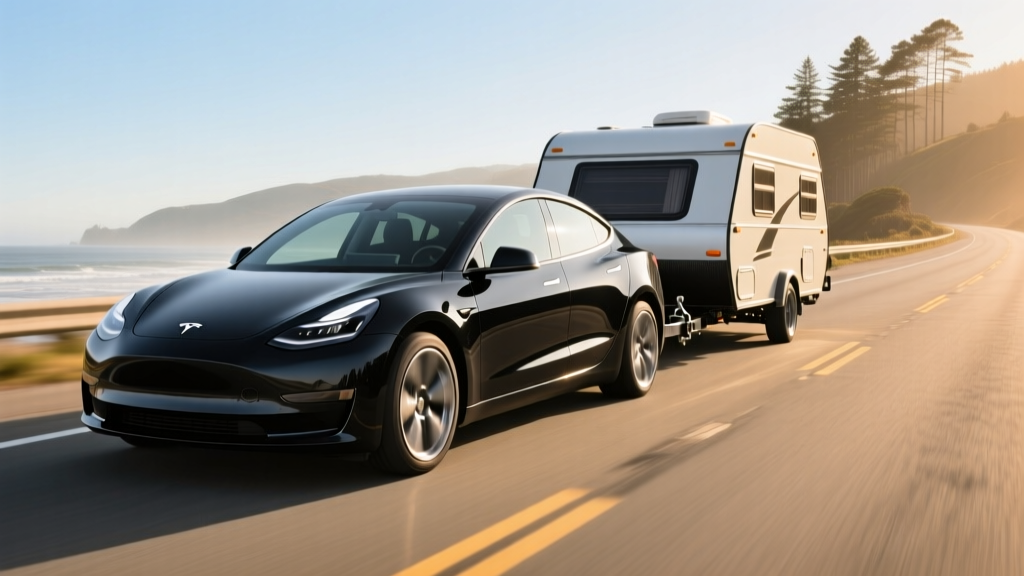
The Tesla Model 3 Highland refresh brought something previous generations lacked: an official towing rating. But the keyword on every buyer's mind — Tesla Model 3 towing — comes with a web of caveats about range loss, hitch availability, and whether a sedan is the right tool for the job. This review covers the 2026 Tesla Model 3 lineup with exact numbers on range, charging, pricing, tax-credit eligibility, and what actually happens to efficiency when you hook up a trailer.
Tesla Model 3 Towing: What the Numbers Actually Allow
Tesla rates the 2026 Model 3 Long Range AWD and Performance variants for 2,200 pounds (1,000 kg) maximum towing capacity with a 220-pound tongue weight limit. The base Rear-Wheel-Drive trim is not officially rated for towing in the U.S. market, even though European-spec RWD Model 3s carry a homologated rating. This is a critical distinction that catches many cross-market shoppers by surprise.
At 2,200 lbs, the Model 3 fits a narrow but real use case: a small teardrop camper (Scamp 13, nuCamp Tab 320), a light utility trailer with an ATV, a pair of dirt bikes on a single-axle carrier, or a compact aluminum boat on a trailer. It does not handle a conventional travel trailer, a horse trailer, or anything approaching the capacity of a Model Y (3,500 lbs) or a Ford F-150 Lightning (7,700-10,000 lbs).
| Spec | RWD | Long Range AWD | Performance |
|---|---|---|---|
| Max Towing | Not rated | 2,200 lbs | 2,200 lbs |
| Tongue Weight | N/A | 220 lbs | 220 lbs |
| EPA Range | 272 mi | 346 mi | 315 mi |
| 0-60 mph | 5.8 sec | 4.2 sec | 2.9 sec |
| Drivetrain | RWD | Dual-motor AWD | Dual-motor AWD |
| Horsepower | 271 hp | 346 hp | 510 hp |
Important note: The U.S. tow hitch accessory is dealer- or service-center-installed and costs approximately $1,000-$1,200 including labor. Third-party hitches (Curt, Draw-Tite) exist for roughly $300-$450 in parts but may complicate warranty claims on rear electrical components. Always verify with your service center before going aftermarket.
Range, Battery, and Efficiency
The 2026 Model 3 Long Range AWD uses an ~79 kWh usable NMC (nickel-manganese-cobalt) lithium-ion pack. The RWD trim uses a ~57.5 kWh LFP (lithium iron phosphate) battery supplied by CATL. The chemistry difference matters for ownership habits: Tesla recommends charging LFP packs to 100% regularly for cell balancing, while NMC packs are best kept between 20-80% for daily use and reserved to 100% only for road trips.
Efficiency is where the Model 3 still leads the EV sedan segment. The Long Range AWD achieves 132 MPGe combined (per fueleconomy.gov), which translates to roughly 25 kWh per 100 miles under mixed driving conditions. That figure degrades sharply under load.
Real-World Range While Towing
This is the part most towing-focused shoppers need to internalize. Towing a 1,800-lb teardrop camper at highway speeds (65-70 mph) typically pushes energy consumption to 45-55 kWh per 100 miles, roughly doubling the baseline draw. On a Long Range AWD with 79 kWh usable, that means:
- Flat terrain, 65 mph, moderate temps: ~160-180 miles before needing to charge
- Rolling hills or 70+ mph: ~130-150 miles
- Mountain grades or headwinds: ~100-130 miles
- Cold weather (sub-40°F) with a trailer: ~90-120 miles
The practical implication: towing turns the Model 3 into a 150-mile-range car with mandatory Supercharger planning every 90 minutes of highway driving. If your typical tow route has sparse DC fast-charging infrastructure, this becomes a significant constraint.
Charging Speed: DC Fast, Level 2, and Towing Logistics
The Model 3 Long Range AWD and Performance accept up to 250 kW peak DC fast charging on V3/V4 Tesla Superchargers. The RWD with LFP peaks closer to 170 kW. Peak numbers are not sustained numbers — the charge curve tapers aggressively past 60% state of charge.
| Charging Method | Long Range AWD | RWD (LFP) |
|---|---|---|
| Peak DC Fast Charge | 250 kW | 170 kW |
| 10-80% DC Fast | ~25 min | ~30 min |
| 50-80% DC (taper) | ~15 min of the total | ~18 min of the total |
| Level 2 (11.5 kW / 48A) | ~44 mi/hr | ~32 mi/hr |
| Level 1 (120V household) | ~3-4 mi/hr | ~3-4 mi/hr |
Towing-specific charging reality: When you arrive at a Supercharger with a trailer attached, you face a logistical hurdle. Most Supercharger stalls are not pull-through, meaning you cannot park with the trailer still hitched without blocking adjacent stalls or the drive lane. Tesla has begun deploying pull-through "Supercharger with trailer" locations, but as of 2026, these remain a minority. Plan stops at stations explicitly marked as trailer-friendly, or be prepared to unhitch at each stop — a time cost most owners underestimate.
For home charging, a Tesla Wall Connector on a 60-amp circuit delivers 11.5 kW / 48 amps, replenishing the Long Range battery in roughly 7-8 hours from near-empty. Installation typically runs $800-$2,000 depending on panel proximity and whether your home needs a service upgrade. The 30% Residential Clean Energy Credit (IRS Form 5695) covers charger hardware and installation up to $1,000 through 2032.
Performance and Driving Dynamics
The Model 3 Performance variant hits 0-60 mph in 2.9 seconds with 510 horsepower — absurdly quick for a four-door sedan and irrelevant to towing. The Long Range AWD at 4.2 seconds and 346 hp is more than adequate for merging with a trailer. The single-motor RWD at 5.8 seconds and 271 hp is the weakest of the three but still passes highway traffic without drama when unladen; with 2,000 lbs behind it, acceleration noticeably softens.
Handling with a trailer is acceptable but not confidence-inspiring. The Model 3's low curb weight (~4,030 lbs for Long Range AWD) means the trailer-to-vehicle weight ratio approaches 50% with a maxed-out load. That ratio is the primary reason EV sedans feel less stable while towing than body-on-frame trucks or heavier crossovers. Electronic stability control intervenes readily, but you will feel crosswinds and passing semis more than you would in a Model Y or Rivian R1S.
Interior, Cargo, and Tech
The Highland-refresh interior is materially better than the pre-2024 Model 3, with ventilated front seats, ambient lighting, rear-seat touchscreen, and acoustic glass that drops cabin noise significantly. Cargo space measures 23 cubic feet combined (trunk + frunk), which is modest for road-trip packing but adequate for two people's luggage. Rear legroom at 35.3 inches is tight for tall passengers on long hauls.
The 15.4-inch center touchscreen runs Tesla's proprietary OS — no Apple CarPlay or Android Auto. Navigation integrates directly with the Supercharger network and battery preconditioning, which warms the pack ahead of a fast-charge stop to maximize charge rate. Autopilot (basic) is standard; Enhanced Autopilot ($6,000) and Full Self-Driving Supervised ($8,000 or $99/month) are optional. All remain SAE Level 2 driver-assist systems — the driver must remain attentive with hands on the wheel at all times. When towing, Tesla disables Autosteer on most routes because trailer dynamics alter braking and steering calibration.
Pricing and Federal Tax Credit Eligibility
2026 Tesla Model 3 pricing starts at $38,990 for the RWD (before destination), with the Long Range AWD at $44,990 and Performance at $52,990. Adding the tow hitch, FSD, and premium paint can push an as-tested Long Range well past $55,000.
| Trim | Base MSRP | §30D Credit Potential | Effective Price Floor |
|---|---|---|---|
| RWD | $38,990 | Up to $7,500 | ~$31,490 |
| Long Range AWD | $44,990 | Up to $7,500 | ~$37,490 |
| Performance | $52,990 | Up to $7,500 | ~$45,490 |
Federal tax credit caveats (IRS §30D): Eligibility requires adjusted gross income below $150,000 (single) / $300,000 (joint), an MSRP under $55,000 for sedans (all Model 3 trims qualify on price), and battery component + critical mineral sourcing thresholds that phase up annually. As of 2026, the sourcing requirements are stringent enough that some Model 3 configurations may qualify for only $3,750 (half credit) depending on build month and supply-chain shifts. The credit can now be transferred to the dealer at point of sale as an instant discount, but you must verify eligibility at the time of purchase on the IRS Energy Credits portal. Consult a tax professional — rules change frequently, and the IRS maintains the current eligible vehicle list.
Warranty and Long-Term Ownership
Tesla's warranty structure is industry-standard for the EV segment:
- Basic Vehicle: 4 years / 50,000 miles
- Battery & Drive Unit (RWD LFP): 8 years / 100,000 miles, 70% minimum capacity retention
- Battery & Drive Unit (Long Range / Performance NMC): 8 years / 120,000 miles, 70% minimum capacity retention
Real-world degradation data from Recurrent Auto and Tesla's own impact reports suggest NMC Model 3 packs lose roughly 10-12% capacity over the first 100,000 miles, with the curve flattening significantly afterward. LFP packs degrade more slowly but start from a smaller total capacity. Towing does accelerate cycle wear due to higher discharge rates, but occasional recreational towing (a few thousand miles per year) will not materially affect long-term state of health.
Insurance is a known pain point. Model 3 premiums average 15-25% higher than comparable gas sedans due to repair cost data. Get quotes before purchasing — IIHS safety ratings are strong (Top Safety Pick+ when equipped with acceptable headlights), but insurance algorithms weight Tesla's collision-repair network heavily.
Pros, Cons, and the Decision Framework
Pros
- Best-in-class efficiency at 132 MPGe combined
- 250 kW peak DC charging with mature Supercharger network
- Highland interior quality is a meaningful step up
- Strong real-world range on Long Range AWD (300+ mi achievable)
- Point-of-sale tax credit transfer simplifies purchase
Cons
- 2,200-lb tow rating is the lowest in the EV crossover/sedan class
- RWD trim not tow-rated in the U.S.
- Trailer-friendly Supercharger stalls remain rare
- Low curb weight creates stability concerns near max tow capacity
- Autosteer disabled when towing
- No Apple CarPlay or Android Auto
Who Should Buy the Model 3 for Towing?
The Model 3 makes sense for a buyer who primarily commutes solo or as a couple, values efficiency and charging speed above all else, and tows only a lightweight teardrop or utility trailer 5-10 times per year on routes with reliable Supercharger coverage. It does not make sense if towing is a weekly activity, if your trailer approaches the 2,200-lb limit regularly, or if you need to tow in mountainous or cold-weather regions where range loss compounds quickly. For those use cases, the Model Y (3,500 lbs), Rivian R1S (7,700 lbs), or a Ford F-150 Lightning are substantially more capable — at a higher purchase price and lower daily efficiency.
Frequently Asked Questions
Can the Tesla Model 3 tow a camper?
Yes, but only small ones. The 2,200-lb limit (Long Range AWD and Performance only) fits teardrop campers like the Scamp 13 (~1,500 lbs loaded) or nuCamp Tab 320 (~1,900 lbs). Any conventional travel trailer exceeds the rating. Range drops to roughly 150 miles per charge while towing, so Supercharger route planning is mandatory.
Why isn't the Model 3 RWD rated for towing in the U.S.?
Tesla has not submitted the U.S.-spec RWD for SAE J2807 tow testing. European RWD Model 3s carry a homologated tow rating, likely due to different regulatory frameworks and market demand. There is no mechanical reason the RWD cannot tow light loads, but doing so without a Tesla-approved hitch and rating may void related warranty coverage.
Does towing affect the Model 3 battery warranty?
Not directly. Tesla's 8-year / 120,000-mile battery warranty (Long Range/Performance) covers capacity retention below 70% regardless of towing use, provided the vehicle is within its rated limits. Exceeding the 2,200-lb rating or using an unapproved hitch could give Tesla grounds to deny a claim related to rear-drive-unit or electrical issues.
How does Model 3 towing compare to Model Y?
The Model Y is rated for 3,500 lbs — roughly 60% more capacity — and its higher curb weight (~4,400 lbs) produces a more stable towing feel. Model Y range is slightly lower (310-330 mi EPA depending on trim), and the tow hitch is similarly dealer-installed. For buyers whose primary towing need is a mid-size camper or small boat, the Model Y is the more practical Tesla option.
Do I need a brake controller for Model 3 towing?
Trailers over roughly 1,000 lbs typically require their own surge or electric brakes by state law. The Model 3 does not have a factory-integrated brake controller output, so electric-brake trailers require an aftermarket controller (Curt Echo, Redarc Tow-Pro) wired through the 7-pin adapter. Surge-brake trailers are simpler and avoid this complexity.
Does the Model 3 qualify for the $7,500 federal tax credit in 2026?
All three trims fall under the $55,000 sedan MSRP cap, and buyer income limits apply ($150K single / $300K joint AGI). The full $7,500 credit depends on battery-sourcing compliance at the time of manufacture, which shifts periodically. Verify current eligibility on the IRS clean vehicle portal before purchase and confirm with your tax advisor, as the credit can be transferred at point of sale for an instant price reduction.