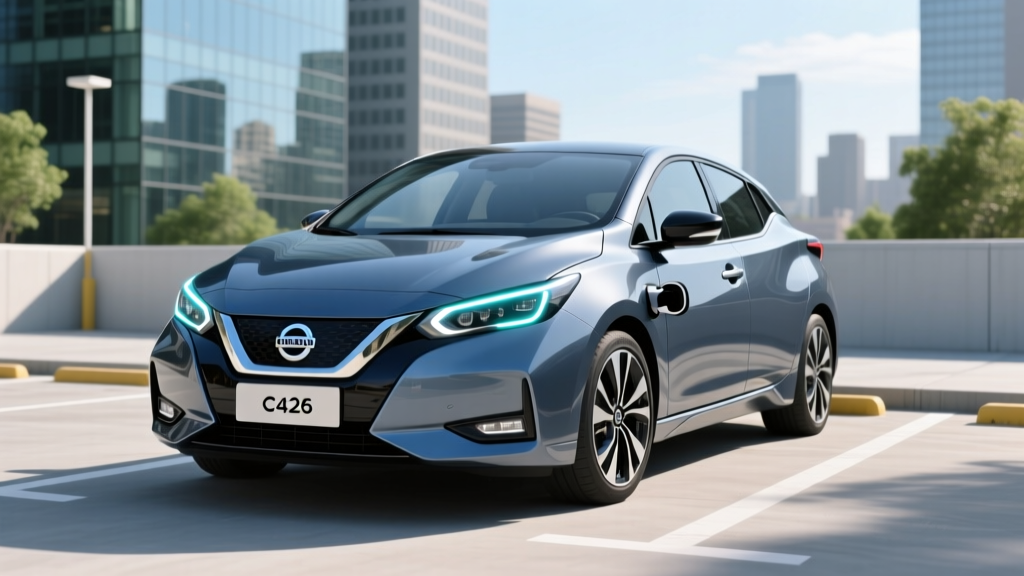
Quick Verdict: Still Safe, Still Affordable, Showing Its Age
The Nissan Leaf has been a staple of the affordable EV segment since 2011, and the current generation continues that tradition with a compelling starting price and strong crash-test credentials. But for 2026 buyers researching the Nissan Leaf safety rating alongside range, charging speed, and long-term ownership value, the picture is more nuanced. The Leaf earns strong marks in crash protection but trails newer rivals in active safety tech, DC fast-charging speed, and highway range. Here is every number you need to decide whether it belongs on your shortlist.
| Spec | Leaf S (40 kWh) | Leaf SV Plus (60 kWh) |
|---|---|---|
| EPA Range | 149 miles | 212 miles |
| Battery Capacity (usable) | ~39 kWh, NMC | ~60 kWh, NMC |
| Motor Output | 110 kW (147 hp) | 160 kW (214 hp) |
| 0–60 mph | ~7.9 sec | ~6.5 sec |
| Drivetrain | FWD | FWD |
| Max DC Fast Charge | ~50 kW (CHAdeMO) | ~100 kW (CHAdeMO) |
| 10–80% DCFC Time | ~40 min | ~45 min |
| Level 2 Charge Rate | 6.6 kW (~22 mi/hr) | 6.6 kW (~25 mi/hr) |
| MPGe (combined) | 111 MPGe | 104 MPGe |
| Base MSRP | $29,235 | $37,285 |
| Battery Warranty | 8 yr / 100,000 mi | 8 yr / 100,000 mi |
Nissan Leaf Safety Rating: NHTSA and IIHS Scores Explained
When buyers search for the Nissan Leaf safety rating, they are typically looking at two authoritative sources: the National Highway Traffic Safety Administration (NHTSA) and the Insurance Institute for Highway Safety (IIHS). Here is how the Leaf performs in each.
NHTSA Star Rating
The Leaf has historically earned a 5-star overall safety rating from NHTSA, with 5 stars in frontal crash and side crash tests, and 4 stars in rollover resistance. This places it among the top-rated compact EVs for crash protection. The rigid battery enclosure mounted low in the chassis contributes to a strong occupant cell and a low center of gravity that helps resist rollover.
IIHS Ratings
The IIHS evaluation tells a more mixed story. While the Leaf has scored "Good" in several crashworthiness categories (moderate overlap front, side, roof strength, head restraints), it has struggled with the updated side crash test (introduced with higher energy to reflect modern traffic) and has not consistently earned Top Safety Pick designation. The headlight rating on lower trims has also been a weak point — halogen projectors on the S trim earn a "Poor" or "Marginal" score, which can disqualify the vehicle from top awards regardless of crash performance.
Active Safety and Driver Assistance
All 2026 Leaf trims include Nissan Safety Shield 360 as standard equipment. This suite includes:
- Automatic Emergency Braking with Pedestrian Detection
- Lane Departure Warning and Lane Keeping Assist
- Blind Spot Warning and Rear Cross Traffic Alert
- Rear Automatic Braking
- High Beam Assist
However, the Leaf does not offer adaptive cruise control or lane-centering steering assist on most trims — features that competitors like the Chevrolet Bolt EV, Hyundai Kona Electric, and Volkswagen ID.4 include standard or on mid-tier trims. This is a Level 1 driver-assist system, not Level 2. For buyers who want hands-on-wheel highway cruising assist, the Leaf falls short of the segment norm.
Range, Efficiency, and Real-World Expectations
The Leaf comes in two battery configurations, and the gap between them is substantial. The base S trim carries a 40 kWh (usable) NMC lithium-ion pack good for an EPA-estimated 149 miles, while the SV Plus steps up to a 60 kWh pack delivering 212 miles EPA. Both use nickel-manganese-cobalt (NMC) chemistry — not the LFP (lithium iron phosphate) packs found in some newer competitors that allow frequent 100% charging without degradation concerns.
EPA Sticker: 212 miles (SV Plus) / 149 miles (S)
Highway driving (70+ mph): Expect ~170–185 miles (SV Plus) and ~115–130 miles (S). The Leaf's upright hatchback shape and lack of an active thermal management system for the battery mean efficiency drops noticeably at sustained highway speeds.
Cold weather (below 32°F): Plan for 25–35% range loss. The Leaf uses resistive cabin heating rather than a heat pump, which draws heavily from the traction battery. A 212-mile SV Plus may deliver 140–160 miles in freezing conditions with the heater running.
City/commuter driving (mild weather): You can match or slightly exceed the EPA estimate thanks to regenerative braking in stop-and-go traffic.
Efficiency figures from fueleconomy.gov put the SV Plus at 104 MPGe combined (roughly 32 kWh/100 mi) and the base S at 111 MPGe combined (~30 kWh/100 mi). These are competitive for the class but not best-in-class — the Hyundai Kona Electric and Tesla Model 3 achieve higher MPGe figures thanks to more aerodynamic profiles and heat-pump HVAC systems.
Charging Speed: The CHAdeMO Challenge
Charging is the area where the Leaf shows the most age relative to 2026 competitors. Nissan remains one of the last automakers using the CHAdeMO DC fast-charging connector rather than the CCS1 or NACS (Tesla-style) plug that now dominates North American public charging networks.
| Charging Level | Connector | Max Power | Speed / Time |
|---|---|---|---|
| Level 1 (120V household) | J1772 | ~1.4 kW | ~4–5 miles per hour |
| Level 2 (240V home/public) | J1772 | 6.6 kW | ~22–25 miles per hour; full charge in 7–10 hours |
| DC Fast Charge (S trim) | CHAdeMO | ~50 kW peak | 10–80% in ~40 min |
| DC Fast Charge (SV Plus) | CHAdeMO | ~100 kW peak | 10–80% in ~45 min |
Several practical realities matter here:
- CHAdeMO infrastructure is shrinking. Electrify America, the largest U.S. DC fast-charging network, uses CCS1 exclusively. Tesla Superchargers (now opening to non-Tesla EVs via adapter) use NACS. CHAdeMO chargers are primarily found on older EVgo stations and some legacy installations. Before buying, check PlugShare or your preferred charging app to confirm CHAdeMO availability along your regular routes.
- Peak kW is not sustained kW. The SV Plus may hit 100 kW briefly at a low state of charge, but the charge curve tapers significantly above 60% SoC. Real-world 10–80% sessions typically average 55–70 kW, which is why the total time stretches to ~45 minutes.
- No active battery thermal management. The Leaf relies on passive air cooling for its battery pack. In hot climates or during repeated DC fast-charge sessions (e.g., a road trip with multiple stops), the car will throttle charging speed to protect the battery — a phenomenon owners call "Rapidgate." This is a meaningful limitation for anyone planning frequent long-distance travel.
- Level 2 home charging is adequate. At 6.6 kW, a standard 240V home charger will replenish the SV Plus from empty in about 9 hours — fine for overnight charging. A licensed electrician will typically install a 40-amp or 48-amp Level 2 circuit; expect $500–$2,000 for installation depending on panel proximity and local permit requirements.
Performance and Driving Dynamics
The Leaf is a front-wheel-drive compact hatchback, and it drives like one — competent, comfortable, and unremarkable. The SV Plus's 160 kW (214 hp) motor delivers a 0–60 mph time of roughly 6.5 seconds, which is brisk for daily driving and merging. The base S trim's 110 kW (147 hp) motor clocks in around 7.9 seconds — adequate but not exciting.
Ride quality is a genuine strength. The Leaf's suspension tuning prioritizes comfort, and the low-mounted battery gives it a planted feel through corners that belies its economy-car roots. The e-Pedal mode enables one-pedal driving by increasing regenerative braking aggressiveness, though it does not bring the car to a complete hold at 0 mph like some competitors — you will still need to use the friction brake at stoplights.
There is no all-wheel-drive option and no towing rating. This is strictly a commuter and errand vehicle.
Interior, Cargo, and Technology
The Leaf's cabin is functional but dated compared to the screens-and-minimalism approach of newer EVs. Key interior specs:
- Front headroom: 41.2 inches
- Front legroom: 42.1 inches
- Rear legroom: 33.5 inches (tight for tall passengers)
- Cargo volume (rear seats up): 23.6 cu ft
- Cargo volume (rear seats folded): 30.0 cu ft
The cargo area is compromised slightly by the charging cable storage tray eating into the load floor. There is no front trunk (frunk).
The infotainment system centers on an 8-inch touchscreen with wireless Apple CarPlay and wired Android Auto. SV Plus trims add built-in navigation with EV-specific routing that factors in charging stops. A 6-speaker audio system, two USB-A ports, and a 7-inch driver information display round out the tech. It works, but the interface and screen resolution feel a generation behind the 12-to-15-inch displays in the Bolt, Kona Electric, and ID.4.
Pricing, Trims, and Federal Tax Credit Eligibility
The Leaf remains one of the most affordable new EVs on the U.S. market. Here is the 2026 trim and pricing breakdown:
| Trim | Base MSRP | As-Tested (typical) | Est. Federal Credit* | Effective Price |
|---|---|---|---|---|
| S (40 kWh) | $29,235 | $30,500 | Up to $3,750 | ~$26,750 |
| SV Plus (60 kWh) | $37,285 | $39,800 | Up to $3,750 | ~$36,050 |
*Federal tax credit estimates based on IRS §30D Clean Vehicle Credit rules. The Leaf's credit amount depends on critical-mineral and battery-component sourcing requirements that change annually. The Leaf has historically qualified for a partial credit ($3,750) rather than the full $7,500, because some battery components are sourced outside North America. Always verify current-year eligibility with a tax professional.
- MSRP cap: Vehicle must be under $55,000 (sedans) or $80,000 (SUVs/vans/pickups). The Leaf qualifies — both trims are well under the $55,000 cap.
- Buyer income cap: Modified AGI must not exceed $150,000 (single), $225,000 (head of household), or $300,000 (joint). If your income exceeds these thresholds, you are ineligible regardless of the vehicle.
- Battery sourcing: A percentage of critical minerals must be extracted or processed in the U.S. or a free-trade-agreement country, and battery components must be manufactured or assembled in North America. These percentages increase each year. The Leaf's Japan-assembled battery has historically limited it to a partial credit.
- Point-of-sale transfer: As of 2024, you can transfer the credit to the dealer at purchase, reducing your out-of-pocket cost immediately rather than waiting to claim it on your tax return.
Ownership Costs and Warranty
Nissan backs the Leaf with a competitive warranty package:
- Battery warranty: 8 years / 100,000 miles (capacity retention guarantee — Nissan warrants the battery against dropping below approximately 66% of original capacity, measured by the car's built-in State of Health bar)
- Powertrain warranty: 5 years / 60,000 miles
- Bumper-to-bumper: 3 years / 36,000 miles
The battery warranty's 66% threshold is notably lower than the industry-standard 70% used by Hyundai, Kia, and Tesla. In practice, modern NMC packs rarely degrade that far within the warranty period under normal use, but the weaker guarantee is worth noting if you plan to keep the car past 100,000 miles or live in a hot climate where passive cooling is a disadvantage.
Insurance costs for the Leaf tend to be below the EV average — its modest power output, strong crash-test scores, and low repair complexity (no ADAS calibration for LiDAR or advanced radar arrays) keep premiums reasonable. Expect roughly $1,200–$1,600 per year depending on your state and driving record.
How the Leaf Compares to Key Rivals
The Leaf competes in the affordable compact EV hatchback segment. Here is how it stacks up against the most common cross-shops:
| Vehicle | EPA Range | DCFC Connector | Max DCFC kW | Base MSRP | ADAS Level |
|---|---|---|---|---|---|
| Nissan Leaf SV Plus | 212 mi | CHAdeMO | ~100 kW | $37,285 | Level 1 |
| Hyundai Kona Electric | 261 mi | CCS1/NACS | ~100+ kW | ~$34,000 | Level 2 |
| Chevrolet Bolt EV | 259 mi | CCS1 | ~55 kW | ~$28,000 | Level 1 (partial) |
| Volkswagen ID.4 | 275 mi | CCS1/NACS | ~170 kW | ~$40,000 | Level 2 |
- Choose the Leaf if: You prioritize a low purchase price, have reliable Level 2 home charging, drive a primarily urban/suburban commute under 60 miles round-trip, have access to CHAdeMO DC fast chargers nearby, and value proven crash-test performance.
- Look elsewhere if: You need highway-capable Level 2 cruise assist, frequently road-trip beyond 150 miles, live in a hot climate where passive battery cooling is a concern, or rely on Electrify America / Tesla Supercharger networks (which do not support CHAdeMO).
- Among the cheapest new EVs available (especially S trim)
- Strong NHTSA 5-star crash protection
- Comfortable ride quality for the class
- Spacious cargo area for a compact hatch (23.6 cu ft)
- Standard Nissan Safety Shield 360 on all trims
- Proven, mature platform with wide service network
- CHAdeMO connector — shrinking public DCFC access
- No active battery thermal management (Rapidgate risk)
- No adaptive cruise control or lane-centering assist
- 212-mile max range trails most rivals
- Dated infotainment interface and small screen
- Battery warranty threshold (66%) weaker than competitors
- No heat pump — significant cold-weather range loss
Frequently Asked Questions
What is the Nissan Leaf's NHTSA safety rating?
The Leaf has earned a 5-star overall safety rating from NHTSA, with 5 stars in frontal and side crash tests and 4 stars in rollover resistance. This is a strong result and competitive with other compact EVs.
Why doesn't the Leaf earn IIHS Top Safety Pick?
The IIHS has given the Leaf lower marks in its updated side crash test and for headlight performance on base trims. These scores can prevent Top Safety Pick designation even when crashworthiness is otherwise strong.
What is the real-world range of the Nissan Leaf?
The SV Plus is EPA-rated at 212 miles, but expect roughly 170–185 miles on the highway and 140–160 miles in freezing temperatures due to the lack of a heat pump. City driving in mild weather can match or slightly exceed the EPA estimate.
Does the Nissan Leaf qualify for the federal EV tax credit?
The Leaf qualifies for a partial §30D federal tax credit (historically $3,750) due to battery-component sourcing rules. Eligibility also depends on your income (under $150K single / $300K joint) and the vehicle's MSRP (well under the $55K cap). Verify current-year rules with a tax professional or the IRS.
Can I use Tesla Superchargers with the Nissan Leaf?
No. Tesla Superchargers use the NACS connector. The Leaf uses CHAdeMO for DC fast charging, and there is no commercially available CHAdeMO-to-NACS adapter for DC fast charging. You are limited to CHAdeMO-equipped public stations.
How fast does the Leaf charge at home?
At 6.6 kW on a 240V Level 2 charger, the Leaf adds roughly 22–25 miles of range per hour. A full charge from empty takes about 7 hours for the 40 kWh pack and roughly 9–10 hours for the 60 kWh SV Plus.
Is the Nissan Leaf worth buying in 2026?
It depends on your use case. For budget-conscious urban commuters with home charging and short daily drives, the Leaf S at under $30,000 (before credits) is one of the most affordable paths to EV ownership. For buyers who need longer range, faster DC charging, modern ADAS, or access to the broader CCS/NACS charging network, competitors like the Hyundai Kona Electric or Chevrolet Bolt EV offer more capability for similar money.
Who is the Nissan Leaf best suited for?
The Leaf is ideal for single drivers or couples with a predictable commute under 60 miles round-trip, reliable Level 2 home charging, and access to CHAdeMO DC fast chargers for occasional longer trips. It is not well-suited for frequent road-trippers, hot-climate drivers who need multiple fast charges per day, or families who need rear-seat space for tall passengers.