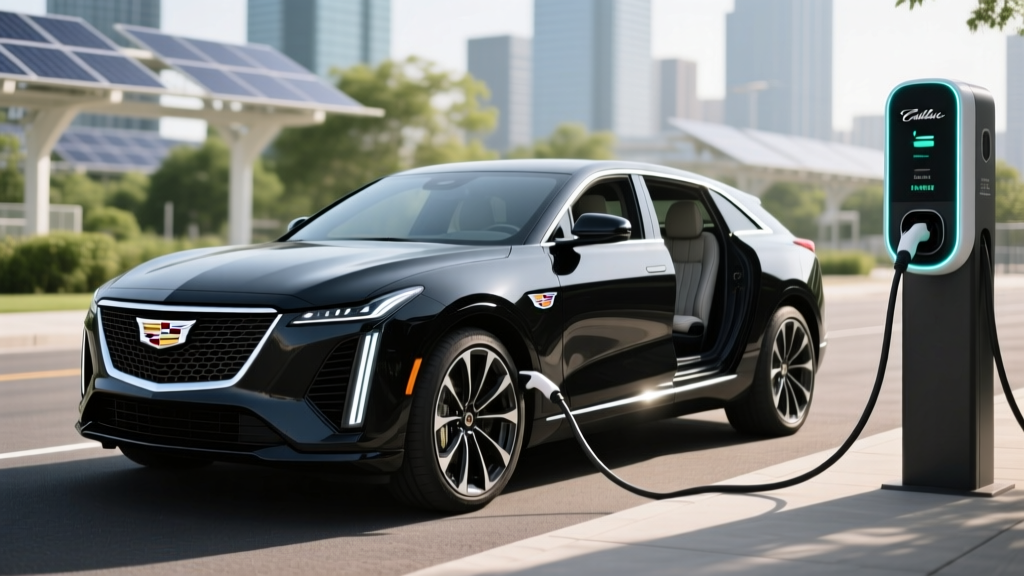
The Cadillac Lyriq has been General Motors' electric flagship since its 2023 debut, but the 2026 Cadillac Lyriq-V marks the nameplate's first foray into the brand's V-Series performance division. With a dual-motor all-wheel-drive powertrain producing an estimated 615 horsepower, a sport-tuned suspension, and aggressive styling cues, the Lyriq-V aims to compete directly with the BMW iX M60, Audi SQ8 e-tron, and Tesla Model X Plaid in the luxury performance EV SUV segment. But does the V badge compromise the Lyriq's strong range and comfort credentials? We break down every spec that matters to buyers.
| Spec | Value |
|---|---|
| Drivetrain | Dual-motor AWD |
| Horsepower | 615 hp (est.) |
| 0–60 mph | ~3.3 seconds (est.) |
| Battery (usable) | ~102 kWh, NMC (Ultium) |
| EPA Range (est.) | 280–300 miles |
| Efficiency | ~89 MPGe / ~36 kWh/100 mi (est.) |
| Max DC Fast Charge | 190 kW peak |
| 10–80% DC Charge | ~30 minutes |
| Level 2 Home Charging | 19.2 kW (up to 52 mi/hr) |
| Cargo (rear seats up) | 28.0 cu ft |
| Cargo (rear seats folded) | 60.8 cu ft |
| Base MSRP | $72,990 (est.) |
| Battery/Powertrain Warranty | 8 years / 100,000 miles |
Note: The 2026 Cadillac Lyriq-V has been announced by GM but final EPA certification and pricing are expected closer to the on-sale date in late 2025 or early 2026. Specs marked "est." are based on GM's preliminary disclosures and Ultium platform data. We will update this review when official figures are published on fueleconomy.gov.
Range and Efficiency: What the V Badge Costs You
The standard 2026 Cadillac Lyriq with rear-wheel drive and the 102-kWh Ultium battery pack carries an EPA-estimated range of 314 miles. The Lyriq-V, with its dual-motor AWD system, stickier tires, and higher performance draw, is expected to land between 280 and 300 miles EPA — a roughly 5–10% reduction that is typical for performance variants in this class.
Real-World Range Expectations
EPA Estimate: ~280–300 miles (preliminary)
Highway (70–80 mph, moderate temps): ~240–265 miles
Cold Weather (below 32°F, highway): ~200–230 miles
City / Suburban Mixed: ~270–295 miles
The Lyriq-V's heat pump and advanced thermal management system help mitigate cold-weather losses, but any performance-oriented EV with wider tires and higher mass will see meaningful range compression at sustained highway speeds and in freezing temperatures. Plan charging stops accordingly on road trips over 220 miles in winter.
Efficiency is projected at roughly 89 MPGe combined (about 36 kWh per 100 miles), which trails the RWD Lyriq's 97 MPGe but is competitive with the BMW iX M60's 86 MPGe and the Audi SQ8 e-tron's 81 MPGe. The Lyriq-V's large battery buffer means you still have practical range for daily commuting and weekend trips — you just won't be hypermiling.
Charging Speed: DC Fast Charging and Home Setup
The Lyriq-V uses GM's Ultium platform with a 400-volt electrical architecture (not the 800V systems found in Hyundai/Kia E-GMP vehicles or the Porsche Taycan). This means peak DC fast-charge rates top out around 190 kW — respectable, but not class-leading.
| Charging Level | Power | Speed (approx.) |
|---|---|---|
| Level 1 (120V household) | 1.4 kW | ~3–4 miles per hour |
| Level 2 (240V, 48A) | 11.5 kW | ~31 miles per hour |
| Level 2 (240V, 80A / 19.2 kW capable) | 19.2 kW | ~52 miles per hour |
| DC Fast Charge (peak) | 190 kW | 10–80% in ~30 minutes |
Charging curve reality: The Lyriq-V will sustain its peak ~190 kW rate roughly between 10% and 40% state of charge. Above 50%, the rate tapers progressively, dropping below 100 kW past 70% SoC and slowing significantly above 85%. This is standard behavior for NMC lithium-ion packs — the battery management system protects cell longevity by reducing current as the pack fills. On a road trip, plan to charge from 10–80% and then drive on, rather than topping off to 100% at a public station.
For home charging, the Lyriq-V's onboard charger supports up to 19.2 kW on a hardwired Level 2 station with an 80-amp circuit. Most buyers will install a 48-amp wallbox on a 60-amp breaker (11.5 kW), which adds roughly 31 miles of range per hour — enough to fully replenish the battery overnight from near-empty. A licensed electrician will typically charge $800–$2,500 for a Level 2 installation, depending on whether your electrical panel needs an upgrade to 200 amps.
The Lyriq-V ships with the NACS (North American Charging Standard) connector, giving it native access to the Tesla Supercharger network — a significant advantage over CCS-only competitors that still require adapters at many fast-charging stations.
Performance: 615 Horsepower and V-Series Dynamics
The Lyriq-V's dual-motor AWD system pairs a front induction motor with a rear permanent-magnet motor for a combined output of approximately 615 horsepower and an estimated 650 lb-ft of torque. GM targets a 0–60 mph time of around 3.3 seconds, which would place the Lyriq-V squarely between the BMW iX M60 (3.8 seconds) and the Tesla Model X Plaid (2.5 seconds).
But straight-line speed is only part of the V-Series story. Cadillac's performance division has retuned the suspension with stiffer springs, adaptive dampers, and a lower ride height compared to the standard Lyriq. Larger Brembo brakes handle the extra mass, and the Lyriq-V rides on 22-inch wheels with performance summer tires (all-season tires are expected to be available as an option for colder climates).
Drive modes include a V-Mode that sharpens throttle response, tightens steering, and adjusts the regenerative braking profile for more aggressive one-pedal deceleration. The Lyriq-V also features GM's latest iteration of Magnetic Ride Control for real-time damping adjustments.
Interior, Cargo, and Technology
The Lyriq-V carries over the standard Lyriq's impressive 33-inch LED advanced display, which spans the dashboard as a single curved unit integrating the instrument cluster and infotainment touchscreen. Google Built-In provides native access to Google Maps, Google Assistant, and the Play Store. Wireless Apple CarPlay and Android Auto are standard.
V-Series-specific interior touches include performance seats with enhanced bolstering, V badging on the steering wheel and door sills, carbon-fiber trim accents, and an available premium audio system from AKG with 19 speakers.
Cargo and passenger space:
- Rear cargo (seats up): 28.0 cubic feet
- Rear cargo (seats folded): 60.8 cubic feet
- Front legroom: 41.4 inches
- Rear legroom: 39.6 inches
- Front headroom: 39.8 inches
- Rear headroom: 38.7 inches
Unlike some competitors, the Lyriq-V does not offer a front trunk (frunk), as GM uses that space for power electronics and HVAC components. The 28 cu ft rear cargo area is adequate for groceries, luggage for a family of four on a weekend trip, or golf clubs — but it trails the BMW iX's 35.5 cu ft and the Tesla Model X's 37.1 cu ft (seats up).
Driver assistance: The Lyriq-V includes GM's Super Cruise hands-free driving system on mapped highways. Super Cruise is an SAE Level 2 system — it controls steering, acceleration, and braking on compatible divided highways, but the driver must remain attentive and a camera monitors eye engagement. This is not autonomous driving. The Lyriq-V also features standard automatic emergency braking, adaptive cruise control, blind-spot monitoring, rear cross-traffic alert, and a surround-view camera system.
Super Cruise: What It Does NOT Do
Super Cruise is a Level 2 driver-assist system. It does not navigate unmapped roads, handle complex urban intersections, or replace driver judgment. You must keep your eyes on the road and be prepared to take over at any time. Hands-free operation is only available on pre-mapped divided highways (over 750,000 miles of compatible roads in North America as of 2025).
Pricing, Trims, and Federal Tax Credit Eligibility
The 2026 Cadillac Lyriq-V is expected to start at approximately $72,990 (including destination), placing it in the upper tier of luxury electric SUVs. A fully loaded model with premium paint, the AKG audio upgrade, and the available technology package could push the as-tested price toward $82,000–$85,000.
| Trim / Config | Est. MSRP | After Potential Credit |
|---|---|---|
| Lyriq-V (AWD, base) | $72,990 | See eligibility below |
| Lyriq-V w/ Premium Pkg | $78,500 | See eligibility below |
| Lyriq-V Fully Loaded | $83,000–$85,000 | See eligibility below |
Does the Lyriq-V Qualify for the Federal EV Tax Credit?
This is where the Lyriq-V faces a significant hurdle. Under current IRS §30D rules, the federal clean vehicle credit of up to $7,500 has strict eligibility requirements:
- MSRP Cap: SUVs must have an MSRP at or below $80,000. The base Lyriq-V at ~$72,990 clears this bar, but higher trims may exceed it.
- Buyer Income Cap: Modified adjusted gross income must not exceed $300,000 (joint filers), $225,000 (head of household), or $150,000 (single filers).
- Battery Sourcing: Critical minerals and battery components must meet escalating domestic/free-trade-partner sourcing thresholds that tighten each year. GM has worked to localize Ultium battery supply chains, but the exact credit amount ($3,750 or $7,500) depends on whether both the minerals and components requirements are satisfied for the specific build month.
- Point-of-Sale Transfer: Eligible buyers can transfer the credit to the dealer at purchase, reducing the out-of-pocket price immediately rather than waiting for a tax refund.
- Final Assembly: Vehicle must undergo final assembly in North America. The Lyriq is built at GM's Spring Hill, Tennessee plant, which satisfies this requirement.
Bottom line: The base Lyriq-V is expected to qualify for at least a partial credit ($3,750) and potentially the full $7,500 depending on battery-sourcing compliance at time of delivery. Buyers should verify eligibility on the IRS clean vehicle credit page and confirm with their dealer before purchasing. Tax situations vary — consult a tax professional for personalized guidance.
How the Lyriq-V Compares to Key Rivals
The luxury performance EV SUV segment is fiercely competitive. Here is how the Lyriq-V stacks up against its three most direct competitors:
| Spec | Cadillac Lyriq-V | BMW iX M60 | Audi SQ8 e-tron | Tesla Model X Plaid |
|---|---|---|---|---|
| Horsepower | 615 hp | 610 hp | 496 hp | 1,020 hp |
| 0–60 mph | ~3.3s | 3.8s | 4.5s | 2.5s |
| EPA Range | ~280–300 mi | ~280 mi | ~255 mi | ~326 mi |
| Max DC Charge | 190 kW | 200 kW | 170 kW | 250 kW |
| Base MSRP | ~$72,990 | ~$111,500 | ~$96,400 | ~$94,990 |
| NACS Native | Yes | No (adapter) | No (adapter) | Yes |
The Lyriq-V's most compelling advantage is price: it undercuts the BMW iX M60 by nearly $40,000 and the Audi SQ8 e-tron by over $20,000 while offering comparable or superior power. The Tesla Model X Plaid is faster but costs more and has a polarizing interior quality that does not match Cadillac's luxury fit and finish.
Pros
- 615 hp at a sub-$75,000 starting price undercuts rivals by tens of thousands
- Native NACS connector for seamless Tesla Supercharger access
- 33-inch curved display and premium interior materials
- Super Cruise hands-free driving on mapped highways included
- Strong real-world range (~250+ miles highway) for a performance SUV
- 19.2 kW Level 2 onboard charger for fast home replenishment
- Built in Tennessee — North American assembly supports tax credit eligibility
Cons
- No front trunk (frunk) — cargo space trails some rivals
- 400V architecture limits peak DC charge rate vs. 800V competitors
- Higher trims may exceed the $80,000 MSRP cap for the federal tax credit
- 22-inch performance wheels may reduce range and ride comfort vs. smaller options
- Real-world highway range drops to ~240 miles in cold weather
- No third-row seating option (unlike the Tesla Model X)
Who Should Buy the 2026 Cadillac Lyriq-V?
The Lyriq-V Is Right for You If:
- You want a luxury performance EV SUV but find the BMW iX M60 and Porsche Cayenne EV out of budget
- You value American-made vehicles and want to maximize federal tax credit eligibility
- You need native Supercharger access for road trips without adapter hassle
- You commute 40–80 miles daily and can charge at home overnight
- You want hands-free highway driving (Super Cruise) for long commutes
Look Elsewhere If:
- You need three rows of seating (consider the Tesla Model X or wait for the Cadillac Vistiq)
- You prioritize absolute maximum range over performance (the RWD Lyriq or Tesla Model X Long Range serves better)
- You regularly tow heavy loads — the Lyriq-V's towing capacity is modest at ~3,500 lbs
- You live in an area with limited DC fast-charging infrastructure and need every mile of range
Battery Warranty and Long-Term Ownership
GM backs the Lyriq-V's Ultium battery pack and electric powertrain with an 8-year / 100,000-mile warranty, which is standard for the segment. The warranty covers defects and battery capacity loss below a specified threshold (typically 70% state of health, though GM has not published the exact retention guarantee for the V variant).
The Ultium platform uses NMC (nickel manganese cobalt) pouch cells manufactured in partnership with LG Energy Solution at facilities in Ohio and Tennessee. NMC chemistry offers high energy density — which is why the Lyriq-V can pack over 100 kWh into a manageable footprint — but it is more sensitive to sustained high state-of-charge and extreme temperatures than LFP (lithium iron phosphate) chemistry. For maximum battery longevity:
- Set daily charge limits to 80–90% and reserve 100% charges for road trips
- Use preconditioning when navigating to a DC fast charger to optimize charge speed and reduce cell stress
- Avoid leaving the vehicle at 100% SoC for extended periods in hot weather
- Leverage the Lyriq's scheduled charging feature to finish charging just before departure rather than sitting at full charge overnight
Based on data from existing Ultium-based vehicles, degradation of 5–8% over the first 100,000 miles is a reasonable expectation — meaning a Lyriq-V starting at ~290 miles EPA would likely retain roughly 265–275 miles of range after five years of typical use.
Frequently Asked Questions
What is the real-world range of the 2026 Cadillac Lyriq-V?
With an estimated EPA range of 280–300 miles, expect roughly 240–265 miles on highway road trips in moderate temperatures and 200–230 miles in freezing cold weather. City and suburban driving with regenerative braking can approach or match the EPA sticker. These are preliminary estimates pending official EPA certification.
How fast does the Lyriq-V charge at home and on the road?
On a DC fast charger, the Lyriq-V peaks at 190 kW and charges from 10–80% in approximately 30 minutes. At home on a 48-amp Level 2 wallbox (11.5 kW), it adds about 31 miles of range per hour, fully recharging overnight. With an 80-amp circuit and 19.2 kW capability, that jumps to ~52 miles per hour.
How much does the Lyriq-V cost after the federal tax credit?
The base MSRP is estimated at $72,990. If the vehicle qualifies for the full $7,500 federal credit and you meet income requirements, the effective price drops to approximately $65,490. However, credit eligibility depends on battery sourcing compliance, buyer income, and MSRP staying under $80,000. Verify current eligibility at irs.gov before purchasing.
Is the Lyriq-V worth buying over the BMW iX M60 or Tesla Model X?
If value is a priority, the Lyriq-V is the clear winner — it offers comparable power to the iX M60 at roughly $40,000 less, with native Supercharger access and a premium interior. The Tesla Model X Plaid is faster and offers more range and a third row, but costs significantly more and lacks Cadillac's luxury refinement. The Lyriq-V is the best choice for buyers who want a performance luxury EV SUV without a six-figure price tag.
Does the Lyriq-V have a frunk or third-row seating?
No to both. The Lyriq-V has no front trunk and no third-row option. Rear cargo space is 28.0 cubic feet with seats up and 60.8 cubic feet folded. If you need three rows, look at the Tesla Model X or Cadillac's upcoming three-row Vistiq SUV.
Is Super Cruise self-driving?
No. Super Cruise is an SAE Level 2 driver-assistance system. It provides hands-free steering, acceleration, and braking on pre-mapped divided highways, but the driver must remain attentive with eyes on the road at all times. A driver-monitoring camera enforces this. It does not operate on city streets or unmapped roads.