The Real Question: Are EVs More Expensive to Own Overall?
If you're shopping for an electric vehicle, you've probably seen headlines claiming EVs save thousands over their lifetime — and others warning that insurance premiums will eat those savings alive. The truth, as usual, lives in the data. Electric cars do cost more to insure on average, but whether that erases your fuel and maintenance savings depends entirely on which model you buy, where you live, and how you charge.
This guide breaks down the full 5-year ownership cost of a mainstream EV versus a comparable gas car, using real 2026 pricing, current IRS §30D tax credit rules, and concrete per-mile math. We'll answer the insurance question head-on, then zoom out to the total cost picture so you can make a numbers-driven decision.
Do Electric Cars Cost More to Insure? The Data
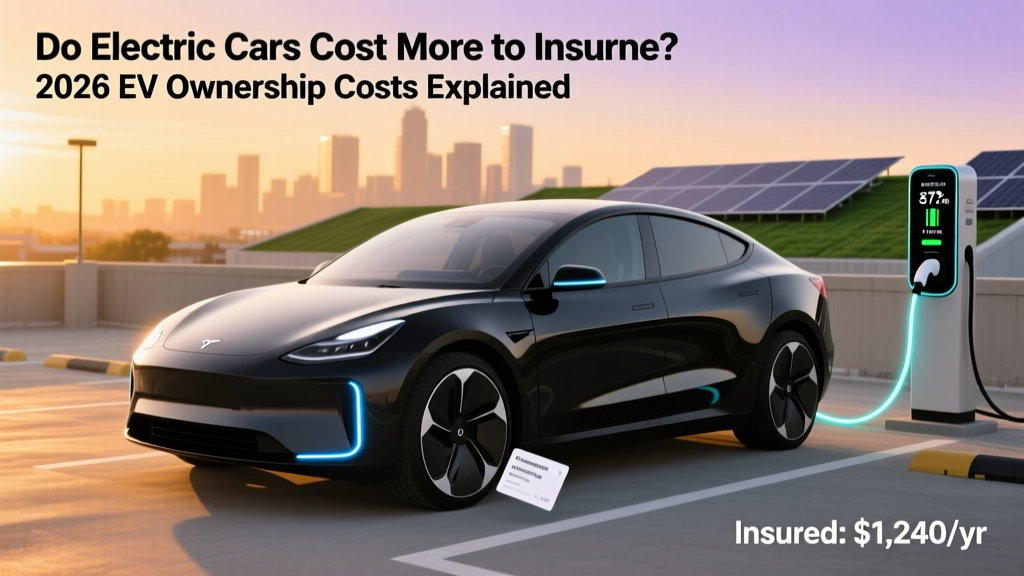
Yes. According to industry data from sources like the Insurance Information Institute and major carrier rate filings, EV insurance premiums run 15% to 30% higher than equivalent internal-combustion vehicles in 2026. A Tesla Model Y Long Range might cost $2,400–$3,100 annually to insure for a 40-year-old driver with a clean record, while a comparably priced Toyota RAV4 gas model might run $1,800–$2,200.
Why EV Insurance Costs More
- Higher repair costs: EV battery packs, power electronics, and specialized structural components (like Tesla's gigacastings or Hyundai's integrated battery trays) are expensive to replace after a collision. A minor rear-end impact that would cost $2,000 to fix on a gas car can total an EV if the battery enclosure is compromised.
- Limited repair network: Fewer body shops have the high-voltage certification and equipment to safely repair EVs, which reduces competition and raises labor rates.
- Higher purchase prices: Insurers factor in replacement cost. A $48,000 EV costs more to replace than a $35,000 gas crossover, even before repairs.
- Tesla effect: Tesla's vertically integrated repair ecosystem and proprietary parts historically drove up claims costs for the brand, pulling up EV averages. Non-Tesla EVs from Hyundai, Ford, and BMW tend to have more moderate premiums.
Insurance Cost by Popular EV Model (2026 Estimates)
| Vehicle | Avg. Annual Premium | 5-Year Insurance Cost |
|---|---|---|
| Tesla Model Y Long Range AWD | $2,700–$3,100 | $13,500–$15,500 |
| Hyundai Ioniq 5 SEL AWD | $2,100–$2,500 | $10,500–$12,500 |
| Ford Mustang Mach-E Select | $2,200–$2,600 | $11,000–$13,000 |
| Chevrolet Equinox EV 2LT | $1,900–$2,300 | $9,500–$11,500 |
| Toyota RAV4 LE (gas baseline) | $1,800–$2,100 | $9,000–$10,500 |
Estimates based on national averages for a 40-year-old married driver, 12,000 miles/year, $500 deductible, 100/300/100 liability. Your rate will differ.
5-Year Total Cost of Ownership: EV vs. Gas
Insurance is one line item. To see whether an EV actually saves or costs you money, you need the full picture. Below is a 5-year/60,000-mile ownership comparison between a 2026 Hyundai Ioniq 5 SEL AWD (MSRP $49,650) and a 2026 Toyota RAV4 XLE AWD (MSRP $33,850) — two popular compact crossovers in similar size classes.
| Cost Category | Hyundai Ioniq 5 SEL AWD (EV) | Toyota RAV4 XLE AWD (Gas) |
|---|---|---|
| Purchase Price (MSRP) | $49,650 | $33,850 |
| Federal Tax Credit (§30D) | −$7,500 | $0 |
| Net Purchase Cost | $42,150 | $33,850 |
| 5-Year Fuel/Energy (60k mi) | $4,320 | $7,500 |
| 5-Year Maintenance | $1,800 | $3,600 |
| 5-Year Insurance | $11,500 | $9,750 |
| 5-Year Depreciation | $18,900 | $13,540 |
| 5-Year Total Cost | $78,670 | $68,240 |
| Cost Per Mile | $0.58/mi (excl. purchase) | $0.57/mi (excl. purchase) |
Key takeaway: The Ioniq 5's higher purchase price and insurance premiums give it a roughly $10,000 higher 5-year total cost in this scenario, even after the full $7,500 tax credit. However, the Ioniq 5 offers significantly more horsepower (320 hp vs. 203 hp), more interior tech, and zero tailpipe emissions. If you qualify for the credit and install a home Level 2 charger, your operating costs (fuel + maintenance) are dramatically lower — the gap narrows substantially with more miles driven per year.
Federal Tax Credit: Do You Qualify for §30D?
The federal EV tax credit under IRS §30D remains one of the biggest variables in EV ownership math. For 2026, the credit offers up to $7,500 for qualifying new EVs — but the eligibility rules are strict and have narrowed over time.
- MSRP Cap: Vans, SUVs, and pickup trucks must have an MSRP at or below $80,000. Sedans and other body styles must be at or below $55,000.
- Buyer Income Cap: Modified adjusted gross income (MAGI) must not exceed $300,000 for joint filers, $225,000 for heads of household, or $150,000 for single filers.
- Battery Component Sourcing: At least 70% of battery components must be manufactured or assembled in North America (2026 threshold).
- Critical Minerals: At least 80% of critical minerals must be sourced from the U.S. or a country with a free-trade agreement (2026 threshold).
- FEOC Restriction: Vehicles with battery components or critical minerals from a "foreign entity of concern" (primarily China, Russia, Iran, North Korea) are disqualified — component restriction active since 2024, critical minerals restriction since 2025.
- Point-of-Sale Transfer: You can transfer the credit to the dealer at purchase, reducing your out-of-pocket cost immediately rather than waiting for tax filing.
Which 2026 models qualify? The list changes as automakers adjust supply chains. As of early 2026, qualifying models include the Tesla Model Y (Long Range and Performance, built in Fremont/Austin), select Ford F-150 Lightning trims, and certain GM Ultium-based vehicles. Many Hyundai and Kia models lost eligibility due to FEOC critical-mineral restrictions, though some trims with revised battery sourcing have regained partial credit. Always verify on fueleconomy.gov before purchasing.
Charging vs. Gas: The Per-Mile Cost Math
This is where EVs shine — but the savings depend heavily on how you charge.
Assumptions
- EV efficiency: 3.2 miles per kWh (typical for a mid-size crossover like the Ioniq 5 — rated 110 MPGe combined per fueleconomy.gov)
- Home electricity rate: $0.16/kWh (national average, 2026)
- Public DC fast charging: $0.48/kWh (national average for networks like Electrify America and EVgo)
- Gas price: $3.50/gallon (national average regular unleaded, 2026)
- Gas car fuel economy: 28 MPG combined (EPA for RAV4 AWD)
| Scenario | Cost per kWh or Gallon | Cost per Mile |
|---|---|---|
| EV — 100% Home Charging (Level 2) | $0.16/kWh | $0.050/mi |
| EV — 50/50 Home + Public DCFC | $0.32/kWh blended | $0.100/mi |
| EV — 100% Public DCFC | $0.48/kWh | $0.150/mi |
| Gas Car (28 MPG) | $3.50/gal | $0.125/mi |
What this means over 60,000 miles:
- Home-only charging: $3,000 (saves $4,500 vs. gas)
- 50/50 mix: $6,000 (saves $1,500 vs. gas)
- Public-only charging: $9,000 (costs $1,500 more than gas)
If you can install a Level 2 home charger and do most of your charging overnight, the fuel savings are substantial and consistent. If you're entirely dependent on public fast charging — as many apartment dwellers are — the cost advantage disappears. This is the single most important variable in EV ownership economics.
Maintenance Savings: Where EVs Quietly Win
EVs have far fewer moving parts than internal-combustion vehicles. No engine oil, no transmission fluid, no spark plugs, no exhaust system, no timing belt. The electric motor has one moving part. Regenerative braking drastically reduces wear on friction brake pads and rotors.
| Maintenance Item | Gas Car (5-Year Cost) | EV (5-Year Cost) |
|---|---|---|
| Oil Changes (6 per year × 5 years) | $1,500–$2,100 | $0 |
| Transmission Fluid Service | $200–$400 | $0 (most EVs use single-speed reducers) |
| Brake Pad Replacement | $600–$1,200 (1–2 sets) | $0–$300 (regen extends life to 80k–100k+ mi) |
| Cabin Air Filter | $150–$300 | $150–$300 |
| Coolant Service | $200–$400 | $200–$400 (battery thermal management loop) |
| Tire Rotation/Replacement | $1,200–$2,000 | $1,400–$2,400 (EVs are heavier; tires wear faster) |
| Total Estimated 5-Year Maintenance | $3,850–$6,400 | $1,750–$3,100 |
The maintenance savings are real but not astronomical — typically $2,000–$3,500 over 5 years. The biggest offset is tires: EVs are 500–1,000 lbs heavier than comparable gas cars and deliver instant torque, which accelerates tire wear. Budget for a tire replacement around 30,000–40,000 miles rather than the 50,000+ miles typical for gas cars.
Depreciation and Resale Value: The Uncomfortable Truth
This is where EV ownership math gets complicated. Historically, EVs have depreciated faster than comparable gas vehicles, and 2025–2026 data continues this trend for several reasons:
- Price wars: Tesla's aggressive price cuts in 2023–2025 cascaded through the used EV market, pulling down resale values for every brand.
- Rapid tech iteration: Newer models offer more range, faster charging, and NACS connectors at similar prices, making 2–3 year-old EVs feel outdated.
- Battery health uncertainty: Used-EV buyers remain cautious about long-term battery degradation, even though real-world data shows most modern LFP and NMC packs retain 85–92% capacity at 100,000 miles.
- Tax credit compression: When a new EV qualifies for a $7,500 point-of-sale credit, the effective new price drops — and used-EV prices must fall to remain competitive.
Typical 5-year depreciation (60,000 miles):
- Mainstream EVs (Ioniq 5, Mach-E, Equinox EV): 45%–55% of MSRP
- Tesla Model Y: 40%–50% (improved with NACS standardization and Supercharger network value)
- Gas crossovers (RAV4, CR-V): 35%–45% of MSRP
On a $49,650 Ioniq 5, that's roughly $22,000–$27,300 in depreciation over 5 years versus $11,800–$15,200 for a $33,850 RAV4. The gap is significant and represents the largest single cost disadvantage for EVs in the current market.
However, depreciation is highly model-specific and market-dependent. Vehicles with strong demand, limited supply, or exceptional reliability reputations (Tesla Model Y, certain Rivian configs) have held value better than average. This landscape will continue to evolve as the market matures.
Home Charging Setup: The Hidden Cost (and Savings Enabler)
To capture the full fuel savings, you need home Level 2 charging. Here's what that costs:
- Level 2 charger hardware: $400–$750 (ChargePoint Home Flex, Emporia Level 2, Wallbox Pulsar Plus)
- Electrical installation (240V/40–50A circuit): $800–$2,500 depending on panel proximity and local code
- Electrical panel upgrade (if needed): $1,500–$3,500 for older homes with 100A service
Total typical installation: $1,200–$3,250. Many utilities offer $250–$500 rebates for home charger installation, and some states provide additional tax credits. This upfront investment pays for itself within 1–3 years through fuel savings if you drive 10,000+ miles annually.
The Bottom Line: Who Saves and Who Doesn't
Electric vehicles are not universally cheaper to own. The math favors EVs when several conditions align:
- You can install a home Level 2 charger and charge overnight at $0.10–$0.18/kWh
- You qualify for the full or partial §30D federal tax credit
- You drive 12,000+ miles per year (more miles = more fuel savings)
- Your state offers additional purchase rebates or HOV lane access
- You value the driving experience (instant torque, quiet cabin, one-pedal driving)
- You live in an apartment or condo without charging access and rely entirely on public chargers
- You don't qualify for the federal credit due to income or vehicle sourcing rules
- You drive fewer than 8,000 miles per year (fuel savings won't offset higher purchase/insurance costs)
- You plan to sell within 3 years (depreciation will hurt more)
Frequently Asked Questions
Do electric cars cost more to insure than gas cars?
Yes, typically 15%–30% more. Higher repair costs, specialized parts, and elevated purchase prices drive premiums up. However, rates vary significantly by insurer, model, and driver profile. Shopping around can save $300–$600 annually.
Which EVs are cheapest to insure in 2026?
Mainstream, moderately priced EVs from established automakers tend to have lower premiums. The Chevrolet Equinox EV, Hyundai Ioniq 5, and Volkswagen ID.4 generally cost less to insure than Tesla models or luxury EVs like the BMW iX or Mercedes EQS. Always get quotes before purchasing.
Does the $7,500 tax credit apply to everyone?
No. The IRS §30D credit has strict eligibility requirements: buyer income caps ($150k single / $300k joint), MSRP caps ($55k sedans / $80k SUVs and trucks), and battery component and critical-mineral sourcing rules that disqualify vehicles with Chinese-sourced materials. The list of qualifying vehicles changes frequently. Verify at fueleconomy.gov before purchasing.
How much do I save on fuel by driving an EV?
If you charge primarily at home at the national average of $0.16/kWh and drive a vehicle rated at 3.2 mi/kWh, your fuel cost is about $0.05 per mile — roughly 60% less than a 28 MPG gas car at $3.50/gallon ($0.125/mi). Over 60,000 miles, that's approximately $4,500 in savings. If you rely on public DC fast charging at $0.48/kWh, your cost rises to $0.15/mi — actually more expensive than gas.
Do EVs really need less maintenance?
Yes. No oil changes, no transmission fluid, no spark plugs, and regenerative braking extends brake pad life to 80,000–100,000+ miles. Expect to save $2,000–$3,500 over 5 years. The main offset is tire wear — EVs are heavier and deliver instant torque, so budget for tire replacement every 30,000–40,000 miles.
How well do EVs hold their resale value?
Most mainstream EVs depreciate 45%–55% over 5 years, compared to 35%–45% for comparable gas crossovers. Price wars, rapid technology updates, and battery health concerns contribute to faster depreciation. Tesla models and high-demand vehicles have fared somewhat better. This remains the weakest link in EV ownership economics as of 2026.
Is a PHEV a better financial choice than a full EV?
For buyers without reliable home charging access or those who frequently drive long distances, a plug-in hybrid like the Toyota RAV4 Prime (42 miles electric-only range, 38 MPG combined after battery depletion) can offer a strong middle ground. PHEVs typically have lower purchase prices, lower insurance costs, and less depreciation risk — but smaller fuel savings since you're still burning gas on longer trips.