Tesla's two volume sellers — the Model 3 sedan and Model Y crossover — remain the default benchmarks in the mainstream EV segment. After the Highland refresh brought meaningful improvements to the Model 3 and the Juniper update modernized the Model Y, these vehicles now compete on refinement and efficiency as much as on the Supercharger network. For 2026, both models carry forward with minor spec adjustments, but the core value proposition — class-leading efficiency, access to the largest fast-charging network, and over-the-air updates — remains intact.
This guide breaks down the exact numbers buyers need: real-world range versus EPA estimates, charging curves at DC fast chargers, battery chemistry trade-offs, total cost after federal tax credits, and which model fits which use case. Whether you're cross-shopping against the Hyundai Ioniq 5, Ford Mustang Mach-E, or BMW iX3, the data below will anchor your decision.
Tesla Model 3 vs Model Y: Side-by-Side Specs at a Glance
| Specification | Model 3 Long Range AWD | Model Y Long Range AWD |
|---|---|---|
| EPA Range | 341 miles | 320 miles |
| Battery (usable) | ~79 kWh (NMC) | ~79 kWh (NMC) |
| Efficiency | 132 MPGe / 25 kWh/100mi | 122 MPGe / 27 kWh/100mi |
| Peak DC Fast Charge | 250 kW | 250 kW |
| 10–80% DC Fast Charge | ~25 minutes | ~27 minutes |
| Level 2 Charge Rate | 11.5 kW (~44 mi/hr) | 11.5 kW (~41 mi/hr) |
| 0–60 mph | 4.2 seconds | 4.8 seconds |
| Horsepower | ~384 hp (dual motor) | ~384 hp (dual motor) |
| Drivetrain | Dual Motor AWD | Dual Motor AWD |
| Cargo Volume (rear seats up) | 23 cu ft (trunk) | 30 cu ft + 4 cu ft frunk |
| Rear Legroom | 35.2 in | 41.6 in |
| Base MSRP (Long Range) | $47,740 | $50,630 |
| Battery/Drive Unit Warranty | 8 yr / 120,000 mi | 8 yr / 120,000 mi |
Note: RWD trims (Model 3 from ~$38,990, Model Y from ~$44,990) use LFP battery chemistry and carry lower EPA range figures — covered in the battery section below.
Real-World Range: What the EPA Sticker Doesn't Tell You
EPA vs. Reality — Model 3 Long Range: The 341-mile EPA estimate assumes a mix of city and highway driving at moderate temperatures. In sustained 75 mph highway testing, expect approximately 285–305 miles. In freezing conditions (below 32°F / 0°C) with cabin heat active, range can drop to 230–260 miles depending on trip length and preconditioning.
EPA vs. Reality — Model Y Long Range: The 320-mile EPA figure translates to roughly 265–285 miles at highway speeds and 215–245 miles in deep cold. The crossover's taller profile and greater weight increase aerodynamic drag and energy consumption at speed.
Tesla's heat pump — standard on both models — significantly mitigates cold-weather range loss compared to EVs using resistive heating. On short winter trips (under 15 miles), the heat pump's efficiency advantage is less pronounced because the cabin and battery take time to reach optimal temperature. For longer drives, preconditioning the battery via the Tesla app before departure recovers meaningful range.
Both vehicles display a rated range estimate on the instrument cluster that tends to be optimistic compared to the EPA cycle. Switching to the energy graph display (showing average Wh/mi over the last 5, 15, or 30 miles) gives a far more accurate picture of remaining distance.
Battery Chemistry: NMC vs LFP — Which Trim Gets What?
Tesla uses two distinct battery chemistries across the Model 3 and Model Y lineup, and understanding the trade-offs is essential before choosing a trim.
| Attribute | NMC (Long Range / Performance) | LFP (RWD Standard Range) |
|---|---|---|
| Energy Density | Higher — enables 341/320 mi range | Lower — ~272 mi (Model 3) / ~260 mi (Model Y) |
| Cycle Life | ~1,500–2,000 cycles to 80% SoH | ~3,000+ cycles to 80% SoH |
| Daily Charging Recommendation | 80% for daily; 100% for trips | 100% regularly recommended |
| Cold-Weather Performance | Better low-temp energy delivery | More range loss in freezing temps |
| Cobalt/Nickel Content | Contains both | Cobalt-free, lower nickel |
| Typical Trim Availability | Long Range, Performance | RWD base trims |
The practical takeaway: if you charge at home nightly and want maximum daily range without thinking about charge limits, the LFP-equipped RWD trims are compelling — you can set the charge limit to 100% and leave it. For road-trippers who need maximum single-charge range and faster DC charging speeds, the NMC Long Range trims deliver. The LFP battery's superior cycle life also means less degradation over 150,000+ miles, though both chemistries are covered by the same 8-year warranty.
Charging Speed: DC Fast Charging and Home Level 2
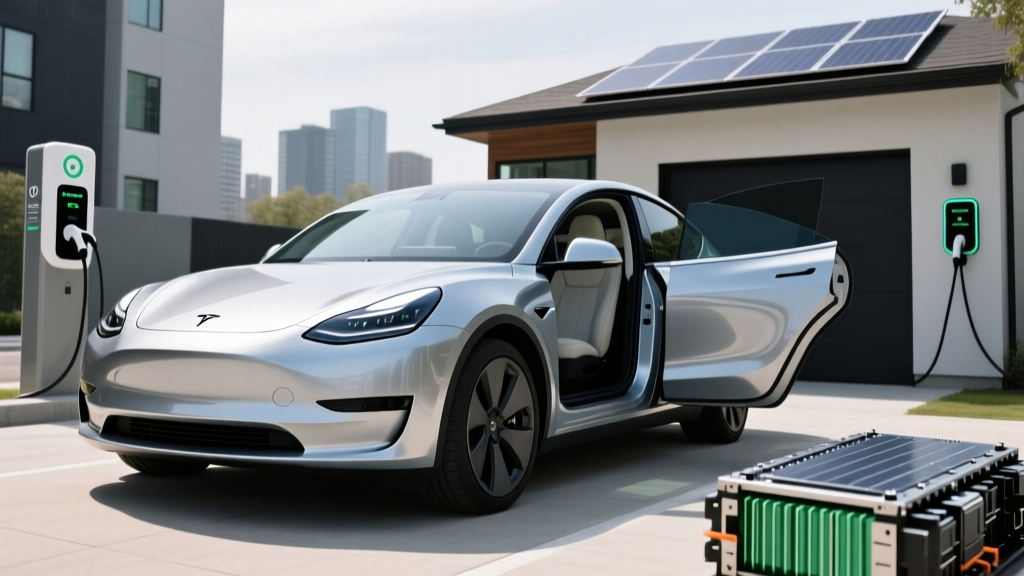
Charging speed is where Tesla's vertical integration — vehicles, Supercharger stalls, and NACS connector — delivers a tangible ownership advantage. Both the Model 3 and Model Y use the North American Charging Standard (NACS) connector natively, granting access to over 65,000 Tesla Superchargers across North America without adapters.
| Charging Level | Power | Model 3 (mi/hr added) | Model Y (mi/hr added) |
|---|---|---|---|
| Level 1 (120V household) | ~1.4 kW | ~5 mi/hr | ~4 mi/hr |
| Level 2 (240V, 48A home charger) | 11.5 kW | ~44 mi/hr | ~41 mi/hr |
| DC Fast Charge (V3 Supercharger) | Peak 250 kW | 10–80% in ~25 min | 10–80% in ~27 min |
| DC Fast Charge (V4 Supercharger) | Peak 250 kW* | Similar to V3 | Similar to V3 |
*V4 Supercharger cabinets can deliver up to 350+ kW, but current Model 3/Y vehicles are limited by their onboard charge architecture to ~250 kW peak. Future vehicle hardware revisions may unlock higher rates.
Charging curve reality: Neither vehicle sustains 250 kW for the full session. Peak power is available roughly between 10–30% state of charge (SoC), after which the rate tapers progressively. From 50–80%, expect average rates closer to 100–130 kW. This is why 10–80% times are the industry-standard metric — the final 20% can add another 20–25 minutes and is best avoided on road trips unless necessary.
For home charging, Tesla's Wall Connector ($420) delivers up to 11.5 kW on a 60-amp circuit (48A continuous). A full overnight charge from 20% to 80% takes roughly 4.5 hours for either vehicle — more than sufficient for daily driving. Installation costs typically range from $800–$2,500 depending on panel capacity and conduit run length, according to licensed electrician estimates. Homes with 100-amp electrical panels may require a $1,500–$3,000 panel upgrade to support a dedicated 60-amp EV circuit.
Performance, Efficiency, and Driving Dynamics
The Model 3 Long Range AWD posts a 4.2-second 0–60 mph time with approximately 384 horsepower from its dual-motor setup. The Model Y Long Range is slightly slower at 4.8 seconds due to its ~350-pound weight penalty. Both deliver instant torque with no turbo lag or gear-shift interruption — the acceleration feel is more immediate than the times suggest.
Efficiency is where Tesla continues to lead the segment. The Model 3 Long Range achieves 132 MPGe combined (25 kWh/100mi) per EPA data on fueleconomy.gov, making it one of the most efficient all-wheel-drive EVs on the market. The Model Y Long Range returns 122 MPGe (27 kWh/100mi) — still excellent for a crossover, but the aerodynamic and weight penalties are measurable.
The Highland-refreshed Model 3 rides noticeably more compliantly than pre-2024 models, with revised dampers, improved sound insulation, and a rear touchscreen for passengers. The Juniper-updated Model Y received similar treatment: ventilated front seats, a rear entertainment screen, ambient lighting, and a quieter cabin. Both remain firmly tuned — comfortable over highway expansion joints but not plush over sharp urban impacts.
Pricing, Trims, and Federal Tax Credit Eligibility
| Trim | Base MSRP | Est. §30D Credit* | Effective Price |
|---|---|---|---|
| Model 3 RWD | $38,990 | Up to $7,500 | ~$31,490 |
| Model 3 Long Range AWD | $47,740 | Up to $7,500 | ~$40,240 |
| Model 3 Performance | $54,630 | Up to $7,500 | ~$47,130 |
| Model Y RWD | $44,990 | Up to $7,500 | ~$37,490 |
| Model Y Long Range AWD | $50,630 | Up to $7,500 | ~$43,130 |
| Model Y Performance | $54,630 | Up to $7,500 | ~$47,130 |
*Federal EV tax credit eligibility under IRS §30D is subject to multiple requirements that change periodically. Key constraints for 2026 include:
- MSRP Caps: Vans/SUVs/pickups (Model Y qualifies as SUV): $80,000 cap. Sedans (Model 3): $55,000 cap. All current trims fall below these limits.
- Buyer Income Caps: Modified AGI must not exceed $150,000 (single), $225,000 (head of household), or $300,000 (joint filers).
- Battery Sourcing: The credit is split into two halves — $3,750 for meeting critical-mineral requirements and $3,750 for battery-component sourcing. Sourcing rules tighten annually; verify current-year eligibility at IRS.gov's qualified vehicle list.
- Point-of-Sale Transfer: Eligible buyers can transfer the credit to the dealer at purchase, reducing the upfront cost rather than waiting for a tax refund.
Because battery-sourcing requirements evolve annually, a trim that qualifies for the full $7,500 one year may qualify for only $3,750 the next. Always confirm current eligibility on the IRS qualified vehicles list before finalizing a purchase. Consult a tax professional for individual circumstances.
Interior, Cargo, and Technology
The Model 3 is a midsize sedan with 23 cubic feet of trunk space and seating for five. Rear legroom measures 35.2 inches — adequate for adults on shorter trips but tight for taller passengers on long drives. The Model Y provides a decisive advantage here: 30 cubic feet behind the second row (plus a 4-cubic-foot frunk), 41.6 inches of rear legroom, and an available third-row seat that accommodates small children (though it effectively eliminates cargo space when deployed).
Both vehicles share Tesla's minimalist interior architecture: a single 15.4-inch central touchscreen controls virtually all vehicle functions, including climate, mirrors, and glovebox. There is no traditional instrument cluster — speed and navigation appear in the upper-left corner of the main display. The 2024+ refreshes added an 8-inch rear touchscreen for climate and entertainment, addressing a frequent complaint from rear-seat passengers.
Standout technology:
- Tesla Supercharger network access (largest and most reliable DC fast-charging network in North America)
- Over-the-air software updates adding features post-purchase
- Sentry Mode dashcam recording with USB storage
- Dog Mode and Camp Mode climate settings
- Phone-as-key with Bluetooth passive entry
Notable drawbacks:
- No Apple CarPlay or Android Auto — Tesla's native infotainment only
- Turn-signal buttons on steering wheel (no stalk) take adaptation
- Glass roof provides no shade option — aftermarket sunshades are a common add-on
- No heads-up display
- Panel gap consistency improved post-refresh but still varies unit-to-unit
Driver Assistance: Autopilot and FSD (Supervised)
SAE Automation Level: Level 2. Tesla's Autopilot and Full Self-Driving (Supervised) are driver-assistance systems that require continuous driver engagement, hands on the steering wheel, and eyes on the road. They do not make the vehicle self-driving. Only Level 4 services like Waymo operate without a human driver in defined geofenced areas.
Standard Autopilot (included with every Model 3 and Model Y) provides adaptive cruise control and lane-centering on marked highways. It works reliably on well-maintained interstates but can struggle with faded lane markings, construction zones, and sudden cut-ins.
Full Self-Driving (Supervised) — currently priced at $8,000 or $99/month — adds automatic lane changes, traffic-light and stop-sign recognition, and city-street navigation. After years of iterative improvement, FSD (Supervised) handles many routine driving scenarios competently but still requires driver intervention multiple times per trip in complex urban environments. It is not a substitute for an attentive driver, and Tesla's own labeling ("Supervised") reflects this reality.
What Autopilot/FSD does NOT do: These systems do not navigate unmapped roads, handle all construction zones, reliably detect emergency vehicles in all conditions, or operate without driver supervision. The driver is legally and operationally responsible for the vehicle at all times. NHTSA continues to monitor Tesla's driver-assistance systems under its automated vehicle safety oversight.
Warranty, Ownership Costs, and Long-Term Outlook
Tesla provides a 5-year/60,000-mile basic vehicle warranty and an 8-year/120,000-mile battery and drive unit warranty for Long Range and Performance trims (8-year/100,000-mile for RWD trims). The battery warranty guarantees at least 70% capacity retention over the warranty period — a threshold that, based on fleet data from sources like Recurrent Auto, most Tesla batteries exceed significantly. Real-world degradation curves typically show 5–8% loss over the first 50,000 miles, followed by a much slower decline.
Insurance costs remain above segment average. Model 3 and Model Y premiums typically run 15–30% higher than comparably priced non-Tesla EVs, driven by higher repair costs after collisions (Tesla's aluminum-intensive structures and proprietary parts). Get quotes before purchasing — the difference can be $400–$800/year depending on your profile and state.
Maintenance is minimal: no oil changes, no transmission fluid, cabin air filter replacement every 2–3 years, tire rotation every 6,250 miles, and brake fluid checks every 2 years. Regenerative braking significantly extends brake pad life — many owners report original pads beyond 80,000 miles.
Pros — Model 3 and Model Y
- Class-leading efficiency (lowest kWh/100mi in segment)
- Supercharger network — still the most reliable DC fast-charging ecosystem
- Strong over-the-air update cadence adding real features
- Spacious cargo area (Model Y especially) with frunk
- Competitive pricing after tax credits
- Excellent real-world range retention with heat pump
Cons — Model 3 and Model Y
- No Apple CarPlay / Android Auto
- Higher insurance premiums than rivals
- Turn signals on steering wheel (no stalk) — polarizing
- FSD (Supervised) remains Level 2 despite price and name
- Service center wait times can be long in some markets
- 250 kW peak DC charge rate trails 800V competitors (Ioniq 5 at 350 kW)
Who Should Buy the Model 3 vs. the Model Y?
Choose the Model 3 if: You prioritize maximum range and efficiency, drive primarily solo or with one passenger, don't need crossover cargo space, and want the lowest possible cost of ownership in the Tesla lineup. The Long Range AWD at ~$40,240 (after credit) delivers 341 miles of EPA range and 132 MPGe — hard to beat at the price.
Choose the Model Y if: You need rear-seat space for children or adults, require cargo versatility (strollers, gear, dogs), prefer a higher seating position, or want the available third-row option for occasional use. The 21-mile range penalty and ~$2,900 price premium over the Model 3 Long Range are modest trade-offs for the utility gain.
Consider a competitor if: You want 800V ultra-fast charging (Hyundai Ioniq 5/Kia EV6 at 350 kW peak), prefer traditional infotainment with CarPlay (Ford Mach-E, Hyundai Ioniq 5), or need a more luxurious interior at this price point (BMW iX1). The Supercharger advantage narrows as competitors gain NACS adapter access to Tesla's network.
Frequently Asked Questions
What is the real-world range of the Tesla Model 3 and Model Y?
The Model 3 Long Range AWD's 341-mile EPA estimate translates to roughly 285–305 miles at sustained highway speeds and 230–260 miles in freezing weather. The Model Y Long Range AWD's 320-mile EPA figure yields approximately 265–285 miles highway and 215–245 miles in deep cold. City driving with regenerative braking often meets or slightly exceeds EPA estimates.
How fast do the Model 3 and Model Y charge at home and on the road?
On a Level 2 home charger (11.5 kW / 48A), the Model 3 adds about 44 miles of range per hour and the Model Y adds about 41 miles per hour — a full overnight session easily replenishes daily driving. At a V3 Supercharger, both vehicles peak at 250 kW and charge from 10–80% in approximately 25–27 minutes, though the rate tapers significantly above 50% SoC.
Do the Model 3 and Model Y qualify for the $7,500 federal EV tax credit?
Both vehicles fall under the MSRP caps ($55,000 for sedans, $80,000 for SUVs) and all current trims qualify on price. However, the full $7,500 credit depends on meeting both critical-mineral and battery-component sourcing requirements under IRS §30D, which tighten annually. Buyer income must also fall below $150K/$225K/$300K thresholds (single/HOH/joint). Verify current eligibility on the IRS qualified vehicles list before purchasing.
Is the Tesla Model 3 or Model Y worth buying over competitors like the Ioniq 5 or Mach-E?
For buyers who prioritize charging-network reliability, efficiency, and software, Tesla still holds an edge — the Supercharger network remains the most dependable DC fast-charging option for road trips. However, competitors like the Hyundai Ioniq 5 offer faster peak charging (350 kW on 800V architecture), Apple CarPlay, and more distinctive interiors. If you charge primarily at home and rarely road-trip, the charging-network advantage narrows considerably, and rivals become more compelling.
What are the biggest drawbacks of owning a Model 3 or Model Y?
The most common ownership complaints are the absence of Apple CarPlay/Android Auto, higher-than-average insurance premiums, and the polarizing stalkless steering wheel controls introduced with the refresh. Service center wait times can also be lengthy in high-volume markets. The FSD (Supervised) package, at $8,000, remains a Level 2 driver-assist system — capable but not autonomous — and many buyers find the standard Autopilot sufficient.
How long will the battery last, and what does replacement cost?
Tesla's 8-year/120,000-mile battery warranty covers capacity retention above 70%. Fleet data suggests most Model 3/Y batteries lose 5–10% capacity over the first 100,000 miles and retain 85–90% at 150,000 miles. Out-of-warranty battery replacement costs range from $12,000–$16,000 depending on the pack, though full replacements before 200,000 miles remain uncommon based on current degradation data.