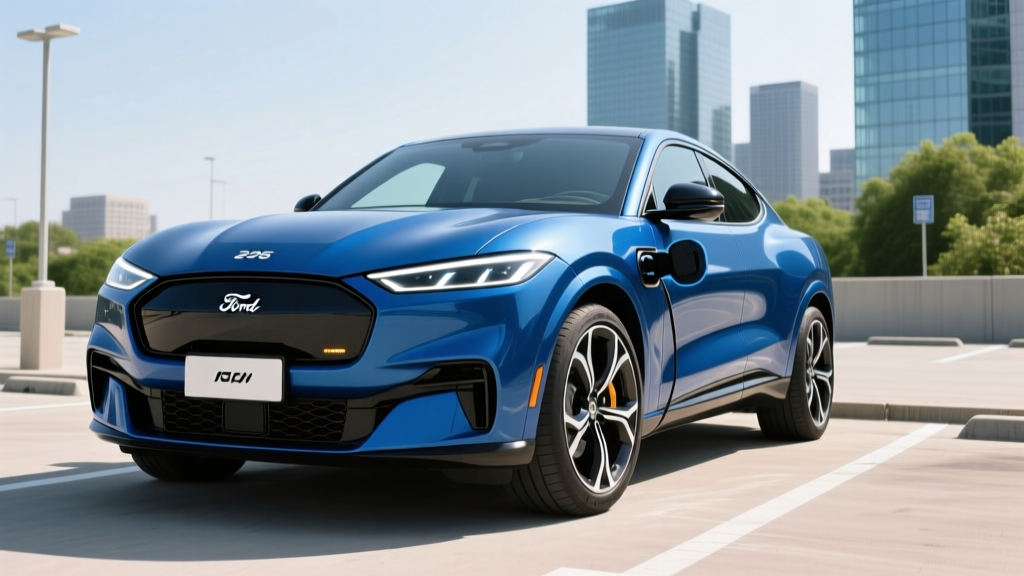
The Ford Mustang Mach-E enters the 2026 model year in a competitive sweet spot: a midsize electric crossover with legitimate road-trip range, improving DC fast-charge speeds, and pricing that undercuts many rivals before incentives. For buyers hunting Ford Mustang Mach-E deals, the math has shifted meaningfully — lease incentives, dealer discounts on 2025 carryover stock, and the federal §30D tax credit (where applicable) can pull a well-equipped Mach-E into the low $40,000s. But not every trim qualifies for the full credit, and real-world range varies significantly by drivetrain and battery pack. Here is the data-driven breakdown you need before signing.
Quick Verdict: Is the 2026 Mach-E Worth the Deal?
The 2026 Mach-E remains one of the most well-rounded EVs in its segment. It offers up to 320 miles of EPA-estimated range (Extended Range RWD), peppy performance from the dual-motor AWD variants, and Ford's BlueCruise hands-free highway driving assist. Its primary weaknesses are a rear seat that trails rivals in legroom and DC fast-charge speeds that, while improved, still lag behind Hyundai/Kia's 800V architecture. For buyers who prioritize driving dynamics and available hands-free tech over maximum cargo space or the absolute fastest charging, Mach-E deals in 2026 are genuinely compelling.
Range, Battery, and Real-World Efficiency
| Configuration | Battery (Usable kWh) | Chemistry | EPA Range (mi) | MPGe (City/Hwy/Combined) | kWh/100 mi |
|---|---|---|---|---|---|
| Select RWD (Standard Range) | 75.7 kWh | NMC (nickel manganese cobalt) | 250 | 111 / 94 / 103 | 33 |
| Premium RWD (Extended Range) | 91.0 kWh | NMC | 320 | 105 / 91 / 98 | 34 |
| Premium AWD (Extended Range) | 91.0 kWh | NMC | 290 | 100 / 86 / 93 | 36 |
| GT AWD (Extended Range) | 91.0 kWh | NMC | 280 | 92 / 80 / 86 | 39 |
| Rally AWD (Extended Range) | 91.0 kWh | NMC | 270 | 88 / 76 / 82 | 41 |
Ford continues to use NMC (nickel manganese cobalt) chemistry across the Mach-E lineup rather than LFP (lithium iron phosphate). NMC offers higher energy density — critical for packaging 91 usable kWh into the Mach-E's floor — but requires more careful long-term charge management. Ford recommends daily charging to 90% for NMC packs and reserving 100% charges for road trips to minimize degradation. Source: fueleconomy.gov.
Charging Speeds: DC Fast Charge and Home Level 2
Charging speed is often the make-or-break factor for EV ownership satisfaction, and the Mach-E's charging profile requires some nuance.
| Charging Method | Max Rate | Speed (Approx.) | Notes |
|---|---|---|---|
| DC Fast Charge (Standard Range) | 130 kW peak | 10–80% in ~38 min | CCS connector (NACS adapter available for Tesla Supercharger access) |
| DC Fast Charge (Extended Range) | 150 kW peak | 10–80% in ~33 min | Peak rate sustained to ~55% SoC, then tapers progressively |
| Level 2 Home (240V, 48A) | 11.5 kW | ~26 mi/hr added | Full charge from empty: ~8.5 hours (ER) / ~7 hours (SR) |
| Level 2 Home (240V, 32A) | 7.7 kW | ~17 mi/hr added | Common for lower-amperage home circuits |
| Level 1 (120V household) | ~1.4 kW | ~3 mi/hr added | Emergency/trickle only — ~36 hours for full ER charge |
A critical detail buyers miss: peak kW is not sustained kW. The Extended Range Mach-E hits 150 kW only in a narrow state-of-charge window (roughly 15–55% SoC) and at optimal battery temperature. Above 80% SoC, charging slows dramatically — expect 40–50 kW tapering further. On a road trip, plan your stops around the 10–80% window for the fastest throughput. Battery preconditioning (available via the FordPass app when you navigate to a charger) warms the pack for faster DC charging and is essential in cold weather.
Ford provides a NACS adapter for Mach-E owners, enabling access to Tesla's Supercharger network — now the largest and most reliable DC fast-charging network in the US. This significantly improves the Mach-E's road-trip viability compared to CCS-only competitors without adapter support.
Performance, Drivetrain, and Driving Dynamics
| Trim | Drivetrain | Horsepower | Torque (lb-ft) | 0–60 mph |
|---|---|---|---|---|
| Select / Premium RWD | Rear-Wheel Drive | 266 hp | 317 | 6.3 sec |
| Premium AWD (ER) | Dual-Motor AWD | 346 hp | 428 | 5.1 sec |
| GT AWD | Dual-Motor AWD | 480 hp | 600 | 3.8 sec |
| Rally AWD | Dual-Motor AWD | 480 hp | 700 | 3.7 sec |
The Mach-E's handling is its secret weapon in the EV crossover segment. Ford tuned the chassis with genuine sporting intent — the GT and Rally variants deliver acceleration that embarrasses most gas-powered performance SUVs, while the base RWD models offer a comfortable, compliant ride with responsive steering. The GT's 3.8-second 0–60 time is legitimized by instant electric torque delivery, making it feel even quicker in real-world passing situations.
Pricing, Trim Levels, and Federal Tax Credit Eligibility
| Trim | Base MSRP | Est. As-Tested* | §30D Credit Eligibility | Effective Price After Credit |
|---|---|---|---|---|
| Select RWD (SR) | $42,995 | $44,500 | Up to $7,500 (if sourcing requirements met) | ~$35,495–$37,000 |
| Premium RWD (ER) | $48,995 | $51,500 | Up to $7,500 | ~$41,495–$44,000 |
| Premium AWD (ER) | $51,995 | $54,500 | Up to $7,500 | ~$44,495–$47,000 |
| GT AWD (ER) | $59,995 | $63,000 | Up to $7,500 | ~$52,495–$55,500 |
| Rally AWD (ER) | $61,995 | $64,500 | Up to $7,500 | ~$54,495–$57,000 |
*As-tested includes common options and destination charge. Actual dealer pricing varies.
- MSRP Cap: SUVs/crossovers must have an MSRP at or below $80,000 — all Mach-E trims qualify.
- Buyer Income Cap: Modified AGI must not exceed $150,000 (single), $225,000 (head of household), or $300,000 (joint filers).
- Battery Sourcing: The full $7,500 requires meeting BOTH critical minerals AND battery component sourcing requirements per IRS guidelines. Partial credit ($3,750) applies if only one requirement is met. Sourcing rules tighten annually — verify current-year compliance on the IRS website or with your dealer before purchase.
- Point-of-Sale Transfer: Eligible buyers can transfer the credit to the dealer at purchase, reducing the sale price directly rather than waiting for a tax refund.
Tax credit rules are subject to change. Consult a tax professional for your specific situation.
Finding the best Mach-E deals in 2026: Ford has periodically offered aggressive lease incentives (often $5,000–$7,500 in "Ford Credit" bonus cash on leases), which can stack with the federal credit on purchased vehicles or effectively reduce lease payments. Check for leftover 2025 models on dealer lots — these may carry additional markdowns. End-of-quarter and end-of-year sales events (particularly September and December) historically yield the deepest discounts.
Interior, Cargo, and Technology
The Mach-E's cabin centers around a massive 15.5-inch vertical touchscreen running Ford's SYNC 4A infotainment system. The interface is responsive and logically organized, with wireless Apple CarPlay and Android Auto as standard. A 10.2-inch digital instrument cluster sits behind the steering wheel.
| Measurement | Specification |
|---|---|
| Cargo Volume (behind rear seats) | 29.7 cu ft |
| Cargo Volume (rear seats folded) | 59.7 cu ft |
| Front Trunk (Frunk) | 4.7 cu ft (drainable, useful for wet items) |
| Front Legroom | 43.3 in |
| Rear Legroom | 38.9 in |
| Front Headroom | 40.4 in |
| Rear Headroom | 39.3 in |
The drainable frunk is a standout feature — perfect for storing muddy gear, groceries that might leak, or a cooler for tailgating. However, rear legroom at 38.9 inches trails the Hyundai Ioniq 5 (41.7 in) and Kia EV6 (39.4 in), which matters for taller passengers or families with rear-facing car seats.
BlueCruise (Ford's SAE Level 2 hands-free driving system) is available on pre-mapped divided highways — over 130,000 miles of compatible roads across the US and Canada. It allows hands-off driving while the driver's eyes remain monitored by an infrared camera. This is not self-driving — you must remain attentive and ready to take over immediately. BlueCruise requires a subscription after the initial trial period (typically $75/month or $800/year).
Warranty and Long-Term Ownership
| Coverage | Term |
|---|---|
| Basic (Bumper-to-Bumper) | 3 years / 36,000 miles |
| Powertrain | 5 years / 60,000 miles |
| Battery (High-Voltage) | 8 years / 100,000 miles |
| Battery Capacity Retention Guarantee | ≥70% of original capacity during warranty period |
| Corrosion Perforation | 5 years / unlimited miles |
| Roadside Assistance | 5 years / 60,000 miles |
Ford's 8-year/100,000-mile battery warranty with a 70% capacity retention floor is industry-standard, matching most competitors. Real-world data from 2021–2024 Mach-E owners suggests degradation has been modest — most high-mileage owners report 5–8% capacity loss over 60,000–80,000 miles, well within the warranty threshold. For context, a battery replacement outside warranty currently costs in the range of $15,000–$20,000+ including labor, though prices are expected to continue declining. Source: ford.com.
Pros, Cons, and How It Compares
✅ Pros
- Engaging driving dynamics — best-in-class handling for an EV crossover
- Up to 320 miles EPA range (ER RWD) covers most road trips with one stop
- NACS adapter unlocks Tesla Supercharger network
- Drainable frunk is genuinely practical
- BlueCruise hands-free highway assist is well-implemented
- GT variant offers supercar-level acceleration (3.8s 0–60)
- All trims qualify under the $80K MSRP cap for §30D credit
❌ Cons
- DC fast-charge speed (150 kW peak) trails Hyundai Ioniq 5 / Kia EV6 (up to 240+ kW via 800V)
- Rear legroom (38.9 in) is tight for the segment
- NMC battery requires 90% daily charge limit for longevity
- BlueCruise subscription adds ongoing cost ($75/mo after trial)
- Base Select trim feels spartan at $42,995
- No heat pump standard on all trims (reduces cold-weather efficiency)
Decision Framework: Mach-E vs. Key Competitors
Choose the Mach-E if: You prioritize driving engagement, want BlueCruise hands-free capability, and value Tesla Supercharger access via NACS adapter.
Choose the Hyundai Ioniq 5 if: You need the fastest possible DC charging (~18 min 10–80%), more rear-seat room, and vehicle-to-load (V2L) power capability.
Choose the Tesla Model Y if: You want native Supercharger access (no adapter), the most mature software/OTA update ecosystem, and maximum Supercharger density for frequent road trips.
Choose the Kia EV6 if: You want a sportier design, 800V fast charging, and slightly better rear-seat space at a competitive price.
Who Should Buy the 2026 Mach-E?
Best for: Daily commuters with home charging who take occasional road trips (200–350 miles), driving enthusiasts who want an EV that actually feels fun in corners, and families with older children (the rear seat fits adults but is snug for long trips with tall passengers).
Not ideal for: Buyers who need maximum cargo space (consider the Hyundai Ioniq 5 or Kia EV6), those who frequently drive 400+ mile road trips in winter (the charging speed and cold-weather range loss add time), or families needing rear-facing car seats plus front-passenger comfort.
Frequently Asked Questions
What is the real-world range of the 2026 Ford Mustang Mach-E?
The EPA rates the Extended Range RWD at 320 miles, but real-world highway driving at 70–75 mph typically yields 265–285 miles. In cold weather (below 30°F), expect 210–240 miles from the ER RWD. AWD and GT trims deliver proportionally less — roughly 240–260 miles highway for the ER AWD in moderate temperatures.
How fast does the Mach-E charge at home and on the road?
On a DC fast charger, the Extended Range model peaks at 150 kW and charges from 10–80% in approximately 33 minutes. At home on a 48-amp Level 2 charger (240V), it adds roughly 26 miles of range per hour, fully charging the ER battery in about 8.5 hours overnight. The Standard Range model peaks at 130 kW DC (10–80% in ~38 min) and charges slightly faster at home due to its smaller 75.7 kWh battery.
How much does the Mach-E cost after federal tax credits?
With the full $7,500 §30D federal tax credit applied, the Select RWD starts around $35,495, the Premium RWD (Extended Range) drops to roughly $41,495, and the GT comes in near $52,495. However, credit eligibility depends on your income, the vehicle's battery sourcing compliance, and current-year IRS rules. The credit can be transferred to the dealer at point of sale to reduce your purchase price directly. Consult irs.gov for current eligibility details.
Does the 2026 Mach-E qualify for the $7,500 federal EV tax credit?
All 2026 Mach-E trims fall under the $80,000 MSRP cap for SUVs/crossovers. Whether you personally qualify depends on your modified adjusted gross income (≤$150K single / ≤$300K joint) and whether the specific vehicle meets the IRS battery component and critical minerals sourcing requirements. These sourcing rules tighten annually, so verify with your dealer that the exact VIN you're purchasing qualifies. A tax professional can confirm your personal eligibility.
Is the Mach-E worth buying over the Tesla Model Y or Hyundai Ioniq 5?
It depends on your priorities. The Mach-E wins on driving dynamics and available BlueCruise hands-free tech. The Ioniq 5 wins on DC charging speed and rear-seat space. The Model Y wins on native Supercharger convenience and software maturity. With competitive dealer pricing and tax credits, the Mach-E's effective price is compelling — but test-drive all three before deciding.
What are the biggest drawbacks of the Mach-E?
The most common complaints are rear-seat legroom that trails key rivals, DC charging speeds that lag behind 800V competitors (adding 5–10 minutes to road-trip stops), and the ongoing BlueCruise subscription cost. The NMC battery chemistry also means you should charge to 90% (not 100%) for daily use to maximize longevity.
Sources: fueleconomy.gov, ford.com, irs.gov. All specifications reflect 2026 model-year data as published by Ford and the EPA. Pricing and credit eligibility are subject to change. Always verify with your dealer and tax professional before purchase.