The Short Answer: Rivian Is an American EV Maker
Rivian is headquartered in Irvine, California, and manufactures its vehicles in Normal, Illinois — a 3.3-million-square-foot former Mitsubishi plant that now employs more than 9,000 people. So if you've been searching what country is Rivian from, the answer is the United States, start to finish: designed in Southern California, engineered across US tech hubs, and assembled in the Midwest with a largely domestic supply chain.
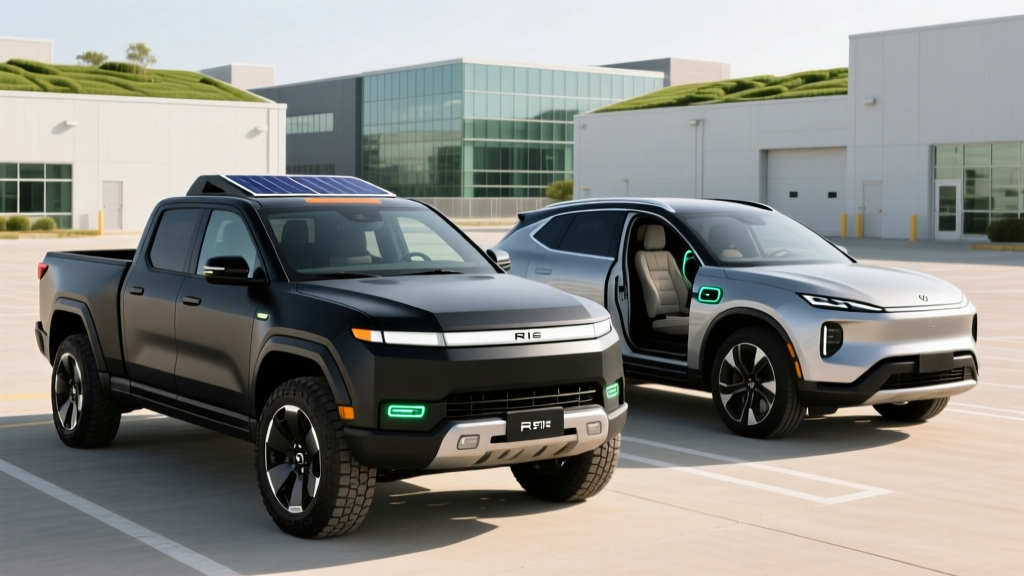
Founded in 2009 by MIT graduate RJ Scaringe, Rivian went public in November 2021 and has since become one of the few American automakers to bring a ground-up electric platform to volume production. For 2026, the company offers two core consumer vehicles — the R1T pickup and the three-row R1S SUV — both riding on the same skateboard architecture and both significantly updated from their 2022 launch versions.
Rivian's US Manufacturing Footprint
Understanding where Rivian comes from matters for buyers who care about supply-chain resilience, service access, and federal tax-credit sourcing. Here's the breakdown:
- Headquarters: Irvine, California — R&D, design, software engineering
- Manufacturing: Normal, Illinois — final assembly, battery pack integration, drivetrain build-out
- Battery cells: Samsung SDI 2170-format cylindrical cells (NMC chemistry), with US pack assembly
- Future plants: A second factory in Stanton, Georgia (announced for the R2 platform, expected late-2020s production)
This domestic assembly is directly relevant to IRS §30D tax-credit eligibility, which requires North American final assembly as a baseline. Rivian's Illinois plant satisfies that requirement, though full credit eligibility still hinges on battery-component and critical-mineral sourcing thresholds that shift annually.
2026 Rivian R1T & R1S: Full Spec Breakdown
Both the R1T (pickup) and R1S (SUV) share the same dual-motor and quad-motor powertrains, battery options, and charging architecture. Here's what the numbers look like for the current model year:
| Spec | Dual-Motor (Standard Pack) | Dual-Motor (Max Pack) | Quad-Motor (Max Pack) |
|---|---|---|---|
| Horsepower | 533 hp | 533 hp | 1,025 hp |
| Torque | 610 lb-ft | 610 lb-ft | 1,198 lb-ft |
| 0-60 mph | 4.5 sec | 4.5 sec | 3.0 sec |
| Drivetrain | AWD (2 motors) | AWD (2 motors) | AWD (4 motors) |
| Battery (usable) | ~95 kWh (NMC) | ~141 kWh (NMC) | ~141 kWh (NMC) |
| EPA Range (R1T) | 270 mi | 410 mi | 328 mi |
| EPA Range (R1S) | 268 mi | 402 mi | 321 mi |
| Efficiency (R1T Dual-Motor Max) | ~2.0 kWh/mi (49 MPGe combined) | ||
| Max DC Fast Charge | ~220 kW peak | ||
| 10-80% DC Time | ~28 min (Standard), ~42 min (Max) | ||
| Level 2 Home Rate | 11.5 kW (~20 mi/hr) | ||
| Max Towing | 11,000 lb (R1T) / 7,700 lb (R1S) | ||
The EPA rates the R1T Dual-Motor Max Pack at 410 miles. In real-world highway driving at 70-75 mph, expect 320-350 miles in mild weather. In cold conditions (below 30°F), that figure can drop to 260-290 miles due to battery internal resistance and cabin heating loads. The Quad-Motor's 328-mile EPA rating translates to roughly 260-280 real-world highway miles — the extra motors and weight consume more energy. For the Standard Pack's 270-mile EPA figure, plan for 210-230 miles on a highway road trip.
Charging: DC Fast, Home Level 2, and the NACS Switch
Rivian's 2026 models ship with the NACS (Tesla-style) charge port natively, meaning direct access to Tesla Supercharger stalls without an adapter — a significant practical advantage that didn't exist on 2022-2024 models.
| Charging Level | Power | Miles Added per Hour | Notes |
|---|---|---|---|
| Level 1 (120V household) | ~1.4 kW | ~3 mi/hr | Emergency/trickle only |
| Level 2 (240V home, 48A) | 11.5 kW | ~20 mi/hr | Full overnight charge in ~12-14 hr (Max Pack) |
| DC Fast Charge (peak) | ~220 kW | ~500+ mi/hr (at peak) | 10-80% in ~28-42 min depending on pack size |
Charge-curve reality: The ~220 kW peak is sustained only between roughly 10-30% state of charge. Above 50%, the rate tapers significantly — expect ~120 kW by 60% and ~60 kW above 80%. This is standard NMC behavior, but it means the 10-80% time is a more honest metric than peak kW. Rivian's preconditioning feature warms the battery when you navigate to a charger, which is essential for hitting these numbers in cold weather.
For home charging, a 48-amp Level 2 wall connector on a 60-amp circuit is the sweet spot. Installation typically runs $800-$2,000 depending on panel proximity and whether your home needs a service upgrade. See a licensed electrician for a site-specific quote.
Pricing, Trims, and Federal Tax Credit (2026)
Rivian positions the R1T and R1S in the premium adventure segment. Here's where pricing stands for the current model year:
| Model / Config | Base MSRP | Typical As-Tested | §30D Credit Eligibility |
|---|---|---|---|
| R1T Dual-Motor Standard | $71,700 | $75,000-$80,000 | Varies by sourcing rules |
| R1T Dual-Motor Max | $82,200 | $87,000-$95,000 | Subject to MSRP cap ($80,000 for trucks) |
| R1T Quad-Motor Max | $99,000 | $105,000+ | Exceeds MSRP cap — ineligible |
| R1S Dual-Motor Standard | $76,700 | $80,000-$86,000 | Subject to MSRP cap ($80,000 for SUVs) |
| R1S Dual-Motor Max | $87,200 | $92,000-$99,000 | Exceeds MSRP cap — ineligible |
Critical §30D caveats: The federal EV tax credit under IRS §30D is not automatic. Eligibility depends on:
- MSRP caps: $80,000 for vans/SUVs/pickups — many R1 configurations exceed this.
- Buyer income limits: $150,000 single / $300,000 joint modified AGI.
- Battery sourcing: Increasingly strict critical-mineral and battery-component thresholds must be met. Rivian's Samsung SDI cells and supply chain are subject to annual rule updates.
- Point-of-sale transfer: Eligible buyers can apply the credit at purchase rather than waiting for tax filing.
Always verify current eligibility on the IRS qualified-vehicles list before purchasing. Tax situations vary — consult a tax professional for your specific case.
Interior, Cargo, and Daily Practicality
R1T (pickup): The R1T is a midsize truck — smaller than an F-150 Lightning but larger than a Maverick. Key dimensions:
- Bed length: 4.5 ft (extends to ~6 ft with the Gear Tunnel open)
- Gear Tunnel: 11 cu ft lockable pass-through storage behind the rear seats — a Rivian-exclusive feature
- Frunk (front trunk): 11 cu ft with a drain, usable as a cooler
- Rear-seat legroom: 38.2 inches
- Max payload: ~1,760 lb
R1S (SUV): The three-row R1S seats up to seven:
- Cargo behind 3rd row: ~10.5 cu ft
- Cargo behind 2nd row: ~46 cu ft
- Cargo with all rows folded: ~83 cu ft
- Third-row legroom: 30.1 inches (tight for adults on long trips)
- Frunk: 11 cu ft
Tech highlights: Rivian's infotainment runs on a custom 15.6-inch landscape touchscreen with a second 6.8-inch cluster display. The software is well-regarded for its clean UI, over-the-air update cadence, and integrated adventure features (camping mode, pet mode, gear-tunnel controls). The Driver+ system offers hands-on highway assist with lane-centering and adaptive cruise — this is an SAE Level 2 driver-assist system, not self-driving. You must keep your hands on the wheel and eyes on the road at all times.
Battery Chemistry, Warranty, and Longevity
Rivian uses NMC (nickel-manganese-cobalt) lithium-ion cells in a 2170 cylindrical format supplied by Samsung SDI. NMC offers high energy density — necessary for the R1's 400+ mile Max Pack — but is more sensitive to sustained high states of charge than LFP chemistry.
Warranty coverage:
- Battery pack: 8 years / 175,000 miles (capacity retention above a defined threshold)
- Powertrain (motors, reducers): 8 years / 175,000 miles
- Bumper-to-bumper: 5 years / 60,000 miles
For longevity, Rivian recommends charging to 80-90% for daily use and reserving 100% charges for road trips. The large thermal management system — including a heat pump — helps preserve battery health across climates. Replacement costs for the Max Pack, should it ever be needed out of warranty, are estimated in the $18,000-$25,000 range based on current NMC cell pricing, though this figure will likely decrease over time.
Rivian vs. the Competition: Is It Worth Buying?
The R1T competes most directly with the Ford F-150 Lightning and the Chevrolet Silverado EV, while the R1S slots against the Tesla Model X, Kia EV9, and BMW iX. Here's the decision framework:
Choose Rivian If...
- You want a premium adventure vehicle with genuine off-road capability (quad-motor tank turns, 14+ inches of ground clearance)
- You need 400+ miles of EPA range (Max Pack) for remote road trips
- You value the Gear Tunnel and frunk for gear-heavy lifestyles
- NACS Supercharger access matters to you
- You want a distinctive design that doesn't look like every other EV
Look Elsewhere If...
- Budget is tight — the R1 starts near $72K and most well-equipped builds exceed $85K
- You need full-size truck bed length (F-150 Lightning offers 5.5-6.5 ft)
- Third-row space is a priority (Kia EV9 and Grand Highlander Hybrid offer more room)
- You want a hands-free highway driving system (GM's Super Cruise or Ford's BlueCruise offer hands-off Level 2 on mapped roads)
- You need immediate service-center access in rural areas — Rivian's service network is still expanding
Pros and Cons at a Glance
Pros
- Class-leading range with Max Pack (410 mi EPA)
- Native NACS port — full Supercharger network access
- Genuine off-road capability (air suspension, quad-motor torque vectoring)
- Innovative storage (Gear Tunnel, drained frunk)
- Strong OTA update cadence and software UX
- US-built with domestic assembly
Cons
- High starting price — most trims exceed §30D MSRP cap
- Heavy vehicle — efficiency suffers vs. lighter EVs (~2.0 kWh/mi)
- Service network still growing in many regions
- Third row (R1S) is cramped for adults
- Quad-motor is thrilling but expensive and range-reducing
- No LFP option for buyers who prefer daily 100% charging
Frequently Asked Questions
What country is Rivian from?
Rivian is an American company. It was founded in 2009, is headquartered in Irvine, California, and manufactures the R1T and R1S in Normal, Illinois. All design, engineering, and final assembly take place in the United States.
What is the real-world range of the Rivian R1T?
The EPA rates the R1T Dual-Motor Max Pack at 410 miles. Real-world highway driving in mild weather yields approximately 320-350 miles. In cold weather (below 30°F), expect 260-290 miles. The Standard Pack's 270-mile EPA rating translates to roughly 210-230 real-world highway miles.
How fast does a Rivian charge at home and on the road?
At home on a 240V Level 2 charger (48A), Rivians add about 20 miles of range per hour, fully charging the Max Pack in 12-14 hours. On DC fast chargers, they peak at ~220 kW, reaching 10-80% in approximately 28 minutes (Standard Pack) or 42 minutes (Max Pack). Native NACS means direct Tesla Supercharger access.
Does Rivian qualify for the $7,500 federal EV tax credit?
It depends on the specific configuration and your income. The IRS §30D credit has an $80,000 MSRP cap for trucks/SUVs/vans, which eliminates many higher-trim R1 models. Income caps ($150K single / $300K joint) and battery-sourcing requirements also apply. Check the IRS qualified vehicles list and consult a tax professional before relying on the credit.
Is Rivian reliable?
Rivian's build quality has improved significantly since the 2022 launch. Early models had software glitches and panel-fit inconsistencies, but 2025-2026 builds show marked improvement. The powertrain (motors, battery) carries an 8-year/175,000-mile warranty. Long-term reliability data is still accumulating given the brand's youth — Consumer Reports and owner forums are good ongoing resources.
Who is the Rivian R1 best suited for?
The R1T and R1S are ideal for buyers who combine outdoor/adventure lifestyles with daily driving — think ski trips, camping, towing boats or trailers, and road trips to remote areas. The Max Pack's 400+ mile range and Supercharger access make it one of the most capable EVs for long-distance travel. It's less suited for budget-conscious shoppers or those who need full-size truck utility or spacious third rows.