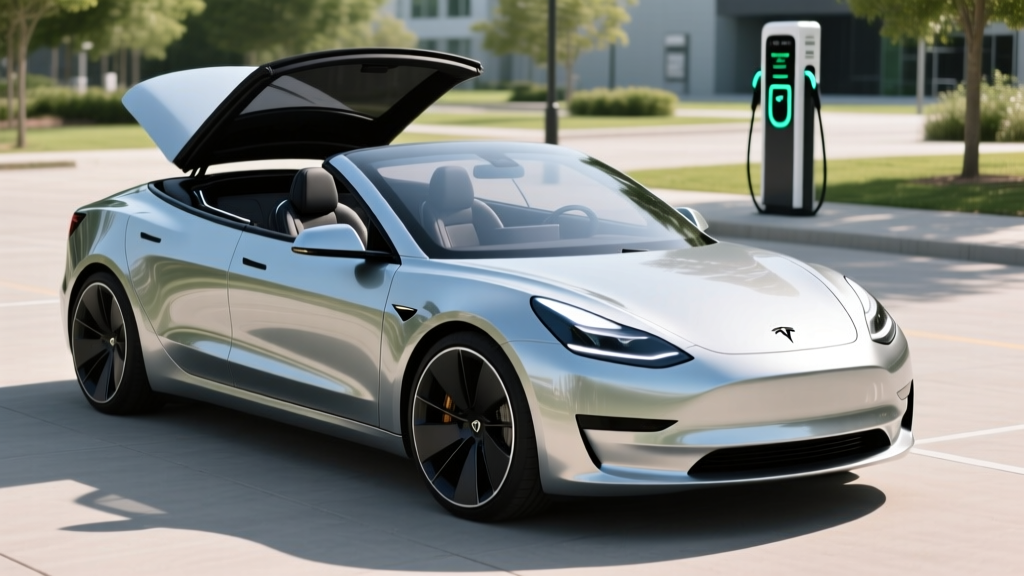
If you've been searching for a Tesla Model 3 convertible, you're not alone — the idea of an open-air electric sedan with Tesla's tech stack and Supercharger access is undeniably appealing. But here's the reality check upfront: Tesla does not manufacture a factory convertible version of the Model 3. As of the 2026 model year, no OEM-produced Tesla Model 3 convertible exists, and Tesla has announced no plans to build one.
That hasn't stopped enthusiasts, aftermarket shops, and curious shoppers from exploring the concept. This guide covers what a Model 3 convertible conversion actually involves, the engineering and safety trade-offs, the cost, and the best factory-built open-air EV alternatives if you want wind-in-your-hair electric driving without the aftermarket gamble.
Why Tesla Has Never Built a Model 3 Convertible
Tesla's vehicle architecture is optimized around a rigid unibody structure with the battery pack integrated into the floor pan as a stressed member. Removing the roof — the primary structural element tying the A-pillars to the C-pillars — requires extensive reinforcement to maintain torsional rigidity, crash safety performance, and handling dynamics.
For a high-volume, cost-optimized vehicle like the Model 3 (starting at $38,990 for the 2026 RWD trim), engineering a convertible variant would add significant cost and complexity for a niche body style. Convertibles also carry weight penalties from reinforcement, which directly reduces range — the metric EV buyers scrutinize most.
Tesla's current lineup focuses on sedans (Model 3, Model S), SUVs (Model Y, Model X), the Cybertruck, and the Semi. A roadster — the second-generation Tesla Roadster, announced years ago — remains Tesla's only open-air vehicle concept, and it is a low-volume halo sports car, not a production commuter.
Aftermarket Model 3 Convertible Conversions: What's Involved
A handful of custom shops worldwide have performed one-off Model 3 convertible conversions. These are not kit-based projects you can order online — they are bespoke fabrication jobs. Here's what the process typically requires:
- Roof removal and structural reinforcement: Steel or aluminum bracing added to the rocker panels, A-pillars, and rear bulkhead to compensate for lost roof rigidity.
- Soft-top or retractable hardtop fabrication: Custom-designed folding roof mechanisms, often adapted from other convertible platforms.
- Windshield and frame modification: Shortened or reinforced windshield frame, new header bar.
- Interior rework: Wind deflector installation, potential seat repositioning, drain channel routing.
- Electrical system integration: Power top motor wiring, sensor relocation, maintaining Tesla's OTA update compatibility.
Cost and Timeline
Based on documented conversions from shops in Europe and the US, expect to pay between $25,000 and $50,000+ for a professional Model 3 convertible conversion, on top of the vehicle's purchase price. Timeline runs 3 to 6 months depending on shop capacity and complexity. The total investment — vehicle plus conversion — can easily exceed $70,000 to $90,000 for a car with compromised structural integrity and no factory warranty on the modified components.
The Real Alternative: 2026 Tesla Model 3 Specs and Ownership
If the convertible dream is a dealbreaker, the standard 2026 Tesla Model 3 remains one of the most efficient and technologically capable electric sedans on the market. Here's the full spec breakdown for buyers evaluating the Model 3 platform:
| Spec | RWD (Base) | Long Range AWD | Performance |
|---|---|---|---|
| EPA Range | 363 mi | 363 mi | 315 mi |
| Battery (usable) | ~60 kWh (LFP) | ~75 kWh (NMC) | ~75 kWh (NMC) |
| Drivetrain | Rear-Wheel Drive | Dual-Motor AWD | Dual-Motor AWD |
| Horsepower | 271 hp | 346 hp | 510 hp |
| 0–60 mph | 5.8 sec | 4.2 sec | 2.9 sec |
| Max DC Fast Charge | 170 kW | 250 kW | 250 kW |
| 10–80% DC Time | ~25 min | ~20 min | ~20 min |
| Level 2 Home Charge | 11.5 kW (~44 mi/hr) | 11.5 kW (~44 mi/hr) | 11.5 kW (~44 mi/hr) |
| EPA Efficiency | 132 MPGe / 25 kWh/100mi | 131 MPGe / 26 kWh/100mi | 119 MPGe / 28 kWh/100mi |
| Cargo Volume | 23 cu ft (trunk + frunk combined) | ||
| Base MSRP | $38,990 | $45,990 | $52,990 |
Sources: EPA fueleconomy.gov, Tesla Model 3 design page
The EPA estimates 363 miles for the Long Range AWD. In real-world highway driving at 70–75 mph, expect approximately 290–320 miles in mild weather. In cold conditions (below 32°F), range can drop to 240–270 miles due to battery resistance and cabin heating demand. LFP-equipped RWD models are more resilient to daily 100% charging, which partially offsets their smaller battery.
Charging Deep-Dive: Model 3 at Home and on the Road
Charging speed is where the Model 3's platform maturity shows. The NACS (North American Charging Standard) connector is native to all 2026 Teslas, granting direct access to the Tesla Supercharger network — over 6,000 stations and 65,000+ connectors across North America.
| Charging Level | Power (kW) | Speed (Miles of Range/Hour) | Use Case |
|---|---|---|---|
| Level 1 (120V outlet) | ~1.4 kW | ~5 mi/hr | Emergency / overnight trickle |
| Level 2 (240V home) | 11.5 kW | ~44 mi/hr | Daily home charging (full overnight) |
| DC Fast (V3 Supercharger) | Up to 250 kW | ~1,000 mi/hr peak | Road trips, 10–80% in ~20 min |
| DC Fast (V4 Supercharger) | Up to 350 kW (vehicle-limited) | Varies | Future headroom; Model 3 peaks at ~250 kW |
Charge curve reality: The Model 3 Long Range peaks near 250 kW only between roughly 10–30% State of Charge. From 50–80%, the rate tapers significantly, often averaging 80–120 kW. This is why Tesla and most EV analysts quote 10–80% times rather than full-charge times — the final 20% can take as long as the first 70%.
Home charging setup: Tesla's Wall Connector ($420) delivers up to 11.5 kW on a 60-amp circuit (48-amp continuous draw). Professional installation by a licensed electrician typically runs $500–$2,000 depending on panel proximity and whether a panel upgrade (to 200A service) is needed.
Federal Tax Credit: Does the Model 3 Qualify?
The 2026 Tesla Model 3's eligibility for the §30D Clean Vehicle Credit (up to $7,500) depends on several factors that change periodically. Here's the current framework per IRS guidelines:
- MSRP cap: Sedans must have an MSRP at or below $55,000. The Model 3 RWD ($38,990) and Long Range ($45,990) qualify. The Performance trim ($52,990) also falls under the cap.
- Buyer income limits: Modified AGI must not exceed $150,000 (single), $225,000 (head of household), or $300,000 (joint).
- Battery sourcing requirements: The critical minerals and battery component sourcing thresholds increase annually. For 2026, a growing percentage of minerals must be sourced from the US or FTA partners. Tesla's shifting supply chain means eligibility can change mid-year — always verify at the point of sale.
- Point-of-sale transfer: Qualified buyers can transfer the credit to the dealer at purchase, reducing the purchase price immediately rather than waiting for a tax refund.
Open-Air EV Alternatives You Can Actually Buy
If the convertible experience is your priority, here are the factory-built open-air electric vehicles available or orderable in 2026:
| Vehicle | Body Style | EPA Range | Starting MSRP | Notes |
|---|---|---|---|---|
| Tesla Roadster (announced) | Convertible sports car | ~620 mi (est.) | $200,000+ (est.) | Not yet in production; reservations only |
| MINI Cooper SE Convertible | Soft-top convertible | ~140 mi (est.) | ~$38,000 (est.) | Limited availability; urban range |
| Fiat 500e La Prima Cabrio | Soft-top convertible | ~150 mi (est.) | ~$36,000 (est.) | EU-focused; limited US allocation |
| Polestar 6 (announced) | Hardtop convertible roadster | ~300 mi (est.) | $125,000 (est.) | Expected late 2026/2027; reservations open |
None of these match the Model 3's combination of range, Supercharger access, tech, and price. The closest practical path to an open-air Tesla experience remains the aftermarket conversion route — with all its trade-offs.
Who Should Buy the Model 3 (and Who Shouldn't)
- Daily commuters who want best-in-class efficiency (25 kWh/100mi)
- Tech-forward buyers who value OTA updates and Autopilot/FSD integration
- Road-trippers who rely on the Supercharger network's reliability
- Buyers seeking the lowest total cost of ownership in the premium EV sedan segment
- Buyers who prioritize an open-air driving experience (no factory convertible)
- Those needing more than 23 cu ft of cargo or regular rear-seat adult passengers
- Drivers who prefer physical buttons, traditional instrument clusters, or Apple CarPlay
- Anyone counting on the full $7,500 credit without verifying sourcing compliance
Frequently Asked Questions
Is there a Tesla Model 3 convertible from the factory?
No. Tesla has never produced a convertible version of the Model 3, and there are no announced plans for one. All aftermarket conversions are third-party modifications that void structural warranties and have not been crash-tested.
How much does an aftermarket Model 3 convertible conversion cost?
Professional conversions typically cost $25,000 to $50,000+ on top of the vehicle purchase price, with a 3–6 month build timeline. Total investment often exceeds $70,000–$90,000.
Does a convertible conversion affect the Model 3's range?
Yes. Structural reinforcement adds weight (typically 100–200 lbs), and open-top driving increases aerodynamic drag. Expect a 5–12% reduction in real-world range depending on driving conditions and top position.
What's the best open-air EV I can buy right now?
Options are limited. The MINI Cooper SE Convertible and Fiat 500e Cabrio offer short-range urban open-air driving. The Polestar 6 and Tesla Roadster are announced but not yet in production. For practical daily use, no factory convertible EV matches the Model 3 sedan's range and charging infrastructure.
Does the 2026 Model 3 qualify for the $7,500 federal tax credit?
All three trims fall under the $55,000 MSRP cap for sedans. Buyer income limits and battery-sourcing requirements apply and change annually. Verify eligibility at point of sale via IRS.gov and with your tax professional.
Is the Model 3 still worth buying over competitors in 2026?
For efficiency, Supercharger network access, and software, the Model 3 remains a benchmark. The Hyundai Ioniq 6 offers comparable range (361 mi) with more traditional styling and physical controls. The BMW i4 provides a more premium interior at a higher price. Your decision hinges on how much you value Tesla's ecosystem versus interior refinement and control layout preferences.