Quick Verdict: The Benchmark Sedan Gets Smarter
The Tesla Model 3 remains the default EV sedan against which every competitor measures itself. For 2026, Tesla continues to refine the "Highland" refresh introduced in late 2023, adding incremental software improvements to its vision-only driver-assistance stack, expanded Tesla camera views for parking and security, and sustained pricing aggression that keeps the base Rear-Wheel Drive model within reach of the federal EV tax credit. If you're researching Tesla camera views — the suite of external and internal camera feeds accessible from the touchscreen — you'll find the Model 3 offers one of the most comprehensive visual systems in any production vehicle, even as the company continues to rely exclusively on cameras (no lidar or radar) for its Autopilot and Full Self-Driving (Supervised) features.
The Model 3 isn't perfect. The removal of ultrasonic sensors means parking relies entirely on camera-based distance estimation, which occasionally struggles with thin objects like trailer hitches. The minimalist interior divides opinion. And the vision-only FSD approach remains a Level 2 system that demands constant driver attention. But for efficiency, charging infrastructure access, and software-driven features, the Model 3 still sets the pace.
| Spec | RWD (Base) | Long Range AWD | Performance |
|---|---|---|---|
| EPA Range | 272 mi | 363 mi | 341 mi |
| Battery (usable) | ~60 kWh (LFP) | ~75 kWh (NMC) | ~75 kWh (NMC) |
| Drivetrain | Rear-Wheel Drive | Dual-Motor AWD | Dual-Motor AWD |
| Horsepower | 271 hp | 346 hp | 510 hp |
| 0–60 mph | 5.8 sec | 4.2 sec | 2.9 sec |
| Max DC Fast Charge | 170 kW | 250 kW | 250 kW |
| 10–80% DCFC Time | ~30 min | ~25 min | ~25 min |
| Level 2 Home Charge | 11.5 kW (~44 mi/hr) | 11.5 kW (~44 mi/hr) | 11.5 kW (~44 mi/hr) |
| MPGe (combined) | 132 MPGe | 131 MPGe | 121 MPGe |
| kWh/100 mi | 26 | 26 | 28 |
| Base MSRP | $38,990 | $47,740 | $54,990 |
| Battery Warranty | 8 yr / 100,000 mi | 8 yr / 120,000 mi | 8 yr / 120,000 mi |
Range, Efficiency, and Real-World Expectations
EPA vs. Real-World Range
RWD: EPA 272 mi — Expect ~240–255 mi on mixed highway/city driving at 70 mph. In cold weather (below 30°F), plan for 195–220 mi due to battery resistance and cabin heating load. The LFP battery lacks the energy density of NMC but tolerates daily 100% charging without accelerated degradation.
Long Range AWD: EPA 363 mi — Expect ~310–335 mi highway at 70 mph. Cold-weather range drops to ~255–285 mi. This is one of the longest-range non-luxury EVs on the market and comfortably handles 250-mile road-trip legs with a buffer.
Performance: EPA 341 mi — Expect ~290–310 mi mixed driving. The stickier tires and sport tuning exact a small efficiency penalty versus Long Range.
The Model 3's efficiency is a genuine strength. At 26 kWh/100 miles (RWD and Long Range), it sips electrons more sparingly than almost any competitor. The Hyundai Ioniq 6 SE achieves similar numbers, but the Model 3's combination of range, performance, and Supercharger access keeps it ahead for road-trippers. According to fueleconomy.gov, the Model 3 Long Range delivers 131 MPGe combined — translating to roughly $550–$650 in annual electricity costs at the national average rate of $0.16/kWh and 15,000 miles driven.
Tesla Camera Views: What You Actually See
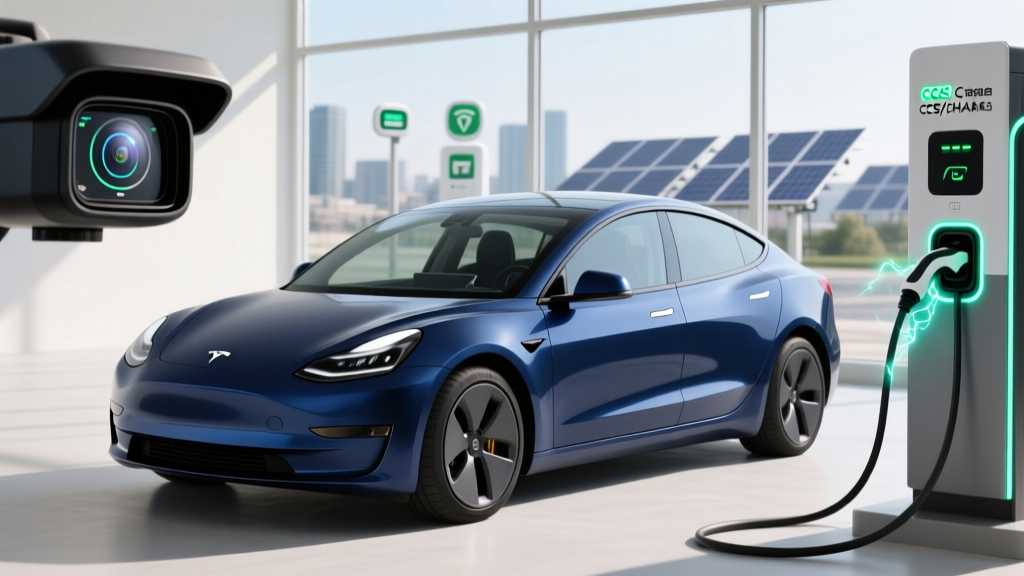
The Model 3 is equipped with Tesla's Hardware 4.0 suite — eight external cameras providing 360-degree coverage around the vehicle. These cameras serve multiple functions: Autopilot/FSD perception, dashcam recording, Sentry Mode surveillance, and driver-facing Tesla camera views accessible from the touchscreen.
Parking and low-speed camera views: When you shift into reverse or tap the camera icon, the touchscreen displays a stitched rear-view feed with dynamic guidelines. Since Tesla removed ultrasonic sensors (Park Assist) in 2022, the car uses vision-based distance estimation — rendering colored proximity overlays on the camera feed. This works well for curbs and large obstacles, but thin posts, trailer hitches, and low walls can occasionally go undetected. Many owners report adapting by relying more heavily on the camera grid and less on the "phantom" proximity warnings.
Dashcam and Sentry Mode: All eight cameras can record simultaneously. Dashcam captures the last 10 minutes of footage on demand or automatically during an incident. Sentry Mode uses the cameras to monitor the car's surroundings while parked, recording clips triggered by proximity or impact. The USB-C port in the glovebox accepts a formatted flash drive for local storage.
Phone livestream and remote access: Through the Tesla app, owners can access live Tesla camera views from the front, rear, and side cameras remotely — useful for checking on a parked car or verifying a delivery. This feature requires Premium Connectivity ($9.99/month) and transmits at reduced resolution to conserve bandwidth.
Interior camera: A cabin-facing camera above the rearview mirror monitors driver attention when Autopilot or FSD (Supervised) is engaged. It does not record footage for owner access but is used by Tesla's driver-monitoring algorithms.
Charging: Supercharger Access and Home Setup
Charging remains one of the Model 3's strongest advantages. Tesla's Supercharger network — now the most reliable DC fast-charging ecosystem in North America — is native to the car. No adapters, no third-party app authentication, no payment fumbling. Plug in and walk away.
| Charging Level | Power | Miles Added per Hour | Notes |
|---|---|---|---|
| Level 1 (120V household) | ~1.4 kW | ~4–5 mi/hr | Emergency/trickle only; not practical for daily use |
| Level 2 (240V home, 48A) | 11.5 kW | ~44 mi/hr | Full charge overnight in ~7–8 hours (Long Range) |
| DC Fast Charge (RWD) | Up to 170 kW peak | ~550 mi/hr (peak) | 10–80% in ~30 min; sustained rate averages ~110 kW |
| DC Fast Charge (LR/Perf) | Up to 250 kW peak | ~1,000 mi/hr (peak) | 10–80% in ~25 min; tapers sharply above 80% SoC |
Charging curve reality check: The 250 kW peak rate on Long Range and Performance trims is achieved only between roughly 10–30% State of Charge. By 60% SoC, the rate drops to ~120 kW. Above 80%, it falls to ~50 kW or less. This is standard lithium-ion behavior — Tesla preconditions the battery when you navigate to a Supercharger, warming it to optimize the curve. Always navigate to a charger via the car's built-in routing to trigger preconditioning; arriving cold can add 10+ minutes to your stop.
NACS compatibility: The Model 3 uses the North American Charging Standard (NACS) connector natively. With Tesla opening its Supercharger network to other EVs via the Magic Dock adapter, the network's value is even more established — but Model 3 owners still enjoy the simplest plug-and-charge experience.
Home charging cost: A Tesla Wall Connector costs $475 (hardware). Professional installation by a licensed electrician typically runs $500–$2,000 depending on panel proximity and whether a 240V/60A circuit already exists. If your electrical panel needs an upgrade to 200A service, add $1,500–$3,000. Total home charging setup: $1,000–$5,500. At $0.16/kWh, a full Long Range charge (75 kWh) costs about $12 at home versus $18–$25 at a public DC fast charger.
Performance and Driving Dynamics
The base RWD Model 3 is no slouch at 5.8 seconds to 60 mph — quicker than most gas-powered compact sedans. But the Long Range AWD's 4.2-second sprint and dual-motor traction make it the sweet spot for most buyers who want all-weather confidence and effortless highway passing. The Performance trim's 2.9-second 0–60 time enters supercar territory, though the ride firmness and 20-inch wheel/tire combo trade comfort for grip.
Regenerative braking on the Model 3 is strong enough for near one-pedal driving in most conditions, though Tesla has softened the maximum regen level slightly compared to pre-2023 models. The heat pump — standard across all trims — significantly improves cold-weather efficiency and cabin warmth compared to resistive heating.
Pricing, Trims, and Federal Tax Credit Eligibility
| Trim | Base MSRP | Federal §30D Credit (max) | Effective Price (est.) |
|---|---|---|---|
| Rear-Wheel Drive | $38,990 | Up to $7,500 | ~$31,490 |
| Long Range AWD | $47,740 | Up to $7,500 | ~$40,240 |
| Performance | $54,990 | Up to $7,500 | ~$47,490 |
Note: Actual credit depends on buyer eligibility. See IRS §30D rules below.
Does the Model 3 qualify for the federal EV tax credit? Yes — all three trims fall under the $55,000 MSRP cap for sedans set by the IRS under §30D. However, the full $7,500 credit requires meeting two sourcing thresholds: critical minerals and battery components. Tesla sources an increasing share of battery materials from North American supply chains, and as of the 2026 tax year, the Model 3 built at the Fremont factory with CATL LFP cells (RWD) or Panasonic NMC cells (Long Range/Performance) has historically qualified for the full credit — but the specific breakdown changes quarterly as sourcing shifts.
Buyer eligibility requirements:
- Income caps: Modified adjusted gross income (MAGI) must not exceed $150,000 (single), $225,000 (head of household), or $300,000 (joint filers).
- MSRP cap: Sedans must have an MSRP at or below $55,000 (the Performance trim at $54,990 squeaks under).
- Point-of-sale transfer: As of 2024, buyers can transfer the credit to the dealer at purchase, receiving the discount upfront rather than waiting to claim it on their tax return. Tesla supports this at checkout.
- Consult a tax professional — eligibility depends on your specific tax situation, and IRS sourcing requirements can shift mid-year.
Interior, Cargo, and Tech Features
The Model 3's cabin is deliberately minimal. A single 15.4-inch touchscreen handles navigation, media, climate, vehicle settings, and Tesla camera views. There is no traditional instrument cluster; speed and range information appear in the upper-left corner of the display. Ventilated front seats, a panoramic glass roof, and ambient lighting come standard on all trims.
Cargo space: 23 cubic feet total (trunk + frunk). The trunk offers 21 cu ft with a wide opening and flat load floor; the front trunk (frunk) provides 2 cu ft — enough for a charging cable bag or small backpack. Rear legroom measures 35.3 inches, adequate for adults on shorter trips but tighter than a Hyundai Ioniq 6 or BMW i4.
Notable tech:
- Autopilot (standard): Lane centering, adaptive cruise, automatic emergency braking. SAE Level 2 — driver must remain engaged.
- Full Self-Driving (Supervised) — $8,000 option or $99/month: Adds automatic lane changes, traffic light/stop sign recognition, and Navigate on Autopilot. Still Level 2, not autonomous. The driver is legally responsible at all times.
- Over-the-air updates: Tesla pushes feature improvements, UI changes, and entertainment additions regularly.
- Gaming and streaming: The touchscreen supports Netflix, YouTube, and Steam-based gaming while parked.
Drawbacks:
- No physical buttons for climate or volume — everything routes through the screen or voice commands.
- Turn signal stalks were removed in the Highland refresh; signals are now on the steering wheel rim — an adjustment period for most drivers.
- Rear visibility through the small backlight is limited; reliance on the camera feed is heavy.
- No Apple CarPlay or Android Auto — Tesla's proprietary system is the only option.
Pros, Cons, and Who Should Buy
Pros
- Class-leading efficiency (26 kWh/100 mi)
- Native Supercharger access — best public charging experience
- Long Range trim offers 363 mi EPA — among the longest of any EV sedan
- Comprehensive Tesla camera views for security, parking, and dashcam
- Strong over-the-air update cadence keeps the car current
- Eligible for full $7,500 federal tax credit (verify sourcing quarterly)
Cons
- Vision-only parking lacks ultrasonic precision for thin obstacles
- No Apple CarPlay/Android Auto
- Turn signals on steering wheel rim require adaptation
- Insurance premiums run 15–30% higher than comparable gas sedans
- Rear seat legroom is tight for taller passengers on long trips
- FSD (Supervised) costs $8,000 and remains a Level 2 driver-assist
Who this EV suits best: The Model 3 RWD is ideal for solo commuters or couples with home charging access who want an efficient, tech-forward daily driver under $35,000 (after credit). The Long Range AWD is the road-trip and all-weather pick — 363 miles of range and dual-motor traction handle mountain passes and Midwest winters. The Performance trim targets driving enthusiasts who want sports-car acceleration with zero tailpipe emissions. Families needing more rear-seat room and cargo should look at the Model Y or Hyundai Ioniq 5.
Frequently Asked Questions
What is the real-world range of the 2026 Tesla Model 3?
The Long Range AWD achieves an EPA-estimated 363 miles, but expect 310–335 miles in real-world highway driving at 70 mph. In freezing temperatures, range drops to roughly 255–285 miles. The base RWD's 272-mile EPA rating translates to about 240–255 miles in mixed driving.
How fast does the Model 3 charge at home and on the road?
At home on a Level 2 Wall Connector (11.5 kW), the Model 3 adds roughly 44 miles of range per hour — a full Long Range charge takes about 7–8 hours. On a Supercharger, the Long Range and Performance trims peak at 250 kW, reaching 10–80% in approximately 25 minutes. The RWD peaks at 170 kW with a 10–80% time of about 30 minutes.
How much does the Model 3 cost after the federal tax credit?
The base RWD starts at $38,990 MSRP. If you qualify for the full $7,500 §30D credit (meeting income caps and battery-sourcing requirements), the effective price drops to approximately $31,490. The Long Range AWD at $47,740 falls to roughly $40,240. Always verify current sourcing eligibility on the IRS website before purchasing.
Is the Tesla Model 3 worth buying vs. competitors like the Ioniq 6 or BMW i4?
The Model 3 wins on charging infrastructure (Supercharger access), efficiency, and software features. The Hyundai Ioniq 6 offers more rear-seat room, physical buttons, and Apple CarPlay. The BMW i4 provides a more traditional luxury interior and driving feel but at a higher price and with less range. If home charging access and road-trip convenience are priorities, the Model 3 remains the strongest overall package.
Does the 2026 Model 3 qualify for the $7,500 federal EV tax credit?
All three trims fall under the $55,000 MSRP cap for sedans. The full credit depends on battery-sourcing requirements (critical minerals and component manufacturing) that the IRS updates quarterly. Historically, the Fremont-built Model 3 has qualified for the full $7,500, but always check the IRS Clean Vehicle Credit page at time of purchase. Buyer income must not exceed $150,000 (single) or $300,000 (joint).
Are Tesla camera views available while driving?
External Tesla camera views are available at low speeds and while parked. The dashcam and Sentry Mode record in the background while driving but the live camera grid is not displayed on-screen above a certain speed for safety reasons. The interior driver-monitoring camera operates whenever Autopilot or FSD (Supervised) is engaged.
What is the battery warranty on the Model 3?
The RWD trim carries an 8-year/100,000-mile battery and drive unit warranty. The Long Range and Performance trims extend that to 8 years/120,000 miles. Tesla warrants that the battery will retain at least 70% of its original capacity during the warranty period. LFP batteries (RWD) generally show slower degradation than NMC and can be charged to 100% daily without concern.