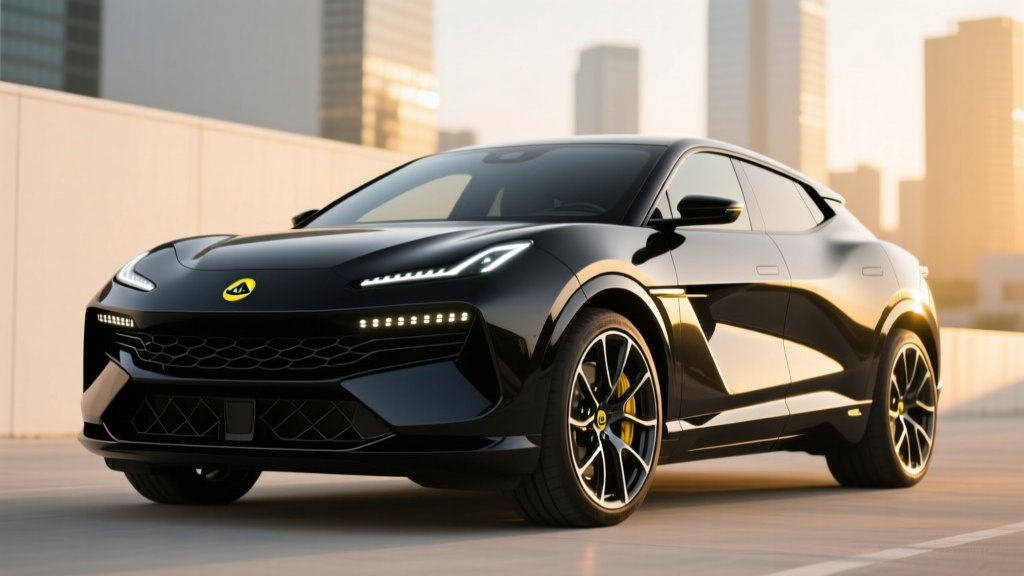
Lotus built its reputation on featherweight, mid-engine sports cars. The 2026 Lotus Eletre is the brand's boldest pivot yet: a full-size, all-electric performance SUV that channels the spirit of Colin Chapman's engineering philosophy into a 5,600-pound luxury machine. As the first widely available electric Lotus car in the U.S. market, the Eletre faces stiff competition from the Porsche Taycan Cross Turismo, BMW iX, and Tesla Model X. We've spent time with the specs, the charging curves, and the ownership math to tell you exactly what you're getting — and where the Eletre falls short.
Quick Verdict: Who Should Buy the Lotus Eletre?
The Eletre is for the buyer who wants Porsche-level build quality and design drama but finds the Cayenne EV (still forthcoming) unavailable and the BMW iX too anonymous on the road. It excels at highway grand touring with a compliant air suspension and a genuinely quick 800V-class charging architecture. It is not for budget-conscious shoppers, families needing three rows, or anyone prioritizing software polish over driving dynamics.
Look elsewhere if: You need third-row seating, maximum cargo volume, the lowest price-per-mile of range, or proven long-term reliability data.
Range, Battery, and Real-World Efficiency
The 2026 Eletre is offered in three trims, all sharing a large lithium-ion battery pack. Lotus uses an NMC (nickel manganese cobalt) chemistry sourced from CATL, prioritizing energy density over the longer cycle life of LFP cells. This is typical for performance-oriented EVs where weight and packaging matter.
| Spec | Eletre (Base) | Eletre S | Eletre R |
|---|---|---|---|
| Battery (usable) | 112 kWh (NMC) | 112 kWh (NMC) | 112 kWh (NMC) |
| EPA Range | 304 mi | 304 mi | 265 mi |
| Drivetrain | AWD (dual-motor) | AWD (dual-motor) | AWD (dual-motor) |
| Horsepower | 603 hp | 603 hp | 905 hp |
| 0-60 mph | 4.5 sec | 4.5 sec | 2.9 sec |
| MPGe (combined) | 87 MPGe | 87 MPGe | 79 MPGe |
| Efficiency | 39 kWh/100mi | 39 kWh/100mi | 43 kWh/100mi |
| Base MSRP | $107,400 | $114,900 | $145,900 |
For comparison, the BMW iX xDrive50 achieves 87 MPGe combined with a slightly smaller battery, while the Tesla Model X Long Range posts 102 MPGe. The Eletre prioritizes power delivery and thermal management headroom over outright efficiency — a trade-off typical of performance EVs.
Charging Speed: 900V Architecture Delivers
Lotus equips the Eletre with a 900-volt electrical architecture — the same voltage class used by the Hyundai Ioniq 5 and Porsche Taycan — enabling fast DC charging with lower current and reduced heat buildup. Here's what the charging profile looks like across levels:
| Charging Level | Max Rate | Speed / Time |
|---|---|---|
| Level 1 (120V household) | ~1.4 kW | ~3-4 mi/hr |
| Level 2 (240V home/public) | 22 kW (onboard charger) | ~60-70 mi/hr; 0-100% in ~6 hr |
| DC Fast Charge | 350 kW (peak) | 10-80% in ~20 min |
Charging curve reality check: The 350 kW peak is achievable only on compatible 350+ kW chargers (such as Electrify America's newest stalls or Ionity in Europe) and only at low states of charge — roughly 10-30% SoC. Above 50%, the curve tapers significantly, dropping to around 150 kW, and above 80% it slows further to protect the NMC cells. Plan your road-trip stops around 10-80% sessions for the best time efficiency; charging to 100% on DC will add 15-20 minutes for minimal range gain.
The 22 kW onboard AC charger is a standout feature. Most competitors offer 11.5 kW (the BMW iX) or 19.2 kW (the Ford F-150 Lightning). At a 48-amp Level 2 home charger, the Eletre can accept the full 11.5 kW, but at a higher-amperage wallbox or public Level 2 station delivering 80+ amps, it can pull up to 22 kW — cutting a full charge from 10+ hours to about 6. This matters for owners who can install an 80-100 amp circuit at home.
The Eletre ships with a NACS (North American Charging Standard) port for the U.S. market, granting native access to the Tesla Supercharger network as well as all CCS-equipped stations via the industry-wide connector transition.
Performance and Driving Dynamics
Every Eletre variant uses a dual-motor all-wheel-drive layout. The base and S trims produce 603 horsepower with a 4.5-second 0-60 time — brisk but not shocking in a segment where the Tesla Model X Plaid hits 60 in 2.5 seconds. The Eletre R, however, cranks output to 905 hp and drops the 0-60 time to 2.9 seconds, placing it firmly in hypercar-SUV territory alongside the Lamborghini Urus and Aston Martin DBX707.
Where the Eletre differentiates itself is in chassis tuning. The standard adaptive air suspension with continuous damping control provides a ride quality that reviewers consistently describe as more compliant and communicative than the BMW iX. Lotus engineers tuned the Eletre with a rear-biased torque split under acceleration and a torque-vectoring rear axle on the R trim, giving it a playful character unusual for a 5,600-pound SUV. The steering is quick and well-weighted, though the sheer mass is always present during hard direction changes.
Regenerative braking offers adjustable levels, but the Eletre does not provide true one-pedal driving to a full stop — you'll still need the friction brakes at low speeds. The blended braking feel is natural, without the abrupt transition some EVs exhibit when blending regen and friction brakes.
Interior, Cargo, and Technology
The cabin seats five passengers across two rows. Front-seat comfort is excellent with standard 12-way power adjustment and available Nappa leather with a wool-blend textile option. Rear legroom measures approximately 39.0 inches — competitive with the BMW iX (38.9 in) and noticeably more generous than the Porsche Taycan Cross Turismo's rear quarters.
Cargo volume behind the rear seats is approximately 21.4 cubic feet, expanding to roughly 54 cubic feet with the rear seats folded. There is a small front trunk (frunk) adding approximately 2.7 cubic feet — enough for charging cables and a small bag. Total cargo capacity trails the BMW iX (35.5 / 77.9 cu ft) and the Tesla Model X significantly, making the Eletre less practical for bulk hauling.
The infotainment system runs on a 15.1-inch OLED center display powered by Unreal Engine — the same rendering technology used in video games. The interface is visually striking but has drawn criticism for menu depth and occasional latency. A slim 12.6-inch instrument cluster sits behind the steering wheel, and an available 29-inch AR-HUD (augmented reality head-up display) projects navigation and speed onto the windshield.
Driver assistance comes via Lotus's ADAS suite, which includes adaptive cruise control with stop-and-go, lane centering, blind-spot monitoring, and automated parking. This is an SAE Level 2 system — meaning the driver must remain fully engaged with hands on the wheel and eyes on the road at all times. It is not autonomous driving. The system performs competently on highways but does not match the hands-free capability of GM's Super Cruise or Ford's BlueCruise on mapped roads.
Pricing, Trims, and Federal Tax Credit Eligibility
The 2026 Eletre starts at $107,400 for the base trim, climbs to $114,900 for the S, and reaches $145,900 for the range-topping R. Options packages — including the Nappa leather upgrade, KEF Reference audio system (2,160 watts, 23 speakers), and carbon-fiber exterior trim — can push an Eletre S past $130,000.
| Trim | Base MSRP | §30D Credit Eligible? | Effective Price (if eligible) |
|---|---|---|---|
| Eletre (Base) | $107,400 | No (over $80,000 SUV cap) | $107,400 |
| Eletre S | $114,900 | No (over $80,000 SUV cap) | $114,900 |
| Eletre R | $145,900 | No (over $80,000 SUV cap) | $145,900 |
Federal tax credit reality: Under current IRS §30D rules, the clean vehicle credit provides up to $7,500 — but only for SUVs with an MSRP at or below $80,000. Every Eletre trim exceeds this cap, making no variant eligible for the federal EV tax credit. Additionally, §30D imposes buyer income limits ($300,000 joint / $150,000 single for modified AGI) and strict battery-critical-mineral and component sourcing requirements. Even if Lotus introduced a lower-priced trim, the CATL-sourced battery cells would likely fail the foreign-entity-of-concern (FEOC) restrictions currently in effect. Budget accordingly — the price you see is the price you pay.
Some states offer their own rebates or incentives that may apply regardless of MSRP caps. Check your state's energy or DMV website for current programs, and consult a tax professional for personal eligibility.
Warranty and Ownership Costs
Lotus provides a competitive warranty package for the Eletre:
- Basic vehicle warranty: 4 years / 50,000 miles
- Battery & powertrain warranty: 8 years / 100,000 miles (with a minimum 70% capacity retention threshold)
- Corrosion warranty: 12 years, unlimited miles
- Roadside assistance: 4 years / unlimited miles
The 8-year/100,000-mile battery warranty is the industry standard, matching BMW, Porsche, and most legacy automakers. The 70% capacity retention floor means Lotus will repair or replace the battery if it degrades below 78.4 kWh of usable capacity within the warranty period. For a large 112-kWh NMC pack with active liquid thermal management, hitting that threshold within 100,000 miles would be unusual under normal use.
Insurance costs are a real consideration. As a low-volume, high-performance luxury EV with carbon-fiber and aluminum construction, expect annual premiums in the $3,500-$5,000+ range depending on your profile — significantly more than a Tesla Model X or BMW iX. Get quotes before ordering.
Long-term reliability data is limited. The Eletre is Lotus's first mass-market EV and the brand's first vehicle built at its new Wuhan, China production facility (a Geely-owned plant). Early build quality reports have been generally positive, but Lotus lacks the multi-year reliability track record that Porsche or BMW can offer. Factor this into your risk assessment.
Pros and Cons
✓ Pros
- 900V architecture enables 350 kW peak DC charging — 10-80% in ~20 minutes
- 22 kW onboard AC charger is best-in-class for home charging speed
- Air suspension delivers a refined, adaptive ride quality
- Eletre R's 905 hp / 2.9-second 0-60 rivals supercar SUVs at a lower price
- Distinctive design — nothing else on the road looks like it
- NACS port provides native Tesla Supercharger access
✗ Cons
- No federal tax credit eligibility — MSRP exceeds the $80,000 SUV cap
- Efficiency trails rivals (79-87 MPGe vs Model X's 102 MPGe)
- Cargo volume (21.4 cu ft) is modest for the class
- Infotainment system can feel laggy with deep menu structures
- No hands-free driving capability (Level 2 only, no mapped-road exemption)
- Limited dealer/service network — few Lotus locations in the U.S.
- No long-term reliability data as Lotus's first EV
How the Eletre Compares to Key Rivals
| Attribute | Lotus Eletre S | BMW iX xDrive50 | Tesla Model X LR |
|---|---|---|---|
| Base MSRP | $114,900 | $92,000 | $81,630 |
| EPA Range | 304 mi | 307 mi | 335 mi |
| 0-60 mph | 4.5 sec | 4.4 sec | 3.8 sec |
| Peak DC Charge | 350 kW | 200 kW | 250 kW |
| Cargo (behind 2nd row) | 21.4 cu ft | 35.5 cu ft | ~37 cu ft* |
| Federal Tax Credit | Not eligible | Not eligible | Not eligible |
*Model X cargo volume varies by configuration (5-seat vs 6/7-seat).
The Eletre wins on charging speed and design exclusivity. The iX wins on cargo practicality, interior tech maturity, and dealer support. The Model X wins on range, efficiency, Supercharger network access (though the Eletre now has NACS), and available third-row seating. None of these vehicles qualify for the federal credit at current MSRP levels.
Frequently Asked Questions
What is the real-world range of the Lotus Eletre?
The EPA rates the Eletre base/S at 304 miles and the R at 265 miles. In real-world highway driving at 70+ mph, expect 250-270 miles from the base/S and 215-230 from the R. Cold weather (below freezing) can reduce these figures by 20-30%. For daily commuting with home charging, range is a non-issue; for road trips, plan stops every 200-220 miles to stay comfortable.
How fast does the Eletre charge at home and on the road?
On DC fast chargers, the Eletre peaks at 350 kW and can go from 10-80% in approximately 20 minutes at a compatible station. At home on a Level 2 charger, the 22 kW onboard charger (with a sufficiently powerful wallbox) can fully replenish the 112 kWh battery in about 6 hours. On a standard 48-amp Level 2 setup (11.5 kW), expect roughly 11 hours for a full charge — still overnight-friendly.
Does the Lotus Eletre qualify for the federal EV tax credit?
No. Under current IRS §30D rules, SUVs must have an MSRP at or below $80,000 to qualify. Every Eletre trim starts well above that threshold. Additionally, the battery's critical-mineral sourcing from CATL (a Chinese manufacturer) would likely trigger the FEOC disqualification even at a lower price point. Consult a tax professional for your specific situation, and check your state for any local incentives.
Is the Lotus Eletre worth buying over a BMW iX or Porsche Taycan Cross Turismo?
It depends on your priorities. If you value exclusivity, the fastest charging in the segment, and a genuinely sporty chassis tune, the Eletre delivers something neither the iX nor the Taycan Cross Turismo can match. If you prioritize cargo space, proven reliability, or a mature service network, the BMW iX is the safer bet. If you want Porsche badge prestige and a wagon form factor, the Taycan Cross Turismo is compelling but offers less range and slower DC charging.
Where can I get a Lotus Eletre serviced?
Lotus has a limited but growing U.S. dealer network, with roughly 20-25 locations as of early 2026 — concentrated in major metro areas (New York, Los Angeles, Miami, San Francisco, Chicago, Dallas). If you don't live near a Lotus dealer, factor in the logistics of service visits. Lotus also offers a mobile service program for minor repairs and recalls in select markets.
How long will the Eletre's battery last?
Lotus warranties the battery for 8 years or 100,000 miles against degradation below 70% of original capacity. NMC chemistry with active liquid thermal management typically loses 1-2% capacity per year under normal use. At that rate, you'd retain roughly 85-90% capacity after 100,000 miles — well above the warranty threshold. Avoid frequent DC fast charging to 100% and habitual deep discharges to maximize longevity.