Quick Verdict: The Benchmark Sedan Still Sets the Pace
The Tesla Model 3 remains the default answer for buyers entering the EV market — and for good reason. With up to 363 miles of EPA-estimated range in Long Range AWD trim, access to the industry's most reliable Supercharger network, and a starting price that undercuts most competitors, the Model 3 is the vehicle against which every new electric sedan is measured. But the headline feature for many shoppers is Tesla Autosteer, the lane-centering driver-assistance system bundled with basic Autopilot. It's effective, frequently updated, and often misunderstood. This review breaks down what Autosteer actually does, what it doesn't, and whether the 2026 Model 3 earns your garage space.
| Spec | RWD (Base) | Long Range AWD | Performance |
|---|---|---|---|
| EPA Range | 363 mi | 341 mi | 315 mi |
| Battery (usable) | ~60 kWh (LFP) | ~75 kWh (NMC) | ~75 kWh (NMC) |
| Drivetrain | Rear-Wheel Drive | Dual-Motor AWD | Dual-Motor AWD |
| Horsepower | 271 hp | 346 hp | 510 hp |
| 0–60 mph | 5.8 sec | 4.2 sec | 2.9 sec |
| Max DC Fast Charge | 170 kW | 250 kW | 250 kW |
| 10–80% DC Time | ~25 min | ~25 min | ~25 min |
| Level 2 Home Charge | 11.5 kW (~44 mi/hr) | 11.5 kW (~44 mi/hr) | 11.5 kW (~44 mi/hr) |
| MPGe (combined) | 142 MPGe | 130 MPGe | 121 MPGe |
| Efficiency | 24 kWh/100 mi | 26 kWh/100 mi | 28 kWh/100 mi |
| Base MSRP | $38,990 | $45,490 | $52,990 |
| Battery Warranty | 8 yr / 100,000 mi | 8 yr / 120,000 mi | 8 yr / 120,000 mi |
Real-World Range: What the EPA Sticker Doesn't Tell You
The EPA publishes one number; real roads deliver another. The 2026 Model 3 Long Range AWD carries a 341-mile EPA estimate, but sustained highway driving at 75 mph typically yields 280–305 miles depending on temperature and elevation. The RWD trim's 363-mile EPA figure benefits from its lighter curb weight and LFP battery's tolerance for regular 100% charges — something Tesla explicitly recommends for LFP chemistry.
- City/commute (Long Range AWD): 320–340 mi — regenerative braking recovers energy in stop-and-go traffic.
- Highway 75 mph (Long Range AWD): 280–305 mi — aerodynamic drag dominates above 65 mph.
- Cold weather (below 32°F, Long Range AWD): 240–275 mi — expect 15–25% range loss from cabin heating and reduced battery efficiency. Preconditioning while plugged in mitigates this significantly.
- RWD in cold weather: 280–310 mi — LFP chemistry is slightly more cold-resilient than NMC, and the heat pump is standard across all trims.
If your daily commute is under 60 miles round-trip, even the cold-weather worst case leaves a comfortable buffer. Road-trippers should plan charging stops around 220–240 miles apart in winter to avoid range stress.
Charging Speed: Supercharger Network and Home Setup
Tesla's charging ecosystem remains its strongest competitive advantage. The Supercharger network now exceeds 6,000 U.S. stations, and with NACS adoption by Ford, GM, Rivian, and others, congestion at popular corridors is a growing consideration — though Tesla has been adding stalls proactively.
| Charging Level | Power / Rate | Miles Added per Hour | Notes |
|---|---|---|---|
| Level 1 (120V household) | ~1.4 kW | ~5 mi/hr | Emergency/trickle only |
| Level 2 (240V home, Wall Connector) | 11.5 kW | ~44 mi/hr | Full overnight charge in 7–8 hours |
| DC Fast Charge (RWD) | Peak 170 kW | ~650 mi/hr at peak | 10–80% in ~25 min; tapers above 80% |
| DC Fast Charge (LR/Perf) | Peak 250 kW | ~900 mi/hr at peak | 10–80% in ~25 min; precondition battery via nav |
Charge-curve reality check: The 250 kW peak on Long Range and Performance trims holds only between roughly 10–30% state of charge. From 50–80%, expect sustained rates closer to 80–120 kW. This is why Tesla's 10–80% time of ~25 minutes is the meaningful metric — and why preconditioning the battery by navigating to a Supercharger is essential. Arriving at a charger without preconditioning in cold weather can double your charge time.
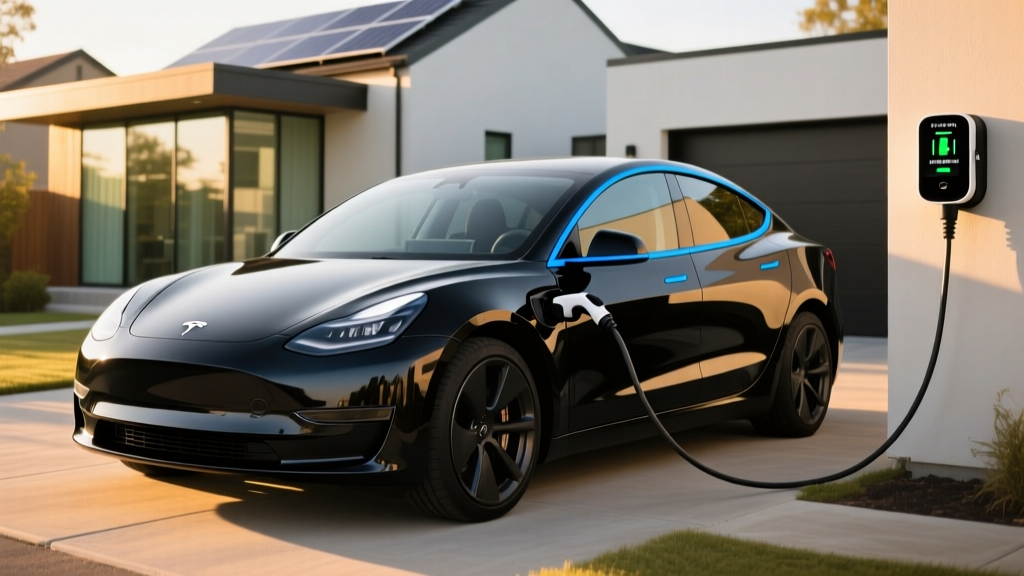
For home charging, Tesla's Wall Connector ($475) on a 60-amp circuit delivers the full 11.5 kW (48 amps continuous). Most owners with a daily commute under 50 miles will replenish their battery overnight without issue. Installation costs vary: expect $800–$2,000 if your electrical panel has capacity, or $2,500–$4,500 if a panel upgrade to 200A is required. Always get a quote from a licensed electrician before committing.
Tesla Autosteer: What It Actually Does (and Doesn't)
"Tesla Autosteer" is the lane-centering component of Tesla's standard Autopilot suite. It is not autonomous driving. It is an SAE Level 2 driver-assistance system, meaning you must remain fully engaged — hands on the wheel (or applying sufficient torque), eyes on the road — at all times.
Tesla Autosteer provides combined longitudinal (speed/distance) and lateral (steering) assistance. The driver is the system. Autosteer handles highway lane-keeping and adaptive cruise competently, but it cannot navigate construction zones, respond to traffic control officers, or handle unmapped roads reliably. Full Self-Driving (Supervised) — the $8,000 add-on — extends capabilities to city streets and stop-light recognition but remains Level 2 and requires active supervision.
What Autosteer does well:
- Maintains lane centering on well-marked highways with smooth, confident steering inputs
- Adaptive cruise control modulates speed naturally in traffic, with adjustable following distance
- Handles gentle curves (interstate-radius) without disengaging
- Visual and auditory alerts prompt steering-wheel torque confirmation at regular intervals
- Over-the-air updates periodically refine behavior — the system you buy today will improve incrementally
Where Autosteer falls short:
- Lane markings that fade, merge unexpectedly, or are obscured by snow/water cause disengagement or erratic corrections
- Construction zones with shifted lanes or temporary barriers require immediate driver takeover
- Phantom braking — sudden deceleration when the system misidentifies shadows, overpasses, or roadside objects — remains an intermittent issue reported by owners and investigated by NHTSA
- Rain, fog, and direct sun glare can degrade camera-based perception (Tesla uses a vision-only system; no radar or lidar)
- The steering-wheel torque sensor can be finicky — some drivers find the required input force unintuitive
Tesla Autosteer and FSD (Supervised) are Level 2 systems. You are legally and physically responsible for the vehicle at all times. NHTSA has issued multiple recalls and investigations related to Tesla's driver-monitoring and Autopilot behavior. Never use Autosteer while fatigued, distracted, or impaired. Review NHTSA's Tesla Autopilot resource page for current safety data.
Is Autosteer worth it? As a standard feature, absolutely — it reduces highway fatigue on long drives and daily commutes. The $8,000 FSD (Supervised) upgrade is a harder sell. It adds traffic-light and stop-sign recognition, city-street autosteer, and auto lane-change on highways, but the experience remains inconsistent in complex urban environments. For most buyers, standard Autosteer delivers 80% of the benefit at no additional cost.
Interior, Tech, and Cargo: Minimalist by Design
The 2026 Model 3 "Highland" refresh (introduced for the 2024 model year and carried forward) brought meaningful refinements: ventilated front seats, ambient lighting, rear-seat touchscreen, acoustic glass for a noticeably quieter cabin, and a redesigned center console. The absence of physical stalks (turn signals and gear selection are now on the steering wheel and touchscreen, respectively) remains divisive — some owners adapt within a week, others find it a persistent annoyance.
Passenger and cargo dimensions:
- Front legroom: 42.2 inches
- Rear legroom: 35.2 inches — adequate for adults under 6 feet; taller passengers will find it snug on long trips
- Cargo volume (rear trunk): 21.0 cu ft
- Frunk (front trunk): 3.1 cu ft — useful for charging cables and small bags
- Total cargo: 24.1 cu ft — competitive with the Hyundai Ioniq 6 (11.2 cu ft trunk) but trails the BMW i4 (16.6 cu ft trunk + hatchback utility)
The 15.4-inch center touchscreen handles infotainment, climate, navigation, and vehicle settings. Response time is excellent. Wireless phone charging, USB-C ports (front and rear), and a premium 17-speaker audio system are standard. Apple CarPlay and Android Auto remain unavailable — Tesla's native system is capable but locks you into their ecosystem.
Pricing, Tax Credits, and Total Cost
| Trim | Base MSRP | Est. Federal Credit (§30D) | Effective Price |
|---|---|---|---|
| RWD | $38,990 | Up to $7,500* | ~$31,490* |
| Long Range AWD | $45,490 | Up to $7,500* | ~$37,990* |
| Performance | $52,990 | Up to $7,500* | ~$45,490* |
*Federal tax credit eligibility under IRS §30D depends on buyer income limits (AGI ≤ $150K single / $300K joint), vehicle MSRP caps ($55,000 for sedans), battery critical-mineral sourcing, and North American final assembly. The Model 3 is assembled in Fremont, CA. Credit can be transferred to the dealer at point of sale for an immediate price reduction. Verify current-year eligibility with a tax professional before purchasing — sourcing rules have tightened annually.
All three trims fall under the $55,000 MSRP cap for sedans. The Performance trim at $52,990 clears the cap but adding FSD ($8,000) or premium paint/wheels pushes the as-tested price above $60,000 — though the MSRP cap applies to base MSRP plus destination, not options. Income caps are the more common disqualifier: single filers with AGI above $150,000 and joint filers above $300,000 are ineligible.
5-year ownership cost perspective: At $0.13/kWh (national average residential electricity rate), fully charging a Long Range Model 3 at home costs roughly $9.75. That's approximately $0.035 per mile. A comparable gas sedan at 30 MPG and $3.50/gallon costs $0.117 per mile — more than three times as much. Over 15,000 miles/year, that's roughly $1,230 in annual electricity vs. $1,750 in fuel. Insurance premiums for the Model 3 tend to run 15–25% higher than equivalent gas sedans, partially offsetting fuel savings. Obtain insurance quotes before purchasing.
Model 3 vs. Key Competitors: Where It Wins and Loses
The electric sedan segment has matured. Here's how the Model 3 Long Range AWD stacks up against its most direct rivals:
| Attribute | Tesla Model 3 LR AWD | Hyundai Ioniq 6 SEL AWD | BMW i4 xDrive40 |
|---|---|---|---|
| EPA Range | 341 mi | 316 mi | 285 mi |
| Base MSRP | $45,490 | $46,700 | $57,995 |
| Max DC Charge | 250 kW | 350 kW (800V) | 205 kW |
| 10–80% DC Time | ~25 min | ~18 min | ~31 min |
| Driver Assist | Autosteer (L2) | HDA 2 (L2) | Driving Asst. Pro (L2) |
| Charging Network | Supercharger (native) | CCS → NACS adapter req. | CCS → NACS adapter req. |
| Infotainment | Tesla native (no CarPlay) | Wireless CarPlay/Android Auto | iDrive 8.5 + CarPlay |
Pros, Cons, and Who Should Buy the Model 3
- Class-leading EPA range and efficiency (363 mi RWD / 341 mi LR)
- Access to Tesla Supercharger network — the most reliable and expansive DC fast-charging system in the U.S.
- Standard Autosteer is one of the most capable Level 2 highway assistants available at no extra cost
- Over-the-air updates continuously add features and refine performance
- Low operating cost: ~$0.035/mile on home charging
- Strong resale value relative to most EVs
- Heat pump standard on all trims (better cold-weather range retention)
- No Apple CarPlay or Android Auto — Tesla-only infotainment ecosystem
- Removed turn-signal stalks and gear selector require adaptation
- Rear seat legroom (35.2 in) is tighter than the Hyundai Ioniq 6 and some competitors
- Phantom braking events on Autopilot remain a documented concern
- Insurance premiums 15–25% higher than comparable gas sedans
- FSD (Supervised) at $8,000 is expensive for a system that still requires full driver attention
- Build quality, while improved, can show panel-gap inconsistencies vs. German and Korean rivals
- Choose the RWD ($38,990) if: You commute under 60 miles daily, charge at home, want the lowest entry price, and don't need AWD. The LFP battery tolerates daily 100% charges, maximizing usable range.
- Choose the Long Range AWD ($45,490) if: You take regular road trips, live in a cold-weather climate (AWD + NMC range buffer), or want the 250 kW peak charging rate for faster DC stops.
- Choose the Performance ($52,990) if: You want 2.9-second 0–60 sprints, track-capable handling, and don't mind sacrificing ~26 miles of range for the privilege.
- Look elsewhere if: You need CarPlay/Android Auto, prioritize rear-seat space for adults, prefer traditional luxury materials (BMW i4), or need the fastest possible DC charging (Hyundai Ioniq 6's 800V system).
Frequently Asked Questions
What is the real-world range of the 2026 Tesla Model 3?
The EPA estimates 363 miles for the RWD, 341 for Long Range AWD, and 315 for Performance. In real-world highway driving at 75 mph, expect 280–310 miles (LR AWD). In cold weather below freezing, plan for 240–275 miles. City driving with regenerative braking gets closer to the EPA sticker.
How fast does the Model 3 charge at home and on the road?
At home on a Level 2 Wall Connector (11.5 kW), you add roughly 44 miles of range per hour — a full charge takes 7–8 hours overnight. On a Tesla Supercharger, Long Range and Performance trims peak at 250 kW and charge from 10–80% in approximately 25 minutes. The RWD peaks at 170 kW with a similar 10–80% time due to its smaller battery. Always precondition via navigation for optimal charge speed.
How much does the Model 3 cost after the federal tax credit?
If you qualify for the full $7,500 §30D credit (income under caps, proper sourcing), the RWD drops to approximately $31,490, the Long Range to ~$37,990, and the Performance to ~$45,490. The credit can be applied at point of sale as an immediate discount. Eligibility depends on AGI limits ($150K single / $300K joint), the $55,000 sedan MSRP cap, and battery mineral sourcing requirements that tighten annually. Consult a tax professional and verify on IRS.gov.
Is Tesla Autosteer safe, and is it self-driving?
Autosteer is an SAE Level 2 driver-assistance system — it is not self-driving. You must keep your hands on the wheel and eyes on the road at all times. It performs well on well-marked highways, reducing fatigue on long drives. However, phantom braking, construction-zone limitations, and reduced performance in poor weather are documented concerns. NHTSA has conducted multiple investigations into Autopilot-related incidents. Use it as an assist, not a replacement for attentive driving.
Is the 2026 Model 3 worth buying over competitors?
For most buyers seeking an electric sedan, yes — the Model 3 offers the best combination of range, efficiency, charging infrastructure access, and price in its class. The Hyundai Ioniq 6 charges faster (350 kW, 800V) and offers CarPlay; the BMW i4 delivers superior interior quality. But the Model 3's Supercharger access, OTA updates, and proven reliability make it the safest bet for first-time EV buyers and road-trippers alike.
Does the Model 3 battery last? What does replacement cost?
Tesla warranties the battery for 8 years / 100,000 miles (RWD) or 8 years / 120,000 miles (LR/Performance), guaranteeing at least 70% capacity retention. Real-world degradation data from high-mileage owners shows most Model 3 batteries retain 85–92% capacity at 100,000 miles. Full battery replacement outside warranty currently costs approximately $12,000–$16,000 depending on trim, though this is expected to decline as battery manufacturing scales.