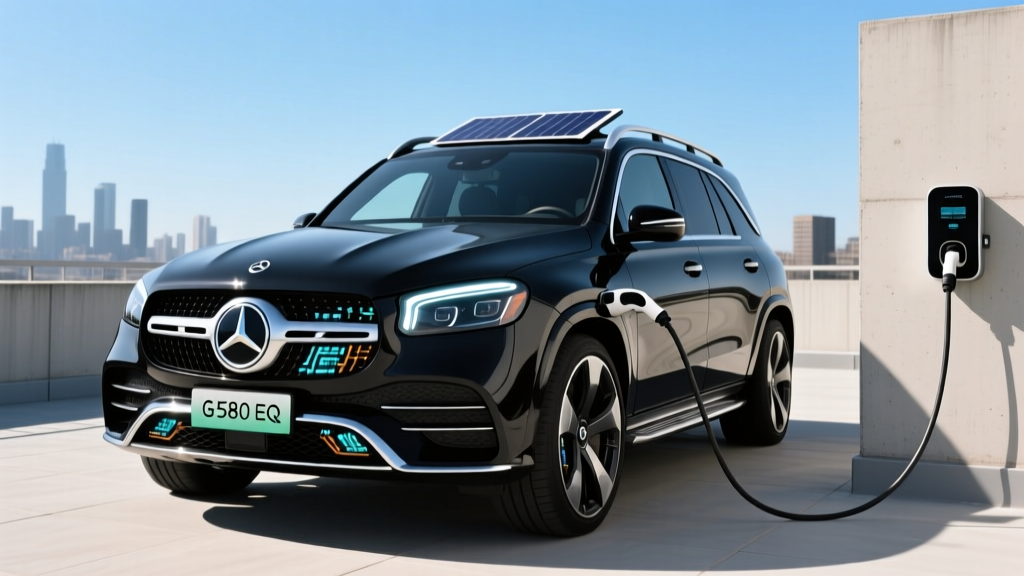
The Mercedes-Benz G580 EQ Technology — known colloquially as the electric G Wagon — is one of the most polarizing EVs on the market. It takes an iconic, gas-guzzling off-road legend and stuffs four electric motors and a 116 kWh battery pack into a body that hasn't changed much since 1979. If you're researching an electric G Wagon lease, you've probably already noticed the sticker shock: the 2026 G580 starts at $161,500 MSRP. But the real question isn't the purchase price — it's what this EV actually costs to own, charge, insure, and (eventually) resell over five years.
This breakdown cuts through the marketing and gives you the exact numbers: total cost of ownership, federal tax credit eligibility, fuel and maintenance savings, insurance reality, and depreciation trends. We'll also address whether leasing might be the smarter financial move for a vehicle at this price point.
2026 Mercedes G580 EQ Technology: Quick Specs
| Specification | 2026 G580 EQ Technology |
|---|---|
| EPA Range (est.) | ~240 miles (real-world highway/cold: ~190-210 mi) |
| Battery Capacity | 116 kWh usable, NMC chemistry |
| Peak DC Fast Charge | 200 kW (10-80% in ~32 min) |
| Level 2 AC Charging | 11 kW (adds ~25 mi/hr) |
| Powertrain | Quad-motor AWD, 579 hp, 859 lb-ft |
| 0-60 mph | 4.6 seconds |
| MPGe (combined, est.) | ~58 MPGe / 58 kWh/100mi |
| Base MSRP | $161,500 |
| Battery Warranty | 8 years / 100,000 miles |
| Connector | CCS1 (NACS adapter available) |
Federal Tax Credit: Does the G580 Qualify Under §30D?
This is where many luxury EV buyers get a rude awakening. The IRS §30D clean vehicle credit offers up to $7,500 — but the G580 faces multiple disqualifying hurdles under current 2026 rules:
- MSRP Cap: SUVs/vans/pickups must be ≤ $80,000. The G580 at $161,500 exceeds this cap and does NOT qualify for the new-vehicle §30D credit.
- Buyer Income Limits: AGI ≤ $300,000 (married filing jointly), $225,000 (head of household), $150,000 (single). Many G580 buyers may also exceed these thresholds.
- Battery Sourcing: Critical minerals and battery components must meet phased-in domestic/FSA-country sourcing percentages. Mercedes has made progress here, but the MSRP cap is the disqualifier.
- Point-of-Sale Transfer: Eligible buyers can transfer the credit to the dealer for an upfront price reduction — but only if the vehicle and buyer both qualify.
- Commercial/Lease Loophole (§45W): Leased EVs are classified as commercial vehicles under §45W, which has no MSRP cap, no income cap, and no battery sourcing requirements. The leasing company receives the $7,500 credit and may pass it through as a lease incentive. This is the primary path for G580 lessees to access federal incentives.
Bottom line: If you buy a G580 outright, you will not receive the §30D credit. If you lease, the lessor (Mercedes-Benz Financial Services or a third party) receives the §45W commercial credit and can factor it into your lease terms. Always confirm the lease offer explicitly reflects any pass-through incentive — it is not automatic.
5-Year Total Cost of Ownership: G580 Electric vs. G550 Gas
To put the electric G Wagon lease in context, let's compare it against the closest gas equivalent: the 2026 Mercedes-Benz G550 (4.0L twin-turbo V8, ~17 MPG combined, ~$148,000 MSRP). Both are luxury off-roaders; the economics diverge sharply after purchase.
| Cost Category (5 yr / 60,000 mi) | G580 EQ Technology (EV) | G550 (Gas V8) |
|---|---|---|
| Purchase / Lease Base Price | $161,500 | $148,000 |
| Estimated Lease Incentive (§45W pass-through) | -$7,500 (if applied) | $0 |
| Fuel / Charging (60k mi) | $5,940 (see breakdown below) | $13,230 |
| Maintenance | $2,800 | $7,200 |
| Insurance (5 yr avg) | $28,500 | $22,000 |
| Estimated Depreciation | $72,000 (45%) | $52,000 (35%) |
| 5-Year Total | ~$191,240 | ~$190,430 |
The totals are remarkably close — but the composition tells the real story. The G580 saves heavily on fuel and maintenance but loses more ground on depreciation and insurance. Let's unpack each line item.
Charging vs. Gas: The Per-Mile Cost Reality
| Scenario | G580 (EV) | G550 (Gas) |
|---|---|---|
| Energy Source Assumption | 80% home L2 @ $0.14/kWh, 20% public DC @ $0.48/kWh | Premium 93 octane @ $4.20/gal avg |
| Efficiency | 58 kWh/100mi (real-world adjusted) | 17 MPG combined |
| Cost Per Mile | $0.099/mi | $0.247/mi |
| 60,000-Mile Total | $5,940 | $13,230 |
| 5-Year Savings | $7,290 saved charging vs. gas | |
Assumptions: Home electricity at national average $0.14/kWh (EIA data); public DC fast charging at $0.48/kWh ( Electrify America/Ionity standard rates). Gas prices per fueleconomy.gov and AAA weekly averages. Actual costs vary by region and utility rate plan.
The G580's poor efficiency (58 kWh/100mi is terrible by EV standards — a Tesla Model Y uses ~27 kWh/100mi) is offset by electricity's low per-unit cost. Home charging is where the economics work. If you rely exclusively on public DC fast charging, your cost-per-mile jumps to ~$0.278/mi — actually more expensive than the gas G550. Home Level 2 charging is essentially mandatory for this vehicle to make financial sense.
Maintenance Savings: Where the Electric G Wagon Wins
| Maintenance Item | G580 EQ (EV) | G550 (Gas V8) |
|---|---|---|
| Oil Changes (every 10k mi) | $0 | $1,800 (6 × $300 synthetic) |
| Brake Pad Replacement | $0-$400 (regen preserves pads; 100k+ mi life typical) | $2,400 (2 sets × $1,200) |
| Transmission Service | $0 (single-speed reduction gear) | $600 |
| Coolant / Fluid Flushes | $400 (battery thermal loop) | $800 |
| Cabin Air Filter / Wipers / Tires | $2,000 (tires wear faster on heavy EVs) | $1,600 |
| 5-Year Total | ~$2,800 | ~$7,200 |
The quad-motor G580 eliminates the V8's oil, spark plugs, timing chain, multi-speed transmission, and exhaust system. Regenerative braking handles most deceleration, dramatically extending pad and rotor life. However, the G580's 5,800-lb weight and instant torque chew through tires faster than the gas model — budget for a set of high-performance SUV tires ($1,200-$1,600) every 25,000-30,000 miles. Net maintenance savings over five years: approximately $4,400.
Insurance: The Uncomfortable EV Premium
EV insurance costs are typically 15-30% higher than comparable gas vehicles, and the G580 is no exception. Expect annual premiums of $5,200-$6,200 depending on your state, driving record, and coverage level. Over five years, that's roughly $28,500 vs. $22,000 for the G550 — a $6,500 gap.
Why the premium? Several factors converge:
- Higher repair costs: Battery pack damage from collision or underbody impact can total the vehicle. The 116 kWh NMC pack replacement is estimated at $30,000-$40,000 out of warranty.
- Specialized labor: High-voltage system repairs require certified EV technicians, and Mercedes-certified shops are limited in many markets.
- Parts cost: Quad-motor assemblies, specialized suspension components, and Mercedes body panels carry premium pricing.
- Total-loss frequency: Insurers are more likely to declare an EV a total loss after moderate damage due to battery safety protocols.
Tip: Shop quotes from EV-friendly insurers (Geico, Progressive, and Hagerty have competitive luxury EV programs). Some states offer insurance discounts for vehicles with advanced ADAS — the G580 includes Mercedes' latest Driver Assistance Package.
Depreciation and Resale Value: The Luxury EV Wildcard
This is the G580's biggest financial risk. Luxury EVs have experienced steeper depreciation than gas counterparts over the past three years, driven by:
- Rapid tech obsolescence: Battery energy density, charging speeds, and efficiency improve yearly. A 2026 G580 with 240 miles of range may feel dated by 2031.
- Price wars: Tesla, Rivian, and Chinese OEMs have compressed EV pricing industry-wide, dragging down used values for legacy-brand EVs.
- Battery health uncertainty: Second buyers discount heavily for out-of-warranty battery risk, even though the G580's 8-year/100,000-mile battery warranty provides coverage.
- Luxury segment depreciation: All high-end Mercedes products depreciate steeply. The gas G-Class has historically been an outlier, holding value exceptionally well due to collector demand and limited supply. The electric version lacks that heritage premium — at least for now.
Industry estimates from Kelley Blue Book and iSeeCars suggest the G580 will retain approximately 50-55% of its value after five years, compared to 60-65% for the gas G550. On a $161,500 purchase, that translates to roughly $72,000-$80,000 in depreciation for the EV vs. $52,000-$59,000 for the gas model.
This is precisely why leasing may be the smarter play. A well-structured lease shifts depreciation risk to the lessor. If Mercedes-Benz Financial prices the lease residual at 55%, you're only paying for the ~$72,000 depreciation (minus any §45W pass-through) over the lease term, with the option to walk away if used values collapse further.
Beyond federal credits, many states and utilities offer additional EV incentives that may apply to the G580 — though some have MSRP or income caps that could exclude it:
- California: CVRP rebate (income-capped; check current eligibility at energy.ca.gov)
- New York: Drive Clean Rebate up to $2,000 (MSRP caps apply)
- Colorado: State EV tax credit up to $5,000 (no MSRP cap as of 2026)
- Utility rebates: Many utilities (PG&E, ConEdison, Xcel Energy) offer $500-$1,500 for home Level 2 charger installation or off-peak charging credits
- HOV lane access: California, New York, New Jersey, and others grant solo HOV lane access to EVs — a significant commute benefit regardless of vehicle price
Always verify current eligibility on your state's energy or DMV website — incentive programs change frequently and may have funding limits.
Leasing vs. Buying the Electric G Wagon: The Decision Framework
- You want access to the §45W commercial credit (no MSRP/income caps) that buying disqualifies you from
- You're uncomfortable with luxury EV depreciation risk in a rapidly evolving market
- You plan to upgrade in 36-48 months anyway
- You drive under 12,000-15,000 miles/year (most lease mileage caps)
- You want predictable monthly costs without surprise battery or drivetrain repair bills post-warranty
Choose to Buy If:
- You drive high annual mileage (lease overage penalties of $0.25-$0.40/mi add up fast)
- You plan to keep the vehicle 7+ years and run it through the full battery warranty period
- You can negotiate a significant dealer discount below MSRP that offsets the lost §30D credit
- You want to modify the vehicle (wraps, wheels, off-road accessories) without lease restrictions
- You believe the electric G-Class will become a collector item (speculative and unlikely in the near term)
Frequently Asked Questions
How much does it really cost to own the electric G Wagon over 5 years?
Approximately $191,000 over five years and 60,000 miles, including purchase price, charging, insurance, maintenance, and depreciation. That's roughly on par with the gas G550 (~$190,000), but the cost composition differs: the EV saves ~$11,700 on fuel and maintenance but costs ~$26,500 more in depreciation and insurance combined.
Do I qualify for the $7,500 federal tax credit on the G580?
Not if you buy it outright. The §30D credit has an $80,000 MSRP cap for SUVs, and the G580 at $161,500 far exceeds this. However, if you lease, the leasing company may receive the $7,500 under the separate §45W commercial vehicle credit, which has no MSRP or income caps. Confirm with Mercedes-Benz Financial whether the lease offer reflects this pass-through.
How much do I save on fuel and maintenance vs. the gas G550?
Combined fuel and maintenance savings total approximately $11,690 over five years and 60,000 miles ($7,290 in fuel + $4,400 in maintenance). These savings assume predominantly home Level 2 charging at $0.14/kWh. Public-only charging erodes the fuel advantage significantly.
Are EVs more expensive to insure?
Yes, typically 15-30% more expensive. The G580's estimated annual premium of $5,200-$6,200 exceeds the G550's $4,000-$4,800 range. Higher repair costs, battery replacement risk, and specialized labor drive the premium. Shop multiple insurers and ask about ADAS discounts.
How well does the electric G Wagon hold its value?
Estimated 5-year depreciation is 45-50%, retaining roughly $80,000-$89,000 of the $161,500 MSRP. This is worse than the gas G550 (35-40% depreciation), which benefits from collector appeal and limited production. The EV luxury segment is still establishing its resale patterns, and rapid technology advancement creates headwinds for older models.
Can I charge the G580 at Tesla Superchargers?
The G580 ships with a CCS1 connector. Mercedes offers a NACS adapter, and with it, you can access Tesla's Supercharger network (now open to non-Tesla EVs at many locations via the "Open to Non-Tesla EVs" program and Magic Dock adapters). Verify adapter availability and Supercharger compatibility in your region before relying on it for travel.
Sources: IRS §30D Clean Vehicle Credits, fueleconomy.gov (EPA efficiency data), Mercedes-Benz USA official specifications. State incentive programs vary; consult your state energy office for current eligibility. Tax and lease structures are complex; consult a qualified tax professional before making purchase decisions.