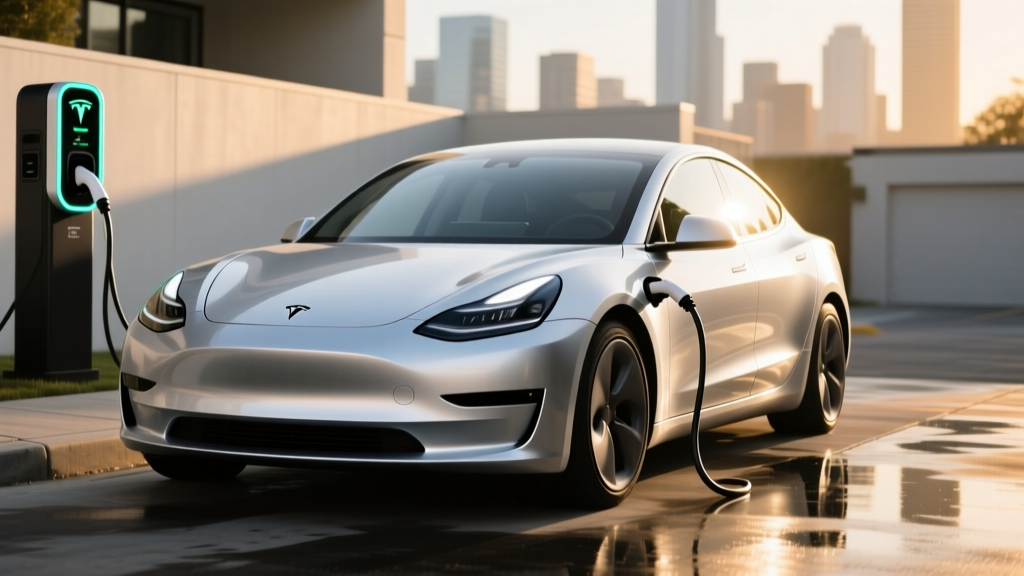
The Tesla Model 3 remains the benchmark compact electric sedan in 2026, balancing blistering acceleration, class-leading efficiency, and access to the most reliable DC fast-charging network in North America. Following its "Highland" refresh, the Model 3 lineup now spans the Long Range RWD, Long Range AWD, and Performance AWD trims — each delivering distinct acceleration profiles, range figures, and price points. This review breaks down exactly what buyers can expect from the 2026 Model 3 in real-world driving, charging, and ownership.
2026 Tesla Model 3 Acceleration and Performance by Trim
Tesla offers the Model 3 in three trims for the 2026 model year, and acceleration varies significantly depending on the powertrain. The dual-motor Performance variant is the headline act, but even the base Long Range RWD delivers sports-sedan punch.
| Trim | Drivetrain | Horsepower | 0-60 mph | Top Speed |
|---|---|---|---|---|
| Long Range RWD | Rear-Wheel Drive | ~295 hp | 5.8 sec | 125 mph |
| Long Range AWD | Dual-Motor AWD | ~384 hp | 4.2 sec | 125 mph |
| Performance AWD | Dual-Motor AWD | ~510 hp | 3.1 sec | 163 mph |
The Performance trim's 3.1-second 0-60 mph time places it in supercar territory, rivaling vehicles costing three to four times as much. The instant torque delivery — a hallmark of electric motors — means the Model 3 Performance feels even quicker in real-world roll-on acceleration (30-50 mph passing) than the 0-60 figure alone suggests. Tesla's updated adaptive dampers on the Performance trim also manage the 4,200-pound curb weight with noticeably improved body control over the pre-refresh model.
Even the RWD Long Range's 5.8-second sprint is quicker than most gasoline-powered compact sedans in its price class. For daily commuting and highway merging, every Model 3 trim provides more than adequate thrust.
EPA Range vs. Real-World Expectations
Range remains a top purchase driver, and the 2026 Model 3 delivers competitive figures across the lineup. However, EPA estimates represent idealized mixed driving — real-world results vary based on speed, temperature, and terrain.
| Trim | EPA Range | Real-World Highway (~75 mph) | Cold Weather (below 32°F) |
|---|---|---|---|
| Long Range RWD | 363 mi | ~290-310 mi | ~240-270 mi |
| Long Range AWD | 341 mi | ~275-295 mi | ~225-255 mi |
| Performance AWD | 315 mi | ~255-275 mi | ~210-240 mi |
Source: EPA / fueleconomy.gov. Real-world estimates based on independent testing and owner data. Highway driving at sustained 75+ mph reduces range ~15-20%. Cold weather can reduce range 20-30% depending on cabin heating use and battery preconditioning.
The Long Range RWD trim's 363-mile EPA rating is the highest in the lineup, aided by its single-motor efficiency and lighter weight. For buyers prioritizing maximum distance between charges — particularly those without reliable home charging — this trim offers the most buffer.
All 2026 Model 3 trims use a ~75 kWh usable battery pack with NMC (nickel manganese cobalt) chemistry. Tesla's thermal management system, including a heat pump standard across all trims, helps mitigate cold-weather range loss compared to resistive-heating EVs, but physics still applies: expect a meaningful range dip in sub-freezing conditions.
Charging Speed: DC Fast Charge and Home Level 2
Charging speed is where the refreshed Model 3 makes a meaningful generational leap. The updated architecture supports faster DC fast charging than pre-2024 models, and Tesla's preconditioning system remains best-in-class for optimizing charge curves.
| Charging Level | Long Range RWD | Long Range AWD | Performance AWD |
|---|---|---|---|
| Max DC Fast Charge (peak) | 250 kW | 250 kW | 250 kW |
| 10-80% DC Fast Charge | ~25 min | ~25 min | ~25 min |
| Level 2 Home (11.5 kW / 48A) | ~44 mi/hr | ~44 mi/hr | ~44 mi/hr |
| Level 1 (120V / 12A) | ~3-4 mi/hr | ~3-4 mi/hr | ~3-4 mi/hr |
| Connector | NACS (native) | NACS (native) | NACS (native) |
Understanding the charge curve: The 250 kW peak rate is achieved at a low state of charge (roughly 10-20% SoC) and with proper battery preconditioning — which the Model 3 initiates automatically when you navigate to a Supercharger. Sustained rates taper as the battery fills: expect roughly 250 kW from 10-30%, stepping down through 150 kW and 100 kW stages as you approach 80%. This is why the 10-80% metric (~25 minutes) is more useful than peak kW alone.
At home on a 48-amp Level 2 charger (requiring a 60-amp circuit), the Model 3 adds approximately 44 miles of range per hour of charging — enough to fully replenish overnight from any realistic daily drive. Tesla's Wall Connector ($420) or any NACS-compatible Level 2 unit will work.
The native NACS (North American Charging Standard) port means the Model 3 plugs directly into Tesla Superchargers without an adapter. As of 2026, the Supercharger network includes over 25,000 stalls in North America and remains the most reliable public DC fast-charging network by uptime metrics. Non-Tesla NACS chargers from Electrify America, EVgo, and others are increasingly available as well.
Efficiency: MPGe and Energy Consumption
The Model 3 is one of the most energy-efficient EVs on the market, a result of Tesla's industry-leading powertrain efficiency and aerodynamic design (0.219 Cd drag coefficient for the Long Range).
| Trim | Combined MPGe | kWh per 100 Miles |
|---|---|---|
| Long Range RWD | 132 MPGe | 25 kWh/100mi |
| Long Range AWD | 121 MPGe | 28 kWh/100mi |
| Performance AWD | 113 MPGe | 30 kWh/100mi |
For context, the Long Range RWD's 25 kWh/100mi means that at the national average electricity rate of ~$0.17/kWh (EIA, 2025), fueling costs roughly $4.25 per 100 miles — versus approximately $12-14 per 100 miles for a comparable 30 MPG gasoline sedan at $3.70/gallon. Over 15,000 annual miles, that's an estimated $1,200-$1,500 annual fuel savings.
Pricing, Trims, and Federal Tax Credit Eligibility
The 2026 Model 3 lineup starts at $38,990 for the Long Range RWD and tops out near $54,990 for the Performance AWD before options and destination charges.
| Trim | Base MSRP | As-Tested (typical options) | Est. §30D Credit |
|---|---|---|---|
| Long Range RWD | $38,990 | $40,490 (w/ paint + wheels) | Up to $7,500* |
| Long Range AWD | $44,990 | $46,990 | Up to $7,500* |
| Performance AWD | $52,990 | $54,990 | Up to $7,500* |
*Federal tax credit subject to IRS §30D requirements. See eligibility checklist below.
- MSRP cap: Sedans must be ≤ $55,000 — all Model 3 trims qualify on base MSRP.
- Buyer income cap: Modified AGI ≤ $150,000 (single) / $225,000 (head of household) / $300,000 (joint). Source: IRS.gov.
- Battery sourcing: Critical minerals and battery components must meet phased-in domestic-content thresholds that tighten annually. Tesla sources many Model 3 batteries from U.S. and FTA-partner supply chains, but confirm eligibility at point of sale.
- Point-of-sale transfer: As of 2024+, buyers can transfer the credit to the dealer for an immediate price reduction at purchase rather than waiting to claim it on their tax return.
- VIN verification: Confirm the specific vehicle's eligibility at fueleconomy.gov before purchase — eligibility can vary by build date and battery batch.
Interior, Cargo, and Technology
The Highland refresh brought meaningful interior upgrades to the Model 3: improved materials, ventilated front seats, ambient lighting, a rear touchscreen for passengers, and a significantly quieter cabin thanks to acoustic glass and additional sound deadening.
Dimensions and cargo:
- Cargo volume: 23 cu ft (trunk + frunk combined)
- Rear legroom: 35.3 inches
- Front headroom: 40.3 inches
- Curb weight: 3,862 lbs (RWD) to 4,200 lbs (Performance)
The 15.4-inch center touchscreen runs Tesla's proprietary infotainment OS, which includes native navigation with Supercharger routing, streaming media, and over-the-air updates. Notably, the refreshed Model 3 eliminates physical turn-signal stalks — signals are now activated via steering-wheel buttons, which remains a polarizing design choice.
Driver assistance: All Model 3 trims include Tesla Autopilot (SAE Level 2), which provides adaptive cruise control and lane-centering. Full Self-Driving (Supervised) is available as an $8,000 option or $99/month subscription and adds automated lane changes, traffic light/stop sign recognition, and city-street navigation — but the driver must remain fully engaged at all times.
Tesla Autopilot and FSD (Supervised) are SAE Level 2 driver-assistance systems. The driver is legally and operationally responsible for the vehicle at all times. Hands-on-wheel monitoring is enforced. These systems do not make the Model 3 autonomous — Level 4 driverless capability exists only in commercial robotaxi services like Waymo.
Warranty Coverage
| Coverage Type | Duration |
|---|---|
| Basic Vehicle Limited Warranty | 4 years / 50,000 miles |
| Battery & Drive Unit Warranty (Long Range / Performance) | 8 years / 120,000 miles |
| Minimum Battery Retention (under warranty) | 70% capacity |
The 8-year/120,000-mile battery warranty guarantees at least 70% capacity retention. Tesla's NMC packs have historically shown modest degradation — owner surveys suggest roughly 5-8% loss over the first 100,000 miles under normal use. Battery replacement outside warranty, however, remains costly: estimated at $12,000-$16,000 including labor.
Pros, Cons, and Who Should Buy
- Class-leading acceleration, especially Performance (3.1s 0-60)
- Top-tier efficiency (up to 132 MPGe combined)
- Supercharger network access (25,000+ stalls, highest uptime)
- Native NACS — no adapter needed at most DC fast chargers
- Over-the-air updates continuously add features
- Strong resale value relative to EV segment average
- No physical turn-signal stalks (steering-wheel buttons only)
- Minimalist interior lacks physical climate/audio controls
- Rear visibility is limited; relies heavily on cameras
- FSD (Supervised) is expensive and still requires full driver attention
- Ride quality on Performance trim can be firm on rough roads
- Insurance premiums tend to run 15-25% above segment average
Who the Model 3 suits best:
- Commuters and daily drivers who want low running costs and can charge at home — the RWD Long Range is ideal here.
- Performance enthusiasts who want sports-car acceleration without gasoline costs — the Performance AWD delivers at a fraction of a Porsche Taycan's price.
- Road trippers who value Supercharger reliability and long range — the Long Range AWD balances distance and all-weather capability.
- Not ideal for: Families needing large rear seats and cargo (consider Model Y), or buyers who prefer traditional controls and physical buttons.
Frequently Asked Questions
What is the fastest 2026 Tesla Model 3?
The Model 3 Performance AWD is the quickest, hitting 0-60 mph in 3.1 seconds with approximately 510 horsepower from its dual-motor setup. This makes it one of the fastest production sedans under $60,000.
Does the Tesla Model 3 qualify for the $7,500 federal tax credit?
All 2026 Model 3 trims fall under the $55,000 MSRP sedan cap. However, buyer eligibility depends on income limits (≤ $150K single / $300K joint), and the vehicle must meet battery critical-mineral and component sourcing requirements that tighten annually. Always verify the specific VIN's eligibility at fueleconomy.gov and consult a tax professional.
How long does it take to charge a Model 3 at home?
On a 48-amp Level 2 home charger (11.5 kW), the Model 3 gains approximately 44 miles of range per hour. A full charge from 10% to 100% takes roughly 8-9 hours — easily completed overnight. On a standard 120V outlet (Level 1), expect only 3-4 miles per hour, suitable only for emergency or very low-mileage use.
Is the Model 3 worth it versus the Hyundai Ioniq 6 or BMW i4?
The Model 3 leads in charging-network access (Supercharger), software/OTA updates, and performance-per-dollar. The Hyundai Ioniq 6 offers a more traditional interior with physical controls and competitive 361-mile range. The BMW i4 provides premium build quality and a more engaging driving feel but at a higher starting price and lower range. If Supercharger reliability and acceleration are priorities, the Model 3 remains the strongest pick.
How does cold weather affect Model 3 range and charging?
In sub-freezing temperatures, expect 20-30% range reduction depending on cabin heating use. Tesla's heat pump and battery preconditioning (which activates when navigating to a Supercharger) help mitigate this. Always precondition before DC fast charging in cold weather — an un-preconditioned battery may charge at half its peak rate.