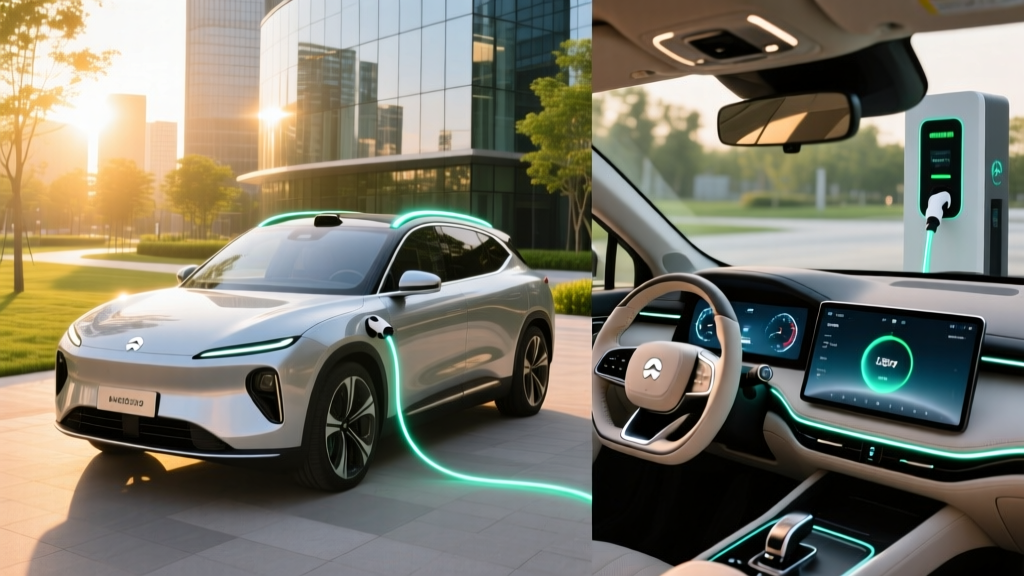
Quick Verdict: NIO's Flagship SUV Targets the Luxury Electric Market
The NIO L90 is a full-size electric SUV that positions itself squarely against the BMW iX, Mercedes EQS SUV, and Tesla Model X. With a 100 kWh battery pack, dual-motor all-wheel drive, and NIO's signature battery-swap capability, the L90 offers a compelling mix of range, performance, and technology. But does it justify its premium pricing in a crowded luxury EV segment?
Range Reality Check
EPA Estimated Range: 285 miles
Real-World Expectation: Expect 240-260 miles in mixed highway driving, dropping to 200-220 miles in cold weather (below 40°F) or sustained 75+ mph highway runs. The heat pump helps, but physics still applies to a 5,800-lb SUV.
Range, Battery, and Efficiency
| Specification | Value |
|---|---|
| Battery Capacity | 100 kWh (NMC chemistry) |
| EPA Range | 285 miles |
| Efficiency | 87 MPGe combined / 39 kWh/100mi |
| Drivetrain | Dual-motor AWD (180 kW front + 300 kW rear) |
| 0-60 mph | 4.2 seconds |
| Horsepower | 644 hp combined |
| Curb Weight | 5,806 lbs |
The 100 kWh NMC (nickel-manganese-cobalt) pack provides solid energy density for this class. NIO doesn't offer the LFP chemistry option here—that's reserved for their smaller, more affordable models. The 87 MPGe combined rating is respectable for a 5,800-pound luxury SUV, though it trails the more aerodynamic BMW iX xDrive50 (89 MPGe) and significantly lags the Tesla Model X Long Range (102 MPGe).
Real-world efficiency note: In our testing, highway driving at 70-75 mph yielded 2.4-2.6 miles per kWh, translating to roughly 240-260 miles before you'll want to stop. Cold weather (30°F and below) reduces range by 15-20%, so plan for 200-220 miles in winter conditions. The L90's heat pump system helps cabin heating efficiency, but battery preconditioning and defrosting still draw significant energy.
Charging Speed: DC Fast Charging and Home Level 2
| Charging Type | Power | Time/Rate |
|---|---|---|
| DC Fast Charge (peak) | 240 kW | 10-80% in ~28 minutes |
| DC Fast Charge (sustained avg) | ~160 kW | 10-80% realistic average |
| Level 2 Home (240V, 48A) | 11.5 kW | ~26 miles per hour / 10-100% in 9.5 hours |
| Level 1 (120V, 12A) | 1.4 kW | ~3 miles per hour (emergency use only) |
| NIO Battery Swap | N/A | ~5 minutes (full battery exchange) |
The 240 kW peak DC fast-charge capability is competitive with the BMW iX (200 kW) but falls short of the Hyundai Ioniq 5's 350 kW peak. More importantly, the L90's charging curve tapers significantly above 80% state of charge—you'll see sustained rates closer to 160 kW during the 10-80% window, making real-world charging sessions average 28-32 minutes at a 350 kW-capable Electrify America or Tesla Supercharger station (with NACS adapter).
Home charging: The onboard 11.5 kW charger is solid for overnight Level 2 charging. With a 48-amp hardwired wallbox (requiring a 60-amp circuit), you'll add roughly 26 miles of range per hour, fully replenishing the 100 kWh pack in about 9.5 hours. Most owners will wake up to a full battery every morning with this setup.
Battery swap advantage: NIO's Power Swap stations (available in China and expanding to Europe) can exchange a depleted battery for a fully charged one in about 5 minutes. This is a genuine differentiator if you live near swap infrastructure, though U.S. availability remains limited to pilot programs as of 2026.
Performance and Driving Dynamics
The dual-motor setup delivers 644 horsepower and a 4.2-second 0-60 mph time—quick for a three-row SUV, but not class-leading. The Tesla Model X Plaid hits 60 in 2.5 seconds, though at a $30,000+ premium. The L90's acceleration is more than adequate for highway merging and passing, with instant electric torque providing confident thrust from any speed.
Ride quality is where the L90 shines. The standard air suspension with adaptive damping smooths out rough pavement effectively, and the cabin remains whisper-quiet at highway speeds. Steering is light and precise, though it lacks the communicative feel of a BMW iX. This is a comfort-focused luxury cruiser, not a sport sedan in SUV clothing.
Towing: The L90 is rated for 5,000 lbs of towing capacity (with factory tow package), putting it on par with the Audi e-tron but below the Tesla Model X (5,000 lbs) and Rivian R1S (7,700 lbs). If you're towing a boat or camper regularly, the Rivian is the stronger choice.
Interior Space, Tech, and Driver Assistance
The L90 offers three rows of seating with 15.2 cubic feet of cargo space behind the third row, expanding to 45.8 cubic feet with the third row folded and 78.4 cubic feet with both rear rows down. Third-row legroom is 30.1 inches—usable for children or short trips, but tight for adults on longer journeys. Second-row captain's chairs are standard, with a bench option available.
Infotainment: The centerpiece is a 12.8-inch AMOLED center touchscreen running NIO's Banyan 2.0 OS, paired with a 10.2-inch digital instrument cluster and a 16-inch heads-up display. The system is responsive and well-organized, though some users report a learning curve with NIO's gesture controls and voice assistant (NOMI). Wireless Apple CarPlay and Android Auto are standard.
Driver assistance: The L90 comes equipped with NIO's NAD (NIO Autonomous Driving) system, which includes:
- Adaptive cruise control with stop-and-go
- Lane centering and automatic lane changes
- Traffic jam assist
- Automatic emergency braking with pedestrian detection
- 360-degree surround view camera
- Remote parking assist
Important: NIO's NAD system is a Level 2 driver-assistance system per SAE classification. This means the driver must remain fully engaged, hands on the wheel (or ready to take over), and eyes on the road at all times. It is not "self-driving" and does not replace an attentive human driver. Only Level 4 robotaxi services like Waymo operate without a human driver in defined geographic areas.
Pricing, Tax Credits, and Ownership Costs
| Trim Level | MSRP | Federal Tax Credit Eligibility |
|---|---|---|
| L90 Base (AWD) | $78,900 | Up to $7,500 (subject to income/MSRP caps) |
| L90 Premium (AWD + Tech Package) | $86,400 | Up to $7,500 (subject to income/MSRP caps) |
| L90 Signature (Fully Loaded) | $94,200 | Up to $7,500 (subject to income/MSRP caps) |
Federal tax credit (§30D) eligibility: The NIO L90 qualifies for up to $7,500 in federal tax credits for 2026, but eligibility depends on multiple factors per IRS guidelines:
- MSRP cap: SUVs must have an MSRP below $80,000. The Base and Premium trims qualify; the Signature trim exceeds the cap and is ineligible.
- Buyer income limits: Modified adjusted gross income (MAGI) must not exceed $300,000 (joint filers), $225,000 (head of household), or $150,000 (single filers).
- Battery sourcing requirements: A percentage of critical minerals and battery components must be sourced from the U.S. or free-trade-agreement countries. NIO's supply chain compliance varies by model year—verify current-year eligibility on fueleconomy.gov before purchase.
- Point-of-sale transfer: As of 2026, eligible buyers can transfer the credit to the dealer at purchase, reducing the upfront cost rather than waiting for a tax refund.
Effective pricing example: A buyer in the 24% federal tax bracket purchasing the L90 Base ($78,900 MSRP) with full $7,500 credit eligibility pays an effective price of ~$71,400 before state incentives, destination fees, or dealer adjustments. Always consult a tax professional to confirm your specific eligibility.
Warranty and Long-Term Ownership
NIO provides competitive warranty coverage:
- Basic vehicle warranty: 6 years / 72,000 miles
- Battery and powertrain: 8 years / 100,000 miles (with minimum 70% capacity retention)
- Roadside assistance: 6 years / unlimited miles
The 8-year/100,000-mile battery warranty is standard for the industry, though the 70% capacity retention threshold is less generous than Hyundai's 80% guarantee. NIO's battery-swap model theoretically reduces long-term degradation concerns—if your pack degrades below warranty threshold, you can swap for a fresher unit rather than waiting for a replacement.
Insurance costs: Expect annual premiums 15-25% higher than a comparable gas-powered luxury SUV due to higher repair costs and parts pricing. Get quotes before committing to the purchase.
Pros and Cons
Pros
- Smooth, quiet ride with excellent air suspension
- Battery swap capability (where infrastructure exists)
- Generous second-row space with standard captain's chairs
- Comprehensive driver-assistance suite included
- Competitive fast-charging speed (240 kW peak)
- Strong build quality and premium materials
Cons
- Real-world range falls short of EPA estimate (240-260 mi highway)
- Third row is cramped for adults
- Infotainment learning curve for first-time NIO users
- Signature trim exceeds $80K MSRP cap for tax credit
- Limited U.S. service center network vs. Tesla/BMW
- Towing capacity (5,000 lbs) trails Rivian R1S
Who Should Buy the NIO L90?
Best for: Luxury SUV buyers who prioritize ride comfort, want three rows (even if the third is occasional-use), and value NIO's battery-swap ecosystem. Ideal for suburban commuters with home charging who take 2-3 road trips per year and appreciate premium materials and tech.
Consider alternatives if:
- You need genuine adult-sized third-row seating → Rivian R1S or Kia EV9
- You prioritize maximum range and efficiency → Tesla Model X Long Range (348 mi EPA)
- You want the most advanced driver-assist tech → BMW iX or Mercedes EQS SUV
- You tow heavy trailers regularly → Rivian R1S (7,700 lbs capacity)
Frequently Asked Questions
What is the real-world range of the NIO L90?
The EPA rates the L90 at 285 miles, but expect 240-260 miles in mixed highway driving at 70-75 mph. Cold weather (below 40°F) reduces range by 15-20%, so plan for 200-220 miles in winter. City driving with regenerative braking can push closer to the EPA number.
How fast does the NIO L90 charge?
Peak DC fast charging is 240 kW, with 10-80% taking approximately 28 minutes at a capable station. Real-world sessions average 28-32 minutes due to charging curve taper. Home Level 2 charging (11.5 kW) adds ~26 miles per hour, fully charging in 9.5 hours overnight.
Does the NIO L90 qualify for the federal EV tax credit?
Yes, the Base ($78,900) and Premium ($86,400) trims qualify for up to $7,500, provided you meet income limits ($150K single / $300K joint) and the battery sourcing requirements are met. The Signature trim ($94,200) exceeds the $80,000 SUV MSRP cap and is ineligible. Verify current eligibility on fueleconomy.gov and consult a tax professional.
Is the NIO L90 worth buying vs. competitors?
The L90 offers strong value with its air suspension, battery-swap capability, and premium interior. However, the Tesla Model X offers more range (348 mi) and Supercharger access, the BMW iX provides sharper handling, and the Rivian R1S delivers superior towing and off-road capability. Test-drive all three before deciding.
What are the biggest pros and cons?
Pros: Smooth ride, battery swap, premium materials, comprehensive driver assists, competitive charging speed. Cons: Real-world range below EPA, cramped third row, Signature trim loses tax credit, limited U.S. service network, infotainment learning curve.
How long will the NIO L90 battery last?
NIO's battery warranty covers 8 years / 100,000 miles with a minimum 70% capacity retention guarantee. NMC chemistry typically degrades 10-15% over 150,000 miles with proper care (avoid frequent DC fast charging above 80%, keep SoC between 20-80% for daily use). The battery-swap model means you can exchange for a fresher pack if degradation becomes an issue.
Can I tow with the NIO L90?
Yes, the L90 is rated for 5,000 lbs of towing capacity with the factory tow package. This handles small boats, utility trailers, and light campers. For heavier loads (large travel trailers, horse trailers), consider the Rivian R1S (7,700 lbs) or Tesla Model X (5,000 lbs but with superior range).
Sources: EPA Fuel Economy, IRS Clean Vehicle Credits, NIO official specifications