Quick Verdict: A Three-Row Electric SUV That Actually Delivers
If you've been searching for Rivian interior photos to decide whether the R1S lives up to its adventure-SUV marketing, you've found the right deep dive. The 2026 Rivian R1S remains one of the few electric SUVs offering three usable rows, genuine off-road capability, and a tri-motor powertrain that embarrasses sports cars at stoplights. But beyond the beautifully shot press images, what's it actually like to live with?
We've spent time with the Gen 2 R1S platform — the heavily revised version Rivian introduced for the 2025 model year and carries forward into 2026 — to separate spec-sheet promise from driveway reality. From the redesigned dual-motor and tri-motor configurations to the updated 106 kWh (usable) battery pack, this is an SUV that has matured significantly since its 2022 launch.
| Spec | Dual-Motor (Standard) | Tri-Motor |
|---|---|---|
| EPA Range (Max Pack) | 410 miles | 380 miles |
| Battery (usable) | ~106 kWh, NMC | ~106 kWh, NMC |
| Horsepower | 665 hp | 1,103 hp (Tri-Motor) |
| 0-60 mph | 4.5 sec | 2.9 sec |
| Drivetrain | AWD (dual-motor) | AWD (tri-motor) |
| Max DC Charge Rate | 220 kW | 220 kW |
| 10-80% DC Fast Charge | ~21 min | ~21 min |
| Level 2 Home Charging | 11.5 kW (~31 mi/hr) | 11.5 kW (~31 mi/hr) |
| MPGe (combined) | 74 MPGe | 70 MPGe |
| Towing Capacity | 7,700 lbs | 7,700 lbs |
| Cargo (behind 3rd row) | 10.5 cu ft | 10.5 cu ft |
| Cargo (3rd row folded) | 46.7 cu ft | 46.7 cu ft |
| Cargo (all rows folded) | 104.7 cu ft | 104.7 cu ft |
| Base MSRP | $84,900 (Adventure) | $105,900 (Tri-Motor) |
| Battery/Powertrain Warranty | 8 yr / 175,000 mi | 8 yr / 175,000 mi |
Inside the R1S: Interior Design, Materials, and Cabin Technology
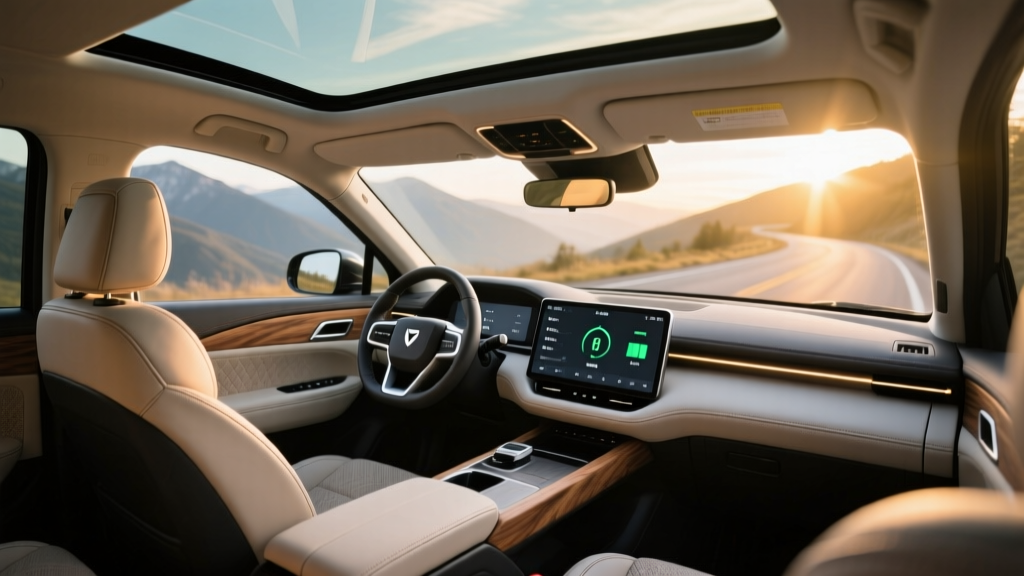
The reason so many shoppers search for Rivian interior photos before visiting a showroom is simple: the R1S cabin doesn't look like a traditional SUV. It looks like a Scandinavian cabin on wheels. Rivian uses a mix of responsibly sourced wood trim (open-pore walnut or ash), vegan leather upholstery across all trims, and a minimalist dashboard dominated by a 15.6-inch central touchscreen and a 12.3-inch digital instrument cluster.
What the Photos Don't Always Show
Press images tend to highlight the panoramic glass roof, which floods all three rows with light and makes the cabin feel significantly more open than competitors like the Tesla Model X or BMW iX. What photos can't convey is the tactile quality: the knurled aluminum drive mode selector, the soft-touch materials on the door panels and center console, and the satisfying heft of the physical volume knob that Rivian wisely kept despite the touchscreen-first approach.
The second row features a 60/40 split bench (or optional captain's chairs) with genuine adult-sized legroom — 36.9 inches — and dedicated climate vents. The third row accommodates children or shorter adults for trips under an hour, with 29.6 inches of legroom. It's not a minivan replacement, but it's legitimate three-row territory.
Infotainment and Driver Assistance
Rivian's in-house infotainment system runs on a custom Linux-based stack. It's responsive, with a tile-based interface, integrated navigation with charging-route planning, and over-the-air updates that have meaningfully improved the system since launch. Wireless Apple CarPlay and Android Auto are standard.
The Rivian Driver+ system is a Level 2 driver-assistance suite — meaning you must keep your hands on the wheel and eyes on the road at all times. It includes adaptive cruise control, lane centering, automatic emergency braking, and a highway assist feature. It is not "self-driving" and does not approach SAE Level 4 autonomy. Competent, but it trails GM's Super Cruise and Ford's BlueCruise in hands-free highway capability.
Real-World Range vs. EPA Estimates: What to Actually Expect
EPA sticker (Dual-Motor, Max Pack): 410 miles
Real-world highway (70-75 mph, moderate weather): ~330-360 miles
Real-world highway (cold weather, 30°F or below): ~270-310 miles
Mixed city/highway (spring/fall): ~360-390 miles
The R1S is a heavy, boxy SUV with the aerodynamics of a brick. Highway speeds above 70 mph and cold temperatures both take a significant toll. Plan conservatively for road trips.
The 2026 R1S carries forward Rivian's Gen 2 battery architecture with approximately 106 kWh of usable capacity using NMC (nickel manganese cobalt) chemistry. Rivian has not adopted LFP (lithium iron phosphate) for the R1S, prioritizing energy density over the cost and cycle-life advantages of LFP.
According to fueleconomy.gov, the Dual-Motor R1S with the Max Pack achieves an EPA-estimated 410 miles. That's a remarkable number on paper. But real-world efficiency tells a more nuanced story. At sustained highway speeds of 70-75 mph, expect consumption around 38-42 kWh/100 miles, translating to roughly 330-360 miles of range in mild weather. Drop temperatures below freezing, and the NMC battery's reduced efficiency — combined with cabin heating demands, even with the standard heat pump — can push real range down to 270-310 miles.
For context, the Tri-Motor variant sacrifices roughly 30 miles of EPA range (380 miles) in exchange for 1,103 hp and a 2.9-second 0-60 time. That's a meaningful trade if you're road-tripping regularly.
Charging Speed: DC Fast Charging and Home Level 2
| Charging Level | Power / Rate | Miles Added per Hour | Notes |
|---|---|---|---|
| Level 1 (120V outlet) | ~1.4 kW | ~3-4 mi/hr | Emergency/trickle only |
| Level 2 (240V, 48A home charger) | 11.5 kW | ~31 mi/hr | Full charge overnight (~10 hrs) |
| DC Fast Charge (peak) | 220 kW | — | 10-80% in ~21 minutes |
| DC Fast Charge (sustained avg) | ~140-160 kW | — | Charge curve tapers above 80% |
Rivian's Gen 2 platform supports a peak DC fast-charge rate of 220 kW via NACS (Tesla's connector, which Rivian adopted starting with 2025 models). That means direct access to the Tesla Supercharger network — currently the most reliable public charging infrastructure in the U.S.
The 10-80% charge time of approximately 21 minutes is competitive but not class-leading. The Hyundai Ioniq 9 and Kia EV9, built on 800V architectures, can achieve 10-80% in roughly 18 minutes at compatible 350 kW chargers. The R1S runs on a 400V architecture, which limits its peak charge rate.
Critical charging-curve reality: The 220 kW peak is sustained roughly from 10-40% state of charge. From 40-80%, the rate tapers progressively to around 80-100 kW. If you're road-tripping and charging from 20-80%, your average rate will be closer to 140-160 kW. Plan stops accordingly.
At home, the R1S accepts up to 11.5 kW on a Level 2, 48-amp charger (such as the Rivian Wall Charger or a ChargePoint Home Flex). That adds roughly 31 miles of range per hour, meaning a full 10-100% charge takes about 10 hours. For most owners, plugging in overnight is more than sufficient.
Performance and Driving Dynamics
The Dual-Motor R1S produces 665 horsepower and hits 60 mph in 4.5 seconds — quick by any measure, and more than adequate for highway merging and passing. The Tri-Motor variant, with its third motor on the rear axle, generates a staggering 1,103 horsepower and a 2.9-second 0-60 time. It's genuinely supercar-quick, though you'll pay for it in both MSRP and efficiency.
Ride quality is controlled thanks to the standard air suspension, which offers adjustable ride height from 5.9 to 14.9 inches of ground clearance. The R1S can ford up to 3 feet of water — a genuine differentiator against crossovers pretending to be off-roaders. On pavement, the air suspension isolates occupants well from road imperfections, though the 6,800+ lb curb weight is noticeable in tight corners.
The R1S uses a single-speed reduction gear (no multi-speed transmission) and delivers seamless, instant torque. Regenerative braking is adjustable through the touchscreen, with a strong regen mode that enables near one-pedal driving in city traffic.
Pricing, Trim Levels, and Federal Tax Credit Eligibility
| Trim | Base MSRP | As-Tested (Typical Options) | Federal §30D Credit Eligibility |
|---|---|---|---|
| Adventure (Dual-Motor, Standard Pack) | $84,900 | $89,000-$93,000 | Likely ineligible (MSRP cap $80K) |
| Adventure (Dual-Motor, Max Pack) | $92,900 | $96,000-$100,000 | Ineligible (exceeds $80K cap) |
| Ascend (Dual-Motor, Max Pack) | $99,900 | $104,000-$110,000 | Ineligible (exceeds $80K cap) |
| Tri-Motor Adventure | $105,900 | $110,000-$118,000 | Ineligible (exceeds $80K cap) |
Here's the hard truth about the federal EV tax credit and the R1S: under current IRS §30D rules, SUVs must have an MSRP at or below $80,000 to qualify for the up-to-$7,500 credit. Every 2026 R1S trim starts above that threshold, making the R1S ineligible for the federal purchase credit.
Additionally, §30D imposes buyer income caps ($300,000 joint / $225,000 head of household / $150,000 single) and battery critical-mineral and component sourcing requirements that change annually. Even if a lower-priced trim were introduced, eligibility would depend on your adjusted gross income and the vehicle's battery sourcing compliance for the delivery year.
Point-of-sale transfer: For vehicles that do qualify, the credit can now be transferred to the dealer at purchase, reducing your out-of-pocket cost immediately rather than waiting until tax filing. This doesn't apply to the R1S under current pricing.
Some state and local incentives may still apply (check your state's EV rebate program), and the used EV credit (up to $4,000 under §25E) could become relevant if you purchase a pre-owned R1S from a dealer — subject to a $25,000 sale-price cap, which makes it unlikely for most R1S examples in the near term.
R1S vs. the Competition: Is It Worth Buying?
- Genuine three-row seating with adult-usable second row
- Best-in-class off-road capability (air suspension, water fording)
- NACS connector = direct Tesla Supercharger access
- 410-mile EPA range (Max Pack) is exceptional for a 3-row SUV
- 7,700-lb towing capacity
- 8-year/175,000-mile battery warranty exceeds industry standard
- Strong OTA update track record since launch
- Ineligible for $7,500 federal tax credit (MSRP exceeds cap)
- 400V architecture limits peak DC charge rate vs 800V rivals
- Real-world highway range drops significantly at speed and in cold
- Third row tight for adults on longer trips
- No hands-free highway driving (Driver+ requires hands on wheel)
- Base price above $84K before options
- Service center network still expanding in some regions
The R1S competes most directly with the Tesla Model X (starting ~$79,990, eligible for partial credit depending on configuration), the Kia EV9 (starting ~$54,900, credit-eligible, 800V architecture), and the BMW iX (two-row only, starting ~$87,250). For families who need three rows, genuine off-road chops, and don't need the tax credit, the R1S is arguably the most well-rounded option. If budget and credit eligibility are priorities, the EV9 offers compelling value at a significant discount.
Who Should Buy the 2026 Rivian R1S?
- You need three rows for children and regular cargo flexibility
- You tow a boat, camper, or trailer (7,700-lb capacity)
- You want genuine off-road capability in an EV
- You value Supercharger network access via NACS
- Budget allows $90K+ all-in without relying on federal credits
- Federal tax credit eligibility is essential to your purchase math
- You only need two rows (consider Rivian R1T, BMW iX, or Tesla Model Y)
- You want the fastest possible DC charging (consider 800V platforms like the Kia EV9)
- You want hands-free highway driving (consider GM Super Cruise vehicles)
Frequently Asked Questions
What is the real-world range of the 2026 Rivian R1S?
The EPA rates the Dual-Motor R1S with the Max Pack at 410 miles. In real-world highway driving at 70-75 mph in moderate temperatures, expect 330-360 miles. In cold weather (below 30°F), plan for 270-310 miles. The Tri-Motor variant drops to a 380-mile EPA estimate with similar real-world reductions.
How fast does the R1S charge at home and on the road?
On a Level 2 home charger (48A, 11.5 kW), the R1S adds about 31 miles per hour, reaching a full charge in roughly 10 hours. On a DC fast charger, it peaks at 220 kW and charges from 10-80% in about 21 minutes, though the charge curve tapers significantly above 80% SoC.
Does the 2026 Rivian R1S qualify for the federal EV tax credit?
No. Under current IRS §30D rules, the R1S exceeds the $80,000 MSRP cap for SUVs at every trim level. Buyer income caps and battery sourcing requirements add further restrictions, but the MSRP alone disqualifies it. Check irs.gov for the most current rules.
How does the R1S interior compare to the Tesla Model X?
The R1S uses higher-quality materials — real wood trim, vegan leather, and more physical controls — compared to the Model X's spartan, screen-centric interior. The R1S also offers a more traditional SUV layout with a usable third row, while the Model X's falcon-wing doors and minimal dashboard are polarizing. Rivian's infotainment is less mature than Tesla's, but it has improved substantially through OTA updates.
What battery chemistry does the R1S use, and how long will it last?
The R1S uses NMC (nickel manganese cobalt) lithium-ion cells with approximately 106 kWh of usable capacity. NMC offers higher energy density than LFP but typically shows slightly more degradation over time. Rivian warranties the battery for 8 years or 175,000 miles, retaining at least 70% of original capacity — one of the stronger warranties in the segment.
Is the Rivian Driver+ system self-driving?
No. Rivian Driver+ is an SAE Level 2 driver-assistance system. It provides adaptive cruise control, lane centering, and highway assist, but the driver must remain fully engaged with hands on the wheel and eyes on the road. It does not offer hands-free or eyes-off capability. Only Level 4 services like Waymo operate without a human driver.
Can the R1S tow, and how does towing affect range?
The R1S is rated to tow up to 7,700 lbs. When towing near maximum capacity, expect range to drop by 40-50% — a common reality for all electric vehicles. A 410-mile EPA range becomes roughly 200-250 miles with a heavy trailer. Plan charging stops accordingly and precondition the battery before fast-charging sessions.