Does Tesla Offer a Military Discount?
Unlike Ford, GM, and BMW, Tesla does not offer a dedicated military discount, veteran rebate, or first-responder incentive program. There is no separate "Tesla military" pricing tier, no promo code for active-duty personnel, and no special lease rate for service members. Tesla's direct-to-consumer sales model keeps pricing uniform across all buyers regardless of occupation or service status.
However, that doesn't mean military members are left without financial advantages when buying a Tesla. Between the federal EV tax credit (IRS §30D), state-level incentives, base-exemption policies in several states, and the inherent fuel and maintenance savings of EV ownership, service members can still realize substantial savings. This guide breaks down the real numbers behind buying a Tesla as a military member in 2026 — pricing, tax credits, range, charging, and whether a Tesla makes sense for military life.
Tesla Lineup at a Glance: 2026 Pricing and Specs
Tesla's current U.S. lineup includes four consumer vehicles. Here's how they stack up on the metrics that matter most for military buyers who may be relocating frequently, commuting long distances to base, or managing a household budget on military pay.
| Model | Base MSRP | EPA Range | Battery (kWh) | 0-60 mph | Drivetrain | MPGe (combined) |
|---|---|---|---|---|---|---|
| Model 3 RWD | $38,990 | 272 mi | ~60 kWh (LFP) | 5.8 sec | RWD | 132 MPGe |
| Model 3 Long Range AWD | $44,990 | 341 mi | ~79 kWh (NMC) | 4.2 sec | Dual-Motor AWD | 125 MPGe |
| Model Y Long Range AWD | $44,990 | 320 mi | ~79 kWh (NMC) | 4.8 sec | Dual-Motor AWD | 117 MPGe |
| Model S Long Range | $74,990 | 402 mi | ~100 kWh (NMC) | 3.1 sec | Dual-Motor AWD | 120 MPGe |
| Model X Long Range | $79,990 | 348 mi | ~100 kWh (NMC) | 3.8 sec | Dual-Motor AWD | 109 MPGe |
Sources: EPA / fueleconomy.gov, Tesla.com (2026 model year). Prices exclude destination fee. Specs reflect current production estimates.
Federal Tax Credit: The Real "Tesla Military Discount"
While Tesla doesn't cut service members a special check, the IRS §30D Clean Vehicle Credit can knock up to $7,500 off the effective cost of a new Tesla — and as of 2024, buyers can transfer this credit to the dealer at the point of sale, effectively reducing the purchase price on delivery day rather than waiting until tax filing.
- Income caps: Adjusted gross income ≤ $150,000 (single), ≤ $225,000 (head of household), ≤ $300,000 (married filing jointly)
- MSRP caps: Vans/SUVs/pickups ≤ $80,000; sedans/other ≤ $55,000
- Battery sourcing: Critical minerals and battery components must meet escalating domestic/free-trade-agreement thresholds (phased in annually through 2029)
- Assembly: Vehicle must undergo final assembly in North America (all U.S.-market Teslas qualify — Fremont, CA and Austin, TX)
- Point-of-sale transfer: Credit can be applied at purchase to reduce out-of-pocket cost immediately
Source: IRS.gov — Clean Vehicle Tax Credits. Rules subject to change; consult a tax professional for your specific situation.
| Model | Base MSRP | Under MSRP Cap? | Est. Credit | Effective Price* |
|---|---|---|---|---|
| Model 3 RWD | $38,990 | Yes (sedan ≤$55K) | Up to $7,500 | ~$31,490 |
| Model 3 Long Range AWD | $44,990 | Yes (sedan ≤$55K) | Up to $7,500 | ~$37,490 |
| Model Y Long Range AWD | $44,990 | Yes (SUV ≤$80K) | Up to $7,500 | ~$37,490 |
| Model S Long Range | $74,990 | No (sedan >$55K) | $0 | $74,990 |
| Model X Long Range | $79,990 | Yes (SUV ≤$80K) | Up to $7,500 | ~$72,490 |
*Effective price assumes full §30D credit eligibility. Battery-sourcing requirements may reduce the credit to $3,750 or $0 depending on the specific vehicle's supply chain compliance in 2026. Always verify current eligibility at fueleconomy.gov before purchasing.
For military families on an E-5 to O-3 pay grade (roughly $40,000–$85,000 base pay), the income caps are rarely a barrier. The bigger variable is battery-sourcing compliance, which changes annually and varies by model and production batch.
Charging Speed: Home, Destination, and Supercharger
Charging access is one of the strongest arguments for Tesla ownership — especially for military members who may PCS (permanent change of station) frequently and need reliable charging in unfamiliar areas. Tesla's Supercharger network remains the most extensive and reliable DC fast-charging network in North America.
| Charging Level | Power | Speed (mi/hr) | Typical Use Case |
|---|---|---|---|
| Level 1 (120V household) | ~1.4 kW | 3-5 mi/hr | Overnight top-up; emergency only |
| Level 2 (240V home — Wall Connector) | 11.5 kW (48A) | ~44 mi/hr | Daily home charging; full charge in 6-9 hrs |
| DC Fast (V3 Supercharger) | Peak 250 kW | ~1,000 mi/hr (peak) | Road trips; 10-80% in ~20-25 min (Model 3 LR) |
| DC Fast (V4 Supercharger) | Peak 350 kW | Varies by vehicle | Newer installations; Tesla vehicles currently limited by onboard architecture to ~250 kW |
Charging curve reality: Peak 250 kW is only sustained at low states of charge (roughly 10-30% SoC). Above 50%, the rate tapers significantly, and above 80% it drops below 50 kW. This is why Tesla (and all EV makers) quote 10-80% times rather than 0-100%. For a Model 3 Long Range, expect 10-80% in approximately 22-25 minutes at a V3 Supercharger under ideal battery-preconditioned conditions. Without preconditioning (navigating to the charger via the Tesla nav system), cold-soaked batteries can double that time.
Home charging cost for military housing: Many military housing privatization companies (Lendlease, Balfour Beatty, Liberty) include electricity in the utility allowance or bill separately. If you have a garage or carport with a 240V outlet (NEMA 14-50), a Tesla Wall Connector installation typically costs $500-$1,500 (equipment + electrician) if no panel upgrade is needed. Check with your housing office — some installations require prior approval.
Military-Specific EV Ownership Considerations
EV ownership in the military comes with unique logistical factors that civilian buyers don't typically weigh. Here's how a Tesla fits into common military scenarios:
PCS Moves and Charging Infrastructure
Tesla's Supercharger network spans all 50 states with over 20,000 stalls. Whether you're driving from Fort Liberty (NC) to Joint Base Lewis-McChord (WA) or from Naval Station Norfolk to NAS Lemoore, Supercharger coverage along major interstates is robust. The Tesla navigation system routes through chargers automatically, estimating arrival SoC and suggesting charge stops.
Base Vehicle Registration and State Incentives
Many states offer additional EV incentives beyond the federal credit — rebates, HOV lane access, reduced registration fees. However, service members registering vehicles at their duty station state vs. home of record need to check eligibility. Some state rebates (like California's CVRP) require state residency. Military members maintaining legal residency in a non-incentive state while stationed in an incentive state may not qualify.
Deployment and Long-Term Parking
Tesla vehicles have a low standby drain (~1-2% per month if Sentry Mode and cabin overheat protection are disabled). For deployments of 6-12 months, leaving the vehicle plugged into a Level 2 charger set to 50% SoC is ideal for long-term battery health. If unplugged, a Tesla can typically sit for 2-3 months without issue at moderate temperatures.
Vehicle Excise Tax Exemptions
Several states exempt or reduce personal property tax for active-duty military. Combined with lower EV "fuel" costs (electricity averages $0.13-$0.16/kWh nationally, or roughly $4.00-$5.50 per 100 miles for a Model 3 vs. $12-$16 per 100 miles for a comparable gas sedan at $3.50/gal), the total cost of ownership for military Tesla buyers can be compelling.
Tesla vs. Key Competitors: Which EV Suits Military Life?
If the lack of a Tesla military discount is a sticking point, several competitors offer explicit military pricing programs. Here's how the alternatives compare for a military buyer cross-shopping a Model 3 or Model Y:
| Feature | Tesla Model Y LR | Ford Mustang Mach-E (ER AWD) | Hyundai Ioniq 5 (SEL AWD) |
|---|---|---|---|
| Base MSRP | $44,990 | ~$48,995 | ~$47,500 |
| Military Discount | None | ~$500-$1,000 (Ford Z-Plan) | None (dealer discretion) |
| EPA Range | 320 mi | ~290 mi | ~290 mi |
| Max DC Fast Charge | 250 kW | 150 kW | ~235 kW (peak) |
| 10-80% DC Time | ~25 min | ~38 min | ~18 min (800V arch) |
| Charging Network | Tesla Supercharger (native NACS) | NACS adapter → Supercharger access | NACS adapter → Supercharger access |
| Federal Tax Credit | Up to $7,500 | Up to $7,500 | Up to $7,500 |
Key takeaway: Ford's military discount (~$500-$1,000 via the Z/A-Plan) is a nice gesture, but it's far smaller than the $7,500 federal credit that Tesla buyers access equally. The more significant competitive factor is the Supercharger network advantage, which Tesla still holds natively — though Ford and Hyundai owners gained Supercharger access via NACS adapters starting in 2024-2025.
- Supercharger network reliability — best for PCS road trips
- Over-the-air updates keep the vehicle improving without dealer visits (ideal when stationed far from service centers)
- Low operating cost: ~$0.04-$0.06/mi (electricity) vs. $0.12-$0.16/mi (gas)
- Minimal maintenance: no oil changes, fewer brake replacements (regen braking), no transmission fluid
- Sentry Mode and dashcam provide security in base parking lots or unfamiliar areas
- Strong resale value relative to most EVs
- No military, veteran, or first-responder discount program
- Limited physical service centers — some bases are 2-3 hours from the nearest Tesla service location
- Insurance premiums run 15-30% higher than comparable gas vehicles in many states
- No Apple CarPlay or Android Auto — all infotainment is Tesla-native
- Model S and Model X exceed MSRP caps, eliminating federal tax credit eligibility (Model S) or limiting it (Model X)
- Panel upgrade may be required for home Level 2 charging in older military housing
Battery, Warranty, and Long-Term Reliability
Tesla provides an 8-year/100,000-mile battery and drive unit warranty on the Model 3 (RWD: 8yr/100K; Long Range and Performance: 8yr/120,000 miles) and Model Y (8yr/120,000 miles). The warranty guarantees the battery will retain at least 70% of its original capacity over that period.
The Model 3 RWD uses an LFP (lithium iron phosphate) battery pack — lower energy density but more durable, with a longer cycle life and less degradation over time. Tesla recommends charging LFP packs to 100% regularly. The Long Range and Performance trims use NMC (nickel manganese cobalt) chemistry, which offers higher energy density (more range per kg) but benefits from daily charge limits of 80-90% for longevity.
For military members planning to keep a vehicle through a full enlistment (4-6 years) or longer, Tesla's real-world battery degradation data is encouraging. Fleet data from high-mileage Teslas shows an average of 10-12% capacity loss at 100,000 miles, well within the warranty threshold. Battery replacements outside warranty currently run $12,000-$16,000 depending on the model — a cost worth factoring into long-term ownership plans if you intend to keep the vehicle beyond the warranty period.
Who Should Buy a Tesla as a Military Member?
- You have reliable home or base charging access (garage, carport, or Level 2 outlet)
- You PCS frequently and need dependable cross-country charging (Supercharger advantage)
- You qualify for the full §30D credit (income under caps, model under MSRP cap, battery sourcing compliant)
- You value low running costs and minimal maintenance over military-branded perks
- You're stationed in a state with high gas prices (CA, HI, WA, AK) where EV savings multiply
- You lack home charging and your base has limited EV infrastructure
- You're stationed in extreme cold (interior AK, ND, MT) where range loss is severe and charging infrastructure is sparse
- You need a truck for duty-related hauling (Tesla Cybertruck exists but has no military discount and limited §30D eligibility due to pricing)
- A nearby military discount from Ford or GM on a PHEV or EV better fits your budget and charging situation
Frequently Asked Questions
Does Tesla offer a military discount in 2026?
No. Tesla does not offer any military, veteran, or first-responder discount. Pricing is uniform for all buyers through Tesla's direct sales model. The primary financial benefit for military buyers is the federal §30D tax credit (up to $7,500) and state-level EV incentives where available.
Can I get the $7,500 federal tax credit on a Tesla as a military member?
Yes — if you meet IRS income caps ($150K single / $300K married filing jointly), the vehicle's MSRP is under the cap ($55K for sedans, $80K for SUVs), and the vehicle's battery meets 2026 critical-mineral and component sourcing thresholds. Most Model 3 and Model Y trims qualify; the Model S does not due to its MSRP. Verify current eligibility at fueleconomy.gov.
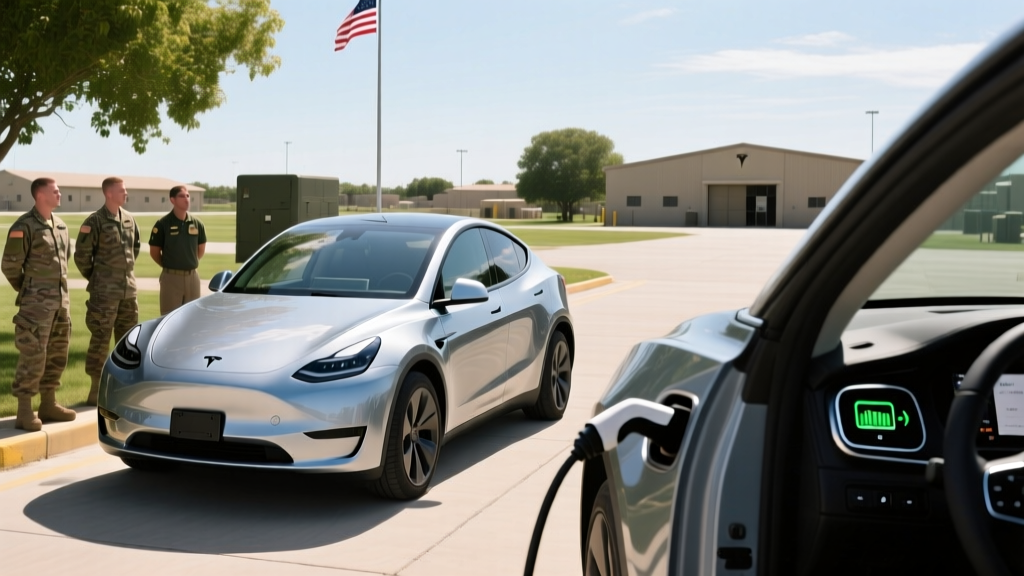
Can I charge a Tesla on a military base?
Some installations have begun adding EV chargers in parking areas and housing, but availability varies widely. Check with your installation's transportation or public works office. You can also use Tesla's mobile connector with a standard 120V outlet for slow overnight charging if your housing unit permits it.
Is a Tesla practical for someone who PCSes every 2-3 years?
Generally yes. Tesla's Supercharger network covers all major interstate corridors, making cross-country drives manageable. The bigger consideration is whether your next duty station has adequate home charging options and whether Tesla service centers are accessible. Use Tesla's website to check Supercharger and service center density near your upcoming assignment.
What's the real-world range of a Tesla Model 3 for daily military commuting?
The Model 3 Long Range AWD is EPA-rated at 341 miles. For a typical daily commute of 20-40 miles round-trip to base, even with climate control and highway speeds, most owners charge once or twice per week at home. Expect 280-300 miles of real-world range in moderate weather and 240-260 miles in freezing temperatures.
Does Tesla offer any financing programs for military members?
Tesla does not offer military-specific financing. However, service members can access competitive auto loans through Navy Federal Credit Union, USAA, and Pentagon Federal Credit Union (PenFed), which often offer rates below market for EV purchases. These institutions may also offer GAP coverage and flexible terms tailored to military pay structures.