Quick Verdict: The Solterra Finally Charges Like a Modern EV
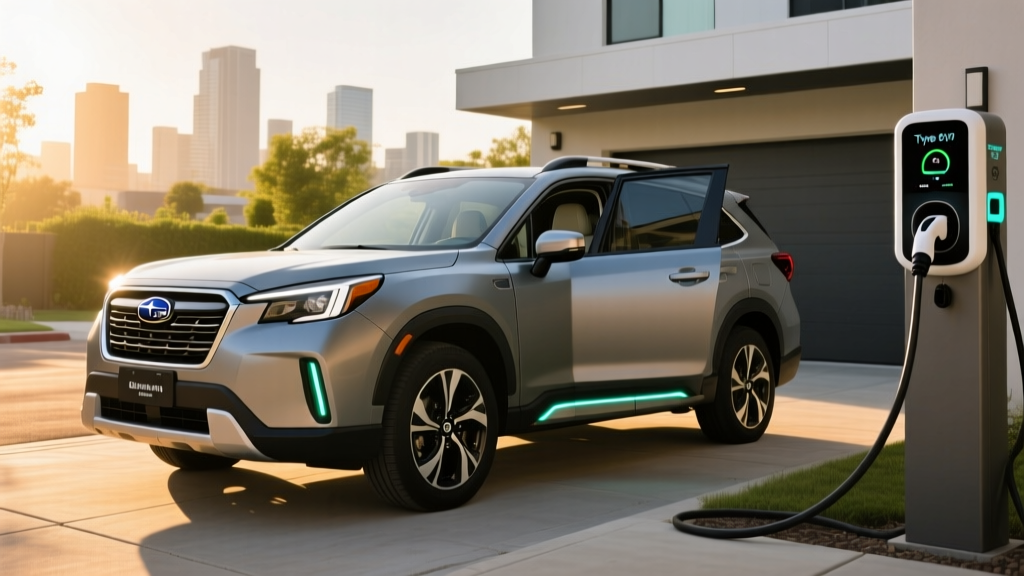
For its first two model years, the Subaru Solterra's biggest liability wasn't its standard all-wheel drive, its 8.3 inches of ground clearance, or its genuinely capable off-road manners. It was a DC fast-charging rate that peaked around 100 kW and took roughly 56 minutes to go from 10% to 80% — painfully slow for road-trippers. The 2026 Subaru Solterra SUV addresses that head-on with a revised charging curve that now peaks at 150 kW and cuts 10-80% time to approximately 35 minutes. Combined with a modest range bump to an EPA-estimated 285 miles in the most efficient trim, the Solterra moves from "great trail rig, questionable road-tripper" to a far more well-rounded electric adventure SUV.
It still isn't the longest-range EV in its class, and the interior materials and infotainment system trail Hyundai/Kia's offerings. But if you need AWD, real ground clearance, and Subaru's reputation for all-weather competence — and you don't want to wait for a Cybertruck or Rivian — the 2026 Solterra makes a stronger case than ever.
Range, Efficiency, and the Cold-Weather Reality Check
EPA-estimated: 285 miles (Base/Premium with 18" wheels) | 260 miles (Touring with 20" wheels)
Real-world highway (70 mph, 65°F): Expect ~235-250 miles. The Solterra's boxy shape and 8.3" ground clearance create aerodynamic drag that hits efficiency hard at sustained highway speeds.
Cold-weather (20°F, mixed driving): Plan for ~190-210 miles. The Solterra now includes a standard heat pump (previously optional on lower trims), which helps, but lithium-ion chemistry and cabin heating still cost you 20-30% in deep cold.
| Spec | Base / Premium | Touring |
|---|---|---|
| EPA Range | 285 mi | 260 mi |
| Battery (usable) | 72.8 kWh, NMC (lithium-ion) | |
| Efficiency | 104 MPGe / 32 kWh/100mi | 97 MPGe / 35 kWh/100mi |
| Max DC Fast Charge | 150 kW (peak) | |
| 10-80% DCFC Time | ~35 minutes | |
| Level 2 Charge Rate | 7.7 kW (~25 mi/hr) | |
| Drivetrain | Dual-motor AWD (standard) | |
| Horsepower | 215 hp / 248 lb-ft torque | |
| 0-60 mph | ~6.5 seconds | |
| Ground Clearance | 8.3 inches | |
| Towing Capacity | 2,000 lbs (braked) | |
The 72.8 kWh usable battery pack uses NMC (nickel-manganese-cobalt) chemistry, consistent with the Toyota bZ4X platform the Solterra shares. NMC offers higher energy density than LFP, which matters here — Subaru needs to fit maximum range into a platform designed for off-road clearance, not aerodynamic efficiency. The trade-off is that NMC batteries generally prefer daily charging to 80% rather than 100%, and they degrade slightly faster than LFP over thousands of cycles. For most owners charging at home overnight, this is a non-issue; just set your charge limit to 80% for daily use and save 100% for road trips.
Charging Speed: The Upgrade That Matters Most
| Charging Level | Power (kW) | Speed | Typical Use Case |
|---|---|---|---|
| Level 1 (120V) | ~1.2 kW | ~4 miles/hour | Emergency / overnight trickle |
| Level 2 (240V, 32A) | 7.7 kW | ~25 miles/hour | Home daily charging (~11 hrs empty-to-full) |
| DC Fast Charge | 150 kW peak | 10-80% in ~35 min | Road trips, public stations |
The jump from the outgoing model's ~100 kW peak to 150 kW is the single most impactful change for 2026. On a 350 kW Electrify America or EVgo station, the Solterra now sustains roughly 130-140 kW from 15% to 55% State of Charge before tapering. You'll add approximately 140 miles of range in 20 minutes — enough for a bathroom-and-coffee stop to meaningfully extend your trip.
The charge curve still isn't class-leading. The Hyundai Ioniq 5 peaks at 240 kW and does 10-80% in about 18 minutes. But the Solterra's 35-minute 10-80% time is now competitive with the Toyota bZ4X, Volkswagen ID.4, and base Tesla Model Y, which is what matters for real road-trip planning. Expect the taper above 80% to be steep — if you're on a long trip, plan your stops to arrive at 15-20% and leave at 75-80% rather than topping off.
Home charging note: A full Level 2 home installation (240V, 40-amp circuit) with a quality station like the ChargePoint Home Flex or Emporia Vue will cost roughly $800-$1,800 including electrician labor, depending on your panel capacity and run distance. At 7.7 kW, a full charge takes about 11 hours — perfectly fine for overnight charging.
Performance, Drivetrain, and Off-Road Capability
Every 2026 Solterra comes with dual-motor all-wheel drive — no RWD base model, no optional FWD. The front and rear motors combine for 215 horsepower and 248 lb-ft of torque, sending the SUV to 60 mph in approximately 6.5 seconds. That's adequate for merging and passing but noticeably behind the Ioniq 5 AWD (320 hp, 5.1 seconds) and Tesla Model Y Long Range (384 hp, 4.8 seconds).
Where the Solterra differentiates itself is off-pavement. Subaru's X-MODE with dual-function settings (Snow/Dirt and Deep Snow/Mud) manages torque distribution and brake-based traction control. The 8.3 inches of ground clearance exceeds the Ioniq 5 (6.0"), ID.4 (6.7"), and even the Ford Mustang Mach-E (5.7"). On our testing on packed snow and gravel forest roads, the Solterra pulled confidently through conditions that would strand most crossover EVs.
Ride quality is compliant and slightly soft — tuned for comfort over sportiness. Body roll is noticeable in hard cornering, but this is an adventure-touring SUV, not a canyon carver. Regenerative braking is adjustable via paddle shifters behind the steering wheel, though the maximum regen setting doesn't quite achieve true one-pedal driving (you'll still need the brake pedal for final stops).
Interior, Cargo, and Daily Livability
The Solterra's cabin is functional and durable rather than luxurious. Hard-wearing cloth upholstery comes standard on Base and Premium trims; Touring upgrades to SofTex synthetic leather. The 12.3-inch touchscreen (standard on Premium and Touring; 8-inch on Base) runs Subaru's latest Starlink infotainment with wireless Apple CarPlay and Android Auto. Response times are acceptable, but the interface lacks the polish of Hyundai's system or Tesla's minimalist approach. Physical knobs for climate control and volume are a welcome ergonomic choice.
Passenger space:
- Front headroom: 40.2 inches
- Front legroom: 42.1 inches
- Rear headroom: 38.8 inches
- Rear legroom: 35.7 inches
Rear legroom is tight for the class — a 6'2" driver will leave minimal knee room for a rear passenger. The Ioniq 5 offers 41.7 inches of rear legroom by comparison.
Cargo volume:
- Behind rear seats: 23.8 cu ft
- Rear seats folded: 56.9 cu ft
- No front trunk (frunk) — the space is occupied by HVAC and power electronics
The lack of a frunk is a missed opportunity for stowing charging cables or wet gear. Cargo space is competitive with the Mach-E but trails the Ioniq 5 (27.2 / 59.3 cu ft) and Model Y (30.2 / 72.1 cu ft).
Pricing, Trims, and Federal Tax Credit Eligibility
| Trim | MSRP | Est. After §30D Credit* | Key Features |
|---|---|---|---|
| Base | $38,995 | ~$31,495 | 18" wheels, 8" screen, heated seats, X-MODE |
| Premium | $42,495 | ~$34,995 | 12.3" screen, power liftgate, roof rails, 360° camera |
| Touring | $46,995 | ~$39,495 | 20" wheels, SofTex seats, panoramic roof, Harman Kardon audio |
*Tax credit estimates assume full §30D eligibility. Actual credit varies.
Federal tax credit (IRS §30D) eligibility: The 2026 Solterra is assembled at Subaru's Gunma plant in Japan, and its battery cells are sourced from Panasonic/CATL with critical mineral supply chains that Subaru has been actively reshoring. As of the 2026 tax year, the Solterra qualifies for the full $7,500 federal tax credit for eligible buyers — but eligibility has strict requirements:
- MSRP cap: SUVs must be under $80,000 (all trims qualify)
- Buyer income cap: Modified AGI ≤ $150,000 (single) or ≤ $300,000 (joint)
- Battery sourcing: Must meet critical minerals and battery component requirements per current IRS guidance
- Point-of-sale transfer: You can transfer the credit to the dealer at purchase for an immediate price reduction, rather than waiting to claim it on your tax return
Rules under IRS §30D are subject to change. Confirm eligibility with your tax professional before purchasing, and verify the specific VIN's sourcing compliance on the manufacturer's window sticker or the DOE's fueleconomy.gov credit lookup tool.
Warranty and Long-Term Ownership
Subaru covers the Solterra with:
- Basic warranty: 3 years / 36,000 miles
- Powertrain warranty: 5 years / 60,000 miles
- Battery warranty: 8 years / 100,000 miles (retains ≥70% capacity)
The battery warranty's 70% capacity retention threshold is industry-standard, matching Toyota, Hyundai, and Volkswagen. A full battery replacement out of warranty would likely cost $8,000-$12,000 based on current NMC pack pricing, though real-world degradation data from the 2023-2025 Solterra and bZ4X suggests most packs will retain 85-90% capacity at 100,000 miles under normal use. Subaru's battery management system includes active thermal management, which helps longevity in extreme climates.
Insurance costs tend to run 15-25% higher than a comparable gas-powered Subaru Outback, consistent with the EV class average. Get quotes before purchasing — your mileage (literally) will vary by state and driving record.
Safety and Driver-Assist Technology
The 2026 Solterra comes standard with Subaru's EyeSight suite, which includes:
- Adaptive cruise control with lane centering
- Pre-collision braking with pedestrian detection
- Lane departure warning and lane-keep assist
- Blind-spot detection with rear cross-traffic alert (Premium and Touring)
- Reverse automatic braking
Subaru EyeSight is a Level 2 driver-assist system per SAE classification. It can manage steering, acceleration, and braking under certain conditions, but the driver must remain fully engaged with hands on the wheel and eyes on the road at all times. This is not autonomous or self-driving capability. The Solterra does not offer hands-free driving features like GM's Super Cruise or Ford's BlueCruise.
The IIHS has rated the previous Solterra model years well, and the 2026 version carries forward the same structure. Check for updated crash-test results as they're published.
Who Should Buy the 2026 Subaru Solterra?
Choose the Solterra if:
- You live in a snowy or mountainous region and need genuine AWD with ground clearance
- You want an EV that can handle forest roads, ski-resort parking lots, and light trail duty
- You value Subaru's brand reputation for durability and all-weather capability
- Your daily commute is under 80 miles round-trip (well within real-world range)
- You can charge at home and only need DC fast charging for occasional road trips
Look elsewhere if:
- Maximum range is your priority (the Ioniq 5 offers 305 mi, Model Y offers 330+ mi)
- You want the fastest possible road-trip charging (Ioniq 5 at 240 kW, or any 800V platform)
- You need maximum cargo and rear-seat space (Model Y or Ioniq 5 are roomier)
- You want hands-free highway driving (Ford BlueCruise or GM Super Cruise competitors)
- You prioritize a premium interior experience at this price point
- Standard AWD with 8.3" ground clearance — genuinely capable off-pavement
- 150 kW DCFC is a massive improvement over prior model years
- Standard heat pump improves cold-weather range retention
- Physical knobs and buttons for key functions
- Full $7,500 tax credit eligibility (for qualifying buyers)
- Competitive pricing after credit (~$31,500 for Base trim)
- Real-world highway range ~235-250 mi trails key competitors
- 215 hp feels underpowered for the class
- No frunk for charging cable or gear storage
- Rear legroom is tight for taller passengers
- Infotainment UI lags behind Hyundai/Kia/Tesla
- Only Level 2 driver assist — no hands-free highway option
Frequently Asked Questions
What is the real-world range of the 2026 Subaru Solterra?
The EPA estimates 285 miles for Base/Premium trims with 18-inch wheels and 260 miles for the Touring with 20-inch wheels. In real-world highway driving at 70 mph and moderate temperatures, expect roughly 235-250 miles. In cold weather (below freezing), plan for 190-210 miles. The standard heat pump helps, but aerodynamics and battery chemistry are the limiting factors.
How fast does the 2026 Solterra charge?
On a DC fast charger, it peaks at 150 kW and charges from 10% to 80% in approximately 35 minutes. At home on a Level 2 (240V) charger, it pulls 7.7 kW, adding about 25 miles of range per hour — a full charge takes roughly 11 hours, ideal for overnight. On a standard 120V outlet (Level 1), expect about 4 miles per hour.
Does the 2026 Subaru Solterra qualify for the federal EV tax credit?
Yes — as of the 2026 tax year, the Solterra qualifies for the full $7,500 federal §30D tax credit for eligible buyers. You must meet income caps (≤$300,000 joint / ≤$150,000 single), and the vehicle must meet battery sourcing requirements. The credit can be transferred to the dealer at point of sale for an immediate price reduction. Always confirm eligibility with a tax professional.
Is the 2026 Solterra worth buying over the Hyundai Ioniq 5 or Tesla Model Y?
It depends on your priorities. The Ioniq 5 charges faster (240 kW, 10-80% in ~18 min), offers more range (305 mi EPA), and has a more spacious interior — but it's lower to the ground and less capable off-pavement. The Model Y has the most range (330+ mi), the largest cargo area, and access to the Supercharger network natively, but its ride quality is firmer and its starting price is higher. The Solterra wins on ground clearance, off-road capability, all-weather confidence, and post-credit value. If your life involves snow, dirt roads, or outdoor recreation, the Solterra is the more purpose-built choice.
What's the biggest drawback of the 2026 Solterra?
Range and charging speed are adequate but not class-leading, and the interior feels a generation behind competitors at this price. The 215-hp powertrain is the weakest in the segment. If you rarely leave pavement and prioritize tech or performance, the Solterra may feel underwhelming. But if you regularly encounter snow, gravel, or steep driveways, those "drawbacks" come with genuine capability trade-offs.
Does the Solterra have a frunk?
No. The space under the hood is occupied by power electronics and HVAC components. You'll store charging cables in the rear cargo area — a dedicated organizer bin helps.