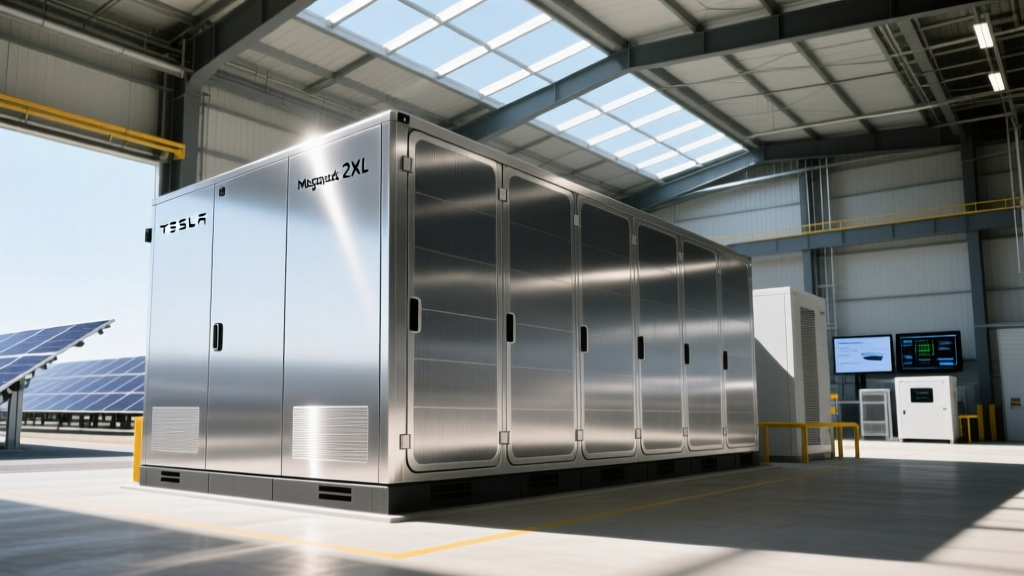
If you landed here searching for the Tesla Megapack 2XL expecting an electric vehicle review, let's clear the air immediately: the Megapack 2XL is not a car. It is a utility-scale battery energy storage system (BESS) designed for power grids, renewable energy farms, and industrial microgrids. It doesn't have wheels, a steering wheel, or an EPA range sticker — and it certainly won't fit in your garage.
But the Megapack 2XL is one of the most consequential pieces of electrification hardware on the planet in 2026, and understanding it matters for every EV owner. Grid-scale storage is what keeps the lights on, stabilizes the electrical grid your home charger draws from, and enables the renewable energy buildout that makes driving electric genuinely cleaner. Here's a deep, data-driven breakdown of what the Megapack 2XL actually is, what it costs, and how it fits into the broader EV ecosystem.
What Is the Tesla Megapack 2XL?
The Tesla Megapack 2XL is Tesla's largest commercially deployed battery storage unit as of 2026, succeeding and scaling up the original Megapack platform. Each Megapack 2XL unit is a self-contained, containerized lithium-ion battery system rated at approximately 3.9 MWh (3,900 kWh) of energy capacity and 1.5 MW of continuous power output. For context, that single unit holds roughly 50 times the energy of a Tesla Model S Long Range battery pack (~75 kWh usable) and can discharge at a rate sufficient to power approximately 1,200 average U.S. homes for one hour.
Megapack 2XL units are deployed in arrays — typically dozens to hundreds of units wired together at a single site — to form installations ranging from 50 MWh to over 3 GWh of total storage. Tesla's Moss Landing project in California and the Victorian Big Battery in Australia are among the most prominent deployments using the Megapack platform.
The Megapack 2XL is sold exclusively to utilities, independent power producers (IPPs), commercial/industrial energy buyers, and grid operators through Tesla's energy division. It is not available for residential purchase, and Tesla does not sell individual units to consumers.
Megapack 2XL Core Specifications
| Specification | Value |
|---|---|
| Energy Capacity | ~3.9 MWh (3,900 kWh) per unit |
| Power Output | ~1.5 MW continuous per unit |
| Battery Chemistry | LFP (Lithium Iron Phosphate) |
| Round-Trip Efficiency | ~92% (AC-AC) |
| Design Lifespan | 20–25 years / 10,000+ cycles |
| Thermal Management | Liquid cooling with integrated HVAC |
| Form Factor | Standard shipping container footprint (~40 ft) |
| Weight (per unit) | ~84,000 lbs (38,000 kg) |
| Operating Temperature | -22°F to 122°F (-30°C to 50°C) |
| Grid Interconnection | Medium-voltage AC (integrated inverter) |
| Software Platform | Tesla Autobidder + Powerhub |
| Typical Project Scale | 50 MWh – 3+ GWh (multi-unit arrays) |
| Base Unit Price (estimated) | ~$1.0–1.3 million per unit (B2B, volume-dependent) |
Battery Chemistry: Why LFP for Grid Storage
The Megapack 2XL uses LFP (Lithium Iron Phosphate) cathode chemistry — the same chemistry found in the standard-range Tesla Model 3 and Model Y, but optimized for stationary rather than mobile use. The choice is deliberate and driven by physics and economics:
- Cycle life: LFP cells tolerate 6,000–10,000+ full charge-discharge cycles before reaching 80% capacity retention, compared to roughly 1,500–3,000 cycles for NMC (Nickel Manganese Cobalt). Grid storage units cycle daily — sometimes twice daily — so longevity is paramount.
- Thermal stability: LFP chemistry is inherently more resistant to thermal runaway than NMC, a critical safety factor when thousands of cells are packed into a container deployed near populated areas.
- Cost per kWh: LFP cells are cheaper to manufacture than NMC, primarily because they use iron and phosphate rather than nickel and cobalt. At grid scale, even a $10/kWh cost difference translates to millions of dollars per project.
- Energy density trade-off: LFP has lower energy density than NMC, which matters in a car where weight and volume are constrained but is largely irrelevant for a stationary container on a concrete pad.
Tesla sources LFP cells primarily from CATL (Contemporary Amperex Technology Co. Limited) for its Megapack production at the Shanghai Megafactory, which began production in early 2025 and significantly expanded Tesla's global Megapack output capacity.
How the Megapack 2XL Affects EV Owners
You can't buy a Megapack 2XL, but you benefit from them every time you plug in your EV. Here's the practical connection:
Grid stabilization and peak shaving: Utilities deploy Megapack arrays to store excess electricity during off-peak hours (when solar and wind generation is high and demand is low) and discharge it during peak demand windows. This reduces the need for utilities to fire up expensive and polluting "peaker" natural gas plants — plants that often run precisely when EV owners come home and plug in around 6–9 PM.
Renewable firming: Solar farms paired with Megapack storage can deliver power after sunset, which directly supports evening EV charging with clean energy rather than fossil generation. Projects like Edwards & Sanborn in California (875 MW solar + 3,287 MWh storage) use Megapack-class systems to make solar effectively dispatchable around the clock.
Charging infrastructure support: High-power DC fast charging stations — particularly those with 350 kW+ chargers — can create enormous instantaneous demand spikes on local distribution grids. Some charging networks and commercial sites are beginning to co-locate battery storage (sometimes Megapack-class, sometimes smaller systems like Tesla's Powerpack) to buffer grid demand, reduce demand charges, and enable fast-charger deployment in areas with limited grid capacity.
Pricing, Procurement, and Project Economics
Tesla does not publish a public MSRP for the Megapack 2XL. Pricing is negotiated on a per-project basis and depends on unit volume, installation complexity, grid interconnection requirements, and long-term service agreements. Based on industry reporting and Tesla's energy generation and storage segment filings, here's what the economics look like in 2026:
| Cost Component | Estimated Range |
|---|---|
| Battery unit (hardware + integrated inverter) | $1,000,000 – $1,300,000 |
| Balance of system (switchgear, transformers, cabling) | $100,000 – $200,000 |
| Installation & commissioning (per unit, at scale) | $50,000 – $150,000 |
| Software licensing (Autobidder/Powerhub) | Variable (often % of revenue or fixed annual) |
| Long-term service agreement (15–20 yr) | Negotiated separately |
| Estimated all-in cost per MWh | $280,000 – $380,000 |
At an all-in installed cost of roughly $300,000–$350,000 per MWh, a 100 MWh project (approximately 26 Megapack 2XL units) represents a capital investment of $30–35 million. These projects typically generate revenue through a combination of energy arbitrage (buying low, selling high on wholesale markets), frequency regulation services, capacity market payments, and contracted services to utilities — with internal rates of return (IRR) in the 8–12% range depending on market structure.
Tesla's Megapack order backlog reportedly extended well into 2027 as of late 2025, reflecting strong global demand driven by renewable energy deployment mandates, grid reliability concerns, and falling battery costs.
Megapack 2XL vs. Competing Grid Battery Systems
Tesla is the most visible player in grid-scale storage but far from the only one. Here's how the Megapack 2XL stacks up against key competitors in 2026:
| Feature | Tesla Megapack 2XL | Fluence Cube (Siemens/AES) | BYD MC Cube-T | CATL EnerC |
|---|---|---|---|---|
| Energy per unit | ~3.9 MWh | ~3.7 MWh | ~3.3 MWh | ~3.4 MWh |
| Chemistry | LFP | LFP | LFP (Blade cells) | LFP |
| Integrated inverter | Yes | Yes | Yes | Yes |
| Software platform | Autobidder (proprietary) | Fluence IQ | BYD proprietary | Third-party compatible |
| Cycle life (to 80% SoH) | 10,000+ | 8,000–10,000 | 10,000+ | 10,000+ |
| Primary market | US, Australia, Europe, Asia | Global | China, Asia, Europe | China, global via integrators |
| Key advantage | Vertical integration + Autobidder AI trading | Open platform, multi-supplier cells | Blade cell safety, cost | Cell-level cost leadership |
Tesla's primary competitive moat is not hardware alone — it's the Autobidder software platform, which uses machine learning to autonomously trade stored energy on wholesale electricity markets, optimizing revenue in real time. For project developers and investors, Autobidder's track record of maximizing dispatch revenue in markets like Australia's National Electricity Market (NEM) and the UK's Balancing Mechanism has become a significant differentiator in procurement decisions.
What This Means for the EV Ecosystem in 2026
The Megapack 2XL is part of a broader trend that directly benefits EV owners: the decoupling of renewable energy generation from real-time consumption. As grid-scale storage costs continue to decline (down roughly 40% since 2020 on a per-MWh basis), the business case for pairing solar and wind with battery storage strengthens, accelerating the retirement of fossil peaker plants and reducing the carbon intensity of the grid that charges your EV.
For EV buyers focused on the real environmental impact of electrification, the grid is getting cleaner faster than many realize — and Megapack-class storage is a primary driver. According to U.S. Energy Information Administration (EIA) data, U.S. utility-scale battery storage capacity surpassed 25 GW by early 2026, with projections to exceed 80 GW by 2028.
If you're evaluating an EV purchase and want to understand the full lifecycle emissions picture, the grid your car charges from matters enormously. States with heavy Megapack and renewable deployment — California, Texas, Arizona, Nevada — are seeing their grid emission factors drop year over year, making every electric mile genuinely cleaner.
Frequently Asked Questions
Can I buy a Tesla Megapack 2XL for my home?
No. The Megapack 2XL is a utility-scale product sold exclusively to commercial, utility, and industrial buyers. For residential energy storage, Tesla offers the Powerwall 3 (~13.5 kWh capacity, ~$9,200 before installation) designed for home solar pairing and backup power. A single Megapack 2XL holds roughly 290 times the energy of a Powerwall 3 and requires medium-voltage grid interconnection that no residential electrical system can accommodate.
How does Megapack storage affect my EV charging cost?
Indirectly but meaningfully. Grid-scale storage reduces peak wholesale electricity prices by displacing expensive peaker plants. In markets with significant storage deployment, peak-hour electricity prices have dropped 20–40% during high-demand periods. If you're on a time-of-use (TOU) rate plan, these wholesale savings gradually translate into lower retail rates — and if you charge during off-peak hours when stored renewable energy is abundant, you're already benefiting from the storage ecosystem Megapack enables.
Is the Megapack 2XL eligible for any federal tax credits?
Yes, but not the §30D consumer EV credit. Grid-scale battery storage systems qualify under the §48 Investment Tax Credit (ITC) as expanded by the Inflation Reduction Act, which offers a base 30% tax credit for qualifying energy storage property placed in service. Additional bonus adders (10% domestic content, 10–20% energy community, 10–20% low-income community) can push the total credit to 50–70% of project cost for qualifying deployments. Consult IRS guidance on the ITC and a qualified tax professional for project-specific eligibility.
What happens when Megapack batteries degrade?
Tesla designs Megapack 2XL systems for a 20–25 year operational life with LFP chemistry that maintains high cycle life. When units eventually reach end-of-life, Tesla's battery recycling program (through partners like Redwood Materials) recovers lithium, iron, phosphate, copper, and aluminum for reuse. The modular design also allows individual battery modules to be replaced within a unit rather than scrapping the entire system.
Where are Megapack 2XL units manufactured?
As of 2026, Tesla manufactures Megapack units at two primary facilities: the original Lathrop, California Megafactory (opened 2022, expanded through 2025) and the Shanghai Megafactory (production began early 2025). Combined, these facilities have pushed Tesla's annual Megapack production capacity well above 40 GWh, though demand continues to outstrip supply with order backlogs extending 18–24 months.
Does Megapack deployment make my EV "greener"?
Yes — measurably. A 2024 study by the National Renewable Energy Laboratory (NREL) found that each MWh of grid-scale storage deployed in the U.S. reduces grid CO₂ emissions by an average of 100–300 metric tons annually by enabling higher renewable penetration and displacing fossil peaker generation. As an EV owner, the carbon intensity of your electricity directly determines your vehicle's well-to-wheel emissions. More Megapack-class storage on your grid means cleaner electrons in your battery.
The Bottom Line
The Tesla Megapack 2XL isn't a vehicle — it's infrastructure. At 3.9 MWh per unit and roughly $1 million+ per container, it's purpose-built for utilities and energy developers, not consumers. But every EV owner benefits from the grid stability, renewable integration, and peak-price suppression that Megapack deployments provide. If you care about the real-world environmental impact of driving electric, understanding and supporting grid-scale storage deployment is just as important as choosing the right EV.