Tesla Lowered the Sticker — But Does the Math Still Work?
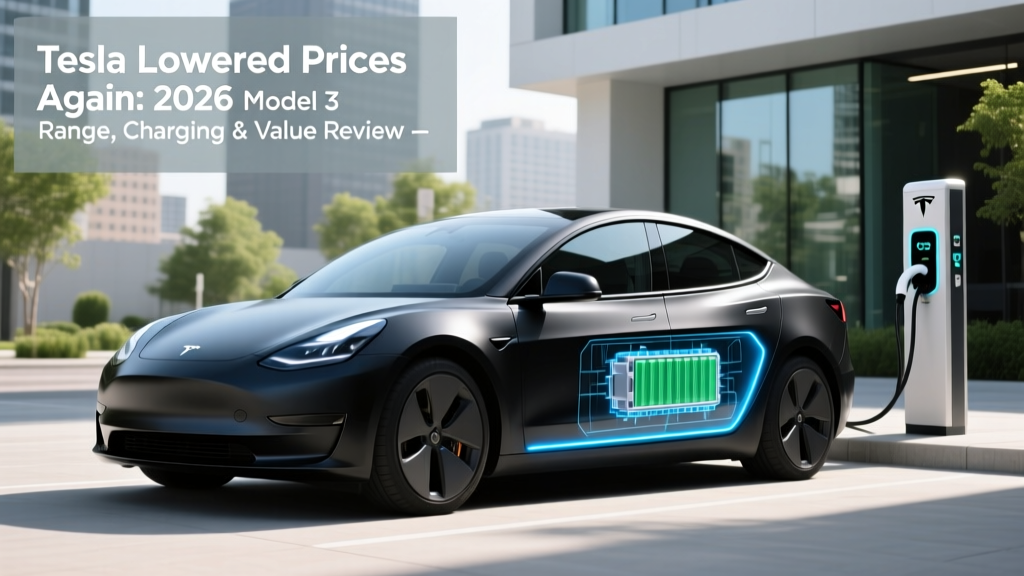
When Tesla lowered prices across its lineup heading into 2026, the Model 3 saw some of the most aggressive cuts in its history. The base Rear-Wheel Drive trim now starts at an MSRP of $36,990 before incentives — a figure that positions it squarely against the Hyundai Ioniq 6, BMW i4, and the refreshed Chevrolet Bolt successor. But a lower price tag only matters if the underlying product delivers on range, charging speed, and daily usability. After spending time with the 2026 Model 3, here is what the numbers actually look like on the road, at the charger, and on your tax return.
Range and Efficiency: EPA vs. the Real World
The 2026 Model 3 Long Range AWD carries an EPA-estimated 341 miles of range, while the base RWD variant is rated at 272 miles. Efficiency remains a Tesla strong suit, with the Long Range achieving approximately 25 kWh per 100 miles (roughly 135 MPGe combined), according to fueleconomy.gov.
EPA Estimate: 341 miles (Long Range AWD) / 272 miles (RWD)
Expect on a 70-mph highway drive: ~290–310 miles (Long Range), ~235–250 miles (RWD)
Cold weather (below 32°F): Subtract 15–25% — plan for ~255–275 miles in the Long Range during winter commutes
City/regenerative driving: Often matches or slightly exceeds EPA thanks to aggressive regen and low idle losses
The Long Range model uses an NMC (nickel manganese cobalt) lithium-ion pack with approximately 75 kWh of usable capacity. The RWD variant uses an LFP (lithium iron phosphate) battery at roughly 57.5 kWh usable. LFP chemistry trades some energy density for longer cycle life and the ability to charge routinely to 100% without degradation concerns — a genuine advantage for daily commuters who can charge at home each night.
Charging Speed: DC Fast Charge and Home Level 2
Charging speed is where Tesla's Supercharger network advantage becomes tangible. The Model 3 Long Range peaks at approximately 250 kW on a V3 Supercharger, while the RWD LFP variant peaks closer to 170 kW.
| Charging Level | Power / Rate | Speed (approx.) | Notes |
|---|---|---|---|
| DC Fast Charge (Long Range) | Peak 250 kW | 10–80% in ~25 min | Charge curve tapers significantly above 80%; add ~15 min for 80–100% |
| DC Fast Charge (RWD/LFP) | Peak 170 kW | 10–80% in ~30 min | Flatter charge curve holds closer to peak longer, partially offsetting lower peak |
| Level 2 Home (48A / 11.5 kW) | 11.5 kW | ~44 mi/hr added | Full charge in ~7 hours (Long Range); requires 60A circuit |
| Level 2 Home (32A / 7.7 kW) | 7.7 kW | ~30 mi/hr added | Adequate for daily commutes under 80 miles round-trip |
| Level 1 (120V) | ~1.4 kW | ~5 mi/hr added | Emergency/trickle only — not practical for daily use |
One nuance many buyers miss: peak kW is not sustained kW. The Model 3 Long Range hits 250 kW only at a low state of charge (roughly 10–20% SoC) and tapers steadily, dropping below 100 kW past 60% SoC. Tesla's navigation system preconditions the battery when you route to a Supercharger, which is essential for achieving advertised speeds — arriving at a Supercharger without preconditioning can add 5–10 minutes to your session, especially in cold weather.
With the NACS connector now adopted industry-wide, the Model 3 also accesses third-party networks like Electrify America and EVgo via adapter-free native compatibility at NACS-equipped stations — an increasingly relevant advantage as competitors transition from CCS.
Performance and Driving Dynamics
The 2026 Model 3 Long Range AWD produces approximately 346 horsepower from its dual-motor setup, achieving a 0–60 mph time of 4.2 seconds. The RWD variant delivers around 271 hp and runs 0–60 in 5.8 seconds. Both figures remain competitive in the segment.
| Spec | RWD | Long Range AWD | Performance AWD |
|---|---|---|---|
| EPA Range | 272 mi | 341 mi | 315 mi |
| Battery (usable) | ~57.5 kWh (LFP) | ~75 kWh (NMC) | ~75 kWh (NMC) |
| 0–60 mph | 5.8 sec | 4.2 sec | 2.9 sec |
| Horsepower | 271 hp | 346 hp | 510 hp |
| Drivetrain | RWD | Dual-Motor AWD | Dual-Motor AWD |
| Top Speed | 125 mph | 125 mph | 163 mph |
| Peak DC Charge | 170 kW | 250 kW | 250 kW |
The refreshed Model 3 (internally called "Highland") improved ride quality substantially over pre-2024 versions, with revised damping and acoustic glass that cut cabin noise noticeably. It remains a firm-riding sedan, however — those prioritizing plush compliance should cross-shop the Ioniq 6 or Genesis Electrified G80.
Interior Space, Tech, and Standout Features
Interior dimensions place the Model 3 firmly in the compact sport sedan category. Rear legroom measures 35.3 inches, and cargo volume totals 23 cubic feet with the 60/40 split rear seats folded (including the frunk). The trunk opening is a conventional sedan shape — less versatile than a hatchback like the Model Y or Ioniq 5 for bulky items.
The 15.4-inch center touchscreen controls virtually every vehicle function, including climate, mirrors, and glovebox — a minimalist approach that some owners love and others find distracting. A rear 8-inch screen was added in the Highland refresh for rear-seat passengers. Tesla's infotainment remains the benchmark for responsiveness, over-the-air updates, and integrated trip planning with Supercharger routing.
Autopilot comes standard and includes adaptive cruise control and lane-centering. Full Self-Driving (Supervised) is an optional upgrade that adds automated lane changes, traffic light recognition, and more assertive navigation — but it remains an SAE Level 2 system requiring continuous driver attention. It is not autonomous driving.
Tesla Autopilot and FSD (Supervised) are SAE Level 2 driver-assistance systems. The driver must remain fully engaged, hands on or near the wheel, and eyes on the road at all times. These systems do not make the vehicle self-driving. Performance degrades in construction zones, heavy rain, faded lane markings, and unmapped roads.
Pricing, Tax Credit Eligibility, and Total Value
Tesla lowered MSRPs heading into 2026 as part of a broader pricing strategy to maintain volume amid increasing competition. Here is where the trims land:
| Trim | Base MSRP | Est. Federal Credit (§30D) | Effective Price |
|---|---|---|---|
| Model 3 RWD | $36,990 | Up to $7,500* | ~$29,490 |
| Model 3 Long Range AWD | $42,990 | Up to $7,500* | ~$35,490 |
| Model 3 Performance AWD | $52,990 | Up to $7,500* | ~$45,490 |
*Federal tax credit caveats: The §30D credit, as outlined by the IRS, requires the buyer to meet income caps ($150,000 single / $300,000 joint modified AGI), the vehicle MSRP must not exceed $55,000 for sedans, and critical mineral and battery component sourcing thresholds must be satisfied. Tesla's US-built vehicles have historically met sourcing requirements, but eligibility can shift with supply chain changes. The credit can now be transferred to the dealer at point of sale, reducing your out-of-pocket cost at purchase. Always verify current-year eligibility with a tax professional before relying on the credit in your budget.
Warranty, Ownership Costs, and Longevity
Tesla covers the Model 3 with a 4-year/50,000-mile limited vehicle warranty and an 8-year/100,000-mile battery and drive unit warranty (120,000 miles for the Long Range). The warranty guarantees the battery will retain at least 70% of its original capacity during the coverage period.
Real-world degradation data from fleet aggregators suggests Tesla's NMC packs lose approximately 10–12% capacity over the first 100,000 miles, with the curve flattening thereafter. LFP packs in the RWD model tend to show slightly slower degradation but start from a lower total capacity. Tesla's service network remains more limited than legacy automakers, and body repair costs after collisions tend to run higher due to aluminum-intensive construction and proprietary parts — a factor worth considering for insurance quotes.
- Class-leading Supercharger network access with native NACS
- Best-in-segment efficiency (kWh/100mi)
- Aggressive post-price-cut MSRP makes it one of the most affordable premium EV sedans
- OTA updates continuously add features post-purchase
- LFP option allows daily 100% charging without degradation worry
- Touchscreen-only controls for climate, mirrors, and glovebox
- Firm ride quality compared to comfort-oriented rivals
- Sedan trunk limits cargo versatility vs. hatchback/crossover competitors
- FSD (Supervised) subscription cost adds up without delivering true autonomy
- Limited service center density in rural areas
Who Should Buy the 2026 Model 3?
The Model 3 is best suited for tech-forward commuters and road-trip-capable households who have access to home Level 2 charging and value efficiency and charging-network reliability above all else. The Long Range AWD is the sweet spot for most buyers — its 341-mile EPA rating and 250 kW charging capability make it genuinely viable for 300+ mile road trips with a single brief stop.
The RWD/LFP variant is ideal for budget-conscious daily drivers with commutes under 80 miles round-trip who can charge nightly at home. Its lower MSRP and LFP longevity make it an outstanding value play, especially after the tax credit.
Consider alternatives if you need hatchback cargo space (look at the Model Y or Ioniq 5), prioritize ride comfort over sportiness (Ioniq 6, BMW i4), or lack home charging access and rely entirely on public infrastructure in a non-Supercharger-dense area.
Frequently Asked Questions
What is the real-world range of the 2026 Tesla Model 3?
The Long Range AWD is EPA-rated at 341 miles, but expect roughly 290–310 miles on sustained highway driving at 70 mph, and 255–275 miles in freezing temperatures. The RWD model's 272-mile EPA rating translates to approximately 235–250 miles highway. City driving with regenerative braking often returns results close to or slightly above the EPA sticker.
How fast does the Model 3 charge at home and on road trips?
On a 48-amp Level 2 home charger (11.5 kW), the Model 3 adds roughly 44 miles of range per hour, achieving a full charge overnight. On Tesla V3 Superchargers, the Long Range peaks at 250 kW and charges from 10–80% in approximately 25 minutes. The RWD peaks at 170 kW with a 10–80% time around 30 minutes.
Does the 2026 Model 3 qualify for the $7,500 federal EV tax credit?
The Model 3 qualifies for up to $7,500 under §30D for eligible buyers, provided your income falls under the caps ($150K single / $300K joint), the vehicle MSRP is under $55,000 (sedan cap — all trims comply), and battery sourcing requirements are met. The credit can be applied at point of sale. Verify current eligibility on irs.gov and with a tax professional.
Is the Model 3 worth buying vs. the Hyundai Ioniq 6 or BMW i4?
The Model 3 wins on charging-network access (Supercharger), efficiency, and post-price-cut value. The Ioniq 6 offers more rear-seat headroom and a hatchback-like rear window, while the BMW i4 provides a more traditional luxury interior and dealer service network. If Supercharger reliability matters to you for road trips, the Model 3 holds a clear edge.
How long will the Model 3 battery last?
Tesla warranties the battery for 8 years / 100,000–120,000 miles (depending on trim) with a 70% capacity retention floor. Real-world data indicates 10–12% degradation over 100,000 miles for NMC packs, with LFP packs showing marginally slower loss. A battery replacement outside warranty currently costs between $12,000–$16,000 depending on the pack.