The Cybertruck's Safety Paradox: What Crash Data Actually Shows
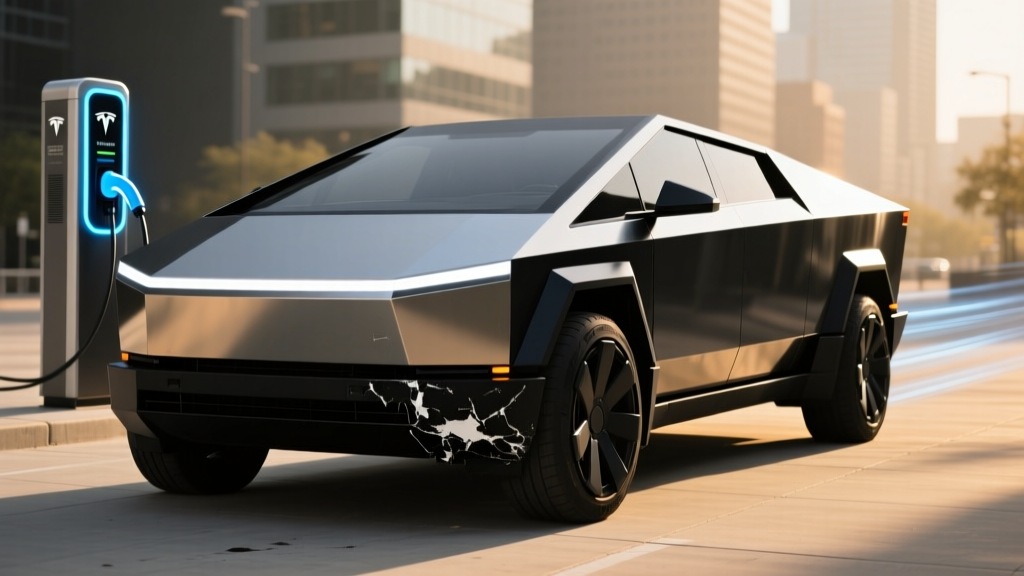
The Tesla Cybertruck's angular stainless-steel exoskeleton was marketed as nearly indestructible, but a growing volume of viral Cybertruck car crash footage — from highway pileups to single-vehicle loss-of-control incidents — has raised legitimate questions about how Tesla's polarizing electric pickup actually performs when the unthinkable happens. As of early 2026, the Cybertruck occupies an unusual position: it is one of the best-selling vehicles in America, yet it lacks full crash-test ratings from both the National Highway Traffic Safety Administration (NHTSA) and the Insurance Institute for Highway Safety (IIHS).
This review goes beyond the viral clips. We break down what's known about Cybertruck crashworthiness, its real-world safety record, and — because safety is only one part of the ownership equation — we cover the full spec sheet: range, charging, pricing, and whether it still qualifies for federal tax credits.
Real-World Range vs. the EPA Sticker
The Cybertruck is offered in three trims for 2026, each with a different battery configuration and range profile. Tesla's claimed EPA figures are competitive for a full-size electric truck, but real-world results tell a more nuanced story — particularly for buyers in cold climates or those who plan to tow.
• Dual Motor AWD: EPA 340 mi → Expect ~280-310 mi highway; ~240-260 mi in sub-30°F weather
• Cyberbeast (Tri-Motor): EPA 320 mi → Expect ~260-290 mi highway; ~220-245 mi cold
• Rear-Wheel Drive (base, announced 2025): EPA 250 mi (est.) → Expect ~210-230 mi highway
The large stainless-steel body creates significant aerodynamic drag at highway speeds (Cd ~0.34, higher than the Rivian R1T), which cuts range by 10-15% on sustained 75+ mph runs. Cold weather compounds this: the steel exoskeleton conducts heat away from the cabin faster than aluminum or composite bodies, forcing the heat pump to work harder and drawing additional energy from the pack.
Battery, Charging & Efficiency Specs
Tesla does not publish exact usable battery capacity for the Cybertruck, but teardown analysis and EPA test data indicate a usable pack of approximately 123 kWh for the Dual Motor and 123 kWh for the Cyberbeast (with slightly different cell configurations). The chemistry is Tesla's latest-generation NMC (nickel-manganese-cobalt) 4680 cells — not LFP, meaning the pack prioritizes energy density over cycle longevity. Tesla recommends daily charging to 80-90% for NMC health, reserving 100% for trips.
| Spec | Dual Motor AWD | Cyberbeast (Tri-Motor) |
|---|---|---|
| EPA Range | 340 mi | 320 mi |
| Battery (usable, est.) | ~123 kWh, NMC 4680 | ~123 kWh, NMC 4680 |
| Max DC Fast Charge | 250 kW (peak) | 250 kW (peak) |
| 10-80% DC Time | ~22 min (preconditioned) | ~22 min (preconditioned) |
| Level 2 Home Charge | 11.5 kW (~37 mi/hr) | 11.5 kW (~37 mi/hr) |
| 0-60 mph | 3.9 sec | 2.6 sec |
| Horsepower | 600 hp | 845 hp |
| Efficiency (MPGe) | ~67 MPGe combined | ~64 MPGe combined |
| Towing Capacity | 11,000 lbs | 11,000 lbs |
On the EPA's fueleconomy.gov database, the Dual Motor AWD achieves roughly 2.0 kWh/mile (50 kWh/100 mi) in mixed driving — making it one of the least efficient EVs on the market per mile, a consequence of its 6,800+ lb curb weight and boxy aero. For context, the Rivian R1T Dual-Motor lands around 2.1 kWh/mi, so they're in the same ballpark.
Charging in Practice: The 800V Architecture Advantage
The Cybertruck uses an 800-volt architecture (similar to the Hyundai Ioniq 5 and Porsche Taycan), which enables faster charging at compatible stations. At a Tesla V4 Supercharger (which supports up to 350 kW), the Cybertruck peaks around 250 kW with proper battery preconditioning. However, the charge curve tapers significantly above 60% SoC — expect the 60-80% portion to take nearly as long as 10-60%. Above 80%, charging drops below 50 kW, so plan your road-trip stops to leave at 80% rather than waiting for a full charge.
At home on a Tesla Wall Connector (48A/11.5 kW), a full 10-100% charge takes approximately 11 hours. Owners with 60A circuits and a hardwired Wall Connector will see the best daily charging experience; those limited to 32A (NEMA 14-50) will add roughly 25 miles per hour of charging.
Crash Safety: What We Know (and Don't Know)
The viral Cybertruck car crash videos that circulate online tend to fall into a few categories, and each tells a different story about the vehicle's safety profile:
Single-vehicle loss-of-control incidents account for a disproportionate share of Cybertruck crash footage. The truck's steer-by-wire system, aggressive instant torque (especially in Cyberbeast trim), and 6,800-lb mass create a vehicle that requires respect. Tesla's stability control is active, but physics is physics — a heavy, high-torque vehicle on wet or icy roads will challenge any traction system.
Multi-vehicle collisions are where the Cybertruck's mass becomes a double-edged sword. At nearly 7,000 lbs, it transfers more force to lighter vehicles in a collision (a concern for other drivers) while its own occupants benefit from the momentum advantage. The stainless-steel exoskeleton is exceptionally rigid, which helps preserve the survival cell — but rigidity also means crash energy must be managed by the vehicle's crumple zones, which are less conventional than unibody designs.
Rollover risk is a legitimate question for any tall pickup. The Cybertruck's battery pack sits low in the chassis, giving it a lower center of gravity than a comparable ICE truck, but its height and weight still place it in a higher rollover-risk category than sedans or crossovers. Without NHTSA's rollover test data, exact figures remain unknown.
• No NHTSA star rating (frontal, side, rollover) published
• No IIHS crash tests or headlight evaluation completed
• Steer-by-wire long-term reliability unproven at scale
• Stainless-steel exterior poses unique challenges for first-responder extrication (requires specialized cutting tools)
• Pedestrian impact safety: rigid front end raises concerns for pedestrian protection scores
Driver-Assist Tech: Autopilot and FSD Supervised
The Cybertruck comes standard with Tesla's Basic Autopilot (adaptive cruise + lane centering) and offers Full Self-Driving (Supervised) as a $8,000 option or $99/month subscription. It is critical to understand: FSD is an SAE Level 2 system. The driver must remain fully engaged, hands on the steering yoke, and eyes on the road at all times. It is not autonomous driving. Tesla's own labeling now includes "Supervised" to reflect this.
The Cybertruck's HW4 (Hardware 4) computer and camera suite provide strong lane-keeping and adaptive cruise performance, but FSD Supervised in city streets remains inconsistent in complex scenarios (construction zones, unprotected left turns, adverse weather). It is a convenience feature, not a replacement for an attentive driver.
Pricing, Tax Credits & Ownership Cost
Tesla has adjusted Cybertruck pricing multiple times since launch. As of early 2026, here is where the lineup stands — along with the all-important federal tax credit question.
| Trim | MSRP | §30D Credit Eligible? | Est. Net Price |
|---|---|---|---|
| RWD (base) | $60,990 | Likely Yes (if under $80K cap) | ~$53,490* |
| Dual Motor AWD | $79,990 | Yes (at MSRP cap) | ~$72,490* |
| Cyberbeast | $99,990 | No (exceeds $80K truck cap) | $99,990 |
* Net price assumes full $7,500 federal tax credit via point-of-sale transfer. Eligibility depends on buyer income limits (≤$300K joint / ≤$150K single for new EVs), battery component and critical-mineral sourcing requirements per IRS §30D rules, and MSRP caps ($80,000 for trucks/vans/SUVs). Consult a tax professional before relying on credit eligibility — rules change frequently.
The Cyberbeast, at $99,990, exceeds the $80,000 MSRP cap for trucks under §30D and is categorically ineligible for the federal credit regardless of buyer income. The Dual Motor AWD at $79,990 just squeaks under the cap, making it the sweet spot for credit-eligible buyers. The base RWD, once available, should qualify comfortably.
Insurance & Total Cost of Ownership
Insurance premiums for the Cybertruck are among the highest in the EV segment. Industry data shows average annual premiums of $3,500-$5,200 depending on trim, location, and driving record — driven by the truck's high repair costs (stainless-steel panels require specialized body shops), expensive parts, and the vehicle's performance profile. Tesla's own insurance product is available in some states and may offer competitive rates for low-mileage drivers.
Cargo, Interior Space & Practicality
The Cybertruck's 6-foot bed (with the tailgate closed) offers ~67 cu ft of cargo space, expandable with the tailgate down. The lockable tonneau-style vault cover is a standout feature, providing secure, weather-sealed storage. The front trunk (frunk) adds approximately 7 cu ft of lockable space — useful for charging cables and groceries.
Interior passenger space is adequate but not class-leading:
- Front legroom: ~41.5 inches
- Rear legroom: ~38.0 inches (tight for tall adults on long trips)
- Seating: 6-passenger (3-across front bench + 3-across rear)
- Rear seat: Flat floor (no transmission tunnel) improves comfort, but seat cushion is thin
The minimalist interior centers on an 18.5-inch front touchscreen (with a secondary 9.4-inch rear screen). There are no physical buttons — climate, mirrors, and even the glovebox are controlled through the screen, which some drivers find distracting. Build quality has improved since early 2024 production units, but panel-gap variability remains a known issue.
Cybertruck vs. Rivian R1T vs. Ford F-150 Lightning
| Spec | Tesla Cybertruck (Dual Motor) | Rivian R1T (Dual Motor) | Ford F-150 Lightning (Ext. Range) |
|---|---|---|---|
| EPA Range | 340 mi | ~352 mi | 320 mi |
| Starting MSRP | $79,990 | $69,900 | $62,995 |
| Max DC Charge | 250 kW | 220 kW | 150 kW |
| Towing | 11,000 lbs | 11,000 lbs | 10,000 lbs |
| NHTSA Rating | Not rated | 5 stars | 5 stars |
| §30D Credit | Eligible (Dual Motor) | Eligible (select trims) | Eligible (select trims) |
The Rivian R1T wins on interior refinement, verified crash safety, and off-road capability. The F-150 Lightning wins on value, dealer service network, and familiarity for truck buyers. The Cybertruck wins on charging speed (800V architecture), raw performance (Cyberbeast), and the Supercharger network advantage — though NACS adoption by Ford and Rivian in 2025-2026 has narrowed this gap significantly.
Warranty Coverage
Tesla provides the following warranty coverage for the 2026 Cybertruck:
- Basic Vehicle: 4 years / 50,000 miles
- Battery & Drive Unit: 8 years / 120,000 miles (whichever comes first), with a minimum 70% capacity retention threshold
- Rust-through (perforation): 4 years / 50,000 miles (notably short vs. competitors — Rivian offers 12 years)
The battery warranty's 70% retention threshold is standard for the industry. Tesla's 4680 cells have shown promising longevity in Model Y applications, but the Cybertruck's heavier weight and higher discharge rates (especially in Cyberbeast trim) may accelerate degradation over time. Long-term data (5+ years) is not yet available.
Who Should Buy the Cybertruck?
• You prioritize Supercharger network access and fast DC charging for road trips
• You want class-leading acceleration and performance in a truck form factor
• You value the secure, lockable vault bed cover and frunk for gear storage
• You are comfortable with a minimalist, screen-centric interior
• You accept the absence of third-party crash-test ratings
Look elsewhere if:
• Independent crash-test validation (NHTSA/IIHS) is a non-negotiable for your family
• You need a proven dealer service network for body/paint repairs
• You frequently carry rear-seat passengers who need generous legroom
• You want a traditional truck experience with physical controls and conventional styling
- Fast DC charging (250 kW peak, 800V)
- Supercharger network + NACS native
- Lockable vault bed + frunk
- Cyberbeast performance (2.6 sec 0-60)
- Stainless-steel body resists dents/scratches
- OTA updates continuously add features
- No NHTSA/IIHS crash-test ratings
- High insurance premiums ($3,500-$5,200/yr avg)
- Heavy and inefficient (~2.0 kWh/mi)
- Screen-only controls can be distracting
- Cold-weather range loss significant
- Limited service center capacity for body repairs
- Cyberbeast ineligible for §30D tax credit
Frequently Asked Questions
Has the Cybertruck been in any major car crashes with safety data?
Several high-profile Cybertruck crashes have been documented through dashcam and surveillance footage, ranging from highway collisions to single-vehicle incidents. However, without NHTSA or IIHS standardized crash testing, there is no comparable, controlled safety data. Tesla has stated its internal testing meets FMVSS standards, but independent validation remains unavailable as of early 2026.
What is the real-world highway range of the Cybertruck?
The Dual Motor AWD achieves an EPA-estimated 340 miles, but real-world highway driving at 70-80 mph typically yields 280-310 miles in moderate temperatures. In cold weather (below 30°F), expect 240-260 miles due to battery resistance and increased cabin heating demands. Towing reduces range dramatically — plan for roughly 150-180 miles when towing near max capacity.
How fast does the Cybertruck charge at home and on the road?
On DC fast chargers, the Cybertruck peaks at 250 kW, achieving a 10-80% charge in approximately 22 minutes with battery preconditioning. At home on a Level 2 Tesla Wall Connector (11.5 kW), expect roughly 37 miles of range per hour of charging, or about 11 hours for a full 10-100% charge.
Does the Cybertruck qualify for the $7,500 federal EV tax credit?
It depends on the trim. The Dual Motor AWD at $79,990 falls under the $80,000 MSRP cap for trucks and is eligible — provided the buyer meets IRS §30D income limits (≤$300K joint filers) and the vehicle's battery meets critical-mineral and component sourcing requirements. The Cyberbeast at $99,990 exceeds the cap and is ineligible regardless of income. The upcoming base RWD should also qualify. Always verify current-year rules with a tax professional.
Is the Cybertruck safe for families?
Without NHTSA or IIHS crash-test ratings, families cannot independently verify the Cybertruck's crashworthiness. Its mass provides physics advantages in multi-vehicle collisions, but the rigid stainless-steel exterior, lack of tested crumple-zone data, and steer-by-wire system introduce unknowns. Families prioritizing verified safety should consider the Rivian R1T (NHTSA 5-star) or F-150 Lightning (NHTSA 5-star, IIHS tested).
How does the Cybertruck handle in snow and ice?
The Dual Motor and Cyberbeast AWD systems provide strong traction, and the low center of gravity (battery pack under the floor) helps stability. However, the truck's 6,800-lb weight means longer stopping distances, and the stainless-steel body's thermal conductivity makes the cabin slower to warm up. Winter tires are strongly recommended for anyone in snow-belt states.