Why the Tesla Key Fob Still Matters in 2026
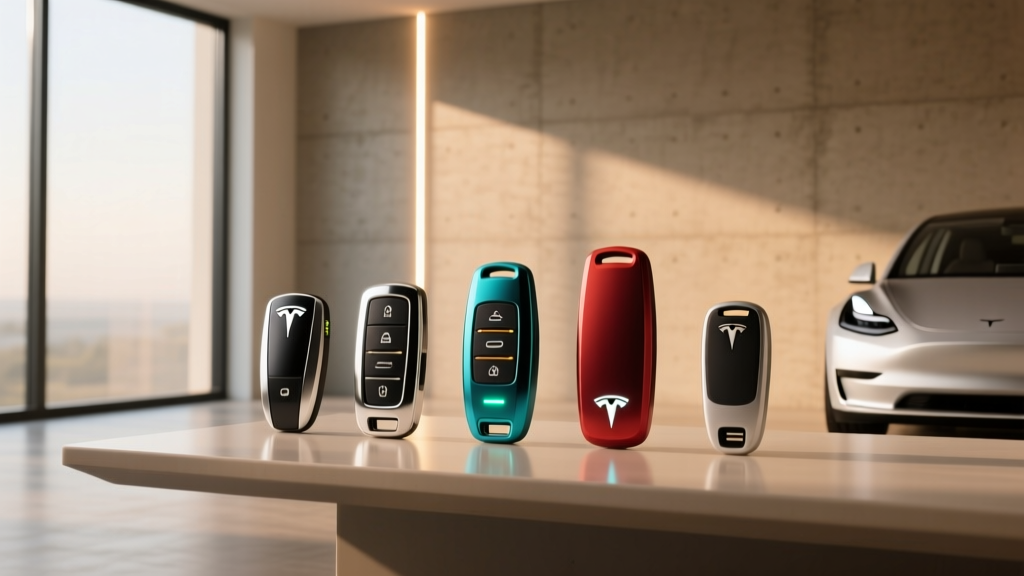
For most Tesla owners, Phone-as-a-Key handles daily unlocking and driving without ever reaching for a physical device. But the Tesla key fob — the small, shaped remote Tesla sells as an accessory — fills real gaps that a smartphone can't always cover: valet situations, dead phone batteries, glovebox backup, and the simple preference for a tactile unlock button. Across the 2026 lineup, Tesla's key fob availability, design, and price vary significantly by model, and understanding those differences matters before you tap "Add to Cart" in the Tesla Shop.
This guide breaks down the Tesla key fob options for every current model, then pairs that with the full vehicle specs — range, charging, battery chemistry, pricing, and federal tax credit eligibility — so you can evaluate the car and the key together.
Tesla Key Fob Options by Model (2026 Lineup)
Tesla currently sells or supports key fobs for four consumer vehicles. Here's what's available and what each one costs as an accessory:
| Model | Key Fob Design | Accessory Price | Phone-as-a-Key | Key Card Included |
|---|---|---|---|---|
| Model S (2026) | Car-shaped fob (trunk/frunk buttons) | ~$175 | Yes | Yes (2 cards) |
| Model 3 (2026 Highland/Refresh) | Compact rounded fob | ~$175 | Yes | Yes (2 cards) |
| Model X (2026) | Car-shaped fob (falcon-wing buttons) | ~$175 | Yes | Yes (2 cards) |
| Model Y (2026 Juniper/Refresh) | Compact rounded fob | ~$175 | Yes | Yes (2 cards) |
All Tesla key fobs use Bluetooth Low Energy (BLE) to communicate with the vehicle. Pairing takes about 30 seconds through the car's touchscreen under Controls > Locks > Add Key. Each vehicle supports up to 19 paired keys (fobs, phones, and cards combined). The key fob requires a CR2032 coin battery, which Tesla recommends replacing roughly every 1–2 years depending on use.
2026 Tesla Model Lineup: Full EV Specifications
The key fob is just the accessory. Here are the complete specs for the vehicles it pairs with, pulled from fueleconomy.gov and Tesla's official specifications.
| Spec | Model 3 RWD | Model 3 Long Range AWD | Model Y Long Range AWD | Model S Long Range | Model X Long Range |
|---|---|---|---|---|---|
| EPA Range | 363 mi | 341 mi | 320 mi | 402 mi | 335 mi |
| Battery (usable kWh) | ~57.5 kWh (LFP) | ~75 kWh (NMC) | ~75 kWh (NMC) | ~95 kWh (NMC) | ~95 kWh (NMC) |
| Drivetrain | RWD, single motor | AWD, dual motor | AWD, dual motor | AWD, dual motor | AWD, dual motor |
| Horsepower | 271 hp | 346 hp | 384 hp | 670 hp | 670 hp |
| 0–60 mph | 5.8 sec | 4.2 sec | 4.8 sec | 3.1 sec | 3.8 sec |
| MPGe (combined) | 132 MPGe | 125 MPGe | 122 MPGe | 120 MPGe | 103 MPGe |
| Efficiency (kWh/100 mi) | 25 | 27 | 28 | 28 | 33 |
| Base MSRP | $38,990 | $44,990 | $46,990 | $79,990 | $84,990 |
| Battery Warranty | 8 yr / 100,000 mi | 8 yr / 120,000 mi | 8 yr / 120,000 mi | 8 yr / 150,000 mi | 8 yr / 150,000 mi |
Charging Speed: DC Fast, Level 2, and Level 1
Charging speed is where Tesla's Supercharger network advantage becomes tangible. All 2026 Teslas use the NACS (North American Charging Standard) connector natively — no adapter needed at Superchargers or the growing number of NACS-equipped third-party stations.
| Charging Level | Model 3 RWD (LFP) | Model 3 LR / Model Y LR | Model S / Model X |
|---|---|---|---|
| Max DC Fast Charge | 170 kW peak | 250 kW peak | 250 kW peak |
| 10–80% DC Time | ~30 min | ~25 min | ~30 min |
| Level 2 (240V, 48A) | 11.5 kW (~44 mi/hr) | 11.5 kW (~44 mi/hr) | 11.5 kW (~35 mi/hr) |
| Level 1 (120V, 12A) | ~1.4 kW (~5 mi/hr) | ~1.4 kW (~5 mi/hr) | ~1.4 kW (~4 mi/hr) |
Charging curve reality: The peak kW number is not sustained across the entire session. A Model 3 Long Range hitting 250 kW at 10% SoC will taper to roughly 150 kW by 50%, and drop below 75 kW past 70%. This is why Tesla quotes 10–80% times rather than 0–100%. Charging past 80% at a DC fast charger is painfully slow — plan your road trips around 80% stops and only charge to 100% at your destination on Level 2.
LFP battery note: The Model 3 RWD uses lithium iron phosphate (LFP) chemistry, which Tesla recommends charging to 100% regularly (unlike NMC batteries, which prefer an 80% daily limit for longevity). LFP also has a flatter voltage curve, making state-of-charge estimation less precise at mid-range — another reason Tesla recommends periodic full charges for calibration.
Federal Tax Credit Eligibility (IRS §30D, 2026 Rules)
The federal EV tax credit under IRS §30D can reduce your effective purchase price by up to $7,500 — but eligibility depends on MSRP caps, buyer income limits, battery component sourcing, and whether the vehicle qualifies under current-year critical mineral requirements.
| Requirement | Threshold | Model 3 RWD | Model 3 LR AWD | Model Y LR | Model S / X |
|---|---|---|---|---|---|
| MSRP Cap (sedans) | ≤ $55,000 | ✅ $38,990 | ✅ $44,990 | N/A (SUV) | ❌ Exceeds cap |
| MSRP Cap (SUVs/trucks) | ≤ $80,000 | N/A | N/A | ✅ $46,990 | ❌ Exceeds cap |
| Buyer Income Cap (single) | ≤ $150,000 AGI | Must qualify | Must qualify | Must qualify | N/A |
| Buyer Income Cap (joint) | ≤ $300,000 AGI | Must qualify | Must qualify | Must qualify | N/A |
| Battery Sourcing | Critical minerals + components | Varies by batch | Varies by batch | Varies by batch | N/A |
Interior Space, Cargo, and Daily Livability
| Dimension | Model 3 | Model Y | Model S | Model X |
|---|---|---|---|---|
| Front Legroom | 42.7 in | 41.8 in | 42.7 in | 41.8 in |
| Rear Legroom | 35.2 in | 41.6 in | 35.4 in | 40.9 in |
| Cargo (rear seats up) | 23 cu ft | 30 cu ft | 28 cu ft | 88 cu ft (seats folded) |
| Frunk | ~3 cu ft | ~4 cu ft | ~5 cu ft | ~6 cu ft |
| Seating Capacity | 5 | 5 (7 optional) | 5 | 5, 6, or 7 |
The Model Y's cargo advantage is substantial — its hatchback design and taller roofline make it the clear choice for families hauling strollers, groceries, or camping gear. The Model 3's trunk is a conventional sedan shape with a narrower opening, which limits what you can load despite reasonable total volume. Model X offers the most flexibility with available 6- and 7-seat layouts and the iconic (if mechanically complex) falcon-wing rear doors that open upward in tight parking spaces.
Driver Assistance: Autopilot and FSD (Supervised)
All Tesla driver-assistance features — including Basic Autopilot, Enhanced Autopilot, and Full Self-Driving (Supervised) — are SAE Level 2 systems. This means the driver must remain fully attentive, keep hands on or near the steering wheel, and be prepared to take over at any moment. These are not self-driving systems. Tesla's "FSD" branding has been a persistent source of confusion; the "(Supervised)" qualifier Tesla now uses is a regulatory acknowledgment of this limitation.
All 2026 Teslas come standard with Basic Autopilot (Traffic-Aware Cruise Control and Autosteer on marked highways). Enhanced Autopilot ($6,000 upgrade) adds Navigate on Autopilot, Auto Lane Change, Autopark, and Summon. FSD (Supervised) is available as a one-time purchase (~$8,000) or monthly subscription (~$99/month) and adds city-street traffic light/stop sign recognition and autosteer on unmarked roads.
From a real-world standpoint: Autopilot on well-marked highways is excellent and reduces fatigue on long drives. FSD (Supervised) in city environments has improved substantially but still makes unpredictable decisions at complex intersections, construction zones, and unprotected left turns. Treat it as an attentive co-pilot, not a chauffeur.
Pros, Cons, and Who Should Buy
✅ Pros
- Supercharger network remains the most reliable DC fast-charging ecosystem in North America
- Class-leading efficiency (kWh/100 mi) across the lineup
- Over-the-air updates continuously add features post-purchase
- Minimal maintenance — no oil changes, brake fluid rarely needed thanks to regen
- Strong resale value relative to most EV competitors
- LFP option (Model 3 RWD) allows worry-free 100% daily charging
❌ Cons
- No Apple CarPlay or Android Auto — Tesla's proprietary infotainment only
- Model 3 rear legroom (35.2 in) is tight for taller passengers
- Build quality inconsistencies still surface (panel gaps, trim alignment)
- FSD (Supervised) is expensive and still requires full driver attention
- Insurance premiums run 15–30% higher than comparable ICE vehicles
- Model S and X no longer qualify for federal tax credit due to MSRP caps
Best for commuters: Model 3 RWD at $38,990 (potentially ~$31,490 after $7,500 credit) is the value champion. The LFP battery handles daily 100% charging without degradation anxiety, and 363 miles of EPA range covers even long commutes with margin.
Best for families: Model Y Long Range AWD offers the best combination of cargo space, rear-seat room, available 7-seat config, and all-weather capability. At $46,990, it remains under the $80,000 SUV MSRP cap for tax credit eligibility.
Best for road-trip enthusiasts: Model S Long Range's 402-mile EPA range and 250 kW Supercharging make it the least range-anxious option for cross-country travel, though at $79,990 it's a premium investment with no federal credit.
Best for those who want maximum space and style: Model X offers falcon-wing doors, up to 7 seats, and 335 miles of range — but at $84,990+ with no tax credit, it's the hardest to justify financially.
Tesla Key Fob and Ownership FAQ
Do I need a Tesla key fob, or is my phone enough?
Phone-as-a-Key works reliably for most owners, but a key fob is worth the $175 as a backup. If your phone dies, you're in an area with Bluetooth interference, or you're handing the car to a valet who can't pair their phone, the fob (or a key card) becomes essential. Many owners keep a fob in a bag or glovebox as a "just in case" measure and use their phone daily.
How do I pair a Tesla key fob?
From the driver's seat, go to Controls > Locks > Add Key on the touchscreen. Hold the new key fob behind the cup holders (the NFC/Bluetooth pairing zone) and follow the prompt. You'll need an already-paired key (card or phone) in the car to authorize the addition. The process takes under a minute.
Does the Tesla key fob battery need replacing?
Yes. The key fob uses a standard CR2032 coin cell battery, which typically lasts 1–2 years. The car's touchscreen will alert you when the fob battery is low. Replacement is a simple pop-open procedure — no tools required on most fob generations.
What is the real-world range of the cheapest 2026 Tesla?
The Model 3 RWD carries a 363-mile EPA estimate. In real-world mixed driving at moderate temperatures, expect roughly 320–340 miles. On sustained highway driving at 75+ mph in warm weather, plan for ~310 miles. In freezing conditions without preconditioning, range can drop to 250–270 miles. The LFP battery's flat discharge curve means range drops off more suddenly near the bottom — avoid running it below 10%.
How fast does a 2026 Tesla charge at home?
With a Tesla Wall Connector on a 60-amp circuit (48A continuous), all 2026 models charge at up to 11.5 kW, adding roughly 35–44 miles of range per hour depending on the model's efficiency. A full overnight charge (8 hours) adds 280–350 miles — more than enough to replenish any single day's driving. Installation of a 240V/60A circuit typically costs $800–$2,000 depending on panel proximity and local permit fees, per Tesla's home charging guide.
Which 2026 Teslas qualify for the $7,500 federal EV tax credit?
As of 2026, the Model 3 (RWD and Long Range AWD) and Model Y Long Range AWD are the primary candidates, as both fall under their respective MSRP caps ($55,000 for sedans, $80,000 for SUVs). However, the actual credit amount ($3,750 or $7,500) depends on battery sourcing compliance for your specific vehicle's production batch, and you must meet income limits ($150,000 single / $300,000 joint AGI). The credit can now be transferred to the dealer at point of sale, reducing your out-of-pocket cost at purchase. Always confirm current eligibility on irs.gov before purchasing.
Is a Tesla worth buying vs. competitors in 2026?
For pure value, the Model 3 RWD remains difficult to beat: 363 miles of range, Supercharger access, and LFP battery longevity at under $39,000. The Hyundai Ioniq 6 and Chevrolet Equinox EV compete on range and price, but neither matches Tesla's charging network or efficiency. The Model Y faces stronger competition from the Hyundai Ioniq 5, Ford Mustang Mach-E, and Kia EV6 — all of which now have NACS access to Superchargers. Tesla's advantages are the integrated ecosystem (navigation, Supercharger routing, OTA updates) and efficiency; competitors often win on interior material quality, infotainment options (CarPlay), and ride comfort. Test-drive both before deciding.