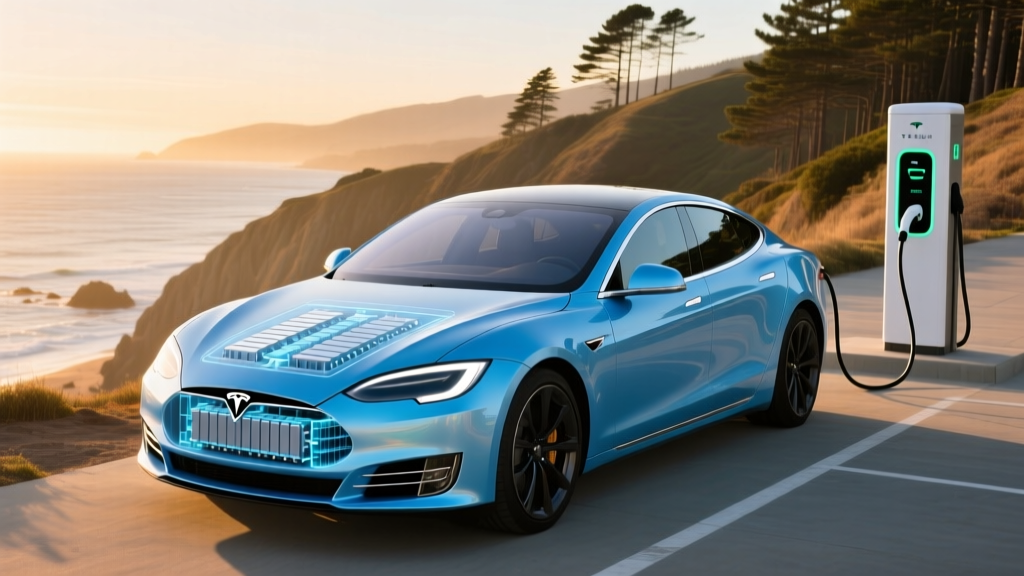
If you've been browsing Tesla's configurator or scrolling owner forums, you've likely seen the keyword Tesla Glacier Blue surface as one of the most discussed exterior paint options in the current lineup. Available across the refreshed Model 3 and Model Y platforms, this cool-toned metallic has become a favorite among buyers who want something beyond the standard Pearl White or Solid Black. But a paint color is only skin-deep — what matters for EV buyers is the engineering underneath.
This review covers the full ownership picture for a Tesla Model 3 or Model Y ordered in Glacier Blue: real-world range versus the EPA sticker, DC fast-charging curves, home Level 2 charging rates, battery chemistry, pricing after federal incentives, and how these vehicles stack up against 2026 competitors like the Hyundai Ioniq 6, BMW i4, and Ford Mustang Mach-E.
Quick Verdict: Who Is the Tesla Glacier Blue For?
Choose a Tesla Model 3 or Model Y in Glacier Blue if: You want access to the Supercharger network, best-in-class software and over-the-air updates, strong efficiency (kWh/100mi), and a distinctive exterior color that photographs well in all lighting.
Look at competitors if: You need physical buttons and stalks (Tesla relies on touchscreen for nearly everything), you prefer traditional dealership service, or you need Apple CarPlay/Android Auto integration.
EPA Range vs. Real-World Range: What to Actually Expect
The most common question from buyers is: What's the real range, not just the EPA sticker? Tesla offers multiple trims with different battery packs, so range varies significantly depending on which version you configure in Glacier Blue.
| Model / Trim | Battery (kWh usable) | Chemistry | EPA Range | Drivetrain | 0-60 mph | HP |
|---|---|---|---|---|---|---|
| Model 3 RWD | ~60 kWh | LFP | 272 mi | RWD | 5.8 sec | 283 |
| Model 3 Long Range AWD | ~75 kWh | NMC | 341 mi | Dual-Motor AWD | 4.2 sec | 346 |
| Model 3 Performance | ~75 kWh | NMC | 315 mi | Dual-Motor AWD | 2.9 sec | 510 |
| Model Y Long Range AWD | ~75 kWh | NMC | 320 mi | Dual-Motor AWD | 4.8 sec | 384 |
| Model Y Performance | ~75 kWh | NMC | 293 mi | Dual-Motor AWD | 3.5 sec | 510 |
Real-World Range Reality Check: EPA estimates assume a mix of city and highway driving at moderate temperatures. In real-world highway testing at 70-75 mph, expect roughly 10-15% less than the EPA sticker — so a Model 3 Long Range rated at 341 miles will deliver approximately 290-310 miles on a flat, temperate highway run. In cold weather (below 32°F), plan for 20-30% range reduction due to battery resistance and cabin heating demands. An LFP-equipped Model 3 RWD rated at 272 miles may deliver as little as 190-210 miles in freezing conditions without preconditioning.
According to fueleconomy.gov, the Model 3 Long Range AWD achieves a combined 134 MPGe, translating to roughly 25 kWh/100mi — among the most efficient vehicles in its class. The LFP-based RWD model sits at 132 MPGe combined.
Battery Chemistry: LFP vs. NMC — Which Glacier Blue Tesla Gets Which?
Tesla uses two distinct battery chemistries across its lineup, and understanding the difference is critical when ordering:
| Attribute | LFP (Lithium Iron Phosphate) | NMC (Nickel Manganese Cobalt) |
|---|---|---|
| Found In | Model 3 RWD | Model 3 LR/Performance, all Model Y |
| Energy Density | Lower (heavier for same kWh) | Higher (lighter, more range) |
| Cycle Life | Superior (3,000+ cycles) | Good (1,500-2,000 cycles) |
| Charging to 100% | Recommended weekly for calibration | Daily limit to 80-90% for longevity |
| Cold-Weather Performance | More range loss in freezing temps | Better cold-weather retention |
| Cobalt Content | None (ethical sourcing advantage) | Contains cobalt |
If you're ordering a Glacier Blue Model 3 RWD, you're getting an LFP pack. For Long Range or Performance variants — and all Model Y configurations — Tesla uses NMC chemistry. LFP's longer cycle life makes it excellent for high-mileage commuters who charge daily, while NMC's higher energy density is better for road-trippers who need maximum single-charge range.
Charging Speed: DC Fast Charging and Home Level 2
Charging speed is where Tesla continues to lead the industry, thanks to the Supercharger network and the vehicle's thermal management system. Here's what Glacier Blue Tesla owners can expect:
| Charging Method | Power / Rate | Speed (Miles Added) | Notes |
|---|---|---|---|
| Level 1 (120V household) | ~1.4 kW | ~3-5 mi/hr | Emergency/trickle only |
| Level 2 (240V home, 48A Wall Connector) | ~11.5 kW | ~37-44 mi/hr | Full charge overnight (~7-8 hrs) |
| Level 2 (240V, 32A mobile connector) | ~7.7 kW | ~25-30 mi/hr | Slower but uses standard NEMA 14-50 |
| DC Fast Charge (V3 Supercharger) | Peak 250 kW | ~170 mi in 15 min | 10-80% in ~25-30 min |
| DC Fast Charge (V4 Supercharger) | Peak 350 kW (capable) | Varies by pack | Current vehicles limited by onboard architecture |
| CCS Adapter (non-Tesla DCFC) | Up to 150-250 kW | Varies | Requires Tesla CCS adapter (included with new vehicles) |
Charging curve reality: The "peak 250 kW" figure applies only to the initial phase of charging (roughly 10-30% State of Charge). As the battery fills, the charge rate tapers significantly. From 10-80%, expect an average sustained rate closer to 120-150 kW, yielding a 10-80% session in approximately 25-30 minutes on a V3 Supercharger. Above 80%, charging slows dramatically to protect battery health — a 80-100% top-off can take as long as the entire 10-80% session. For road trips, plan your stops around the 10-80% window.
For home charging, Tesla's Wall Connector at 48 amps on a 60-amp circuit is the gold standard. Expect roughly $500-$800 for the unit plus $800-$2,000 for electrician installation depending on panel proximity and whether a service upgrade is needed. A licensed electrician should evaluate your panel before committing — older homes with 100-amp panels may require a $1,500-$3,000 upgrade to 200 amps.
Pricing, Trims, and Federal Tax Credit Eligibility
The Glacier Blue paint option is a premium color on Tesla's configurator. As of the current model year, it typically carries a $1,000-$2,000 premium over the no-cost Pearl White, depending on the model and any ongoing promotional adjustments. Here's the pricing breakdown:
| Model / Trim | Base MSRP | Glacier Blue Add-On | Est. As-Configured | §30D Credit Eligibility |
|---|---|---|---|---|
| Model 3 RWD | ~$38,990 | +$1,000 | ~$39,990 | Likely eligible (up to $7,500) |
| Model 3 Long Range AWD | ~$45,240 | +$2,000 | ~$47,240 | Eligibility varies by sourcing |
| Model 3 Performance | ~$52,990 | +$2,000 | ~$54,990 | Eligibility varies by sourcing |
| Model Y Long Range AWD | ~$44,990 | +$2,000 | ~$46,990 | Likely eligible (up to $7,500) |
| Model Y Performance | ~$49,990 | +$2,000 | ~$51,990 | Eligibility varies by sourcing |
Federal §30D Tax Credit Requirements (2026 Rules):
- MSRP Cap: Sedans (Model 3) must be under $55,000; SUVs/trucks/vans (Model Y) must be under $80,000.
- Buyer Income Cap: Modified AGI must not exceed $150,000 (single), $225,000 (head of household), or $300,000 (joint filing).
- Battery Sourcing: A percentage of critical minerals and battery components must be sourced from the U.S. or free-trade-agreement countries. These thresholds increase annually — check the latest IRS eligible vehicle list before purchasing.
- Point-of-Sale Transfer: You can transfer the credit to the dealer at purchase, reducing your out-of-pocket cost immediately rather than waiting for tax filing.
- Consult a tax professional — individual eligibility depends on your specific tax situation.
For a Model 3 RWD in Glacier Blue at ~$39,990, a full $7,500 credit could bring the effective price to approximately $32,490 — making it one of the most value-competitive premium sedans on the market. However, sourcing requirements shift regularly, and not every trim qualifies in every delivery quarter. Always verify on the IRS website before signing a purchase agreement.
Interior Space, Cargo, and Daily Practicality
The Glacier Blue exterior pairs with Tesla's minimalist interior, which has drawn both praise and criticism. Here are the concrete dimensions:
Model 3 (Highland Refresh):
- Front legroom: 42.7 in | Rear legroom: 35.2 in
- Cargo (trunk + frunk): ~23 cu ft total
- Seats 5 adults comfortably; rear middle seat is narrow
- 15.4-inch center touchscreen; rear 8-inch screen for passengers
- Ambient lighting, ventilated front seats, power-folding mirrors
Model Y (Juniper Refresh):
- Front legroom: 41.8 in | Rear legroom: 37.0 in
- Cargo (behind 2nd row): ~30 cu ft | Max (seats folded): ~72 cu ft
- Optional 3rd row (very small children only)
- Frunk: ~4.1 cu ft
- 15.4-inch front screen + 8-inch rear screen
The Model Y's cargo advantage is substantial for families — 72 cu ft with seats folded rivals many midsize SUVs. The Model 3's trunk is adequate for weekly groceries and luggage for two, but it's not a hauler.
Technology, Autopilot, and Driver Assistance
Every Tesla in Glacier Blue ships with Basic Autopilot standard, which includes Traffic-Aware Cruise Control and Autosteer (lane centering). This is a SAE Level 2 driver-assistance system — you must keep your hands on the wheel and eyes on the road at all times.
SAE Automation Level: Level 2 — The vehicle can control steering and acceleration/braking simultaneously under certain conditions, but the driver is fully responsible for supervision. Tesla's optional Full Self-Driving (Supervised) software ($8,000 one-time or $99/month) adds automatic lane changes, traffic light/stop sign recognition, and Navigate on Autopilot — but it remains a Level 2 system requiring constant driver engagement. This is not autonomous driving.
Standout tech features:
- Over-the-air updates that add features post-purchase
- Tesla app with remote climate control, charging status, and vehicle location
- Sentry Mode dashcam recording when parked
- Dog Mode and Camp Mode for climate management
- Native navigation with real-time Supercharger routing and battery preconditioning
- Netflix, YouTube, and gaming on the center display while parked
Notable drawbacks:
- No Apple CarPlay or Android Auto — you must use Tesla's native interface
- Turn signals are on steering-wheel buttons (no traditional stalk in refreshed models)
- Gear selection is via screen swipe (no physical shifter in refreshed Model 3)
- Build quality variability — panel gaps and paint imperfections still reported by some owners
- Service center wait times can be lengthy in some metro areas
Warranty Coverage and Battery Longevity
Tesla's warranty structure is straightforward:
- Basic Vehicle Limited Warranty: 4 years / 50,000 miles, whichever comes first
- Battery & Drive Unit Warranty (Model 3 RWD / LFP): 8 years / 100,000 miles with minimum 70% capacity retention
- Battery & Drive Unit Warranty (Model 3 LR/Performance, Model Y): 8 years / 120,000 miles with minimum 70% capacity retention
The 70% retention threshold is standard across the industry. In practice, Tesla's battery degradation data from fleet analytics shows most packs retaining 88-92% capacity at 100,000 miles — well above the warranty floor. LFP packs in the Model 3 RWD show particularly strong longevity due to the chemistry's inherent stability, with many fleet vehicles exceeding 200,000 miles with minimal degradation.
If you do need an out-of-warranty battery replacement, expect $12,000-$16,000 for a Model 3 pack and $14,000-$20,000 for a Model Y, based on current service center pricing. However, complete pack failures are rare — most degradation-related issues involve individual module replacements at significantly lower cost.
Tesla Glacier Blue vs. Key Competitors
| Spec | Tesla Model 3 LR (Glacier Blue) | Hyundai Ioniq 6 SEL | BMW i4 eDrive40 |
|---|---|---|---|
| EPA Range | 341 mi | 361 mi | 307 mi |
| Battery (kWh) | ~75 (NMC) | 77.4 (NMC) | 81.5 (NMC) |
| Peak DC Charge | 250 kW | 350 kW | 205 kW |
| 10-80% DCFC | ~25-30 min | ~18 min | ~31 min |
| 0-60 mph | 4.2 sec | 5.1 sec | 5.5 sec |
| Base MSRP | ~$45,240 | ~$42,750 | ~$57,900 |
| Charging Network | Supercharger (native) | NACS adapter / CCS | NACS adapter / CCS |
The Ioniq 6 charges faster thanks to its 800V architecture, and it offers CarPlay. The BMW i4 delivers premium build quality and driving dynamics. But the Tesla's combination of Supercharger access, efficiency, software, and price — especially after the federal credit — remains difficult to beat for the total package.
The Glacier Blue Paint: What Owners Should Know
Glacier Blue is a multi-coat metallic that shifts between steel-blue and silver depending on lighting conditions. It's one of Tesla's more popular premium colors because it hides road dust and minor swirl marks better than Solid Black or Deep Blue Metallic. However, like all Tesla paint, it benefits from immediate paint protection film (PPF) or ceramic coating — Tesla's factory paint is thinner than many legacy automakers, and rock chips on the front bumper and hood are a common owner complaint. Budget $1,500-$3,000 for full-front PPF if paint preservation matters to you.
Pros and Cons
Pros
- Best-in-class Supercharger network access (20,000+ stalls in North America)
- Industry-leading software with regular OTA updates
- Excellent efficiency (25 kWh/100mi combined for LR)
- Strong real-world range (290-310 mi highway for LR)
- LFP option for high-mileage commuters (Model 3 RWD)
- Glacier Blue hides dust/chips better than darker colors
- Competitive pricing after §30D credit
- Low center of gravity and responsive handling
Cons
- No Apple CarPlay or Android Auto
- Steering-wheel turn signals take adjustment
- Paint quality inconsistency; PPF recommended
- Service center wait times in some regions
- Rear visibility in Model 3 is limited
- FSD ($8,000) remains Level 2 — expensive for what it delivers
- LFP packs lose more range in extreme cold
- Glacier Blue availability can fluctuate by quarter
Frequently Asked Questions
What is the real-world range of a Glacier Blue Tesla Model 3?
The EPA rates the Model 3 Long Range AWD at 341 miles, but expect roughly 290-310 miles in real-world highway driving at 70-75 mph, and as low as 240-260 miles in freezing weather. The RWD model with LFP battery is rated at 272 miles EPA, with real-world highway range around 230-250 miles.
How fast does a Glacier Blue Tesla charge at home and on the road?
At home on a 48-amp Level 2 Wall Connector, you'll add roughly 37-44 miles of range per hour, achieving a full overnight charge in 7-8 hours. On a V3 Supercharger, DC fast charging peaks at 250 kW with a 10-80% session taking approximately 25-30 minutes.
How much does a Glacier Blue Tesla cost after the federal tax credit?
A Model 3 RWD in Glacier Blue starts around $39,990. If you qualify for the full $7,500 §30D credit (meeting income, MSRP, and battery-sourcing requirements), the effective price drops to approximately $32,490. Verify eligibility on the IRS website before purchasing.
Does a Glacier Blue Tesla qualify for the $7,500 federal EV tax credit?
It depends on the specific trim, your income, and current battery-sourcing compliance. The Model 3 RWD (under the $55,000 sedan cap) has frequently qualified, but critical-mineral and component sourcing thresholds change annually. Always check the IRS eligible vehicle list for the current status.
Is a Glacier Blue Tesla worth buying over the Ioniq 6 or BMW i4?
If Supercharger network access, software, and value-after-credit are your priorities, the Tesla wins. If you prefer CarPlay, faster 800V DC charging, and a traditional dealership experience, the Ioniq 6 is compelling. The BMW i4 suits buyers who prioritize build quality and driving refinement over range-per-dollar.
Does Glacier Blue paint require special care?
Glacier Blue hides dust and minor imperfections better than black or dark blue, but Tesla's paint is relatively thin. Applying PPF to the front bumper, hood, and mirrors within the first few weeks is strongly recommended. Budget $1,500-$3,000 for professional full-front coverage.
Is Tesla's Autopilot or FSD actually self-driving?
No. Both Basic Autopilot and Full Self-Driving (Supervised) are SAE Level 2 driver-assistance systems. You must remain fully attentive, keep your hands on the wheel, and be prepared to take over at any moment. No Tesla vehicle sold today is capable of autonomous driving.