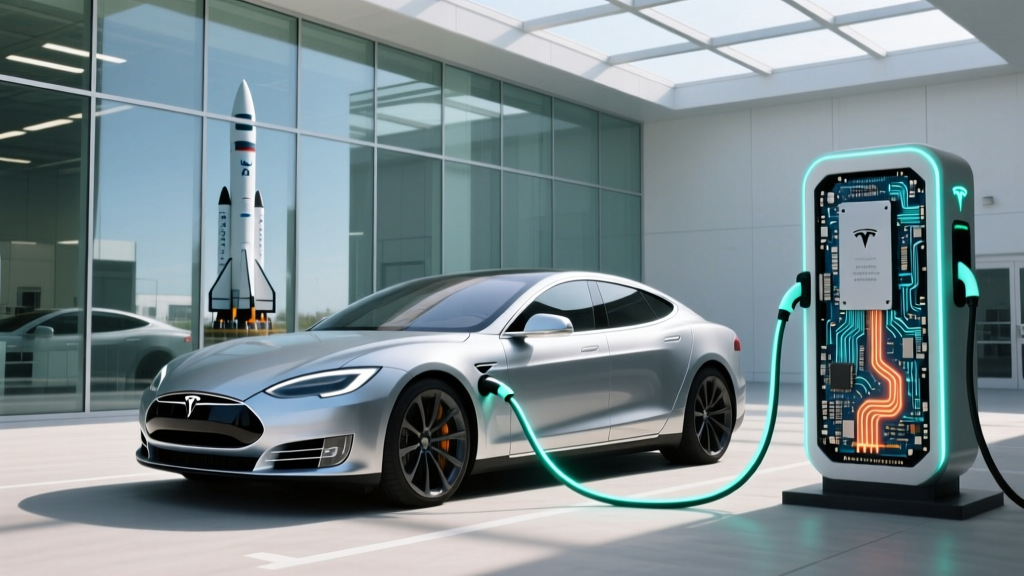
If you follow electric vehicles, space exploration, or just Elon Musk's business empire, you have probably asked: is SpaceX part of Tesla? The short answer is no — SpaceX and Tesla are entirely separate legal and financial entities. But the longer answer is more nuanced. The two companies share a founder, overlapping executive talent, occasional technology cross-pollination, and a growing web of indirect business relationships that make the question worth examining in detail.
This guide untangles the corporate reality, the technology overlaps, and what the SpaceX-Tesla relationship actually means for EV buyers, investors, and enthusiasts in 2026.
The Short Answer: No, SpaceX Is Not Part of Tesla
Tesla, Inc. (NASDAQ: TSLA) and Space Exploration Technologies Corp. (SpaceX) are independent companies with separate boards of directors, separate financial statements, separate employees, and separate corporate governance. Tesla is a publicly traded automaker and energy company headquartered in Austin, Texas. SpaceX is a privately held aerospace manufacturer and space transportation company, also based in the greater Austin area (Hawthorne, California, with major operations in Boca Chica, Texas).
Neither company owns a controlling stake in the other. Tesla does not appear on SpaceX's cap table as a parent entity, and SpaceX is not a subsidiary of Tesla. If you buy TSLA stock, you are not buying a piece of SpaceX — and vice versa.
How Tesla and SpaceX Are Structurally Connected
While legally independent, the two companies share several structural and human-capital connections that blur the lines in practice:
Shared Founder and CEO
Elon Musk serves as CEO of both Tesla and SpaceX (as well as xAI, Neuralink, and The Boring Company). His public persona, social media presence, and personal brand are deeply intertwined with both companies. Controversies or news involving Musk tend to affect public perception of both entities simultaneously.
Talent and Knowledge Transfer
Engineers and executives have moved between the two companies over the years. SpaceX's expertise in lightweight materials, advanced manufacturing, and software-driven systems has informed Tesla's engineering culture, and vice versa. Tesla's early adoption of large-scale casting techniques (the Giga Press) drew on aerospace-style manufacturing philosophy that SpaceX helped normalize in Musk's companies.
Shared Supplier and Vendor Relationships
Both companies operate at the intersection of advanced battery technology, power electronics, and autonomous systems. While they don't share a formal supply chain, their overlapping needs in areas like high-performance computing, sensor technology, and advanced alloys mean they sometimes engage with similar vendors in the technology and materials space.
The Starlink-Tesla Connection
SpaceX's Starlink satellite internet division has become increasingly relevant to Tesla owners. In 2025, Tesla began offering enhanced in-vehicle connectivity powered by Starlink's low-Earth-orbit constellation in select regions, providing more reliable over-the-air updates and navigation data in rural areas where cellular coverage is sparse. This is a commercial partnership, not a corporate merger — Tesla pays SpaceX/Starlink for connectivity services, much like any other vendor relationship.
Does the SpaceX Relationship Affect Tesla Vehicles?
For EV buyers evaluating a Tesla purchase in 2026, the SpaceX connection is mostly a footnote. Tesla's vehicles are designed, engineered, manufactured, and warranted entirely by Tesla, Inc. Here is what actually matters when you are shopping for a Tesla:
| Spec | Value |
|---|---|
| EPA Range | 330 miles |
| Battery Capacity | ~78 kWh usable (NMC chemistry) |
| Drivetrain | Dual Motor AWD |
| 0-60 mph | 4.8 seconds |
| Horsepower | 384 hp |
| MPGe (combined) | 117 MPGe |
| Efficiency | 29 kWh/100 mi |
| Peak DC Fast Charge | 250 kW (Supercharger V3/V4) |
| 10-80% DC Charge Time | ~25 minutes |
| Level 2 Home Charge Rate | 11.5 kW (~44 mi/hr) |
| Cargo Volume | 30.2 cu ft (rear seats up) / 72.1 cu ft (folded) |
| Rear Legroom | 41.6 inches |
| Base MSRP | $47,990 |
| Battery Warranty | 8 years / 120,000 miles (70% capacity retention) |
Source: EPA fueleconomy.gov, Tesla.com specifications (2026 model year). Specs may vary by configuration.
Tesla vs. Competitors: Where Does It Stand in 2026?
The question "is SpaceX part of Tesla" sometimes arises because people assume Musk's companies share a technological edge. In the EV market, Tesla's real advantages are its Supercharger network, software integration, and manufacturing scale — not SpaceX technology. Here is how the Model Y Long Range stacks up against key rivals:
| Spec | Tesla Model Y LR AWD | Hyundai Ioniq 5 Limited AWD | Ford Mustang Mach-E ER AWD |
|---|---|---|---|
| EPA Range | 330 mi | 290 mi | 312 mi |
| Battery (kWh) | ~78 (NMC) | 84 (NMC) | 91 (NMC) |
| Peak DC Charge | 250 kW | 350 kW | 150 kW |
| 10-80% Time | ~25 min | ~18 min | ~45 min |
| 0-60 mph | 4.8 sec | 5.1 sec | 5.6 sec |
| Base MSRP | $47,990 | $53,600 | $49,995 |
| Cargo (seats up) | 30.2 cu ft | 27.2 cu ft | 29.7 cu ft |
Sources: fueleconomy.gov, manufacturer specifications. Prices and specs subject to change.
Tax Credits, Pricing, and the Bottom Line for Buyers
Tesla's pricing and tax credit eligibility are governed by Tesla, Inc. — not SpaceX. Under the current IRS §30D clean vehicle credit rules, the Model Y may qualify for up to $7,500 in federal tax credits, but eligibility depends on several factors:
- MSRP Cap: SUVs must have an MSRP at or below $80,000 (the Model Y qualifies at $47,990 base).
- Buyer Income Cap: Modified adjusted gross income must not exceed $300,000 (joint filers), $225,000 (head of household), or $150,000 (single).
- Battery Sourcing: Critical minerals and battery components must meet escalating domestic-content and free-trade-agreement thresholds. These requirements tighten annually, and specific trim eligibility can shift mid-year.
- Point-of-Sale Transfer: As of 2024, qualifying buyers can transfer the credit to the dealer at purchase, reducing the upfront price rather than waiting for a tax refund.
Because battery sourcing rules are complex and subject to change, always verify current eligibility on fueleconomy.gov before purchasing. Do not assume a flat $7,500 credit applies — consult a tax professional for your specific situation.
Standout Tech and Notable Drawbacks
Pros
- Best-in-class EPA range (330 mi) for the segment
- Access to Tesla Supercharger network — the most reliable and extensive DC fast-charging network in North America
- Strong over-the-air update cadence adding features post-purchase
- Excellent efficiency (29 kWh/100 mi) means lower per-mile electricity cost
- Class-leading cargo space with frunk + rear cargo
- Standard Autopilot (SAE Level 2) with solid lane-keeping and adaptive cruise
Cons
- FSD (Supervised) costs extra and remains a Level 2 driver-assist system — you must stay engaged at all times
- 250 kW peak DC charge rate trails Hyundai/Kia's 800V architecture (350 kW)
- Minimalist interior lacks physical buttons — climate and mirror controls are screen-only
- Ride quality can be firm on rough pavement compared to comfort-tuned rivals
- No Apple CarPlay or Android Auto — Tesla's proprietary infotainment only
- Insurance premiums tend to run higher than segment average
Who Should Buy a Tesla (and Who Should Look Elsewhere)?
The SpaceX-Tesla connection, while fascinating from a corporate perspective, has no bearing on whether a Tesla is the right EV for you. What matters is your driving pattern, charging access, and priorities:
Choose Tesla Model Y if:
- You regularly drive long distances and want access to the Supercharger network (over 6,500 stations in North America as of 2026)
- Range is your top priority and 330 miles EPA gives you confidence
- You value over-the-air software updates that continuously improve the vehicle
- You prefer a vertically integrated ecosystem (vehicle, charger, solar, Powerwall)
Look at Competitors if:
- You want the fastest possible DC charging — the Ioniq 5's 800V architecture charges 10-80% in ~18 minutes vs. Tesla's ~25 minutes
- You prefer physical buttons, Apple CarPlay, or a more traditional interior layout
- Comfort-tuned ride quality is a priority over sportiness
- You want a more distinctive exterior design — the Model Y is ubiquitous in many metro areas
Frequently Asked Questions
Is SpaceX part of Tesla?
No. SpaceX and Tesla are separate, independent companies. They share a founder and CEO (Elon Musk) and have some indirect business relationships (such as Starlink connectivity in Tesla vehicles), but neither owns the other.
Can I buy SpaceX stock through Tesla?
No. Tesla (TSLA) is publicly traded on NASDAQ. SpaceX remains a private company. You cannot gain SpaceX equity exposure by purchasing Tesla shares. Some investment platforms offer limited secondary-market access to SpaceX shares, but this is unrelated to Tesla.
Does SpaceX technology go into Tesla cars?
Not directly. Tesla's vehicles use Tesla-designed batteries, motors, software, and manufacturing processes. However, engineering talent and manufacturing philosophies have flowed between the two companies informally over the years, and Starlink satellite internet is now used for Tesla vehicle connectivity in some regions.
Does the SpaceX-Tesla connection affect my warranty or service?
No. Tesla's vehicle warranty (8 years/120,000 miles for the battery and drive units on the Model Y) is backed entirely by Tesla, Inc. SpaceX has no involvement in vehicle manufacturing, warranty, or service.
Why do people think SpaceX and Tesla are the same company?
The confusion stems from Elon Musk's high-profile role at both companies, their shared presence in tech and sustainability narratives, and occasional cross-company references in earnings calls and media coverage. They are separate legal entities that happen to share a visionary founder.
Does Tesla qualify for the federal EV tax credit?
The Model Y may qualify for up to $7,500 under IRS §30D, subject to MSRP caps (it qualifies), buyer income limits, and battery critical-mineral sourcing requirements that change annually. Always verify current eligibility on fueleconomy.gov and consult a tax professional before relying on the credit in your purchase decision.