The Quick Answer: Tesla's 2026 Global Headcount
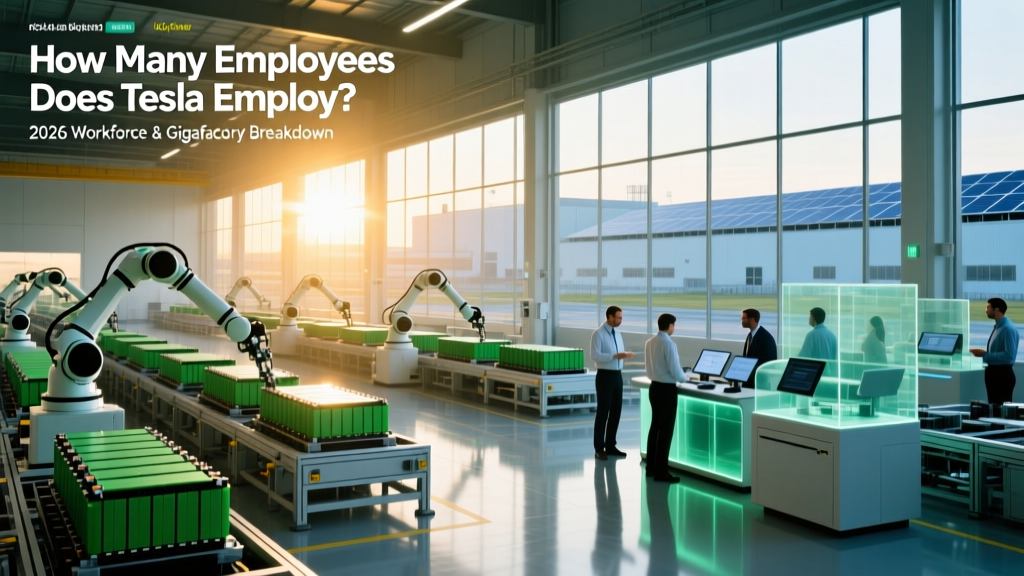
If you've been searching how many employees does Tesla employ, the short answer is that Tesla's global workforce stood at roughly 140,000 full-time employees entering 2026, based on the company's most recent annual filings and earnings disclosures. That number has fluctuated over the past two years — Tesla cut approximately 10% of staff in early 2024, then selectively rehired in manufacturing and AI/autonomy roles through 2025.
But a single headcount figure only tells part of the story. For EV buyers and industry watchers, understanding where those employees work, what they do, and how Tesla's staffing compares to legacy automakers reveals a lot about the company's production capacity, quality trajectory, and long-term viability as an EV manufacturer. Let's break it all down.
Tesla Employee Count by Factory and Region
Tesla operates six major vehicle and battery production facilities worldwide, plus dozens of smaller offices, R&D centers, and Supercharger operations teams. Here's how the workforce distributes across key locations:
| Facility | Location | Est. Employees (2025–2026) | Primary Output |
|---|---|---|---|
| Gigafactory Texas | Austin, TX | ~20,000 | Model Y, Cybertruck, 4680 cells |
| Gigafactory Nevada | Sparks, NV | ~7,000 | Battery packs, drive units, Semi |
| Fremont Factory | Fremont, CA | ~20,000 | Model S, 3, X, Y |
| Gigafactory Shanghai | Shanghai, China | ~25,000 | Model 3, Model Y (export hub) |
| Gigafactory Berlin | Grünheide, Germany | ~12,000 | Model Y, battery cells |
| Gigafactory New York | Buffalo, NY | ~1,500 | Supercharger components, solar |
| Corporate / R&D / Retail | Global | ~55,000 | Engineering, sales, service, FSD |
Gigafactory Texas serves as Tesla's global headquarters and has been steadily growing since production ramped in 2022. Fremont remains the largest U.S. vehicle plant by output, though Texas is closing the gap. Shanghai continues to be Tesla's highest-volume single facility and a critical export hub for Europe and Asia-Pacific markets.
How Tesla's Workforce Compares to Legacy Automakers
To put Tesla's ~140,000 employees in context, legacy automakers operate at a vastly different scale:
- Toyota (global): ~375,000 employees
- Ford (global): ~174,000 employees
- General Motors (global): ~158,000 employees
- Volkswagen Group (global): ~684,000 employees
- BYD (global): ~900,000+ employees (including battery and semiconductor divisions)
Tesla produces roughly 1.8–2.0 million vehicles annually with a fraction of the workforce that legacy OEMs require. This gap reflects Tesla's heavy investment in manufacturing automation — particularly gigacasting, which replaces hundreds of stamped and welded parts with single-piece castings — and its vertically integrated, direct-to-consumer sales model that eliminates dealership layers.
However, headcount-per-vehicle is an imperfect metric. Legacy automakers employ tens of thousands in R&D for internal-combustion powertrains, transmission engineering, and emissions compliance — roles Tesla simply doesn't need. Conversely, Tesla invests disproportionately in AI, autonomy software, and custom silicon design (the FSD chip and Dojo supercomputer teams), where headcount doesn't directly correlate with vehicle output.
What Tesla's Staffing Means for EV Buyers
You might wonder why workforce size matters when you're shopping for a Model Y or Model 3. Here's the practical connection:
Production Capacity and Delivery Times
More manufacturing employees at a given gigafactory generally means higher throughput and shorter wait times. When Texas and Berlin ramped staffing through 2024–2025, U.S. and European delivery windows for the Model Y dropped from 8–12 weeks to 2–4 weeks in most configurations.
Service and Support Network
Tesla's retail and service headcount (~20,000+ globally) directly affects your post-purchase experience. The company has been expanding mobile service fleets and authorized body shop partnerships, but service-center wait times in metro areas remain a common owner complaint. Staffing growth in this division is a leading indicator of whether that will improve.
Software and Autonomy Development
Tesla's AI and Full Self-Driving (Supervised) teams represent a significant and growing share of the workforce. For buyers considering the $8,000 FSD add-on, the size and stability of these teams matters — it signals whether Tesla can sustain the rapid OTA update cadence that FSD development requires.
Tesla's Hiring Trends: Where the Jobs Are (and Aren't)
Tesla's employment strategy has shifted noticeably since 2023. Here are the key trends shaping the 2026 workforce:
Growth Areas
- Energy storage: Megapack and Powerwall production at Lathrop, CA (the Megafactory) has driven significant hiring, with that facility now employing an estimated 5,000+ workers.
- AI and robotics: The Optimus humanoid robot program and Dojo supercomputer team have expanded aggressively, recruiting heavily from robotics and semiconductor backgrounds.
- Supercharger network: Following the NACS industry standardization (now adopted by Ford, GM, Rivian, Volvo, and others), Tesla has hired to expand charger deployment and network operations.
Contraction Areas
- Sales and marketing: Tesla's 2024 layoffs disproportionately affected sales roles, consistent with the company's shift toward online-only ordering and reduced showroom footprint.
- Administrative overhead: Middle management layers were trimmed, particularly at Fremont and in corporate functions.
Model Lineup Snapshot: What Tesla Sells in 2026
For buyers evaluating Tesla alongside its workforce stability, here's a quick reference of the current U.S. lineup with the numbers that matter:
| Spec | Model 3 (Long Range AWD) | Model Y (Long Range AWD) | Cybertruck (AWD) |
|---|---|---|---|
| EPA Range | 341 mi | 320 mi | 340 mi |
| Battery (usable) | ~75 kWh (NMC) | ~75 kWh (NMC) | ~123 kWh (NMC) |
| Peak DC Charge | 250 kW | 250 kW | 250 kW (400V arch) |
| 10–80% DC Time | ~28 min | ~28 min | ~35 min |
| Level 2 Home Rate | 11.5 kW (~44 mi/hr) | 11.5 kW (~44 mi/hr) | 11.5 kW (~35 mi/hr) |
| 0–60 mph | 4.2 sec | 4.8 sec | 3.9 sec |
| Horsepower | 346 hp | 384 hp | 600 hp |
| Base MSRP | $47,740 | $48,990 | $79,990 |
| MPGe (combined) | 134 MPGe | 122 MPGe | 78 MPGe |
| Cargo Volume | 23 cu ft (rear) + frunk | 76 cu ft (rear folded) + frunk | 67 cu ft (bed + vault) |
| Battery Warranty | 8 yr / 120,000 mi | 8 yr / 120,000 mi | 8 yr / 150,000 mi |
Federal Tax Credit Eligibility for Tesla Vehicles
Under the current IRS §30D Clean Vehicle Credit rules, Tesla buyers face several eligibility requirements:
- MSRP cap: Vans, SUVs, and pickup trucks (Model Y, Cybertruck) must have an MSRP at or below $80,000. Sedans (Model 3) must be at or below $55,000.
- Buyer income cap: Adjusted gross income must not exceed $150,000 (single), $225,000 (head of household), or $300,000 (married filing jointly).
- Battery sourcing: A percentage of critical minerals and battery components must be sourced from the U.S. or free-trade-agreement countries. These thresholds increase annually and have eliminated some trims from full credit eligibility.
- Point-of-sale transfer: Eligible buyers can transfer the credit to the dealer at purchase, reducing the out-of-pocket price immediately rather than waiting to claim it on their tax return.
As of the most recent IRS guidance, the Model Y Long Range and Model 3 Long Range have qualified for at least partial credit, but the exact amount ($3,750 or $7,500) depends on the specific battery sourcing for that production batch. Always verify current eligibility at fueleconomy.gov before purchasing, as sourcing requirements can shift with supply chain changes.
Tesla vs. Key Competitors: Staffing and Scale in Context
When you're cross-shopping a Tesla against the Hyundai Ioniq 5, Ford Mustang Mach-E, or Rivian R1S, the employee-count question translates into a practical one: Can this company support my vehicle for the next decade?
| Company | Global Employees | Annual EV Production (est.) | U.S. Service Centers |
|---|---|---|---|
| Tesla | ~140,000 | ~1.8–2.0M | ~250+ |
| Ford (EV division, Model e) | ~174,000 (total) | ~100,000+ EVs | 3,000+ dealers |
| Hyundai/Kia (global) | ~280,000 | ~500,000+ EVs | 1,600+ dealers |
| Rivian | ~16,000 | ~60,000–80,000 | ~50+ |
Tesla's advantage is vertical integration and manufacturing scale. Its disadvantage remains service density — legacy automakers offer thousands of dealer service bays, while Tesla owners in some regions face multi-week waits for collision repair or complex diagnostics. If service proximity matters to you, check Tesla's service center map for your area before committing.
Frequently Asked Questions
How many employees does Tesla have in the United States?
Tesla employs an estimated 70,000–80,000 people in the U.S., concentrated at its Fremont (CA), Austin (TX), Sparks (NV), and Buffalo (NY) manufacturing sites, plus corporate offices in Palo Alto and Austin, and retail/service locations across all 50 states.
Did Tesla lay off employees recently?
Yes. In April 2024, Tesla announced a company-wide reduction of roughly 10%, affecting an estimated 14,000 employees globally. The cuts primarily targeted sales, marketing, and administrative roles. Since late 2024, Tesla has selectively rehired in manufacturing (particularly Cybertruck and 4680 cell production), AI/autonomy, and energy storage divisions.
How does Tesla's employee count compare to SpaceX?
SpaceX, also led by Elon Musk but a separate company, employs approximately 15,000–17,000 people as of 2025. While both companies share a founder, they operate independently with separate workforces, finances, and supply chains.
Does Tesla employ more engineers than factory workers?
No. Like all automakers, Tesla's manufacturing workforce significantly outnumbers its engineering staff. However, Tesla's ratio of software/AI engineers to mechanical engineers is much higher than legacy OEMs, reflecting its emphasis on over-the-air updates, FSD development, and custom silicon design.
Is Tesla's workforce growing or shrinking in 2026?
Net headcount is relatively flat compared to 2023 peaks. Growth in energy storage, AI, and Supercharger operations has offset reductions in sales and administrative roles. Manufacturing headcount is steady, with shifts in where workers are located (more in Texas, fewer in some Fremont roles) rather than large net changes.
Why does Tesla need fewer employees per vehicle than other automakers?
Three main factors: (1) Gigacasting replaces hundreds of parts with single castings, reducing assembly labor. (2) Fewer SKUs — Tesla sells four consumer vehicles vs. 20–40 at legacy OEMs, simplifying production planning. (3) Direct sales — no dealer network means no wholesale-to-retail handoff staff. These structural differences let Tesla achieve higher revenue-per-employee than traditional automakers.
Bottom Line: What Tesla's Headcount Tells You as a Buyer
Tesla's ~140,000 employees make it lean by automotive-industry standards, but that leanness is a deliberate feature of its manufacturing philosophy — not a sign of fragility. For buyers, the relevant takeaways are:
- Production scale is proven: Nearly 2 million vehicles per year from six factories demonstrates mature manufacturing capability.
- Service remains the weak link: Employee growth in retail/service hasn't kept pace with the installed vehicle base. Plan for potential service delays depending on your metro area.
- Software investment is outsized: Tesla's AI and autonomy headcount signals continued OTA feature development — a key differentiator if you value tech-forward ownership.
- Financial stability: A workforce of this size, supported by consistent (if fluctuating) profitability, indicates Tesla will be around to honor your 8-year battery warranty.
If workforce data is part of your purchase calculus — and for a $40,000–$80,000 vehicle, it should be — Tesla's numbers suggest a company that's operationally mature but still evolving its post-sale support infrastructure. Cross-shop accordingly, and verify service availability in your zip code before signing.