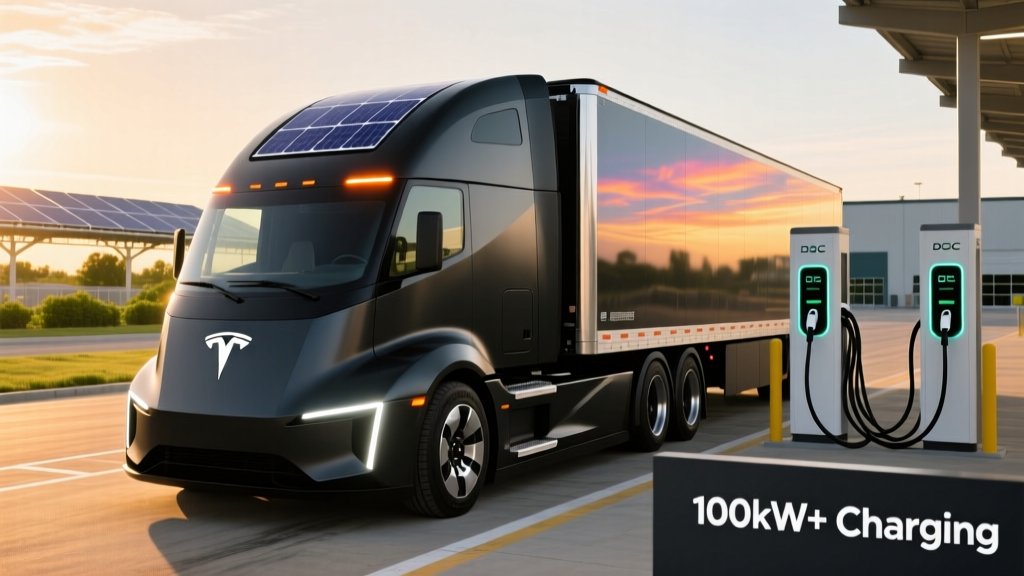
The Tesla Semi: A Class 8 Electric Truck That Actually Hauls
The Tesla electric semi truck has transitioned from a prolonged concept to a revenue-generating asset for select fleets. As of 2026, Tesla is ramping Semi production at its Nevada Gigafactory, delivering units to early enterprise customers including PepsiCo, DHL, and Schneider. This isn't a consumer vehicle — it's a Class 8 day-cab tractor built for regional and short-haul freight. But for fleet managers and owner-operators evaluating electrification, the Semi presents a fundamentally different cost equation than diesel, provided your routes align with its range and charging infrastructure.
This profile covers the 2026 Tesla Semi 500-mile variant — the higher-volume configuration — alongside the 300-mile base model. We'll break down EPA-estimated range versus real-world hauling conditions, Megacharger speeds, total cost of ownership, and the commercial tax incentive landscape that makes or breaks the purchase decision.
Spec Table: 2026 Tesla Semi at a Glance
| Specification | Semi 300 (Base) | Semi 500 (Long Range) |
|---|---|---|
| EPA Estimated Range | 300 miles (loaded) | 500 miles (loaded) |
| Battery Capacity (est.) | ~600 kWh (NMC/NCA) | ~900 kWh (NMC/NCA) |
| Max DC Fast Charge | Megacharger ~750 kW | Megacharger ~900 kW |
| 10–80% Charge Time | ~35 minutes | ~40 minutes |
| 0–60 mph (loaded, 80k lbs) | ~20 seconds | ~20 seconds |
| 0–60 mph (unladen) | ~5 seconds | ~5 seconds |
| Drivetrain | Tri-Motor AWD | Tri-Motor AWD |
| Horsepower (peak) | ~1,000+ hp | ~1,000+ hp |
| Base MSRP | $250,000 | $290,000 |
| Energy Consumption | < 2 kWh/mile (est.) | < 2 kWh/mile (est.) |
| Battery Warranty | Undisclosed (est. 8 yr / 1M mi) | Undisclosed (est. 8 yr / 1M mi) |
Range and Efficiency: What the EPA Number Doesn't Tell You
Tesla's energy consumption target of under 2 kWh per mile is a significant engineering achievement for a Class 8 tractor. For context, a diesel truck at 7 MPG consumes roughly the energy equivalent of 5.5 kWh per mile. The Semi's tri-motor setup — one permanent-magnet motor for efficiency at cruise, two additional induction motors for acceleration and grade-climbing — allows the truck to operate efficiently across varied duty cycles. Regenerative braking on all three motors recovers substantial energy on downhill grades and stop-and-go port operations.
Fleet operators should note that the Semi's range is rated at maximum payload. Running empty or at partial load will extend range considerably — some fleet telemetry from early deployments shows 600+ mile capability at 50% payload on flat terrain. However, route planning must always account for worst-case loaded conditions to avoid stranding a trailer full of freight.
Charging: Megacharger Infrastructure Is the Bottleneck
| Charging Level | Power | Rate / Notes |
|---|---|---|
| Level 2 (Depot AC) | ~40–80 kW (J1772/CCS) | ~20–40 miles of range per hour; full overnight charge in 12–18 hours |
| DC Fast (CCS, public) | Up to 350 kW | ~140 miles in 30 min; limited by public infrastructure |
| Tesla Megacharger | Up to 900 kW peak | ~70% (10–80%) in ~40 minutes; proprietary deployment |
The Semi uses a proprietary Tesla Megacharger connector capable of sustaining charge rates far beyond what public CCS infrastructure supports. At peak, the Semi 500 can accept approximately 900 kW — but this requires Tesla-deployed Megachargers at fleet depots or along designated corridors. As of early 2026, Tesla has installed Megachargers at select customer sites (PepsiCo Sacramento, DHL Stockton) and along a handful of California freight corridors, but the network remains sparse compared to the Supercharger passenger network.
The charging curve matters enormously for fleet scheduling. The Semi sustains its peak rate from roughly 10% to 50% state of charge, then tapers progressively. The 10–80% time of approximately 40 minutes assumes optimal battery preconditioning and a dedicated Megacharger stall. On a standard 350 kW CCS charger (using the adapter Tesla provides), charging takes significantly longer — roughly 90 minutes from 10–80%.
For depot-based operations, Level 2 overnight charging at 40–80 kW is the practical daily solution. A Semi arriving at 20% SoC can fully recharge in 12–18 hours, which aligns with most single-shift regional operations. Fleet depots will need substantial electrical infrastructure — a single Semi charging at 80 kW draws roughly the same power as 8–10 residential homes. Plan for utility coordination and potential transformer upgrades 12–18 months ahead of vehicle delivery.
Performance: Tri-Motor Powertrain and Real-World Drivability
The Tesla Semi's tri-motor all-wheel-drive powertrain delivers over 1,000 peak horsepower to the rear axles. The result is a 0–60 mph time of approximately 20 seconds at the full 80,000-pound gross combination weight — roughly twice as fast as a comparable diesel Class 8 tractor. Unladen, the Semi hits 60 mph in about 5 seconds, which is sportscar territory for a vehicle with a cab and fifth wheel.
But raw acceleration isn't the operational advantage. The Semi's torque delivery is instant and linear, eliminating the gear-hunting and turbo lag that characterize diesel powertrains on grades. On the 6% grade of California's Grapevine (I-5 over the Tejon Pass), early fleet data shows the Semi maintains 55–60 mph under full load while diesels drop to 35–40 mph. This translates to measurable time savings on mountainous routes and reduces the speed-differential risk that causes highway collisions.
The Semi's cabin is a radical departure from conventional Class 8 tractors. The driver sits in a centered position with dual 15-inch touchscreens flanking the steering wheel — one for vehicle telemetry and navigation, the other for camera feeds and media. There is no sleeper berth in the current day-cab configuration. Visibility is exceptional thanks to a low dashboard, large windshield, and the elimination of a protruding engine hood. The absence of a diesel engine means near-silent operation, which drivers consistently report reduces fatigue on multi-hour shifts.
Pricing, Tax Incentives, and Fleet Economics
| Cost Factor | Semi 300 | Semi 500 |
|---|---|---|
| Base MSRP | $250,000 | $290,000 |
| Federal Commercial Clean Vehicle Credit (§45W) | Up to $40,000 | Up to $40,000 |
| Estimated Net Price (after federal credit) | ~$210,000 | ~$250,000 |
| Estimated Annual Fuel Savings vs. Diesel | $25,000–$40,000/year (based on 60,000 mi/yr, $4.50/gal diesel, $0.15/kWh electricity) | |
| Estimated Annual Maintenance Savings | $8,000–$12,000/year (no oil, DEF, DPF, fewer brake replacements) | |
The Tesla Semi does not qualify for the consumer §30D federal tax credit — that credit applies to light-duty vehicles under 14,000 lbs GVWR. Instead, fleet buyers access the §45W Commercial Clean Vehicle Credit, which provides up to $40,000 for qualifying heavy-duty electric trucks. Per IRS guidelines, eligibility requires the vehicle to be placed in service for business use, meet battery component and critical mineral sourcing requirements, and be manufactured by a qualified OEM. Unlike §30D, there is no buyer income cap or MSRP ceiling under §45W, but the credit cannot exceed the incremental cost of the EV over a comparable diesel vehicle.
Many states layer additional incentives on top of the federal credit. California's Hybrid and Zero-Emission Truck and Bus Voucher Incentive Project (HVIP) has offered vouchers up to $120,000–$240,000 for Class 8 zero-emission tractors, though funding is competitive and subject to legislative renewal. Operators should consult their state's clean-fleet programs and work with a tax professional to model the full incentive stack.
The total-cost-of-ownership equation is where the Semi makes its strongest case. Diesel at $4.50 per gallon and 7 MPG costs roughly $0.64 per mile in fuel. Electricity at $0.15 per kWh and 2 kWh per mile costs $0.30 per mile — a savings of $0.34 per mile. Over 60,000 annual miles, that's $20,400 in annual fuel savings, rising to $30,000+ in regions with higher diesel prices or lower commercial electricity rates. Add $8,000–$12,000 in annual maintenance savings (no oil changes, no diesel exhaust fluid, no particulate filter regeneration, and dramatically reduced brake wear from regenerative braking), and the Semi can achieve payback against a $170,000 diesel tractor in 4–6 years depending on utilization.
Warranty, Battery Longevity, and Service Considerations
Tesla has not published formal warranty terms for the Semi as of early 2026, but industry expectations based on Tesla's light-duty warranties and commercial norms suggest a battery and drive unit warranty of approximately 8 years or 1 million miles, whichever comes first, with a capacity retention threshold of 70%. The Semi's massive battery pack (estimated 900 kWh for the 500-mile variant) uses Tesla's latest 4680-format cells with an NMC/NCA chemistry optimized for cycle life and energy density.
At 2 kWh per mile and 60,000 miles per year, the Semi's battery will see roughly 120,000 kWh of throughput annually — equivalent to about 133 full cycles per year on the 900 kWh pack. Modern NMC cells rated for 2,000+ cycles to 80% capacity should comfortably support 1 million miles before approaching the warranty threshold. However, Megacharger sessions at 900 kW generate significant thermal stress, and Tesla's thermal management system — a liquid-cooled pack with active heating for cold-weather preconditioning — is critical to maintaining long-term battery health.
Service remains an open question for many prospective buyers. Tesla's commercial service network is nascent compared to established truck OEMs like Freightliner, Volvo, and Peterbilt, which have thousands of authorized service centers nationwide. Tesla is building dedicated Semi service bays at select locations and training mobile service teams, but fleets operating outside California, Nevada, and Texas may face limited support in the near term. This is a meaningful risk factor for operators who cannot tolerate extended downtime.
Who the Tesla Semi Is For — And Who Should Wait
Wait if: You operate long-haul OTR routes exceeding 500 miles, run in regions without Megacharger access, require sleeper-cab configurations, or need OEM service coverage in the Mountain West or Southeast. The Semi's day-cab design and infrastructure dependency make it a poor fit for irregular-route trucking.
The Tesla Semi is a compelling but narrow-use-case vehicle in 2026. It excels in high-utilization, depot-based regional hauling where the combination of low operating cost, driver comfort, and performance advantages compound over thousands of daily miles. PepsiCo's early deployment data has validated the concept for beverage distribution, and DHL's adoption signals confidence for parcel logistics.
But the Semi is not a drop-in replacement for all Class 8 operations. Long-haul trucking, irregular routes, and regions without charging infrastructure remain better served by diesel or, increasingly, hydrogen fuel-cell tractors from competitors like Nikola and Hyundai's XCIENT. Fleet buyers should also weigh the Volvo VNR Electric (now in its third generation with 275-mile range and broad dealer service coverage) and the Freightliner eCascadia (320-mile range with the Daimler Truck service network) as lower-risk alternatives with more mature support ecosystems.
Pros and Cons
- 500-mile loaded range (class-leading for Class 8 BEV)
- Under 2 kWh/mile energy consumption
- ~$0.30/mile fuel cost vs. ~$0.64/mile diesel
- Tri-motor AWD maintains speed on grades under load
- Centered driver position with exceptional visibility
- Regenerative braking drastically reduces brake wear
- Near-silent operation reduces driver fatigue
- $250,000–$290,000 MSRP (2× a diesel tractor)
- Megacharger network extremely limited (2026)
- Day-cab only — no sleeper berth available
- Service network still developing outside key metros
- Depot charging requires major electrical infrastructure investment
- Real-world highway range ~350–425 mi (below 500-mi claim)
- Cold-weather range loss of 15–30%
- Production volume still limited; long lead times
Frequently Asked Questions
What is the real-world range of the Tesla Semi?
The EPA-estimated range is 500 miles for the long-range variant and 300 miles for the base model, both rated at full 80,000-lb gross weight. In real-world highway operation at 65–70 mph, expect 350–425 usable miles from the 500-mile model. Cold weather (below 32°F) can reduce range by 15–30%, and mountainous terrain further reduces it. Lighter payloads will extend range — some fleets report 600+ miles at 50% load on flat routes.
How fast does the Tesla Semi charge?
At a Tesla Megacharger (up to 900 kW peak), the Semi 500 charges from 10% to 80% in approximately 40 minutes with proper battery preconditioning. On a standard 350 kW CCS public charger with an adapter, 10–80% takes roughly 90 minutes. Depot Level 2 charging at 40–80 kW provides a full overnight charge in 12–18 hours — the practical daily solution for most fleet operations.
How much does the Tesla Semi cost after incentives?
The Semi 300 starts at $250,000 and the Semi 500 at $290,000. The federal §45W Commercial Clean Vehicle Credit provides up to $40,000, bringing effective prices to roughly $210,000 and $250,000. State incentives (notably California HVIP vouchers of $120,000–$240,000) can reduce net cost substantially further. Consult a tax professional — incentive availability varies by state, fleet size, and application year.
Does the Tesla Semi qualify for the $7,500 federal EV tax credit?
No. The consumer §30D credit applies only to light-duty vehicles under 14,000 lbs GVWR. The Semi qualifies for the §45W Commercial Clean Vehicle Credit (up to $40,000) instead, which has different rules: no MSRP cap or buyer income limit, but it requires business use, battery sourcing compliance, and the credit cannot exceed the incremental cost over a comparable diesel vehicle. See IRS §45W guidance for current eligibility details.
Is the Tesla Semi worth buying versus diesel or competitor electric trucks?
For regional fleet operators with depot charging and predictable 150–400 mile routes, the Semi's operating cost advantage (potentially $30,000–$40,000 annual savings in fuel and maintenance) can justify the premium over a $170,000 diesel tractor within 4–6 years. Against competitors like the Volvo VNR Electric (275-mi range, broader dealer network) or Freightliner eCascadia (320-mi range, Daimler service footprint), the Semi offers superior range and performance but carries higher infrastructure and service-network risk. The right choice depends on your route structure, depot charging feasibility, and tolerance for early-adopter service gaps.
Can the Tesla Semi do long-haul trucking?
Not practically in 2026. Even with 500 miles of range, long-haul OTR routes (600–1,200+ miles daily) would require multiple 40-minute Megacharger stops — and the Megacharger network along interstate corridors remains extremely limited. The day-cab configuration also lacks a sleeper berth. Long-haul operators should consider diesel, hydrogen fuel-cell tractors, or wait for next-generation solid-state battery platforms expected later this decade.