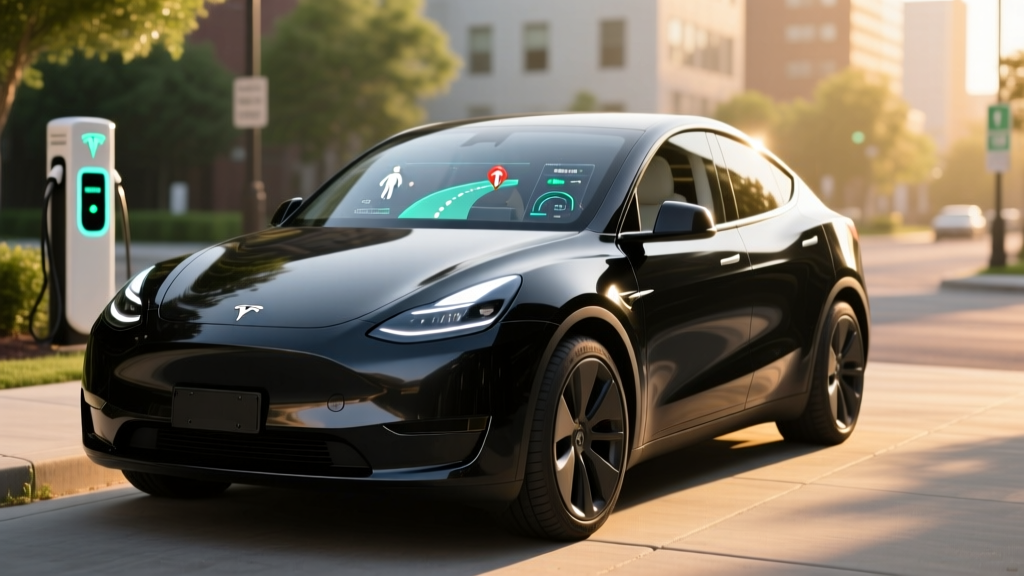
Tesla's approach to autonomous driving hinges on a process most buyers never think about: data labeling. Every mile driven by a Tesla on the road contributes to a massive pipeline of annotated video that trains the neural networks behind Full Self-Driving (Supervised). For the 2026 Model Y — Tesla's best-selling vehicle globally — understanding how data labeling shapes the car's driver-assistance capabilities is as important as knowing its range or charging speed.
This review covers the 2026 Tesla Model Y Long Range AWD with the latest hardware and FSD (Supervised) software, examining not just the spec sheet but how Tesla's data-labeling infrastructure translates into real-world driving behavior. We'll also cover the fundamentals: range, charging, pricing, tax credit eligibility, and whether this EV earns your money.
2026 Model Y Specs at a Glance
| Spec | 2026 Model Y Long Range AWD |
|---|---|
| EPA Range | 320 miles |
| Battery Capacity | 78.1 kWh usable (NMC) |
| Drivetrain | Dual-motor AWD |
| Horsepower | 384 hp combined |
| 0–60 mph | 4.8 seconds |
| Max DC Fast Charge | 250 kW peak |
| 10–80% DC Charge Time | ~25 minutes |
| Level 2 Home Charging | 11.5 kW (~44 mi/hr) |
| MPGe (Combined) | 111 MPGe |
| Efficiency | 30 kWh/100 mi |
| Cargo Volume | 30.2 cu ft (rear seats up) / 72.1 cu ft (folded) |
| Rear Legroom | 38.2 inches |
| Battery Warranty | 8 years / 120,000 miles |
| Base MSRP | $44,990 |
What Is Tesla Data Labeling and Why Does It Matter?
Tesla data labeling refers to the process of annotating the massive volumes of video and sensor data collected from Tesla's fleet to train its neural networks. Unlike competitors that rely on LiDAR and pre-mapped routes, Tesla's vision-only system uses cameras and deep learning to interpret the driving environment. Data labeling is the human-and-AI-assisted process of tagging objects, lane markings, traffic signals, road edges, and edge-case scenarios in this footage.
In practice, Tesla employs a hybrid labeling approach: automated pre-labeling by existing neural networks, followed by human review and correction for ambiguous or novel scenarios. The labeled data then feeds back into training cycles for the FSD (Supervised) stack. According to Tesla's AI team disclosures, the company processes millions of video clips per week, with the labeling pipeline increasingly relying on auto-labeling tools and shadow mode validation.
For buyers, the practical implication is this: the Model Y's driver-assistance capabilities improve over time via over-the-air updates, but the system's real-world performance depends heavily on how well Tesla's data-labeling pipeline has covered the scenarios you'll encounter. Urban environments with complex intersections benefit most from ongoing labeling improvements; rural or poorly marked roads may still challenge the system.
Real-World Range: EPA vs. What You'll Actually Get
Real-World Expectation: ~260–280 miles at sustained highway speeds (70–80 mph); ~200–230 miles in freezing temperatures with cabin heat. City driving with regenerative braking recovers closer to the EPA sticker, typically 290–310 miles in mild weather.
The Model Y Long Range AWD carries a 78.1 kWh usable NMC (nickel manganese cobalt) battery pack. NMC chemistry offers higher energy density than LFP (lithium iron phosphate), which is why it appears in the Long Range and Performance trims, while the base RWD Model Y uses an LFP pack at lower cost and slightly less range.
Efficiency lands at 30 kWh per 100 miles, translating to 111 MPGe combined per fueleconomy.gov. That's competitive with the Hyundai Ioniq 5 (114 MPGe combined) and slightly behind the BMW iX xDrive50 (86 MPGe combined but a heavier, larger vehicle).
The real-world range gap matters most on road trips. On a 300-mile winter drive through the Midwest, expect to arrive with roughly 10–15% State of Charge if you started at 100% — plan a DC fast-charge stop accordingly. Tesla's built-in trip planner and battery preconditioning help mitigate this by warming the battery before you arrive at a Supercharger, improving charge speed in cold conditions.
Charging Speed: Supercharger Network and Home Setup
| Charging Level | Power (kW) | Speed (miles added per hour) | Notes |
|---|---|---|---|
| Level 1 (120V) | ~1.4 kW | ~5 mi/hr | Emergency/trickle only |
| Level 2 (240V, 48A) | 11.5 kW | ~44 mi/hr | Home Wall Connector; full charge in ~7 hours |
| DC Fast (Supercharger V3) | 250 kW peak | ~1,000 mi/hr at peak | 10–80% in ~25 min; tapers above 80% |
| DC Fast (Supercharger V4) | Up to 350 kW (future) | Faster above 50% SoC | Model Y currently limited by onboard architecture to ~250 kW |
The Model Y's peak charge rate of 250 kW on V3 Superchargers is solid but no longer class-leading. The Hyundai Ioniq 5 and Kia EV6 peak at 240–250 kW on 800V architectures but sustain that rate longer, often completing 10–80% in 18 minutes versus the Model Y's ~25 minutes. The charge curve matters: the Model Y pulls its peak rate only between roughly 10–35% SoC, then steps down progressively. Above 80%, expect a dramatic taper to under 50 kW — this is why Tesla's navigation system targets 80% for road-trip stops.
For home charging, the Tesla Wall Connector at 48 amps on a 240V circuit delivers 11.5 kW, adding roughly 44 miles of range per hour. A full charge from 10% takes about 7 hours — easily overnight for most drivers. Installation costs vary: expect $800–$2,000 for a straightforward install near your electrical panel, or $2,500–$5,000+ if you need a panel upgrade or long conduit runs. Always hire a licensed electrician and pull permits.
The Model Y now ships with the NACS (North American Charging Standard) connector natively. This is a significant advantage in 2026: Tesla's Supercharger network remains the most reliable and widespread DC fast-charging infrastructure in the US, with over 25,000 stalls nationally. Non-Tesla EVs gaining NACS access still face occasional stalls or compatibility quirks, while Model Y owners enjoy plug-and-charge seamlessness.
Performance and Driving Dynamics
The dual-motor AWD Model Y Long Range delivers 384 hp and hits 0–60 mph in 4.8 seconds. That's brisk for a family crossover and quicker than the Ford Mustang Mach-E Extended Range AWD (5.1 seconds) but slower than the Performance trim (3.5 seconds). The instant torque delivery makes highway merging effortless, and the low center of gravity (battery pack under the floor) keeps body roll well-controlled for a tall crossover.
Regenerative braking offers two modes: standard (strong one-pedal driving feel) and low (more traditional coasting). Most Tesla owners adapt to one-pedal driving within a week, reducing brake wear significantly. The Model Y's stopping distance and brake feel remain average for the segment — not a strong point compared to the more refined pedal feel in the BMW iX or Mercedes EQB.
Ride quality improved with the latest refresh: updated damping reduces the harshness over expansion joints that plagued pre-2025 models. Cabin noise is lower at highway speeds, though still not luxury-quiet. Wind noise around the A-pillars remains noticeable above 75 mph.
Pricing, Trims, and Federal Tax Credit Eligibility
| Trim | Base MSRP | Est. After §30D Credit* | FSD Add-On |
|---|---|---|---|
| Long Range AWD | $44,990 | $37,490 | $8,000 (or $99/mo subscription) |
| Performance AWD | $48,990 | $41,490 | $8,000 (or $99/mo subscription) |
*Federal tax credit estimates assume buyer eligibility. Actual credit depends on IRS §30D rules.
- MSRP Cap: Vehicle must be under $55,000 (sedans) or $80,000 (SUVs/trucks/vans). The Model Y qualifies under the SUV cap.
- Income Cap: Modified AGI must not exceed $150,000 (single), $225,000 (head of household), or $300,000 (joint filers).
- Battery Sourcing: Increasing percentages of critical minerals and battery components must be sourced from the US or FTA partners. Tesla's US-built battery packs generally meet current thresholds, but verify at purchase.
- Point-of-Sale Transfer: Eligible buyers can apply the credit as an instant rebate at the dealership, reducing the purchase price directly.
- Verification: Always confirm eligibility via the IRS's official EV credit tool at irs.gov and consult a tax professional.
The FSD (Supervised) package adds $8,000 to the purchase price or is available as a $99/month subscription. Whether FSD is worth the cost depends entirely on your commute. For heavy highway commuters, the reduced fatigue is tangible. For city-only drivers with short commutes, basic Autopilot (included standard) may suffice. The subscription model makes sense for buyers who want to evaluate FSD before committing.
Tech, Interior, and the FSD Data Pipeline in Practice
The Model Y's interior remains minimalist: a 15.4-inch touchscreen handles virtually all vehicle controls, navigation, media, and climate. The latest refresh adds ventilated front seats, ambient lighting, a rear-seat touchscreen for passengers, and improved materials (soft-touch surfaces replacing the hard plastics of earlier models). Cargo space is generous at 30.2 cu ft behind the rear seats, expanding to 72.1 cu ft with seats folded — plus a small front trunk (frunk) for additional storage.
The standout technology is the FSD (Supervised) system and its connection to Tesla's data-labeling pipeline. In real-world use on marked highways and well-mapped urban streets, FSD handles lane changes, merges, traffic light recognition, and intersection navigation with increasing competence. The system's confidence in complex scenarios — unprotected left turns, construction zones, four-way stops — has improved measurably with each software update, a direct result of expanded labeled training data.
- It does not drive autonomously — you must keep your hands on the wheel and eyes on the road.
- It can misread faded lane markings, temporary construction signage, and unusual road geometries.
- Performance degrades in heavy rain, fog, or direct sun glare on cameras.
- It is not a substitute for an attentive driver and is not a Level 4 system.
Other notable tech: Sentry Mode (360-degree security recording), Dog Mode (climate control for pets), the Tesla app for remote preconditioning and monitoring, and over-the-air updates that regularly add features. The lack of Apple CarPlay and Android Auto remains a sticking point for some buyers, though Tesla's native navigation and media integration are robust.
Pros, Cons, and Who Should Buy the Model Y
- Supercharger network access — most reliable DC charging in the US
- 320 miles EPA range with excellent efficiency (30 kWh/100 mi)
- Continuous FSD improvement via data-labeling pipeline and OTA updates
- Spacious cargo area (72.1 cu ft max) and practical crossover form factor
- Strong resale value and low maintenance costs (no oil changes, minimal brake wear)
- NACS native connector — future-proof for charging infrastructure
- FSD (Supervised) is Level 2 — not self-driving despite the name
- DC charging speed (250 kW peak) trails 800V competitors in sustained rate
- No Apple CarPlay or Android Auto
- Ride quality improved but still not luxury-segment smooth
- FSD $8,000 cost is steep; subscription model adds ongoing expense
- Insurance premiums run 15–25% higher than comparable ICE vehicles
- Commuters: Ideal for 40–100-mile daily commutes with home charging. FSD reduces highway fatigue significantly.
- Families: Generous cargo and passenger space, strong safety ratings (NHTSA 5-star), and low running costs.
- Road trippers: Supercharger network makes long-distance travel practical, though cold-weather range loss requires planning.
- Tech enthusiasts: OTA updates and FSD's evolving capabilities appeal to buyers who want a car that improves over time.
- You need luxury ride quality (look at BMW iX or Mercedes EQE SUV).
- You require the fastest DC charging available (Hyundai Ioniq 5 / Kia EV6 with 800V architecture).
- You prefer traditional infotainment with CarPlay/Android Auto.
Frequently Asked Questions
What is the real-world range of the 2026 Tesla Model Y?
The EPA rates the Model Y Long Range AWD at 320 miles. In real-world highway driving at 70–80 mph, expect 260–280 miles. In freezing temperatures, range drops to roughly 200–230 miles. City driving with regenerative braking recovers closer to the sticker, around 290–310 miles in mild weather.
How fast does the Model Y charge?
On a Tesla V3 Supercharger, the Model Y peaks at 250 kW and charges from 10–80% in approximately 25 minutes. At home on a Level 2 Wall Connector (11.5 kW), it adds about 44 miles per hour, fully charging overnight in ~7 hours. The charge curve tapers significantly above 80% SoC.
How much does the Model Y cost after tax credits?
The Long Range AWD starts at $44,990 MSRP. Eligible buyers can reduce this to approximately $37,490 with the $7,500 federal §30D credit (applied at point of sale). Eligibility depends on income caps, battery sourcing requirements, and MSRP thresholds — verify at irs.gov.
Is the Model Y worth buying vs. competitors?
The Model Y excels in charging infrastructure (Supercharger network), efficiency, cargo space, and continuously improving driver-assist tech. It trails the Hyundai Ioniq 5 in sustained DC charge speed and the BMW iX in ride refinement. If Supercharger access and FSD's data-driven improvements matter to you, the Model Y remains the benchmark electric crossover.
What is Tesla data labeling and how does it affect my car?
Tesla data labeling is the process of annotating fleet-collected video data to train FSD's neural networks. This pipeline enables regular over-the-air improvements to Autopilot and FSD (Supervised), meaning the car's driver-assistance capabilities improve over time based on real-world scenarios labeled from millions of Tesla miles driven daily.
Does the Model Y qualify for the federal EV tax credit?
Yes, the Model Y qualifies for up to $7,500 under IRS §30D, subject to buyer income caps ($300,000 joint / $150,000 single), battery sourcing rules, and the $80,000 SUV MSRP cap. The credit can be applied as a point-of-sale rebate. Always confirm current eligibility on the IRS website before purchasing.