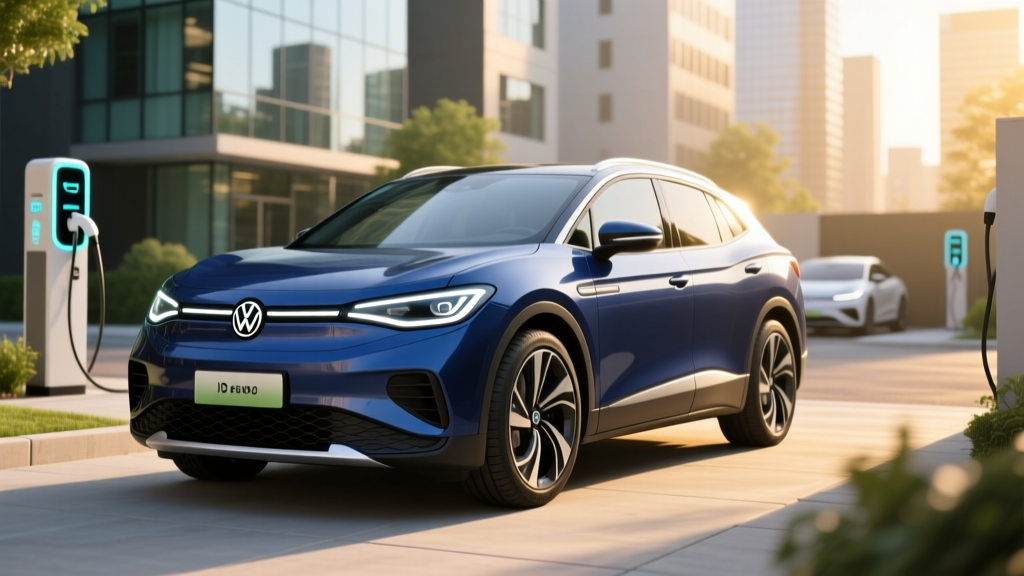
Quick Verdict: The Volkswagen ID.4 Electric SUV in 2026
The Volkswagen ID.4 remains one of the most approachable entries in the compact electric SUV segment for 2026. Built at VW's Chattanooga, Tennessee plant, it qualifies for the full federal tax credit when transferred at the point of sale — a significant advantage in a market where many competitors have lost eligibility due to battery-sourcing rules. With an EPA-estimated 275 miles of range on the Pro S RWD trim, a usable 77 kWh battery, and a comfortable, spacious cabin, the ID.4 targets buyers who want a practical, no-drama EV without paying a premium badge tax.
It isn't the fastest-charging SUV in its class, and the infotainment system still trails Korean rivals in responsiveness. But for families prioritizing cargo space, ride comfort, and a lower effective price after incentives, the ID.4 makes a compelling, data-backed case.
| Spec | Pro RWD | Pro S AWD |
|---|---|---|
| EPA Range | 275 mi | 263 mi |
| Battery (usable) | 77 kWh (NMC) | 77 kWh (NMC) |
| Max DC Fast Charge | 175 kW | 175 kW |
| 10–80% DCFC Time | ~30 min | ~30 min |
| Level 2 Home Charge | 11 kW (~36 mi/hr) | 11 kW (~36 mi/hr) |
| 0–60 mph | 7.7 sec | 5.4 sec |
| Horsepower | 282 hp | 335 hp |
| Drivetrain | Rear-Wheel Drive | Dual-Motor AWD |
| MPGe (combined) | 104 MPGe | 98 MPGe |
| Base MSRP | $40,790 | $49,190 |
Source: fueleconomy.gov and Volkswagen of America. Specs reflect 2026 model year.
Range and Efficiency: EPA Sticker vs. Real-World Miles
EPA Estimate: 275 miles (Pro RWD) / 263 miles (Pro S AWD)
Real-World Expectation: Plan for 230–250 miles on mixed highway driving in moderate weather. In sub-freezing temperatures, expect a 20–30% reduction, dropping effective range to roughly 190–220 miles on the RWD model. City driving with regenerative braking recovers more energy, often matching or slightly exceeding the EPA figure.
The ID.4's 77 kWh usable battery (82 kWh gross) uses NMC (nickel-manganese-cobalt) pouch cells supplied by SK On. This chemistry delivers strong energy density but is more sensitive to sustained high state-of-charge storage than LFP packs found in some competitors. VW recommends setting a daily charge limit of 80% for routine commuting and reserving 100% for road trips — a practice that extends long-term battery health.
Efficiency on the RWD model comes in at 104 MPGe combined (32 kWh/100 mi), which is competitive with the Hyundai Ioniq 5 (114 MPGe RWD) and slightly behind the Tesla Model Y Long Range (120 MPGe). The AWD variant's 98 MPGe reflects the added mass and mechanical drag of the front motor.
One factor worth noting: the ID.4's heat pump — standard on Pro S and above — significantly reduces cabin-heating energy draw in cold weather compared to resistive heaters. If you live in a northern climate, this is a meaningful range-preservation feature that not every competitor includes as standard equipment.
Charging Speed: DC Fast Charging and Home Level 2
| Charging Level | Power / Rate | Time / Miles Added |
|---|---|---|
| Level 1 (120V household) | ~1.4 kW | ~5 miles per hour |
| Level 2 (240V home, 48A) | 11 kW | ~36 miles per hour; 0–100% in ~8.5 hours |
| DC Fast Charge (CCS) | Peak 175 kW | 10–80% in ~30 minutes |
The ID.4 peaks at 175 kW on a DC fast charger, which is adequate but not class-leading. The Hyundai Ioniq 5 and Kia EV6, built on 800V architectures, peak at 240+ kW and achieve 10–80% in roughly 18 minutes. The ID.4's 400V architecture means it sustains its peak rate for a shorter window before tapering — in our experience, you'll see 175 kW briefly around 15–25% state of charge, then a gradual decline to roughly 100 kW above 60% SoC.
For road trips, this means a typical 10–80% stop takes about 30 minutes at a 350 kW Electrify America or similar station. That's a coffee-and-snack break, not a quick pit stop, but it's manageable with route planning.
At home, the 11 kW onboard charger is a strong point. On a 48-amp Level 2 circuit (like the Volkswagen Home Charging Station or a ChargePoint Home Flex), you'll add roughly 36 miles of range per hour and fully replenish the battery overnight in about 8.5 hours. This is faster than some competitors still using 7.2 kW onboard chargers.
VW includes three years of complimentary charging on the Electrify America network (with a kWh cap that varies by model year — check your purchase agreement for specifics). This offsets a meaningful portion of early road-trip charging costs.
Performance, Drivetrain, and Ride Quality
The rear-wheel-drive ID.4 produces 282 horsepower from its single rear motor, delivering a 0–60 mph time of 7.7 seconds. That's adequate for highway merging and daily commuting but won't win any stoplight races. The instant torque delivery, as with all EVs, makes it feel quicker in city driving than the 0–60 number suggests.
Step up to the Pro S AWD (or any AWD trim), and the dual-motor setup bumps output to 335 horsepower with a 5.4-second 0–60 time. The front motor also enables light off-road capability and better traction in snow, though this is a crossover — not a trail rig.
Ride quality is where the ID.4 earns consistent praise. VW tuned the suspension for comfort over sportiness, with compliant damping that absorbs rough pavement better than the firmer-riding Tesla Model Y. The steering is light and numb by enthusiast standards, but for the target buyer — families and commuters — it's easy and relaxed.
Regenerative braking offers two modes: a coasting mode (D) that lets the SUV glide with minimal drag, and a B mode that increases regen but does not enable true one-pedal driving. Unlike the Nissan Ariya or some Tesla modes, the ID.4 will not come to a complete stop using regen alone — you'll still use the brake pedal at low speeds. This is a deliberate VW engineering choice, but it frustrates buyers expecting full one-pedal capability.
Interior, Cargo Space, and Technology
The ID.4's cabin prioritizes space and simplicity. Rear-seat legroom measures 37.6 inches — generous for the segment and enough for adults on long trips. Cargo volume behind the rear seats is 30.3 cubic feet, expanding to 64.2 cubic feet with the 60/40 split rear seats folded. That's competitive with the Toyota RAV4 Hybrid and slightly less than the Model Y's 76 cu ft maximum.
A notable omission: the ID.4 has no front trunk (frunk). The space under the hood houses HVAC and power electronics, so all cargo must go in the rear. For buyers who use a frunk for charging cables or groceries, this is a real practicality gap.
The infotainment system uses a 12.9-inch touchscreen (on Pro S and above; 10.25-inch on base trims) running VW's latest software. Response times have improved over the launch-year ID.4, but capacitive touch sliders for volume and climate control remain a frustration point — they lack backlighting at night and offer no tactile feedback. Wireless Apple CarPlay and Android Auto are standard across all trims.
Driver assistance comes via VW's IQ.DRIVE suite, which includes adaptive cruise control with stop-and-go, lane-centering assist, blind-spot monitoring, and front emergency braking. This is a Level 2 SAE system — the driver must remain attentive and keep hands on or near the wheel at all times. It is not autonomous driving.
SAE Automation Level: The ID.4's IQ.DRIVE is a Level 2 driver-assistance system. It can manage steering, acceleration, and braking under certain conditions, but the driver is fully responsible for monitoring the road and intervening at any time. This is fundamentally different from Level 4 robotaxi services like Waymo.
Pricing, Trim Levels, and Federal Tax Credit
| Trim | MSRP | Est. After §30D Credit* | Drivetrain |
|---|---|---|---|
| Standard Range S | $38,990 | $31,490 | RWD |
| Pro | $40,790 | $33,290 | RWD |
| Pro S | $44,590 | $37,090 | RWD |
| Pro S Plus | $47,790 | $40,290 | RWD or AWD |
| Pro S AWD | $49,190 | $41,690 | AWD |
*Estimated effective price assumes full $7,500 federal tax credit via point-of-sale transfer. Actual eligibility depends on buyer income, MSRP caps, and battery-sourcing requirements under IRS §30D. See IRS guidance for current rules. Destination charges, taxes, and dealer fees not included.
Because the ID.4 is assembled in Chattanooga, Tennessee, it meets the North American final-assembly requirement for the §30D federal tax credit. The battery cell sourcing and critical-minerals thresholds are met for the full $7,500 credit as of the 2026 model year, but buyers should verify current eligibility at fueleconomy.gov before purchasing, as these rules are subject to change.
Income caps apply: Modified adjusted gross income must not exceed $150,000 (single filers), $225,000 (head of household), or $300,000 (joint filers). The vehicle MSRP must not exceed $80,000 for SUVs — all ID.4 trims clear this threshold comfortably.
The point-of-sale transfer option, available since January 2024, lets eligible buyers apply the $7,500 credit directly as a down-payment reduction at the dealership rather than waiting to claim it on their tax return. This effectively lowers the barrier to entry and is one of the ID.4's strongest purchase arguments versus competitors that have lost credit eligibility.
Battery Warranty and Long-Term Ownership
Volkswagen covers the ID.4's high-voltage battery with an 8-year / 100,000-mile warranty (whichever comes first), guaranteeing that the battery will retain at least 70% of its original usable capacity during that period. The basic vehicle warranty is 4 years / 50,000 miles, and the powertrain is covered for 4 years / 50,000 miles as well.
NMC battery degradation data for the ID.4 platform is still maturing — the vehicle launched in the U.S. for the 2021 model year, so the longest-running examples have roughly five years of real-world data. Early indications from owner forums and fleet data suggest typical degradation of 5–8% over the first 60,000 miles, which is within the industry norm for liquid-cooled NMC packs. The 70% retention threshold at 8 years / 100,000 miles is consistent with Hyundai, Kia, and Tesla warranty terms.
If out-of-warranty replacement ever becomes necessary, current estimates for the ID.4's battery pack range from $12,000 to $18,000 including labor, though prices are expected to decline as the battery supply chain matures. Most buyers will trade or sell the vehicle long before reaching this point.
Pros and Cons
Pros
- Full $7,500 federal tax credit eligibility — a significant price advantage over non-qualifying competitors
- Spacious cabin and cargo area — 30.3 cu ft rear cargo, 37.6" rear legroom
- Comfortable ride quality — well-tuned for daily commuting and family use
- Strong 11 kW Level 2 charging — faster overnight replenishment than some rivals
- Heat pump standard on higher trims — better cold-weather efficiency
- Three years of Electrify America charging included
Cons
- 175 kW peak DC charging — slower than 800V competitors (Ioniq 5, EV6 at 240 kW)
- No front trunk (frunk) — all cargo must go in the rear
- Capacitive touch sliders — frustrating for volume and climate adjustments
- No true one-pedal driving — B mode doesn't bring the vehicle to a full stop
- Infotainment responsiveness — improved but still lags Korean and Tesla systems
- AWD trims push past $49,000 before options
Who Should Buy the Volkswagen ID.4?
Choose the ID.4 if:
- You want a family-sized electric SUV under $35,000 effective (after tax credit) with strong cargo space
- You charge primarily at home and take occasional road trips (30-min DC stops are acceptable)
- You value ride comfort over sporty handling
- You live in a region with Electrify America coverage and will use the included free charging
- Federal tax credit eligibility is a priority in your purchase decision
Look elsewhere if:
- You need the fastest possible DC charging for frequent long-distance travel (consider the Ioniq 5 or EV6)
- You want one-pedal driving as a core feature (consider the Tesla Model Y or Ford Mustang Mach-E)
- You need a frunk for cable storage or additional cargo
- You prioritize cutting-edge infotainment and over-the-air feature updates (Tesla remains the benchmark here)
Frequently Asked Questions
What is the real-world range of the Volkswagen ID.4?
The EPA rates the ID.4 Pro RWD at 275 miles and the AWD at 263 miles. In real-world mixed driving at highway speeds (70–75 mph), expect 230–250 miles in moderate temperatures. In cold weather (below 32°F), range can drop to 190–220 miles due to battery heating demands and cabin climate use. The heat pump on Pro S and higher trims mitigates some of this loss.
How fast does the ID.4 charge at home and on the road?
At home on a 240V Level 2 charger (48 amps), the ID.4 charges at 11 kW, adding roughly 36 miles of range per hour — a full charge from empty takes about 8.5 hours. On DC fast chargers, it peaks at 175 kW and reaches 10–80% in approximately 30 minutes. This is slower than 800V competitors but sufficient for planned road-trip stops.
Does the 2026 Volkswagen ID.4 qualify for the $7,500 federal tax credit?
Yes — as of the 2026 model year, the ID.4 qualifies for the full $7,500 §30D federal tax credit because it is assembled in Tennessee and meets battery-sourcing and critical-minerals requirements. However, buyer income caps apply ($150K single / $300K joint), and the credit can be transferred at the point of sale to reduce your purchase price directly. Always verify current eligibility on irs.gov before finalizing your purchase.
Is the ID.4 worth buying versus the Tesla Model Y or Hyundai Ioniq 5?
It depends on your priorities. The Model Y offers more range (320+ mi), faster Supercharger access, and a more advanced software experience, but starts at a higher price and has lost some federal credit eligibility depending on the variant. The Ioniq 5 charges faster (10–80% in ~18 min) and has a more modern interior, but its effective price after incentives may be higher. The ID.4 wins on effective price after the tax credit, ride comfort, and cabin space — making it a strong value pick for buyers who don't need maximum range or charging speed.
How long will the ID.4 battery last?
VW warranties the battery for 8 years or 100,000 miles with a minimum 70% capacity retention guarantee. Industry data on NMC packs suggests most will retain 85–92% capacity at the 100,000-mile mark with proper care (avoiding frequent 100% charges and prolonged high-SoC storage). Out-of-warranty replacement costs currently range from $12,000 to $18,000 but are expected to decline over time.
Does the ID.4 have a frunk?
No. The ID.4 does not have a front trunk. The area under the hood is occupied by power electronics and the HVAC system. All cargo must be stored in the rear cargo area (30.3 cu ft behind rear seats, 64.2 cu ft with seats folded).