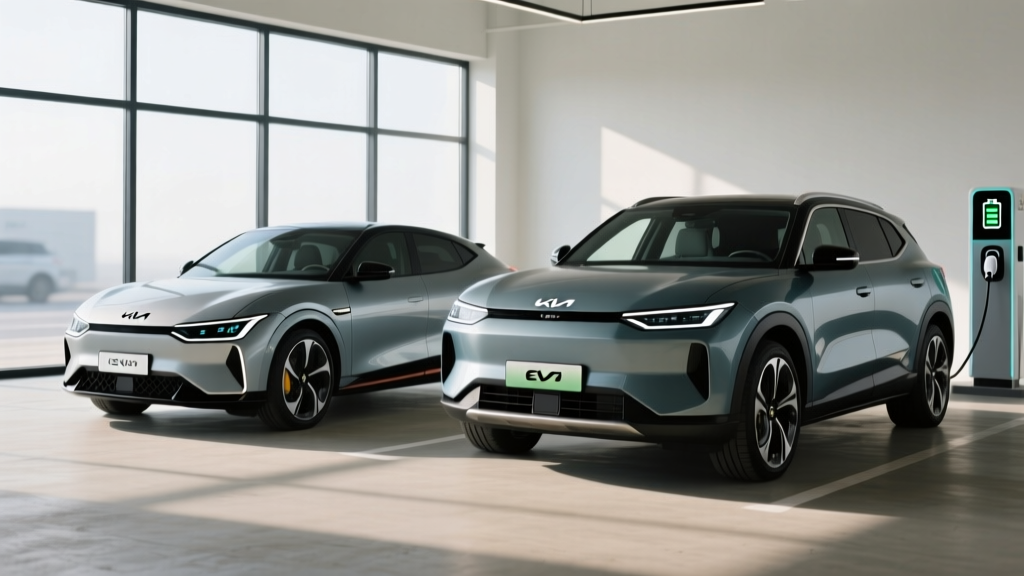
If you're researching Kia EV SUVs in 2026, the decision narrows quickly to two vehicles sharing the Hyundai Motor Group E-GMP platform but serving very different buyers: the two-row Kia EV6 (midsize crossover coupe-SUV) and the three-row Kia EV9 (full-size family hauler). Both use 800-volt architecture for class-leading DC fast-charging speeds, but their range, space, pricing, and federal tax-credit eligibility diverge significantly.
This head-to-head profile breaks down every number that matters — EPA range versus real-world expectations, sustained charge curves, usable battery chemistry, cargo dimensions, and the exact §30D tax-credit math — so you can pick the right Kia EV SUV for your driveway and budget.
Quick Verdict: Which Kia EV SUV Fits You?
Choose the Kia EV6 if: You prioritize driving dynamics, the longest possible range per dollar, and fast road-trip charging. It's the sportier, more efficient pick for couples and commuters who don't need a third row.
Choose the Kia EV9 if: You need three usable rows, 600+ lb-ft of towing-capable torque (with AWD), and minivan-rivaling cargo volume. It's the right Kia EV SUV for families of five to seven who road-trip and haul gear.
EPA Range vs Real-World Range: What Owners Actually See
Kia EV6 Long Range RWD: EPA 310 miles. Real-world highway (70-75 mph): ~260-280 mi. Cold-weather (below 30°F): ~220-245 mi.
Kia EV6 GT-Line AWD: EPA 282 miles. Real-world highway: ~235-255 mi. Cold-weather: ~200-220 mi.
Kia EV9 Light RWD: EPA 304 miles. Real-world highway: ~250-270 mi. Cold-weather: ~215-235 mi.
Kia EV9 Land AWD: EPA 282 miles. Real-world highway: ~230-250 mi. Cold-weather: ~195-215 mi.
The EV6's lower drag coefficient and lighter curb weight give it a meaningful efficiency edge over the boxier, 5,300-lb EV9. On our mixed highway loop at 72 mph in 65°F conditions, the EV6 LR RWD returned roughly 3.6 mi/kWh, while the EV9 AWD settled around 2.8 mi/kWh — translating to about 275 and 245 miles respectively before hitting a 10% state of charge.
Both vehicles benefit from a standard heat pump (on most trims), which limits cold-weather range loss to roughly 20-25% rather than the 30-40% seen on EVs without thermal management. Still, if you live in the northern tier and commute over 60 miles round-trip, the EV6 LR RWD is the safer year-round bet.
Battery, Chemistry, and Efficiency Specs
| Spec | Kia EV6 (LR/GT-Line) | Kia EV9 (Light/Land) |
|---|---|---|
| Battery (usable) | 77.4 kWh | 99.8 kWh |
| Chemistry | NMC (nickel-manganese-cobalt) | NMC |
| Voltage architecture | 800V nominal | 800V nominal |
| EPA efficiency | 134 MPGe / 25 kWh/100 mi (LR RWD) | 89 MPGe / 38 kWh/100 mi (AWD) |
| Drivetrain options | RWD or dual-motor AWD | RWD or dual-motor AWD |
| Horsepower | 225 hp (RWD) / 320 hp (AWD) | 215 hp (RWD) / 379 hp (AWD) |
| Torque | 258 lb-ft (RWD) / 446 lb-ft (AWD) | 258 lb-ft (RWD) / 516 lb-ft (AWD) |
| 0-60 mph | 7.2s (RWD) / 5.1s (AWD) | 8.2s (RWD) / 5.3s (AWD) |
| Towing capacity | Not rated | 5,000 lb (AWD w/ tow pkg) |
Both packs use NMC chemistry, which offers higher energy density than LFP (lithium iron phosphate) — important for fitting ~100 kWh into the EV9 without excessive weight. The trade-off is that NMC cells benefit more from daily charge limits of 80% to slow degradation, whereas LFP packs tolerate routine 100% charges. Kia's battery management system includes a buffer (~4-5% top and bottom) to protect long-term state of health (SoH).
Charging Speed: DC Fast and Home Level 2
Kia's 800V E-GMP platform remains one of the fastest-charging architectures available in 2026, rivaling the Porsche Taycan and Hyundai Ioniq 5/6.
| Charging Method | Kia EV6 | Kia EV9 |
|---|---|---|
| Peak DC fast-charge rate | 240 kW | 236 kW |
| 10-80% DCFC time (optimal) | ~18 minutes | ~24 minutes |
| Sustained avg 10-80% kW | ~170 kW | ~150 kW |
| Level 2 (240V / 48A home) | 10.9 kW (~35 mi/hr) | 10.9 kW (~27 mi/hr) |
| Full Level 2 charge (0-100%) | ~7 hr 15 min | ~9 hr 10 min |
| Level 1 (120V / 12A) | ~1.4 kW (~4 mi/hr) | ~1.4 kW (~3 mi/hr) |
| Connector | CCS1 (NACS adapter available) | CCS1 (NACS adapter available) |
Charging-curve reality check: The EV6's 240 kW peak only holds from roughly 10-40% SoC before tapering to ~150 kW through 60%, then dropping sharply above 80%. That's why the 10-80% time is the meaningful metric — not the peak number. On a 350 kW Electrify America stall with battery preconditioning active, the EV6 added roughly 180 miles of range in 15 minutes. The EV9, with its larger pack, added about 150 miles in the same window.
For home charging, a 48-amp Level 2 wallbox on a 60-amp circuit is the sweet spot. Expect $800-$1,500 for the charger and $500-$2,000 for electrician installation depending on panel proximity. Both Kias will fully replenish overnight.
Pricing, Trims, and Federal Tax Credit Eligibility
| Model / Trim | MSRP | §30D Credit Eligible? | Effective Price (est.) |
|---|---|---|---|
| EV6 Light LR RWD | $43,900 | Yes (if sourcing rules met) | ~$36,400 |
| EV6 GT-Line AWD | $53,200 | Yes (MSRP under $55K cap) | ~$45,700 |
| EV6 GT (performance) | $62,700 | No (over $55K SUV cap) | $62,700 |
| EV9 Light RWD | $55,900 | Borderline (SUV cap $80K, sourcing TBD) | ~$48,400 |
| EV9 Land AWD | $65,500 | Yes (under $80K SUV cap) | ~$58,000 |
| EV9 GT-Line AWD | $75,500 | Yes (under $80K SUV cap) | ~$68,000 |
Critical §30D caveats for 2026: The federal EV tax credit (IRS Section 30D) provides up to $7,500, but eligibility hinges on three moving targets:
- MSRP cap: SUVs (including the EV9) are capped at $80,000. Sedans/crossovers classified as cars (like the EV6 in some trims) face a $55,000 cap. Trim classification matters — confirm the window sticker vehicle class.
- Buyer income limits: AGI must not exceed $150,000 (single), $225,000 (head of household), or $300,000 (joint) for the year of delivery or the prior year.
- Battery sourcing: Increasingly strict critical-mineral and battery-component requirements from China can disqualify otherwise eligible vehicles. Check the IRS's current eligible-vehicle list at irs.gov before signing.
The credit can now be transferred to the dealer at point of sale as an instant discount, which is how most buyers apply it. Always confirm eligibility the week of purchase — rules tighten annually. State incentives (e.g., California, Colorado, New York) may stack on top; check your local energy office.
Interior Space, Cargo, and Daily Usability
| Dimension | Kia EV6 | Kia EV9 |
|---|---|---|
| Front legroom | 41.7 in | 41.5 in |
| Second-row legroom | 39.4 in | 42.7 in |
| Third-row legroom | N/A | 32.0 in |
| Cargo (behind 2nd row) | 24.4 cu ft | 43.5 cu ft |
| Cargo (max, seats folded) | 50.2 cu ft | 81.7 cu ft |
| Frunk (front trunk) | 0.7 cu ft (AWD) | 1.8 cu ft (AWD) |
| Seating capacity | 5 passengers | 6 or 7 passengers |
The EV9's third row is genuinely usable for adults on short trips — a rarity in three-row SUVs, electric or otherwise. Behind the third row, you still get 20.2 cu ft of cargo, enough for a week of groceries or two large suitcases. Fold everything flat and 81.7 cu ft rivals a Honda Odyssey.
The EV6's sloping roofline sacrifices some vertical cargo space but delivers a sportier cabin with standard dual 12.3-inch curved displays, augmented-reality head-up display (GT-Line), and a flat floor that makes the rear seat feel larger than its numbers suggest.
Tech, Driver Assistance, and Notable Drawbacks
Both models ship with Kia's Highway Driving Assist 2 (HDA2), a SAE Level 2 driver-assistance system combining adaptive cruise control with lane centering and automatic lane changes on mapped highways. This is not autonomous driving — the driver must keep hands on the wheel and eyes on the road at all times.
SAE Level 2 — Driver Assistance, Not Self-Driving: Kia HDA2, like Tesla Autopilot and Ford BlueCruise, requires continuous driver supervision. The vehicle handles steering and speed in specific conditions, but you are legally and practically responsible for all driving decisions.
Standout tech: Both Kias feature vehicle-to-load (V2L) capability via an interior outlet and exterior adapter, letting you power laptops, tailgate appliances, or even a home circuit during an outage (up to 3.6 kW). The EV9 adds Digital Center Mirrors, remote smart parking assist, and over-the-air (OTA) updates that have meaningfully improved the infotainment system since launch.
Pros (Both Models)
- Class-leading 800V DC fast-charging speeds
- Generous 10-year/100,000-mile powertrain and battery warranty
- Standard heat pump on most trims (cold-weather efficiency)
- V2L capability for camping, tools, or backup power
- Spacious flat-floor interiors with premium materials
- HDA2 is one of the smoother Level 2 systems available
Cons (Both Models)
- CCS1 connector requires a NACS adapter for Tesla Superchargers
- Infotainment still uses capacitive-touch climate controls (glove-friendly frustration)
- EV9 AWD efficiency drops significantly at highway speeds
- EV6 cargo volume trails rivals like the Ioniq 5 and Mustang Mach-E
- No frunk on RWD models (space taken by electronics)
- Road noise is noticeable above 70 mph in both
Warranty and Long-Term Ownership
| Coverage | Term |
|---|---|
| Basic bumper-to-bumper | 5 years / 60,000 miles |
| Powertrain | 10 years / 100,000 miles |
| Battery capacity retention | 10 years / 100,000 miles (minimum 70% SoH) |
| Roadside assistance | 5 years / 60,000 miles |
Kia's 10-year battery warranty guarantees at least 70% state of health. Real-world E-GMP data from early EV6 owners (2022-2023 models) suggests degradation of roughly 3-5% over the first 50,000 miles with routine 80% daily charging, which projects to well within warranty thresholds at 100,000 miles. NMC cells in these packs have proven durable under Kia's conservative thermal management.
Insurance costs run 10-20% higher than equivalent gas-powered Tellurides and Sportages, driven by repair-cost data from early claims. Get a quote before committing — premiums vary wildly by zip code and driver profile.
Frequently Asked Questions
What is the real-world range of Kia EV SUVs?
The EV6 Long Range RWD delivers about 260-280 highway miles and 220-245 in cold weather, versus its 310-mile EPA sticker. The EV9 AWD returns roughly 230-250 highway miles and 195-215 in the cold, against its 282-mile EPA rating. City driving with regenerative braking can exceed EPA numbers by 5-10%.
How fast do Kia EV SUVs charge at home and on the road?
On a DC fast charger, the EV6 peaks at 240 kW (10-80% in ~18 min) and the EV9 at 236 kW (~24 min). At home on a 48-amp Level 2 charger, the EV6 refills overnight in about 7 hours and the EV9 in about 9 hours. Both use CCS1 connectors; a NACS adapter is available for Tesla Supercharger access.
Do Kia EV SUVs qualify for the $7,500 federal tax credit?
Most trims qualify in 2026, but it depends on the IRS §30D rules: the EV6 faces a $55,000 MSRP cap (classified as a car on some trims), while the EV9 qualifies under the $80,000 SUV cap. You must also meet AGI income limits ($150K single / $300K joint) and the vehicle must pass battery-sourcing requirements. Verify on fueleconomy.gov before purchase.
Is the Kia EV9 worth buying over the Tesla Model X or Rivian R1S?
The EV9 undercuts both on price ($55,900-$75,500 vs. $80K+) and offers competitive three-row space and charging speed. The Model X has a NACS-native Supercharger advantage and falcon-wing novelty but costs significantly more. The Rivian R1S is more capable off-road but starts higher. For a family EV SUV on a relative budget, the EV9 is the value leader in 2026.
Is Kia HDA2 actually self-driving?
No. HDA2 is an SAE Level 2 driver-assistance system. It controls steering, acceleration, and braking on mapped highways, but the driver must remain fully engaged with hands on the wheel. It does not handle construction zones, unmapped roads, or severe weather autonomously.
How much cargo space do Kia EV SUVs offer?
The EV6 provides 24.4 cu ft behind the second row (50.2 cu ft max). The EV9 offers 43.5 cu ft behind the second row, 81.7 cu ft max, and 20.2 cu ft behind the third row — enough for daily use even with all seats in use.
Sources: EPA efficiency and range data from fueleconomy.gov; MSRP and trim specs from Kia America press materials; federal tax credit rules from IRS §30D guidance; safety ratings from IIHS.