Why Cybertruck Owners Are Wrapping Instead of Painting
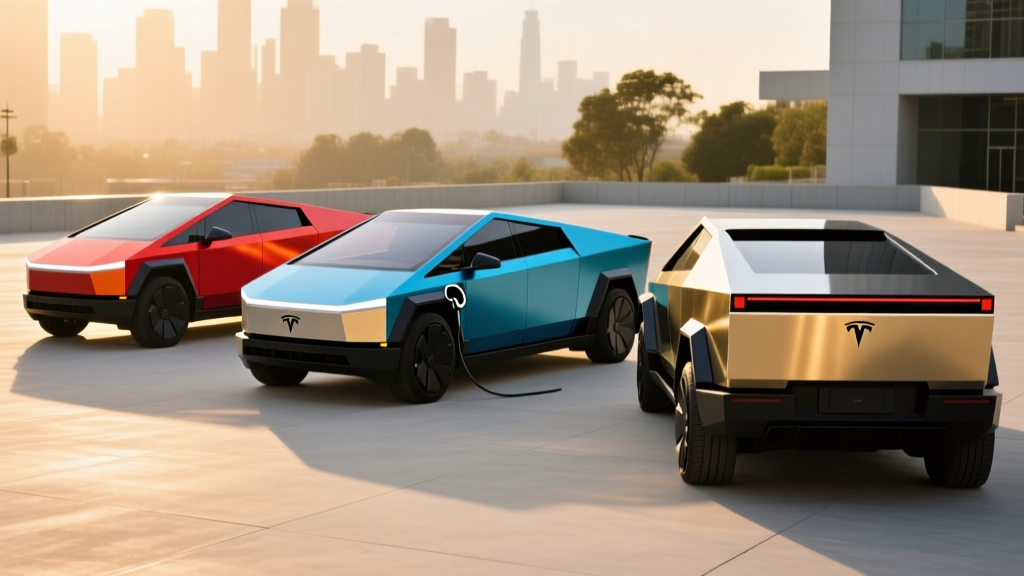
The Tesla Cybertruck's cold-rolled stainless steel exoskeleton doesn't accept traditional automotive paint. That hasn't stopped owners from personalizing their trucks. Vinyl wraps have become the default customization route, with shops reporting a surge in Cybertruck wrap jobs since the vehicle's late-2023 launch ramped into full production. If you're researching Tesla Cybertruck wrap colors, you're likely also weighing the truck's real-world capabilities — range, charging, cost, and daily usability. This guide covers both the customization landscape and the hard specs you need before committing to a purchase and a wrap.
2026 Tesla Cybertruck: Core Specifications at a Glance
| Specification | AWD (Dual-Motor) | Cyberbeast (Tri-Motor) | RWD (Base) |
|---|---|---|---|
| EPA Range | 340 miles | 320 miles | ~250 miles (est.) |
| Battery Capacity | ~123 kWh (NMC) | ~123 kWh (NMC) | ~123 kWh (NMC) |
| Horsepower | 600 hp | 845 hp | ~275 hp (est.) |
| 0-60 mph | 3.9 sec | 2.6 sec | ~6.5 sec (est.) |
| Max DC Fast Charge | 250 kW | 250 kW | 250 kW |
| 10-80% DC Charge | ~30 min | ~30 min | ~30 min |
| Level 2 Charge Rate | 11.5 kW (~44 mi/hr) | 11.5 kW (~44 mi/hr) | 11.5 kW (~44 mi/hr) |
| Towing Capacity | 11,000 lbs | 11,000 lbs | 7,500 lbs |
| Base MSRP | $79,990 | $99,990 | $60,990 |
Sources: Tesla Cybertruck design page, fueleconomy.gov. RWD trim specs are estimated based on Tesla's announced figures; availability has been limited.
Real-World Range: What the EPA Sticker Doesn't Tell You
Cold-weather impact: In temperatures below 32°F, range drops 20-30% due to battery chemistry limitations and cabin heating demands. A 340-mile AWD Cybertruck may deliver as little as 220-250 miles in winter highway conditions. The truck lacks a heat pump in early production runs, relying on resistive heating — a meaningful efficiency penalty.
For a wrapped Cybertruck, the vinyl adds negligible weight (roughly 40-60 lbs for a full wrap) and has no measurable impact on range. However, darker wrap colors can increase cabin heat soak in summer, marginally increasing A/C load.
Charging Speed: Home and DC Fast Charging
| Charging Level | Power (kW) | Speed (Miles/Hour) | Typical Use Case |
|---|---|---|---|
| Level 1 (120V) | ~1.4 kW | ~5 mi/hr | Emergency / trickle |
| Level 2 (240V, 48A) | 11.5 kW | ~44 mi/hr | Home overnight charging |
| DC Fast (Tesla Supercharger V3) | Up to 250 kW | ~180 mi in 15 min (peak) | Road trips |
The Cybertruck uses Tesla's proprietary NACS connector natively, giving it full access to the Supercharger network — now the largest and most reliable DC fast-charging network in North America. The 250 kW peak charge rate is competitive but not class-leading; the Hyundai Ioniq 5 and Kia EV9 can hit 350 kW on compatible chargers.
Charging curve reality: The Cybertruck's large ~123 kWh NMC battery means the 10-80% charge takes approximately 30 minutes at a V3 Supercharger. However, sustained charging averages closer to 130-150 kW as the battery management system tapers current above 50% State of Charge (SoC) to protect cell longevity. Don't expect the full 250 kW for the entire session — that peak only holds in a narrow SoC window, typically between 10-30%.
For home charging, a Tesla Wall Connector on a 60-amp circuit delivers the full 11.5 kW, replenishing roughly 350 miles overnight (8 hours). Installation typically runs $800-$2,000 depending on panel proximity and whether a 200-amp service upgrade is needed.
Tesla Cybertruck Wrap Colors: Popular Options and Costs
Since the Cybertruck ships in bare stainless steel only, wraps are the primary color customization method. Here's what the market looks like in 2026:
- Satin/Matte Black: The most requested Cybertruck wrap color by a wide margin. Gives the truck a stealth-military aesthetic. Cost: $4,500-$6,500 full wrap.
- Satin Chrome / Colorshift: Chameleon wraps that shift between purple, teal, and copper depending on viewing angle. Cost: $5,500-$8,000 due to premium vinyl.
- Matte Military Green / Olive Drab: Popular among overlanding-oriented owners. Cost: $4,500-$6,000.
- Gloss White / Satin White: A clean contrast to the truck's angular geometry. Cost: $4,000-$5,500.
- Flat Dark Gray / Gunmetal: Subtly darker than the raw steel without the drama of full black. Cost: $4,500-$6,000.
- PPF (Paint Protection Film) with Tint: Some owners opt for clear PPF with a slight smoke tint to protect the steel from fingerprints and light scratches while maintaining the factory look. Cost: $3,500-$5,000.
Wrap lifespan: Premium cast vinyl (3M, Avery Dennison, XPEL) lasts 5-7 years with proper care. The Cybertruck's flat panels are actually easier to wrap than curved vehicles, which can reduce labor costs slightly compared to wrapping a Porsche Taycan or similar contoured body.
Important note: Wrapping the Cybertruck does not void the battery or powertrain warranty. However, Tesla service centers may need to remove portions of the wrap for body-panel work. Discuss removal/reinstallation terms with your wrap shop upfront.
Pricing, Trims, and Federal Tax Credit Eligibility
| Trim | Base MSRP | Federal §30D Credit | Effective Price |
|---|---|---|---|
| RWD | $60,990 | Eligible (up to $7,500) | ~$53,490 |
| AWD (Dual-Motor) | $79,990 | Not eligible (MSRP cap) | $79,990 |
| Cyberbeast (Tri-Motor) | $99,990 | Not eligible (MSRP cap) | $99,990 |
Add a premium wrap ($5,000-$7,000) to the RWD model and your total out-the-door investment lands around $58,500-$60,500 after the credit — still a significant sum, but meaningfully less than the AWD or Cyberbeast without any customization.
Efficiency, Cargo, and Daily Livability
Efficiency: The AWD Cybertruck achieves approximately 2.0-2.2 kWh/mile (roughly 56 MPGe combined per fueleconomy.gov). That's notably less efficient than a Tesla Model Y (~3.5 mi/kWh) and reflects the truck's mass and frontal area. Expect to spend $0.08-$0.14 per mile on electricity depending on your local utility rates — still cheaper than gasoline at $3.50/gal for a comparable truck getting 18 MPG combined.
Cargo: The 6-foot bed offers 67 cu ft of volume with the tonneau cover closed. The vault-style bed is lockable and weather-sealed. Interior rear-seat legroom measures approximately 41.5 inches — adequate for adults on shorter trips but compromised by the upright seatback angle. Front legroom is generous at ~42 inches. The frunk (front trunk) adds roughly 7 cu ft of secure storage.
Notable drawbacks:
- Stainless steel body shows fingerprints aggressively (a primary reason owners wrap)
- Rear visibility is poor; the camera-based mirror system helps but requires adaptation
- Ride quality is firm, especially when unloaded — the air suspension helps but doesn't fully isolate the truck's weight
- Panel gaps and build-quality inconsistencies have been widely documented in early production units
- Steer-by-wire system (no mechanical linkage) feels unusual and takes acclimation
Warranty, Tech, and Driver Assistance
Battery & Powertrain Warranty: Tesla covers the Cybertruck's battery and drive units for 8 years or 120,000 miles (whichever comes first), with a minimum 70% capacity retention threshold. This is competitive with the Ford F-150 Lightning (8 yr/100,000 mi) and slightly better on mileage.
Autopilot & FSD: The Cybertruck ships with Tesla's Basic Autopilot (adaptive cruise + lane centering). Full Self-Driving (Supervised) is a $8,000 add-on or $99/month subscription. FSD remains an SAE Level 2 driver-assistance system — the driver must remain fully engaged, hands on the yoke, eyes on the road. It is not autonomous driving. Tesla's camera-only "Tesla Vision" approach lacks lidar redundancy that competitors like GM's Super Cruise employ.
Infotainment: The 18.5-inch center touchscreen runs Tesla's proprietary OS — fast, responsive, and feature-rich (navigation, streaming, gaming). However, it lacks Apple CarPlay and Android Auto, which remains a dealbreaker for some buyers. The Cybertruck also features a rear-seat 9.4-inch touchscreen.
Who Should Buy the Cybertruck (and Wrap It)?
Not ideal for: Traditional truck work (bed access is awkward with the tonneau design), buyers in extreme-cold climates without garage parking (range loss is significant), or anyone needing proven long-term reliability data — the Cybertruck is still early in its production lifecycle.
Pros and Cons
Pros
- Distinctive design; wraps transform the truck dramatically
- Strong Supercharger network access (NACS native)
- 845 hp Cyberbeast is absurdly quick for a 6,800-lb truck
- 11,000-lb towing capacity (AWD/Cyberbeast)
- Stainless steel body won't rust or corrode
- OTA updates continuously add features
Cons
- Real-world highway range significantly below EPA sticker
- Only RWD trim qualifies for $7,500 federal credit
- Steer-by-wire takes getting used to; no mechanical backup
- No Apple CarPlay or Android Auto
- Build quality inconsistencies persist
- Stainless steel shows every fingerprint (wrap strongly recommended)
Frequently Asked Questions
What is the real-world range of the Tesla Cybertruck?
The AWD Cybertruck's EPA range is 340 miles, but real-world highway driving at 70+ mph typically yields 260-290 miles. In cold weather (below 32°F), expect 220-250 miles. The Cyberbeast delivers roughly 240-270 miles on the highway.
How fast does the Cybertruck charge at home and on the road?
On a Level 2 home charger (11.5 kW), the Cybertruck adds approximately 44 miles of range per hour — a full charge takes about 8 hours. At a Tesla V3 Supercharger (250 kW peak), 10-80% takes roughly 30 minutes, though sustained charging averages 130-150 kW due to taper.
Does the Cybertruck qualify for the federal EV tax credit?
Only the base RWD trim at $60,990 MSRP qualifies for the IRS §30D credit (up to $7,500), assuming you meet income limits ($150K single / $300K joint) and the vehicle meets battery-sourcing requirements. The AWD ($79,990) and Cyberbeast ($99,990) exceed the $80,000 MSRP cap for trucks and are ineligible.
How much does a Tesla Cybertruck wrap cost?
A full-body vinyl wrap on the Cybertruck costs between $4,000 and $8,000 depending on material (standard vs. colorshift/chrome), shop location, and prep work. Premium materials like XPEL or 3M last 5-7 years.
Is the Cybertruck worth buying vs. the F-150 Lightning or Rivian R1T?
The Cybertruck offers the most distinctive design and best Supercharger access. The F-150 Lightning is more practical for traditional truck work and offers CarPlay, while the Rivian R1T delivers superior interior quality and off-road capability. Your choice depends on whether you prioritize tech/brand cachet (Cybertruck), utility (Lightning), or premium adventure capability (R1T).
Does wrapping the Cybertruck affect the warranty?
No. A vinyl wrap does not void Tesla's battery, powertrain, or vehicle warranty. However, body repairs may require partial wrap removal and reinstallation, which is typically not covered by Tesla's warranty.