The Verdict: A Compact Electric SUV That Finally Fits a Normal Budget
For years, Rivian has been the EV brand adventurous buyers wanted but couldn't quite justify. The R1S and R1T are exceptional machines, but with starting prices north of $70,000, they remain aspirational for most households. The 2026 Rivian R2 changes that equation. Starting at approximately $45,000 before incentives, the R2 is the cheaper Rivian the company has promised since its IPO — a compact electric SUV that retains the adventure DNA of its larger siblings while targeting the highest-volume segment in the U.S. market.
After spending time with the R2's published specifications, production details, and early drive impressions, the picture is clear: this is a serious contender in the compact electric SUV space, competing directly with the Tesla Model Y, Hyundai Ioniq 5, and Ford Mustang Mach-E. But it also introduces real trade-offs that buyers need to understand before signing a reservation agreement.
2026 Rivian R2 Specifications at a Glance
| Specification | R2 Standard | R2 Dual-Motor | R2 Performance |
|---|---|---|---|
| Base MSRP | $45,000 | $52,000 | $57,500 |
| EPA Range (est.) | ~270 mi | ~330 mi | ~315 mi |
| Battery Capacity | ~75 kWh (usable) | ~92 kWh (usable) | ~92 kWh (usable) |
| Battery Chemistry | LFP (estimated) | NMC | NMC |
| Drivetrain | RWD (single motor) | AWD (dual motor) | AWD (dual motor) |
| Horsepower | ~280 hp | ~450 hp | ~550 hp |
| 0-60 mph | ~6.5 sec | ~4.5 sec | ~3.5 sec |
| Max DC Fast Charge | ~200 kW | ~300+ kW | ~300+ kW |
| 10-80% DCFC Time | ~28 min | ~22 min | ~22 min |
| Level 2 Home Charging | 11.5 kW (~37 mi/hr) | 11.5 kW (~37 mi/hr) | 11.5 kW (~37 mi/hr) |
| Towing Capacity | ~3,300 lbs | ~4,500 lbs | ~4,500 lbs |
| Cargo Volume (rear seats up) | ~32 cu ft | ~32 cu ft | ~32 cu ft |
| Cargo Volume (rear seats folded) | ~65 cu ft | ~65 cu ft | ~65 cu ft |
Note: Specifications reflect Rivian's published and estimated figures for the 2026 model year as of early 2026. Final EPA certification numbers may vary slightly by trim. Source: Rivian R2 Official Page.
Range and Efficiency: What the EPA Number Doesn't Tell You
R2 Dual-Motor (Large Battery): EPA ~330 miles
Real-world highway (70-75 mph): Expect ~265-285 miles
Real-world cold weather (below 30°F): Expect ~220-255 miles
Combined mixed driving: Expect ~280-310 miles
The dual-motor R2 with the larger battery pack targets an EPA range of approximately 330 miles — competitive with the Tesla Model Y Long Range and comfortably above the Hyundai Ioniq 5's 305-mile EPA figure. But as any experienced EV owner knows, the EPA sticker is an optimistic ceiling, not a floor.
In highway driving at sustained speeds of 70-75 mph, aerodynamic drag dominates energy consumption in any SUV-shaped vehicle. The R2, while more streamlined than the boxy R1S, still presents a larger frontal area than a sedan. Expect real-world highway range to settle around 265-285 miles on the dual-motor large-battery variant. That's still enough for most road-trip legs between charging stops, but it's a meaningful gap from the 330-mile sticker.
Cold weather compounds the loss. Lithium-ion batteries lose efficiency in low temperatures, and cabin heating draws significant energy — even with a heat pump system, which the R2 includes. In sub-30°F conditions, plan for 20-30% range reduction, putting real-world winter range at roughly 220-255 miles for the dual-motor model. This is consistent with industry-wide EV behavior and not a R2-specific weakness, but buyers in northern climates should size their expectations accordingly.
The base single-motor R2 with the standard battery targets around 270 miles EPA. With real-world highway and cold-weather adjustments, that drops to approximately 215-235 miles in mixed winter driving. For city commuters who can charge at home nightly, this is perfectly adequate. For road-trippers, the large battery is the clear choice.
Efficiency is estimated at approximately 3.0-3.3 kWh/mile (roughly 100-110 MPGe combined) for the dual-motor variant, in line with compact electric SUV competitors. The single-motor RWD model should edge slightly higher in efficiency due to reduced weight and drivetrain losses.
Charging Speed and Infrastructure: 800-Volt Architecture Pays Off
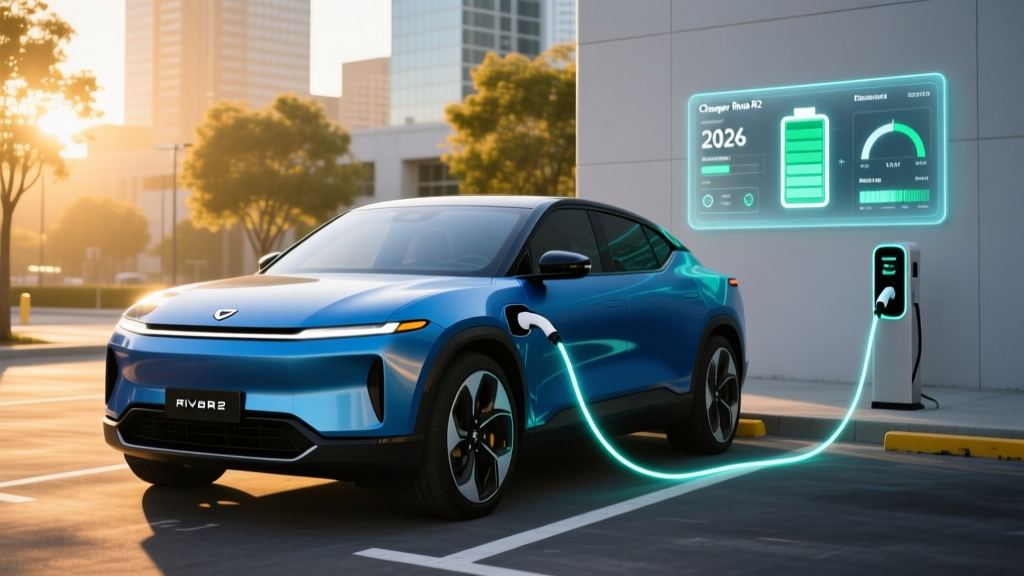
Rivian has confirmed the R2 uses an 800-volt electrical architecture, a significant upgrade from the R1S/R1T's 400-volt system and a key differentiator in this price segment. Higher voltage allows faster DC fast charging without requiring proportionally higher current, reducing heat and improving sustained charge rates.
| Charging Level | Power / Rate | Miles Added per Hour | Typical Use Case |
|---|---|---|---|
| Level 1 (120V household) | ~1.4 kW | ~3-4 mi/hr | Emergency / trickle top-up |
| Level 2 (240V home) | 11.5 kW | ~37 mi/hr | Overnight home charging |
| DC Fast Charge (Standard) | Up to ~200 kW peak | N/A (28 min 10-80%) | Road trips, public stations |
| DC Fast Charge (Large Battery) | Up to ~300+ kW peak | N/A (22 min 10-80%) | Road trips, public stations |
The large-battery R2 variants target a peak DC fast-charge rate above 300 kW, with a 10-80% charge time of approximately 22 minutes on a capable charger (350 kW-class stations like Electrify America's latest stalls or Tesla Supercharger V4). That's competitive with the Hyundai Ioniq 5's class-leading charge speed and substantially faster than the Tesla Model Y's ~250 kW peak and ~27-minute 10-80% time.
However, peak charge rate is not sustained charge rate. As with all EVs, the R2's charge curve will taper as the battery's state of charge climbs. Expect the 300+ kW peak to hold through roughly 30-40% SoC, then taper progressively. The 10-80% average rate will likely land around 180-220 kW — still excellent, but don't expect 300 kW for the full session. This is basic battery physics, not a Rivian limitation.
For home charging, the R2's 11.5 kW onboard charger adds roughly 37 miles of range per hour on a Level 2 (240V) connection. A full overnight charge (8-10 hours) easily replenishes the battery for daily driving. Installation of a home Level 2 charger typically costs $500-$2,000 depending on your electrical panel's capacity and the run length from panel to garage — budget for a potential panel upgrade if your home has a 100-amp service.
The R2 uses the NACS (Tesla-style) charge port, giving it native access to Tesla's Supercharger network — the most reliable and extensive DC fast-charging network in North America. This is a major practical advantage over CCS-equipped vehicles that rely on Electrify America or EVgo, whose uptime records are more variable.
Performance and Driving Dynamics
Rivian built its reputation on making heavy electric vehicles drive with surprising agility, and the R2 benefits from a lighter, more compact platform. The single-motor RWD base model produces approximately 280 horsepower — adequate for commuting and highway merging, with a 0-60 mph time around 6.5 seconds. That's quick by any historical compact SUV standard, though it won't win drag races against the dual-motor variants.
The dual-motor AWD R2 jumps to roughly 450 horsepower and a 0-60 time near 4.5 seconds, putting it in the same performance bracket as the Tesla Model Y Long Range. The Performance trim pushes further to approximately 550 horsepower and a 3.5-second sprint, rivaling the Model Y Performance and Porsche Macan Electric.
All R2 variants feature Rivian's updated adaptive air suspension (on higher trims), which adjusts ride height for highway efficiency, off-road clearance, and cargo loading. The R2's ground clearance — approximately 8.5 inches in standard mode, rising to over 10 inches in off-road mode — exceeds most compact SUV competitors and reinforces Rivian's adventure positioning.
Regenerative braking is configurable, with a strong one-pedal driving mode that allows most daily driving without touching the friction brake pedal. Rivian's brake-blending system seamlessly transitions between regen and mechanical braking, a detail that's easy to overlook but significantly improves the driving experience in stop-and-go traffic.
Interior, Cargo, and Technology
The R2's interior represents a deliberate step toward mainstream appeal while retaining Rivian's design identity. The cabin seats five adults, with rear legroom estimated at approximately 38 inches — competitive with the Model Y and slightly ahead of the Ioniq 5. The panoramic glass roof, a Rivian signature, carries over to the R2 and floods the cabin with natural light.
Cargo space measures approximately 32 cubic feet behind the second row and 65 cubic feet with the rear seats folded — strong numbers for the compact SUV class, though the Model Y edges ahead at roughly 34/76 cubic feet. The R2 also includes a front trunk (frunk) for additional secure storage, estimated at around 10 cubic feet — useful for charging cables, groceries, or gear you want to keep separate from the main cargo area.
The infotainment system runs on Rivian's proprietary software, displayed on a 15.6-inch center touchscreen. Wireless Apple CarPlay and Android Auto are expected to be supported (a notable addition, as earlier Rivian software lacked phone projection). The driver display is a 12.3-inch digital instrument cluster. Over-the-air (OTA) updates continue to be a core part of the Rivian ownership experience, with regular feature additions and performance improvements delivered remotely.
Rivian's driver-assistance suite, branded as Rivian Autonomy, includes adaptive cruise control, lane-centering assist, automatic emergency braking, blind-spot monitoring, and rear cross-traffic alert. This is a SAE Level 2 system — meaning the driver must remain fully engaged with hands on the wheel and eyes on the road at all times. It is not autonomous or self-driving. Expect a hands-free highway driving feature (similar to Ford BlueCruise or GM Super Cruise) to be available on higher trims, though Rivian has been measured in its rollout of such capabilities.
Pricing, Tax Credits, and Total Cost of Ownership
The 2026 Rivian R2's pricing structure is designed to capture buyers stepping up from mainstream compact SUVs and stepping down from premium EVs:
| Trim | Base MSRP | Est. After §30D Credit | Key Features |
|---|---|---|---|
| R2 Standard (RWD) | $45,000 | ~$37,500* | 270 mi range, single motor, cloth interior |
| R2 Dual-Motor (AWD) | $52,000 | ~$44,500* | 330 mi range, AWD, premium interior |
| R2 Performance | $57,500 | ~$50,000* | 315 mi range, 550 hp, sport suspension |
*After-credit prices assume full $7,500 federal §30D tax credit eligibility. Actual credit depends on buyer income, vehicle MSRP cap compliance, and battery component/critical mineral sourcing requirements. Consult a tax professional and review current IRS §30D guidelines.
- MSRP Cap: SUVs must be under $80,000 MSRP — all R2 trims qualify on price.
- Buyer Income Cap: AGI must not exceed $150,000 (single), $225,000 (head of household), or $300,000 (joint). Check your modified adjusted gross income.
- Battery Sourcing: A percentage of critical minerals and battery components must be sourced from the U.S. or free-trade-agreement countries. Requirements tighten annually. Rivian's supply chain compliance for 2026 is expected but verify at purchase.
- Point-of-Sale Transfer: Eligible buyers can transfer the credit to the dealer at purchase, reducing the out-of-pocket price immediately rather than waiting for a tax refund.
- Assembly: Vehicle must undergo final assembly in North America. The R2 is built at Rivian's Normal, Illinois facility — qualifying on this requirement.
Beyond the purchase price, the R2's total cost of ownership benefits from lower fuel and maintenance costs compared to gas-powered compact SUVs. At a national average electricity rate of $0.16/kWh, fully charging the R2's large battery costs approximately $14.70 — versus roughly $45-$55 to fill a comparable gas SUV's tank at $3.50/gallon. Over five years and 75,000 miles, fuel savings alone can offset $6,000-$9,000 of the purchase premium, depending on local electricity and gas prices.
Insurance costs for the R2 are expected to land in the mid-range for electric SUVs — higher than a basic compact crossover but likely below the R1S/R1T. Budget $1,800-$2,400 annually depending on your location, driving record, and coverage level.
Warranty and Long-Term Battery Confidence
Rivian covers the R2 with the following warranty structure:
- Basic Vehicle Warranty: 5 years / 60,000 miles
- Battery & Drive Unit Warranty: 8 years / 100,000 miles (with minimum 70% capacity retention guaranteed)
- Corrosion Warranty: 12 years / unlimited miles
The 8-year/100,000-mile battery warranty is industry-standard, matching Tesla and most competitors. The 70% capacity retention threshold means Rivian will repair or replace the battery if it degrades below 70% of original capacity within the warranty period. Based on current lithium-ion degradation data, most EV batteries retain 85-92% capacity at 100,000 miles under normal use — so the warranty threshold is a floor, not an expectation.
For the LFP-equipped base model, longevity may be even stronger. LFP (lithium iron phosphate) chemistry trades energy density for superior cycle life and thermal stability, often retaining 90%+ capacity well beyond 150,000 miles. LFP batteries also tolerate regular 100% charging without the degradation concerns associated with NMC chemistry — a practical advantage for daily drivers who want maximum available range every morning.
Pros and Cons: The Honest Assessment
- Starting at $45,000 — the most affordable Rivian ever
- 800V architecture enables 300+ kW DC fast charging
- NACS port gives native Tesla Supercharger access
- Class-leading ground clearance and off-road capability
- Strong cargo space with frunk included
- LFP option on base model for maximum battery longevity
- Rivian's OTA update track record and build quality reputation
- Real-world highway range falls 40-60 miles below EPA sticker
- Initial production ramp-up may cause delivery delays
- Base RWD model's 270-mile range may limit road-trip flexibility
- No hands-free highway driving at launch (expected later)
- Rivian's service center network is still expanding
- Rear visibility could be improved (thick C-pillars)
- Towing capacity trails the R1T/R1S significantly
Who Should Buy the Rivian R2?
- Choose the R2 if: You want an adventure-capable electric SUV with genuine off-road chops, NACS/Supercharger access, and you value build quality and OTA improvements over having the lowest possible price.
- Choose the Tesla Model Y if: You prioritize maximum charging infrastructure, proven Autopilot/FSD capability, and the highest efficiency per kWh in the segment — and you're comfortable with Tesla's minimalist interior and polarizing brand.
- Choose the Hyundai Ioniq 5 if: You want the fastest 10-80% charging time (under 18 minutes), a distinctive design, and a lower starting price — and you don't need serious off-road capability or a frunk.
- Choose the Ford Mustang Mach-E if: You prefer a sportier driving feel, a more traditional dealership service network, and you find Ford's BlueCruise hands-free driving feature important for highway commuting.
The R2's ideal buyer is someone who wants an electric SUV that can handle weekday commuting and weekend trailhead runs without compromise — and who finds the Model Y's ubiquity and the Ioniq 5's car-like ride insufficient for their lifestyle. It's also the right pick for current Rivian reservation holders who've been waiting for a more accessible entry point into the brand.
Frequently Asked Questions
What is the real-world range of the Rivian R2?
The dual-motor R2 with the large battery targets an EPA range of approximately 330 miles. In real-world highway driving at 70-75 mph, expect 265-285 miles. In cold weather below 30°F, plan for 220-255 miles. The base single-motor model targets 270 miles EPA, with real-world mixed driving around 230-255 miles.
How fast does the R2 charge at home and on the road?
At home on a Level 2 (240V) charger, the R2 charges at up to 11.5 kW, adding roughly 37 miles of range per hour — enough for a full overnight charge. On DC fast chargers, the large-battery variants peak above 300 kW, achieving a 10-80% charge in approximately 22 minutes on a 350 kW-class station. The standard battery peaks around 200 kW with a 10-80% time of roughly 28 minutes.
How much does the R2 cost after federal tax credits?
The base R2 starts at $45,000 MSRP and could drop to approximately $37,500 after the full $7,500 federal §30D credit — if you meet all eligibility requirements including income caps ($150K single / $300K joint), battery sourcing rules, and North American assembly (which the R2 satisfies). The dual-motor at $52,000 would land around $44,500 after credit. Verify your personal eligibility via the IRS clean vehicle credit page and consult a tax professional.
Does the Rivian R2 qualify for the federal EV tax credit?
Based on current §30D rules, the R2 is expected to qualify for up to $7,500 in federal tax credits. It meets the MSRP cap (under $80,000 for SUVs), is assembled in North America (Normal, Illinois), and Rivian is working to satisfy battery component and critical mineral sourcing requirements. However, your personal eligibility depends on your adjusted gross income. Point-of-sale transfer is available, allowing you to apply the credit at purchase rather than at tax time.
Is the Rivian R2 worth buying vs. the Tesla Model Y?
It depends on your priorities. The Model Y offers slightly more cargo space, a more mature Supercharger network (though the R2 now has native access), and higher efficiency. The R2 offers superior ground clearance, genuine off-road capability, a frunk, a more conventional interior layout with physical controls, and Rivian's strong build-quality reputation. If adventure capability and a less ubiquitous choice matter to you, the R2 is compelling. If pure efficiency and the lowest cost per mile are paramount, the Model Y remains the benchmark.
When can I actually buy the Rivian R2?
The Rivian R2 began production at the Normal, Illinois facility in early 2026, with initial deliveries to reservation holders starting in the first half of 2026. Walk-up orders are expected to open as production ramps through the year. Early delivery timelines may vary based on trim, configuration, and reservation priority. Check Rivian's official R2 page for the latest availability updates.