If you own a Tesla Cybertruck—or are about to take delivery—you have probably discovered that routine maintenance items aren't always straightforward on this angular pickup. One of the most-searched maintenance questions in 2026 is the Tesla Cybertruck wiper blade: what size fits, how do you replace it, and why does it matter on a truck this large? We will answer all of that below, then pivot into our full Cybertruck ownership profile so you know exactly what you are buying, charging, and spending.
Why the Cybertruck Wiper Blade Gets So Much Attention
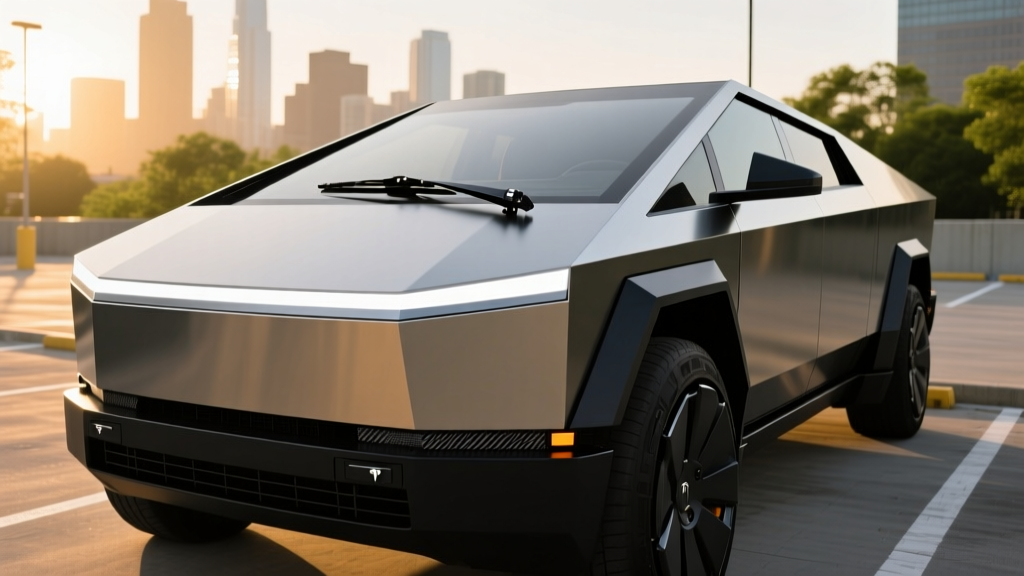
The Cybertruck's windshield is massive—nearly flat, steeply raked, and bonded into the stainless-steel exoskeleton. Tesla uses a single, oversized wiper blade on the driver side (approximately 28 inches) paired with a shorter passenger-side blade (approximately 20 inches), though exact OEM part numbers have shifted between 2024 and 2026 model years. The blade mounts to a proprietary J-hook–style adapter rather than a standard universal clip, which means most auto-parts-store blades will not attach without an adapter kit.
Why does this matter? At highway speeds above 65 mph, the Cybertruck's flat windshield and blunt leading edge generate substantial wind lift. A poorly fitted or incorrect-length blade will chatter, skip, or lift off the glass entirely—dangerous in rain or snow. Tesla's OEM replacement blades (available through the Tesla app or service centers) use a beam-style construction with a graphite-coated rubber element designed for the truck's specific arm tension and windshield curvature.
Tesla Cybertruck Wiper Blade Quick Reference
| Position | Length | Connector Type | OEM Part Source |
|---|---|---|---|
| Driver Side | 28 in (approx.) | Proprietary J-hook adapter | Tesla Service / App |
| Passenger Side | 20 in (approx.) | Proprietary J-hook adapter | Tesla Service / App |
Replacement tip: Put the wiper arms into service mode via the touchscreen (Controls → Service → Wiper Service Mode) before lifting them off the glass. The Cybertruck's arms sit flush against the hood when parked and cannot be raised without this step—forcing them can damage the cowl or arm pivot.
Cybertruck Range, Battery, and Efficiency
For 2026, the Cybertruck is offered in three primary configurations: the Dual Motor AWD, the Cyberbeast (tri-motor AWD), and the Long Range AWD. Battery chemistry across the lineup is NMC (nickel manganese cobalt), chosen for its higher energy density over LFP—a necessary trade-off given the truck's 6,800+ lb curb weight and towing demands.
The Long Range AWD carries an EPA-estimated 340 miles, while the Dual Motor AWD is rated at 320 miles and the Cyberbeast at 305 miles. In real-world highway driving at 70–75 mph, expect roughly 260–280 miles from the Long Range and 240–260 from the Dual Motor. Cold-weather testing (below 30°F) reduces range by 20–30%, bringing the Long Range down to approximately 230–260 miles. The Cybertruck's heat pump helps mitigate cabin heating losses, but battery thermal management still consumes energy in extreme cold.
| Spec | Dual Motor AWD | Cyberbeast (Tri-Motor) | Long Range AWD |
|---|---|---|---|
| EPA Range | 320 mi | 305 mi | 340 mi |
| Battery (usable) | ~123 kWh (NMC) | ~123 kWh (NMC) | ~123 kWh (NMC) |
| MPGe (combined) | 72 MPGe | 68 MPGe | 74 MPGe |
| Efficiency | 48 kWh/100 mi | 50 kWh/100 mi | 46 kWh/100 mi |
| 0–60 mph | 4.1 sec | 2.6 sec | 4.5 sec |
| Horsepower | 600 hp | 845 hp | 600 hp |
| Drivetrain | Dual Motor AWD | Tri-Motor AWD | Dual Motor AWD |
| Towing Capacity | 11,000 lb | 11,000 lb | 11,000 lb |
Efficiency is the Cybertruck's weak point relative to lighter EVs. At roughly 46–50 kWh per 100 miles, this truck consumes electricity at nearly double the rate of a Model Y. On a road trip, that means more frequent charging stops and higher per-mile energy costs. For context, fueleconomy.gov lists the Cybertruck's combined MPGe well below that of the Rivian R1T and Ford F-150 Lightning in certain trims.
Charging Speed: DC Fast Charge and Home Level 2
The Cybertruck uses the NACS (North American Charging Standard) connector natively—no adapter needed at Tesla Superchargers. Its 800-volt-class architecture enables peak DC fast-charge rates up to 250 kW at V3 Superchargers, though the charge curve tapers significantly above 60% state of charge.
| Charging Level | Power / Rate | Time or Miles Added |
|---|---|---|
| DC Fast Charge (V3 Supercharger) | Peak 250 kW | 10–80% in ~30 min |
| DC Fast Charge (V4 Supercharger) | Up to 350 kW capable | 10–80% in ~25 min (varies by station) |
| Level 2 (Tesla Wall Connector, 48A) | 11.5 kW | ~34 miles per hour of charging |
| Level 2 (standard 240V/32A outlet) | 7.7 kW | ~22 miles per hour of charging |
| Level 1 (120V standard outlet) | ~1.4 kW | ~4 miles per hour of charging |
Charging-curve reality: The 250 kW peak is sustained only between roughly 10% and 40% SoC. From 40–60%, the rate drops to approximately 150 kW, and from 60–80% it tapers further to around 80–100 kW. This is why the 10–80% time is approximately 30 minutes rather than the ~18 minutes a flat 250 kW rate would suggest. Preconditioning the battery (which the Cybertruck does automatically when a Supercharger is set as your navigation destination) is essential to hitting peak rates—without it, cold-soak can reduce initial charge speed by 40% or more.
For home charging, a Tesla Wall Connector on a 60-amp circuit (48A continuous) is the practical minimum for daily Cybertruck ownership. Given the ~123 kWh battery, a full charge from 20% to 100% at 11.5 kW takes roughly 8.5 hours—manageable overnight but tight if you arrive home late and need a full battery by morning. Budget-conscious owners who drive under 60 miles daily can get by with a 32A Level 2 setup, but towing days demand the full 48A circuit.
Pricing, Trim Levels, and Federal Tax Credit Eligibility
The Cybertruck's pricing has shifted since its late-2023 launch, and 2026 model-year MSRPs reflect Tesla's latest adjustments. Here is where each trim stands before incentives:
| Trim | Base MSRP | As-Tested (typical options) | §30D Federal Credit | Effective Price (with credit) |
|---|---|---|---|---|
| Dual Motor AWD | $79,990 | $83,000–$86,000 | Up to $7,500* | ~$72,490 |
| Cyberbeast (Tri-Motor) | $99,990 | $103,000–$108,000 | Up to $7,500* | ~$92,490 |
| Long Range AWD | $84,990 | $87,000–$91,000 | Up to $7,500* | ~$77,490 |
*Critical §30D tax credit caveats: The Cybertruck's eligibility for the full $7,500 federal tax credit under IRS §30D depends on three moving targets: (1) the buyer's modified adjusted gross income must not exceed $300,000 (joint), $225,000 (head of household), or $150,000 (individual); (2) the vehicle MSRP must not exceed $80,000 for pickup trucks—and the Dual Motor AWD at $79,990 squeaks under this cap, while the Cyberbeast and Long Range exceed it; (3) battery critical-mineral and component sourcing requirements must be met, which Tesla has satisfied for US-built vehicles as of 2025 but which are subject to annual rule updates. Always verify current eligibility at irs.gov before purchase. The credit can be transferred to the dealer at point of sale, reducing your out-of-pocket cost immediately.
Note: The Cyberbeast at $99,990 MSRP exceeds the §30D truck MSRP cap of $80,000 and is therefore not eligible for the federal credit. The Long Range may also exceed the cap depending on final MSRP configuration. Only the base Dual Motor AWD at $79,990 currently qualifies—making it the value leader by a significant margin after incentives.
Cargo, Passenger Space, and Daily Practicality
The Cybertruck's 6-foot bed (approximately 72 cubic feet of volume) is shorter than a full-size F-150's 6.5-foot box but gains utility from its width and the motorized tonneau cover that creates a sealed, lockable vault. The bed's stainless-steel floor is durable but slippery—cargo slides more easily than on a sprayed-in liner. The powered frunk (front trunk) adds roughly 7 cubic feet of secure storage.
Inside, rear-seat legroom measures approximately 38 inches—adequate for adults on shorter trips but tighter than a Rivian R1T's rear cabin. The rear seatback folds in a 60/40 split, and the flat floor (no transmission tunnel) makes the middle seat usable. Headroom is generous thanks to the truck's tall roofline, but the steeply raked windshield and low cowl create an unusual seating position that some drivers find less commanding than a traditional pickup.
Visibility is a known compromise. The Cybertruck's rear-view camera and digital mirror system are essential—over-the-shoulder sightlines are poor due to the angular sail pillars and small rear window. Tesla addresses this with a wide-angle backup camera displayed on the 18.5-inch center touchscreen, but drivers accustomed to physical mirrors should budget time to adapt.
Tech, Driver Assists, and Standout Features
The Cybertruck runs Tesla's latest infotainment stack on an 18.5-inch center display and a 9.4-inch rear touchscreen for passengers. Standard features include over-the-air updates, Tesla's app-based vehicle controls, and a 15-speaker audio system with active road-noise reduction.
On the driver-assistance front, the Cybertruck ships with Tesla Autopilot (SAE Level 2), which includes adaptive cruise control, lane-keeping assist, and automatic emergency braking. Full Self-Driving (Supervised) is available as a paid add-on or subscription, but it remains a Level 2 system requiring continuous driver attention—it is not autonomous driving. The Cybertruck's steer-by-wire system (a first for a mass-production US vehicle) provides variable-ratio steering that reduces lock-to-lock turns at low speeds, making parking-lot maneuvering surprisingly easy for a truck this size.
Tesla Autopilot and FSD (Supervised) are SAE Level 2 driver-assistance systems. You must keep your hands on the yoke (or steering wheel) and eyes on the road at all times. These systems do not handle construction zones, unmapped roads, or severe weather autonomously. Driver monitoring is enforced via camera and torque sensors.
Unique Cybertruck features include 48-volt electrical architecture (replacing the traditional 12V system for most vehicle functions), four-wheel steering for tighter turning radius, and adaptive air suspension with up to 16 inches of ground clearance in Off-Road mode. The stainless-steel body panels require no paint, eliminating a common source of rock-chip complaints—but they do show fingerprints and water spots prominently.
Warranty and Long-Term Battery Outlook
Tesla covers the Cybertruck with a 4-year/50,000-mile basic vehicle warranty and an 8-year/120,000-mile battery and drive unit warranty. The battery warranty guarantees a minimum 70% capacity retention over the warranty period—meaning if your pack degrades below 70% of its original capacity within 8 years or 120,000 miles, Tesla will repair or replace it. For a truck priced near $80,000+, this coverage is competitive with Rivian's 8-year/120,000-mile battery warranty and slightly better than Ford's 8-year/100,000-mile coverage on the F-150 Lightning.
NMC battery chemistry in the Cybertruck typically degrades 8–12% over the first 100,000 miles based on fleet data from Tesla's existing NMC packs. To maximize longevity, Tesla recommends daily charging to 80–90% and reserving 100% charges for road trips. The Cybertruck's thermal management system actively heats and cools the pack, which helps mitigate degradation in both hot and cold climates.
Pros, Cons, and Verdict: Who Should Buy the Cybertruck?
- Class-leading 11,000-lb towing capacity for an EV pickup
- 250 kW DC fast charging with extensive Supercharger network access
- Steer-by-wire and four-wheel steering improve low-speed maneuverability
- Stainless-steel exoskeleton eliminates paint maintenance
- 8-year/120,000-mile battery warranty with 70% retention guarantee
- Dual Motor AWD qualifies for $7,500 federal credit (income permitting)
- Poor rear visibility; heavy reliance on camera-based mirrors
- Low efficiency (46–50 kWh/100 mi) means higher charging costs and more stops
- Cyberbeast and Long Range exceed $80K MSRP cap—no federal tax credit
- Proprietary wiper blade and other parts limit aftermarket options
- Steep learning curve for steer-by-wire and yoke-style controls
- Real-world highway range falls 15–20% short of EPA estimates
Choose a competitor (Rivian R1T, F-150 Lightning) if: You prioritize rear-seat comfort, traditional visibility, or lower starting prices. The F-150 Lightning starts significantly lower and offers comparable towing, while the R1T provides better off-road articulation and a more conventional driving position.
Frequently Asked Questions
What is the real-world range of the Tesla Cybertruck?
The EPA rates the Long Range AWD at 340 miles, the Dual Motor at 320, and the Cyberbeast at 305. In real-world highway driving at 70–75 mph, expect 260–280 miles from the Long Range and 240–260 from the Dual Motor. Cold weather (below 30°F) reduces these figures by 20–30%. Towing a trailer cuts range roughly in half regardless of trim.
How fast does the Cybertruck charge at home and on the road?
On a V3 Supercharger (250 kW peak), the Cybertruck charges from 10–80% in approximately 30 minutes, though the rate tapers significantly above 60% SoC. At home on a 48A Tesla Wall Connector (11.5 kW), expect about 34 miles of range added per hour—a full overnight charge from 20% takes roughly 8.5 hours.
Does the Cybertruck qualify for the $7,500 federal EV tax credit?
Only the Dual Motor AWD at $79,990 MSRP falls under the §30D pickup truck cap of $80,000. The Cyberbeast ($99,990) and Long Range ($84,990) exceed the cap and do not qualify. Even for the Dual Motor, buyer income must not exceed $300K (joint)/$150K (individual), and battery sourcing rules must be met. Verify at irs.gov before purchasing.
Is the Cybertruck worth buying versus the Rivian R1T or F-150 Lightning?
It depends on your priorities. The Cybertruck leads in Supercharger network access, towing capacity, and tech novelty. The F-150 Lightning starts at a much lower price and offers a more traditional truck experience. The Rivian R1T excels in off-road capability, rear-seat space, and build quality. If you value the Supercharger ecosystem and can accept the visibility and efficiency compromises, the Cybertruck Dual Motor AWD after the tax credit is compelling at ~$72,500.
Where do I buy replacement Tesla Cybertruck wiper blades?
OEM replacement wiper blades are available through the Tesla app (Shop → Accessories → Cybertruck) or at any Tesla Service Center. Due to the proprietary J-hook adapter, most aftermarket blades from auto parts stores will not fit without a specific adapter. Budget approximately $40–$60 for a set of two OEM blades.
How does the Cybertruck handle in winter and off-road?
The Cybertruck's adaptive air suspension provides up to 16 inches of ground clearance and the stainless-steel body is impervious to road salt. However, the NMC battery loses 20–30% range in sub-freezing temperatures, and the truck's weight (6,800+ lbs) means longer braking distances on ice. The heat pump and battery preconditioning help, but winter owners should plan for reduced range and rely on the dual-motor AWD system for traction.