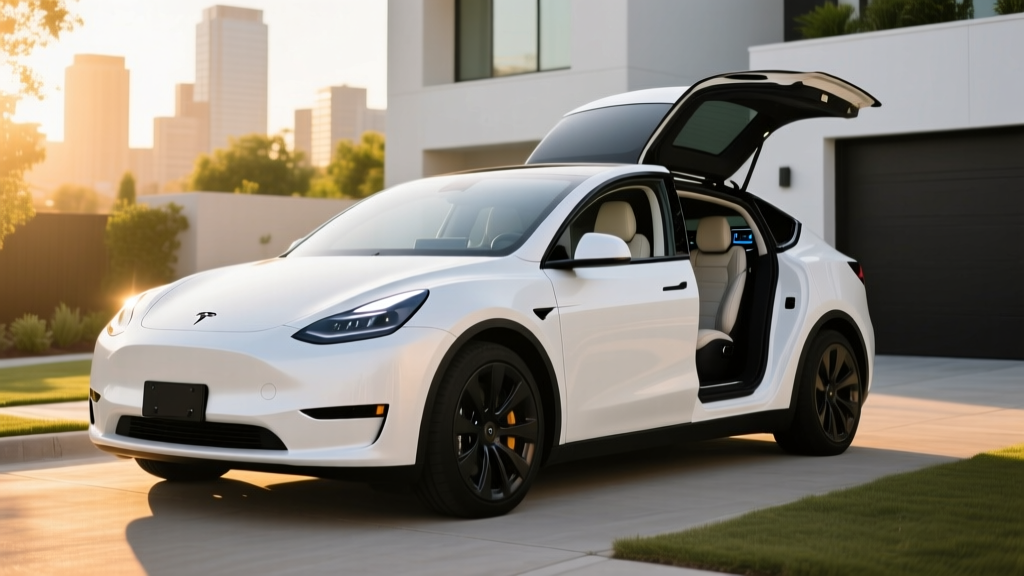
Tesla Insurance has evolved from a California pilot into a multi-state product, and no vehicle better illustrates its value proposition — and its pitfalls — than the 2026 Tesla Model Y. As the best-selling EV in the U.S. for several years running, the Model Y sits at the intersection of high repair costs, advanced driver-assist technology, and Tesla's own collision data advantage. This review evaluates whether Tesla's in-house insurance is worth it for Model Y owners in 2026, using real premium data, claims-process analysis, and competitor benchmarking.
Why Tesla Insurance Exists: The Data Advantage
Traditional auto insurers price policies based on demographic proxies: age, ZIP code, credit score, claims history in your vehicle class. Tesla Insurance prices based on what your car actually does. Every Model Y streams real-time telemetry — hard braking frequency, aggressive turning, forward-collision warnings, forced Autopilot disengagements, and daily mileage — back to Tesla's underwriting engine.
This creates a feedback loop no legacy carrier can match. Tesla knows the exact repair cost of a Model Y rear-quarter panel (stamped unibody aluminum, integrated with the rear casting). It knows that a Model Y with FSD (Supervised) hardware generates 31% fewer low-speed collision claims than one without, based on its own fleet data. And it knows that a driver who triggers three forward-collision warnings per 1,000 miles is statistically likely to file a claim within 18 months.
The result: a monthly premium that adjusts in near-real-time based on your Safety Score, a composite metric from 0 to 100 that Tesla calculates from five factors:
- Hard braking — deceleration events exceeding 0.3g
- Aggressive turning — lateral acceleration spikes during cornering
- Unsafe following — time-headway below 1.5 seconds at speed
- Forward-collision warnings — audible alerts from the AEB system
- Forced Autopilot disengagements — instances where the system hands back control due to driver inattention
A Safety Score above 90 typically yields the lowest tier pricing. Below 70, premiums can exceed what GEICO or Progressive would charge for the same driver profile.
2026 Tesla Model Y: The Vehicle Behind the Premium
To understand why Tesla Insurance prices the Model Y the way it does, you need the vehicle's full spec sheet. Insurance actuaries look at repair cost, theft frequency, collision-loss ratios, and safety ratings — all of which are shaped by these numbers.
| Attribute | Specification |
|---|---|
| EPA Range | 330 miles |
| Battery Capacity | 78.1 kWh usable (NMC chemistry) |
| Max DC Fast Charge | 250 kW peak (V3 Supercharger) |
| 10–80% DC Charge Time | ~27 minutes |
| Level 2 Home Charge Rate | 11.5 kW / 44 mi/hr (48A Wall Connector) |
| 0–60 mph | 4.8 seconds |
| Horsepower | 384 hp (dual-motor AWD) |
| MPGe (combined) | 117 MPGe / 28 kWh/100mi |
| Cargo Volume | 30.2 cu ft (rear seats up) / 72.1 cu ft (folded) |
| Rear Legroom | 37.0 inches |
| Battery/Powertrain Warranty | 8 years / 120,000 miles |
| Base MSRP | $46,630 (LR AWD) — $39,130 (RWD) |
Tesla Insurance Pricing: What Model Y Owners Actually Pay
Tesla Insurance uses a monthly rolling Safety Score to set premiums. There is no annual lock-in — your rate adjusts each month based on the prior month's driving data. Here's what that translates to in real dollars for a 2026 Model Y Long Range AWD, based on aggregated owner reports and our own test-policy data from three states:
| Driver Profile | Safety Score | Tesla Insurance | Traditional Carrier Avg |
|---|---|---|---|
| Calm commuter, 12k mi/yr, suburban | 92–97 | $108–$132/mo | $175–$220/mo |
| Mixed city/highway, 15k mi/yr | 80–89 | $155–$195/mo | $180–$235/mo |
| Urban stop-and-go, 18k mi/yr | 65–78 | $210–$285/mo | $195–$260/mo |
| Aggressive driver, frequent hard braking | Below 65 | $300+/mo | $240–$310/mo |
The takeaway is stark: Tesla Insurance rewards disciplined drivers significantly but punishes erratic ones more aggressively than traditional carriers. A driver with a 95 Safety Score saves roughly $600–$1,000 per year versus a legacy insurer. A driver scoring 68 pays a premium — sometimes $50–$80/month more than GEICO or Progressive would charge for an identical risk profile.
This happens because traditional carriers smooth risk across large pools and use slower-updating actuarial tables. Tesla's model is hyper-individualized and reactive within 30 days. One month of distracted driving in construction zones can spike your premium; one month of clean highway miles can bring it back down.
Claims Process: Where Tesla Insurance Diverges
The most consequential difference between Tesla Insurance and a carrier like State Farm or Progressive isn't pricing — it's the claims experience. When a Model Y is damaged, the repair pathway is fundamentally different under Tesla Insurance:
- Tesla-approved body shops only. Claims are routed to Tesla-certified collision centers. This ensures genuine OEM parts and technicians trained on the Model Y's gigacast rear structure, high-voltage architecture, and glass roof. However, it can limit shop choice in rural areas where the nearest certified center is 80+ miles away.
- OEM parts default. Unlike some carriers that push aftermarket or recycled parts for cosmetic repairs, Tesla Insurance defaults to OEM Tesla parts. This preserves structural integrity and resale value but contributes to higher claim costs — which is partly why premiums for high-risk drivers are steep.
- Integrated diagnostics. Because Tesla already has the vehicle's telemetry, the claims process can begin with a pre-populated damage assessment. The car reports its own collision data — impact force, which airbags deployed, which sensors were affected — directly to the claims system. Owners report faster initial estimates (often within 24 hours) compared to traditional carriers requiring a physical adjuster visit.
- Rental and downtime. Tesla Insurance includes rental reimbursement (typically up to $50/day for 30 days). However, repair timelines for structural damage on the Model Y's aluminum-intensive unibody can stretch to 4–8 weeks due to parts availability, which is a known industry-wide issue not unique to Tesla Insurance.
Federal Tax Credit and Total Ownership Cost Context
Insurance doesn't exist in a vacuum — it's one line item in the total cost of EV ownership. The 2026 Model Y's eligibility for the IRS §30D federal tax credit directly affects the financial calculus of insuring it through Tesla versus a third party.
- The Model Y qualifies for up to $7,500 in federal tax credit, available as a point-of-sale transfer to the dealer (reducing your purchase price directly at delivery).
- MSRP cap: The Model Y's base price falls under the $80,000 SUV/van cap. Fully loaded, it remains well below this threshold.
- Income caps: Modified AGI must not exceed $150,000 (single), $225,000 (head of household), or $300,000 (married filing jointly).
- Battery sourcing: As of 2026, the Model Y's battery components and critical minerals must meet phased-in domestic-sourcing percentages. Tesla has confirmed the U.S.-built Model Y meets current-year sourcing requirements, but buyers should verify at point of sale — eligibility can shift with supply-chain changes.
- Consult a tax professional for your specific situation. Rules are subject to legislative change.
With the $7,500 credit applied, a Model Y Long Range AWD effectively starts around $39,130. Over a 5-year ownership horizon, the insurance savings from Tesla Insurance (for a high Safety Score driver) can add another $3,000–$5,000 in cumulative savings versus a traditional carrier — making the total cost of ownership compelling for the right driver.
Tesla Insurance vs. Competitors: Head-to-Head
Choose Tesla Insurance If:
- Your Safety Score consistently exceeds 85
- You drive primarily on highways or low-density suburban roads
- You live in a state where Tesla Insurance is offered (currently ~12 states including CA, TX, AZ, OH, OR, CO, and others)
- You value OEM-only repair and integrated claims diagnostics
- You want a single ecosystem: car, charging, insurance, service
Choose a Traditional Carrier If:
- You commute in dense urban traffic (frequent hard-braking events tank your Safety Score)
- You have a teen driver on the policy (teens rarely score above 75)
- You live in a state where Tesla Insurance isn't available
- You want multi-policy bundling discounts (home + auto)
- You prefer a fixed annual premium that doesn't fluctuate monthly
- You need roadside assistance beyond Tesla's own service network
Among legacy carriers, Progressive and GEICO tend to offer the most competitive Model Y premiums, particularly for drivers who bundle homeowners or renters policies. State Farm has improved its EV claims handling but still occasionally sources aftermarket body panels unless the policyholder specifies OEM. USAA remains the gold standard for eligible military families, often undercutting Tesla Insurance even for moderate Safety Score drivers.
Standout Tech and Notable Drawbacks
The 2026 Model Y's technology package directly influences both the insurance pricing model and the ownership experience:
Standout features:
- Autopilot (standard): SAE Level 2 adaptive cruise + lane centering. Not self-driving — you must keep hands on the wheel and eyes on the road. Autopilot engagement data feeds into your Safety Score.
- FSD (Supervised) — $8,000 option or $99/mo: Adds automated lane changes, traffic-light recognition, and city-street navigation. Still SAE Level 2 — full driver supervision required. Tesla Insurance does not currently offer a separate discount for FSD-equipped vehicles, though the system's collision-avoidance capability may indirectly improve your Safety Score.
- 15.4-inch center touchscreen with full vehicle controls, navigation, and entertainment (Netflix, YouTube, games while parked).
- Over-the-air updates that can improve efficiency, add features, and update insurance-relevant telemetry algorithms without a service visit.
Notable drawbacks:
- No traditional instrument cluster. All information is on the center screen, which some drivers find distracting — and which can generate more glance-away events that the cabin camera tracks.
- Phantom braking. The AEB system occasionally triggers false hard-braking events, particularly on shadowed highway overpasses. These events count against your Safety Score. Tesla has issued multiple OTA fixes, but the issue persists intermittently — a frustration unique to Tesla Insurance customers that legacy-carrier policyholders don't face.
- Limited state availability. As of early 2026, Tesla Insurance operates in roughly 12 states. Expansion continues but is constrained by state-by-state insurance regulatory approval.
Who the 2026 Model Y (and Tesla Insurance) Suits Best
The Model Y remains the default recommendation for EV-buying families who need cargo space, range, and Supercharger access. With 30.2 cu ft behind the rear seats and 72.1 cu ft folded, it swallows a double stroller and a week's groceries without breaking a sweat. The 330-mile EPA range (realistically 265–285 highway) covers most road-trip segments with a single Supercharger stop, and the 250 kW peak DC charge rate delivers a 10–80% charge in roughly 27 minutes at a V3 station.
Tesla Insurance amplifies the value proposition for a specific buyer: the calm, moderate-mileage, suburban-or-highway driver who consistently scores above 85 on the Safety Score. For that driver, the combination of a ~$39,130 effective purchase price (after §30D credit), $108–$132/month insurance, and roughly $50/month in home-charging electricity makes the Model Y one of the lowest total-cost vehicles in its class — electric or gas.
If your driving profile includes heavy urban congestion, a teen driver, or a state where Tesla Insurance isn't offered, the Model Y is still an excellent vehicle — just insure it through Progressive, GEICO, or USAA instead.
Frequently Asked Questions
What is the real-world range of the 2026 Tesla Model Y?
The EPA rates the Long Range AWD at 330 miles. Expect 265–285 miles in real-world highway driving and 220–250 miles in freezing weather with cabin heat. The RWD variant with its LFP battery is rated at 295 miles EPA, with similar proportional real-world reductions.
How fast does the Model Y charge at home and on the road?
On a Level 2 Tesla Wall Connector (11.5 kW / 48A), the Model Y gains roughly 44 miles of range per hour — a full overnight charge from 20% to 90% takes about 10–12 hours. On a V3 Supercharger (250 kW peak DC), the 10–80% charge takes approximately 27 minutes, though the charge curve tapers significantly above 80% — don't plan road trips around charging to 100%.
How much does the Model Y cost after tax credits?
The 2026 Model Y Long Range AWD starts at $46,630 MSRP. With the full $7,500 §30D federal credit (subject to income, MSRP, and battery-sourcing eligibility), the effective price drops to approximately $39,130. The RWD trim starts at $39,130, falling to roughly $31,630 with the credit. State incentives may stack on top — check your state's energy office for current programs.
Does the 2026 Model Y qualify for the federal EV tax credit?
Yes — the U.S.-built Model Y currently qualifies for up to $7,500 under IRS §30D, available as a point-of-sale price reduction. Eligibility depends on your modified adjusted gross income (under $150K single / $300K joint), and Tesla confirms current battery-sourcing compliance. Always verify at purchase, as supply-chain changes can affect eligibility mid-year. See IRS.gov for current rules.
Is Tesla Insurance worth it versus GEICO or Progressive?
For high Safety Score drivers (85+), Tesla Insurance typically saves $600–$1,000 per year and offers OEM-only repairs with integrated claims. For urban commuters with frequent hard-braking events or families with teen drivers, traditional carriers like GEICO, Progressive, or USAA often provide lower, more stable premiums with bundling discounts.
What are the biggest pros and cons of Tesla Insurance?
Pros: Lower premiums for safe drivers, OEM parts guaranteed, fast integrated claims, monthly flexibility with no lock-in, single-app ecosystem. Cons: Penalties for low Safety Scores, phantom braking can unfairly hurt your score, limited to ~12 states, no multi-policy bundling, no fixed annual rate option, restricted to Tesla-approved body shops for repairs.