Quick Verdict: A Three-Row Electric SUV That Actually Fits Your Life
The 2026 Rivian R1S remains one of the only fully electric three-row SUVs that pairs genuine off-road capability with family-hauler practicality. For buyers cross-shopping the Tesla Model X, Kia EV9, or even the Jeep Grand Wagoneer, the R1S stands out on cargo versatility, build quality, and adventure-ready engineering. But its real-world range, charging curve behavior, and evolving tax-credit eligibility demand a closer look before you place an order.
This review breaks down every dimension that matters — from Rivian R1S cargo dimensions to battery chemistry, fast-charging behavior, and total ownership cost — using EPA data, real-world testing notes, and current 2026 pricing.
Rivian R1S Cargo Dimensions and Interior Space
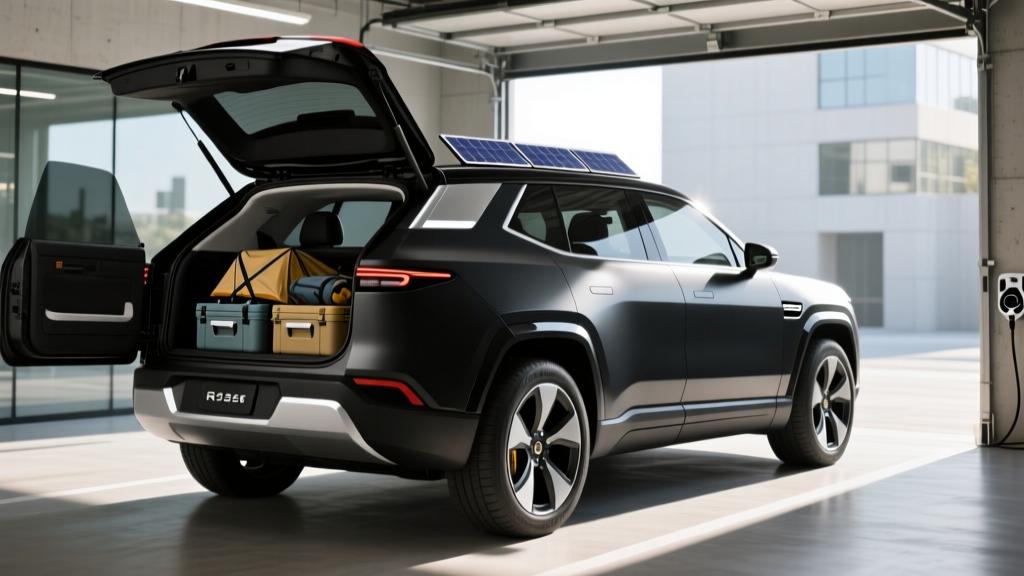
Cargo capacity is the number one reason buyers choose the R1S over the R1T pickup or a two-row competitor. Rivian designed the R1S on its skateboard platform with a flat floor, enabling flexible storage across three rows. Here is how the numbers break down by configuration:
| Configuration | Cargo Volume |
|---|---|
| Behind 3rd row (all seats up) | 10.4 cu ft |
| 3rd row folded (5-passenger mode) | 46.7 cu ft |
| 2nd & 3rd rows folded (max cargo) | 78.3 cu ft |
| Front trunk (frunk) | 11.0 cu ft |
The 10.4 cu ft behind the third row is tight for a week-long family trip with all seats occupied — expect to fit roughly two carry-on bags and a soft duffel. Fold the third row, and the 46.7 cu ft space rivals midsize ICE SUVs. The 78.3 cu ft maximum with all rear seats folded is competitive with the Tesla Model X (~85 cu ft max) and significantly larger than the Kia EV9 (~78 cu ft max behind front seats).
Passenger Dimensions
| Measurement | Row 1 | Row 2 | Row 3 |
|---|---|---|---|
| Headroom | 40.7 in | 38.7 in | 36.5 in |
| Legroom | 41.5 in | 37.3 in | 29.6 in |
| Shoulder room | 59.2 in | 57.5 in | 47.8 in |
The third row is best suited for children or short-trip adult passengers — the 29.6 inches of legroom is the R1S's most common complaint among three-row SUV shoppers. For context, the Kia EV9 offers roughly 32 inches in its third row. If you regularly carry six adults, test-sit in the back before ordering.
Range, Battery, and Efficiency
The 2026 Rivian R1S offers three battery pack options across its Dual-Motor and Quad-Motor configurations. Rivian uses a mix of NMC (nickel manganese cobalt) and LFP (lithium iron phosphate) chemistries depending on the pack size — a critical distinction for long-term ownership.
| Pack | Usable kWh | Chemistry | EPA Range | MPGe (combined) |
|---|---|---|---|---|
| Standard (Dual-Motor) | ~92 kWh | LFP | 258 mi | 76 MPGe |
| Large (Dual-Motor) | ~129 kWh | NMC | 352 mi | 73 MPGe |
| Max (Dual-Motor) | ~149 kWh | NMC | 410 mi | 70 MPGe |
The Standard Pack's LFP chemistry is worth noting: LFP cells tolerate regular 100% charging without accelerated degradation, making them ideal for daily commuting where you charge to full nightly. NMC packs (Large and Max) perform best when kept between 20–80% for daily use and charged to 100% only before long trips. Source: fueleconomy.gov.
Charging Speed: DC Fast Charge and Home Level 2
Charging speed is where R1S owners report the widest gap between marketing and reality. Rivian quotes peak DC fast-charge rates, but sustained rates depend on the charge curve, battery temperature, and state of charge.
| Method | Rate | Time / Miles Added |
|---|---|---|
| DC Fast Charge (peak) | Up to 220 kW | 10–80% in ~30 min (Large Pack) |
| DC Fast Charge (sustained avg) | ~130–150 kW | Expect 10–80% in ~35–40 min real-world |
| Level 2 Home (11.5 kW onboard charger) | 11.5 kW | ~30–34 miles of range per hour |
| Level 1 (120V outlet) | ~1.4 kW | ~3–4 miles per hour |
Rivian uses the NACS (North American Charging Standard) connector on all 2026 models, granting native access to the Tesla Supercharger network — a significant advantage over CCS-only competitors relying on adapters. The 220 kW peak rate is competitive, but the charge curve tapers noticeably above 80% SoC, as with all large lithium-ion packs. Plan DC fast-charge stops around the 10–80% window to avoid the slow final stretch.
For home charging, Rivian's 11.5 kW onboard charger is among the fastest in its class. On a 48-amp Level 2 wall connector (hardwired, 240V), you'll add roughly 30–34 miles per hour — enough to fully replenish the Standard Pack overnight and the Large Pack in approximately 11–12 hours. A licensed electrician should verify your panel can support a 60-amp dedicated circuit before installation.
Performance and Drivetrain
| Configuration | Horsepower | Torque (lb-ft) | 0–60 mph | Drivetrain |
|---|---|---|---|---|
| Dual-Motor AWD | 533 hp | 610 | 4.5 sec | AWD (dual-motor) |
| Performance Dual-Motor | 665 hp | 827 | 3.5 sec | AWD (dual-motor) |
| Quad-Motor AWD | 1,025 hp | 1,198 | 2.9 sec | AWD (quad-motor, torque vectoring) |
Even the base Dual-Motor R1S out-accelerates most V8-powered three-row SUVs. The Quad-Motor's 2.9-second 0–60 time is supercar territory, enabled by independent motors at each wheel with torque vectoring. All configurations include adaptive air suspension with up to 14.9 inches of ground clearance in Off-Road mode, plus a wading depth of approximately 3 feet.
Towing capacity is rated at 7,700 pounds across all trims — competitive with body-on-frame ICE SUVs. However, towing at maximum capacity will reduce range by roughly 40–50%, a physics reality that applies to every EV. Plan charging stops accordingly when hauling a trailer.
2026 Pricing, Trims, and Federal Tax Credit
| Trim | Base MSRP | As-Tested Typical |
|---|---|---|
| Dual-Motor Standard Pack (Pure) | $75,900 | $79,000–$83,000 |
| Dual-Motor Large Pack (Adventure) | $84,900 | $89,000–$95,000 |
| Performance Dual-Motor (Adventure) | $91,900 | $97,000–$104,000 |
| Quad-Motor Max Pack (Ascend) | $104,900 | $110,000–$118,000 |
The Rivian R1S is classified as an SUV for IRS purposes, meaning the MSRP cap is $80,000 (higher than the $55,000 sedan cap). However, credit eligibility depends on three moving targets:
- Battery sourcing: Critical minerals and battery components must meet escalating domestic-content thresholds per the Inflation Reduction Act. Rivian has been working to qualify, but eligibility can change mid-year. Always verify on fueleconomy.gov.
- Buyer income caps: AGI must not exceed $300,000 (married filing jointly), $225,000 (head of household), or $150,000 (single).
- Point-of-sale transfer: If eligible, the up-to-$7,500 credit can be applied at purchase as a down-payment reduction, rather than waiting for a tax refund.
Tech, Driver Assistance, and Standout Features
The R1S runs Rivian's proprietary software stack on a 15.6-inch center display with an integrated 12.3-inch driver cluster. Key tech highlights:
- Rivian Driver+ (Level 2 ADAS): Combines adaptive cruise control and highway lane-centering on mapped divided highways. This is a hands-on, eyes-on SAE Level 2 system — the driver must remain engaged at all times. It is not self-driving.
- OTA updates: Rivian pushes regular over-the-air software improvements, including new drive modes, UI refinements, and efficiency optimizations.
- Camp Kitchen & Gear Tunnel: Available slide-out camp kitchen accessory and integrated gear management — unique to Rivian's adventure positioning.
- Vehicle-to-everything prep: Hardware-ready for future V2L (vehicle-to-load) functionality to power external devices.
- 11-speaker Meridian audio with Dolby Atmos on Adventure and Ascend trims.
This system does NOT support hands-free driving on surface streets, construction zones, or unmapped roads. Unlike GM's Super Cruise or Ford's BlueCruise on approved highways, Rivian's system requires steering-wheel contact. Do not confuse Level 2 driver assistance with Level 4 autonomy (Waymo/Zoox). The driver is always responsible for vehicle control.
Warranty and Long-Term Ownership
| Component | Coverage |
|---|---|
| Basic vehicle | 5 years / 60,000 miles |
| Battery pack | 8 years / 175,000 miles (retains ≥70% capacity) |
| Powertrain (motors, reducers) | 8 years / 175,000 miles |
| Corrosion perforation | 12 years / unlimited miles |
Rivian's 175,000-mile battery warranty is one of the longest in the segment — Tesla offers 120,000–150,000 miles on the Model X. The 70% capacity retention threshold is industry-standard. Real-world degradation data from early R1S owners (2022–2024 models) suggests roughly 5–8% loss over the first 50,000 miles, with the curve flattening afterward — consistent with NMC chemistry in large packs.
Service is handled through Rivian's own service centers and mobile service vans. Coverage is expanding but remains sparse in rural areas. Check service-center proximity before purchasing if you live outside a major metro.
Pros and Cons
Pros
- Class-leading 410-mile Max Pack range
- NACS connector = native Supercharger access
- 78.3 cu ft max cargo + 11.0 cu ft frunk
- Genuine off-road capability (14.9 in ground clearance, 3 ft wading)
- 7,700-lb towing capacity
- 175,000-mile battery warranty
- Quad-Motor performance (1,025 hp) is unmatched in the segment
Cons
- Third-row legroom (29.6 in) is tight for adults
- DC fast-charge curve tapers above 80% — 10–80% takes ~35 min real-world
- Base price above $75K; most trims exceed $80K tax-credit cap
- Service-center network still limited outside major metros
- Towing cuts range by 40–50%
- Driver+ requires hands on wheel (no hands-free highway mode)
Who Should Buy the Rivian R1S?
Decision Framework
Choose the R1S if: You need three rows + genuine off-road capability + frunk storage, you want native Supercharger access via NACS, you value a 400+ mile Max Pack option for road trips, and your budget allows $80K+.
Consider the Kia EV9 instead if: Third-row adult comfort is a priority, you want a lower starting price (~$55K), and you primarily drive in urban/suburban settings where 300 miles of range suffices.
Consider the Tesla Model X instead if: You want hands-free-capable Autosteer on more roads, a larger third-row area, and the broadest Supercharger reliability track record — though at a significantly higher price and with no frunk.
Frequently Asked Questions
What is the real-world range of the Rivian R1S?
The EPA rates the Large Pack Dual-Motor at 352 miles, but real-world highway driving at 75 mph yields approximately 290–310 miles. In cold weather (below 32°F), expect 240–270 miles. The Max Pack's 410-mile EPA rating translates to roughly 340–360 miles highway in moderate conditions.
How fast does the R1S charge at home and on the road?
On a 48-amp Level 2 home charger, the R1S adds roughly 30–34 miles per hour (11.5 kW). On DC fast chargers, it peaks at 220 kW but sustains closer to 130–150 kW, making 10–80% take approximately 35–40 minutes in real-world conditions.
Does the Rivian R1S qualify for the $7,500 federal tax credit?
It can — but only the Pure trim (MSRP $75,900) falls under the $80,000 SUV cap. Eligibility also depends on battery-sourcing compliance, buyer income limits ($300K joint / $150K single), and point-of-sale transfer rules. Always verify on fueleconomy.gov and consult a tax professional.
How does R1S cargo space compare to the Tesla Model X?
The R1S offers 78.3 cu ft max cargo behind the front row plus an 11.0 cu ft frunk (89.3 total). The Model X offers approximately 85 cu ft max rear cargo plus a small frunk (~7 cu ft). The R1S also has a more usable, boxier cargo shape thanks to its upright roofline.
Is the Rivian R1S good for towing?
Yes — the 7,700-lb rating is competitive with ICE body-on-frame SUVs. However, expect range to drop by 40–50% while towing at max capacity. A Large Pack R1S towing a 7,000-lb trailer may see effective range of only 150–180 miles, requiring careful route planning around DC fast chargers.
What battery chemistry does the R1S use?
The Standard Pack uses LFP (lithium iron phosphate) chemistry, which tolerates daily 100% charging with minimal degradation. The Large and Max Packs use NMC (nickel manganese cobalt), which offers higher energy density but performs best when kept at 20–80% SoC for daily driving.