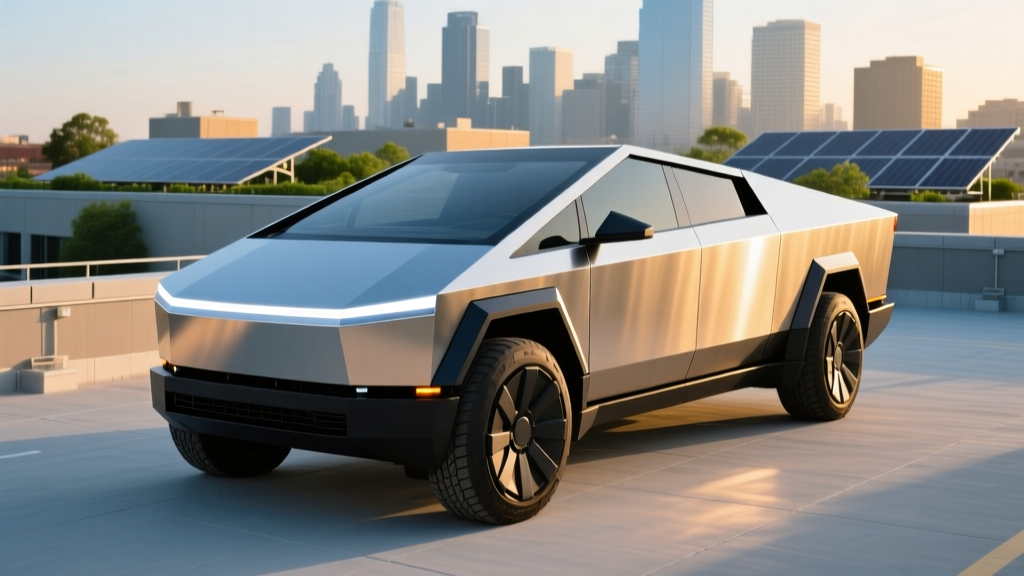
Love it or loathe it, the Tesla Cybertruck has become one of the most talked-about electric vehicles on the road. As Cybertruck sales in 2026 settle into a more predictable cadence following its late-2023 launch and turbulent 2024-2025 production ramp, buyers now have enough real-world data to evaluate whether Tesla's angular stainless-steel pickup actually delivers on its promises. This review breaks down every number that matters — from EPA range and 800V charging speeds to federal tax credit eligibility and total ownership cost — so you can decide if the Cybertruck belongs in your driveway or if a rival like the Ford F-150 Lightning or Rivian R1T makes more sense.
Cybertruck 2026 Lineup: Trims, Pricing, and Tax Credit Eligibility
For the 2026 model year, Tesla continues to offer the Cybertruck in three primary configurations. Pricing has stabilized after the significant mid-2024 adjustments that drew early-reservation-holder backlash. Here is where each trim stands:
| Trim | Drivetrain | 0-60 mph | EPA Range | Towing | Base MSRP |
|---|---|---|---|---|---|
| Long Range (Dual Motor AWD) | Dual Motor AWD | 4.1 sec | 340 mi | 11,000 lb | $79,990 |
| Cyberbeast (Tri-Motor AWD) | Tri-Motor AWD | 2.6 sec | 320 mi | 11,000 lb | $99,990 |
| RWD (Standard Range) | Rear-Wheel Drive | 6.2 sec (est.) | 250 mi (est.) | 7,500 lb | $60,990 |
Federal tax credit (§30D) note: As of 2026, the Cybertruck qualifies as a light truck under IRS rules, meaning the MSRP cap is $80,000 (versus $55,000 for sedans). The Long Range AWD at $79,990 falls just under the cap and may be eligible for the full $7,500 credit — provided the buyer meets income thresholds ($150K single / $300K joint AGI) and the vehicle's battery satisfies critical-mineral and component-sourcing requirements, which remain subject to annual IRS updates. The Cyberbeast at $99,990 exceeds the MSRP cap and does not qualify. The RWD variant, once deliveries begin at scale, should also qualify. Tesla offers point-of-sale transfer of the credit, reducing your purchase price at the dealer (or in Tesla's case, at delivery). Always verify current eligibility at irs.gov before committing.
Range and Efficiency: EPA Stickers vs. Real-World Reality
The Cybertruck's stainless-steel exoskeleton and flat-panel geometry create an aerodynamic profile unlike any conventional truck — and not entirely in a positive way. Its brick-like frontal area means highway efficiency takes a hit compared to sleeker EVs, even with Tesla's claimed drag coefficient improvements over traditional pickups.
- City / mixed driving (65°F): ~310-330 miles achievable with moderate regen use
- Highway cruising (75 mph, 75°F): ~260-280 miles — the flat aero profile costs you roughly 18-22% versus EPA at sustained interstate speeds
- Cold weather (25°F, highway): ~210-240 miles — battery chemistry resistance and cabin heating compound the highway penalty
- Towing (5,000 lb trailer): ~150-180 miles — expect range to roughly halve under load, consistent with all electric trucks
Source: EPA estimates via fueleconomy.gov; real-world figures from owner-reported data and independent testing.
The Cybertruck Long Range achieves an EPA-rated 67 MPGe combined (roughly equivalent to 50 kWh per 100 miles). That is noticeably less efficient than the Ford F-150 Lightning Extended Range (~70 MPGe combined) and substantially behind passenger EVs, but it is in line with what a 6,600+ lb electric truck can achieve with current battery technology. The Cyberbeast's efficiency drops further due to its tri-motor setup and performance-oriented tuning.
Battery, Chemistry, and Charging Speed
The Cybertruck uses a structural battery pack that serves as a stressed member of the vehicle's frame — a design Tesla introduced with the 4680 cell format. The pack capacity is approximately 123 kWh usable (Long Range AWD), utilizing Tesla's in-house manufactured NMC (nickel manganese cobalt) 4680 cylindrical cells. Tesla has not released an LFP variant of the Cybertruck, and given the vehicle's weight and towing requirements, an LFP pack's lower energy density would likely compromise range targets.
| Charging Level | Power / Rate | Speed | Notes |
|---|---|---|---|
| Level 1 (120V household) | ~1.4 kW | ~3-4 mi/hr | Emergency/trickle only; full charge takes days |
| Level 2 (240V home, 48A) | 11.5 kW | ~28-30 mi/hr | Full overnight charge in ~10-12 hours; Wall Connector recommended |
| DC Fast Charge (Tesla Supercharger V4) | Peak 250 kW (800V architecture) | 10-80% in ~25 min | Sustained rate tapers significantly above 60% SoC; expect ~180 kW average in the 10-80% window |
| DC Fast Charge (CCS adapter, non-Tesla networks) | Up to ~200 kW | 10-80% in ~32 min | Adapter included with 2026 models; Electrify America and EVgo compatible |
Charging curve reality check: The Cybertruck's 800V electrical architecture enables impressive peak charge rates, but as with all lithium-ion packs, the charge curve tapers aggressively as State of Charge (SoC) climbs. You will see 250 kW only briefly in the 10-30% SoC window. By 60% SoC, speeds typically drop to ~120 kW, and above 80% they fall below 50 kW. Plan road-trip stops to charge in the 10-80% sweet spot for the fastest sessions. Preconditioning the battery (automatic when a Supercharger is set as your navigation destination) is essential to hit peak rates — arriving at a charger with a cold pack can cut speeds in half.
Performance, Drivetrain, and Towing
The Cybertruck's performance figures remain startling for a vehicle weighing over three tons. The Cyberbeast tri-motor variant produces an estimated 845 horsepower and rockets to 60 mph in 2.6 seconds — faster than most supercars and genuinely absurd for a pickup. The Long Range dual-motor delivers approximately 600 horsepower with a 4.1-second 0-60 time, which is more than adequate for any real-world truck use.
Both AWD variants feature torque vectoring across the rear axle (Cyberbeast) or between front and rear (dual-motor), providing surprisingly competent off-road traction. The steer-by-wire system — which eliminates the mechanical connection between the steering wheel and the wheels — remains a polarizing choice. It enables the Cybertruck's yoke-style steering wheel and variable ratio, but some drivers report a disconnected feel at highway speeds that takes weeks to acclimate to.
Towing: The AWD models are rated for 11,000 pounds, competitive with the F-150 Lightning (10,000 lb) and ahead of the Rivian R1T (11,000 lb max with Max Pack). However, as noted in the range section, towing any significant load cuts range dramatically. The integrated trailer brake controller and Tesla's trailer-assist camera system are well-implemented.
Cargo, Interior Space, and Daily Practicality
The Cybertruck's 6-foot bed (officially called the "vault") offers 67 cubic feet of enclosed cargo volume with the tonneau cover closed. The bed is wider than a traditional F-150 bed between the wheel wells, and the stainless-steel surface is dent-resistant — though it shows scratches readily. A front trunk (frunk) adds approximately 7 cubic feet of lockable storage, useful for charging cables and groceries.
Interior space is where the Cybertruck faces its strongest criticism:
- Front legroom: 41.5 inches — adequate for most adults
- Rear legroom: 34.8 inches — tight for taller passengers on longer trips; noticeably less generous than the F-150 Lightning (43.5 in) or Rivian R1T (37.3 in)
- Rear headroom: Compromised by the sloping roofline; passengers over 6'2" will notice
- Seating: 5-passenger capacity (3-across rear bench), though the center rear position is best for shorter trips
The 18.5-inch center touchscreen handles nearly all vehicle controls, including glove-box release and mirror adjustments. There are no physical buttons for climate or volume — a design choice that frustrates some owners daily and barely registers for others. The rear passengers get their own 9.4-inch touchscreen, which is a nice touch for entertainment and climate control.
Driver Assistance, Tech, and Notable Drawbacks
Tesla Autopilot and Full Self-Driving (Supervised) are Level 2 driver-assistance systems. The driver must remain fully engaged, hands on the yoke (or applying torque), and eyes on the road at all times. The Cybertruck is not a self-driving vehicle. Only Level 4 services like Waymo operate without a human driver in geofenced areas.
The Cybertruck ships with Tesla's latest HW4 (Hardware 4) sensor suite, including higher-resolution cameras and improved neural-net processing. FSD (Supervised) has improved markedly through 2025-2026 over-the-air updates, with smoother lane changes and better handling of construction zones. However, it still struggles with unmapped road changes, heavy rain, and complex multi-lane roundabouts. The $8,000 FSD purchase (or $99/month subscription) remains a personal calculation — many owners find basic Autopilot sufficient for highway commuting.
Notable drawbacks worth knowing before purchase:
- Stainless-steel fingerprint magnet: The exterior panels show smudges, water spots, and scratches; many owners apply ceramic coating immediately
- Panel-gap variability: While improved from early 2024 production, panel alignment still varies unit-to-unit more than legacy automakers
- Tire cost: The Cybertruck uses a proprietary 35-inch tire (285/65R20); replacement tires run $350-$450 each, and availability was limited through 2025 but has improved in 2026
- Visibility: The angular design creates substantial blind spots over the rear shoulders; the camera-based mirror system (optional) helps but is not standard
- Insurance premiums: Expect 30-50% higher insurance costs versus a comparably priced F-150 Lightning, driven by repair costs and stainless-steel panel replacement complexity
Warranty Coverage and Battery Longevity
Tesla provides the following warranty coverage for the 2026 Cybertruck:
- Basic vehicle limited warranty: 4 years / 50,000 miles
- Battery and drive unit warranty: 8 years / 120,000 miles (whichever comes first), with a guaranteed minimum 70% capacity retention over the warranty period
- Restraint system: 5 years / 60,000 miles
The 120,000-mile battery warranty is competitive and slightly more generous than the 100,000-mile coverage Tesla offers on some other models, likely reflecting the heavier-duty use case expected of a truck. The 4680 NMC cells have shown promising degradation data in early fleet use — Tesla's internal data suggests approximately 8-10% degradation at 100,000 miles under normal use patterns, though cold-climate and frequent DC-fast-charging users may see slightly higher loss. Full battery pack replacement out of warranty is estimated at $15,000-$20,000, though this figure is expected to decline as 4680 cell production scales.
Cybertruck vs. Competitors: Which Electric Truck Should You Buy?
| Spec | Tesla Cybertruck LR AWD | Ford F-150 Lightning Ext. Range | Rivian R1T Dual-Motor Max |
|---|---|---|---|
| EPA Range | 340 mi | 320 mi | 410 mi |
| Battery (usable) | ~123 kWh NMC | ~131 kWh NMC | ~141 kWh NMC |
| DC Fast Charge (peak) | 250 kW | 150 kW | 220 kW |
| 10-80% DCFC Time | ~25 min | ~41 min | ~30 min |
| 0-60 mph | 4.1 sec | 4.5 sec | 3.5 sec |
| Towing Capacity | 11,000 lb | 10,000 lb | 11,000 lb |
| Rear Legroom | 34.8 in | 43.5 in | 37.3 in |
| Base MSRP | $79,990 | $69,995 | $87,900 |
| §30D Credit Eligible | Likely (MSRP under $80K cap) | Yes | Yes (MSRP under $80K cap on some trims) |
- You prioritize DC fast-charge speed for road trips (250 kW peak is the fastest in this segment)
- You want the performance thrill of a sub-3-second Cyberbeast or a 4.1-second Long Range
- You are invested in the Tesla Supercharger network and ecosystem
- You value the stainless-steel durability and polarizing design as a statement
- Rear-seat passenger comfort is a priority (43.5 inches of legroom vs. 34.8)
- You want a lower entry price and proven dealer-service infrastructure
- You prefer a conventional truck form factor with familiar ergonomics
- Maximum range is your top concern (410 mi with Max Pack)
- You want best-in-class off-road capability with quad-motor tank turns
- Build quality and interior materials are a higher priority than raw performance
Frequently Asked Questions
What is the real-world range of the 2026 Tesla Cybertruck?
The Long Range AWD carries a 340-mile EPA rating, but real-world highway driving at 75 mph yields approximately 260-280 miles. In cold weather (below freezing), expect 210-240 miles on the highway. City driving with regenerative braking gets closest to the EPA sticker, around 310-330 miles in moderate temperatures.
How fast does the Cybertruck charge at home and on the road?
On a home Level 2 charger (240V, 48 amps / 11.5 kW), the Cybertruck adds roughly 28-30 miles of range per hour, requiring about 10-12 hours for a full charge. On Tesla Superchargers, it peaks at 250 kW and charges from 10-80% in approximately 25 minutes, though sustained rates taper significantly above 60% SoC.
How much does the Cybertruck cost after the federal tax credit?
The Long Range AWD at $79,990 may qualify for the $7,500 §30D credit (effective price ~$72,490) if the buyer meets income limits ($150K single / $300K joint) and the battery satisfies sourcing requirements. The Cyberbeast at $99,990 exceeds the $80,000 truck MSRP cap and does not qualify. Always confirm current rules at irs.gov.
Does the Cybertruck qualify for the federal EV tax credit?
The Long Range AWD trim ($79,990) falls under the $80,000 MSRP cap for light trucks and is potentially eligible. Eligibility also depends on buyer income, battery critical-mineral sourcing, and North American assembly requirements. The credit can be transferred at point of sale. Verify current-year rules with a tax professional or at irs.gov.
Is the Cybertruck worth buying versus the F-150 Lightning or Rivian R1T?
It depends on your priorities. The Cybertruck wins on DC fast-charge speed (250 kW), raw performance, and Supercharger network access. It loses on rear-seat space, starting price, and insurance costs. If you need a practical family truck with a comfortable back seat, the F-150 Lightning is the stronger choice. If range and off-road capability matter most, the Rivian R1T Max Pack leads. The Cybertruck is best for buyers who want a fast-charging, high-performance truck and accept its compromises.
What are the biggest pros and cons of the Cybertruck?
Pros: Class-leading DC fast-charge speed, explosive acceleration (Cyberbeast: 2.6 sec 0-60), durable stainless-steel body, Supercharger network access, 11,000-lb towing capacity, 800V architecture.
Cons: Tight rear-seat legroom (34.8 in), high starting price, expensive proprietary tires, polarizing design limits resale pool, elevated insurance premiums, panel-gap inconsistency, steer-by-wire takes significant adaptation.