Quick Answer: What Is an Electric Tugboat and Who Should Buy One?
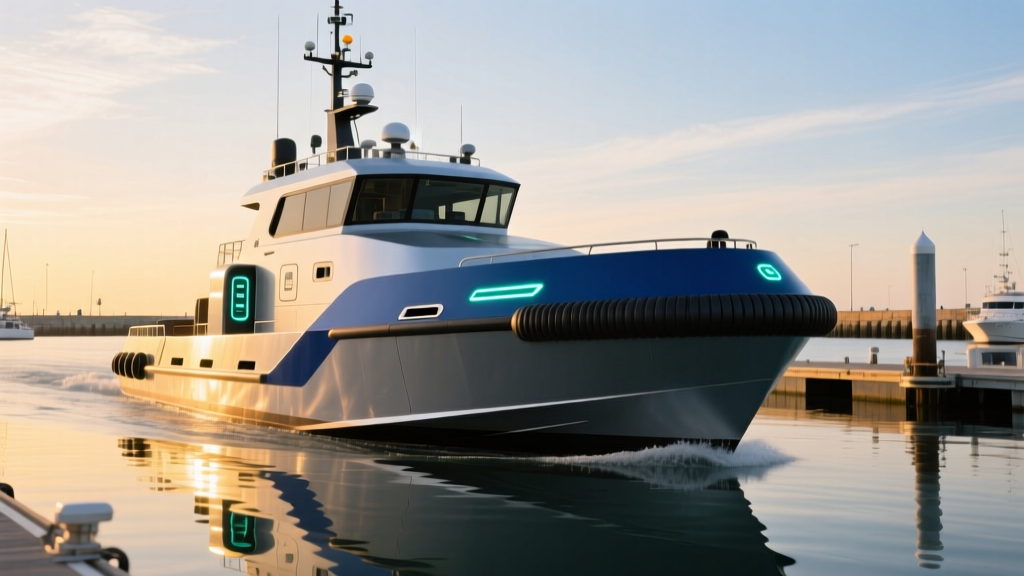
An electric tugboat replaces a diesel harbor assist vessel with battery-electric propulsion, typically packing 2,000–7,000 kWh of lithium iron phosphate (LFP) battery capacity and 1,500–5,000 kW of electric motor output. The most prominent production example, the SparkTech eWolf (formerly Crowley's eWolf), delivers roughly 70 MWh of usable battery and 6.5 MW of bollard pull power. Expect a purchase price of $12–25 million depending on capacity, versus $8–14 million for a comparable diesel tug. The payoff: 60–80% lower energy cost per operating hour, near-zero local emissions, and dramatically reduced maintenance — but only if your port has shore-power infrastructure capable of delivering 1–3.5 MW of charging.
This guide applies to commercial harbor operators, port authorities, and maritime fleet managers evaluating electric tugboat acquisition. It does not cover recreational electric boats, which operate at a fundamentally different scale.
Electric Tugboat vs. Diesel Tug: The Numbers That Matter
The decision to go electric on the water mirrors the EV-vs-gas calculation on land — higher upfront capital cost, lower operating cost — but the magnitudes are far larger. Here's how a modern electric harbor tug compares to a conventional diesel counterpart across key metrics:
| Metric | Electric Tugboat (e.g., eWolf-class) | Diesel Tug (e.g., ASD 2413 class) |
|---|---|---|
| Propulsion Power | 5.0–6.5 MW (6,700–8,700 HP) | 4.0–5.2 MW (5,400–7,000 HP) |
| Energy Storage | 3,500–7,000 kWh (LFP) | ~15,000–25,000 kWh (diesel fuel equivalent) |
| Bollard Pull | 60–80 metric tons | 60–85 metric tons |
| Operating Range (typical harbor shift) | 8–14 hours continuous assist work | 18–24+ hours continuous |
| Energy Cost per Operating Hour | $45–$90 (at $0.08–$0.14/kWh industrial rate) | $180–$350 (at $3.50–$4.50/gal marine diesel) |
| Annual Maintenance | $80,000–$150,000 | $250,000–$500,000 |
| Purchase Price (new build) | $12M–$25M | $8M–$14M |
| Crew Required | 2–4 | 2–4 |
| Local Emissions at Berth | Zero | NOx, PM, CO₂ |
The energy density gap is the defining constraint. Diesel fuel stores roughly 10 kWh per liter; LFP cells deliver 150–180 Wh/kg at the cell level and around 100–130 Wh/kg at the pack level. That means an electric tugboat must carry 30–50 times the mass of a diesel fuel load to match the same energy — which is why electric tugs are designed around shift-based harbor operations with shore charging between assignments, not multi-day offshore duty.
Battery, Propulsion, and Charging Specs: What's Under the Deck
Modern electric tugboats use modular LFP battery racks for three reasons: superior cycle life (4,000–6,000 cycles to 80% state of health), inherent thermal stability (no thermal runaway risk at the cell level under normal abuse conditions), and lower cost per kWh at scale ($120–$180/kWh for marine-grade LFP packs in 2026). NMC chemistry is generally avoided in maritime applications due to fire safety concerns in enclosed engine rooms and port-adjacent environments.
Propulsion is typically twin azimuth thruster pods driven by permanent-magnet synchronous motors, each rated 2.0–3.5 MW. Unlike diesel tugs that lose efficiency at partial load, electric motors deliver peak torque from zero RPM — giving electric tugs exceptional responsiveness during ship-assist maneuvers. Regenerative braking during deceleration and thruster reversal recovers 8–15% of energy per assist cycle, extending effective shift length.
| Specification | Typical Electric Tugboat (2026) |
|---|---|
| Battery Chemistry | LFP (lithium iron phosphate) |
| Usable Capacity | 3,500–7,000 kWh |
| Peak Propulsion Power | 5.0–6.5 MW |
| Motor Type | Permanent-magnet synchronous (twin azimuth) |
| Shore Charging Power | 1.0–3.5 MW DC (CCS2-marine or custom) |
| 10–80% Charge Time (at 2.5 MW) | ~90–120 minutes (7,000 kWh pack) |
| Battery Warranty | 10 years or 30,000 cycles / 80% SoH |
| Regen Recovery | 8–15% per assist cycle |
Charging infrastructure is the make-or-break factor. A 2.5 MW shore charger requires dedicated medium-voltage electrical service — typically a 4,160V or 12,470V feeder from the local utility, a pad-mounted transformer, and a marine-grade DC dispenser rated for saltwater environments. Installation costs run $1.5–4.0 million per berth including civil works, switchgear, and utility interconnection fees. Ports without existing high-capacity electrical infrastructure may face 12–24 month lead times for utility upgrades.
Total Cost of Ownership: 10-Year Harbor Fleet Comparison
The electric tugboat business case hinges on total cost of ownership (TCO), not sticker price. Here's a modeled 10-year comparison assuming 2,500 operating hours per year — typical for a busy port assist tug:
| Cost Category (10-Year) | Electric Tugboat | Diesel Tugboat |
|---|---|---|
| Acquisition (vessel) | $18,000,000 | $11,000,000 |
| Shore Charger Install | $2,500,000 | $0 |
| Energy / Fuel | $1,575,000 ($63/hr × 2,500 hr × 10 yr) | $6,625,000 ($265/hr × 2,500 hr × 10 yr) |
| Maintenance & Overhauls | $1,150,000 | $3,750,000 |
| Emissions Compliance / Credits | $0 (often earns credits) | $400,000–$800,000 |
| Battery Replacement (Year 10+) | $1,800,000–$3,500,000 (if needed) | Engine rebuild: $800,000–$1,500,000 |
| 10-Year Total | $25,025,000–$26,725,000 | $22,575,000–$23,175,000 |
| Cost per Operating Hour | $1,001–$1,069 | $903–$927 |
At face value, the diesel tug still holds a narrow TCO advantage over 10 years. However, this model does not include federal and state incentives that dramatically shift the equation:
- EPA Clean Ports Program (Diesel Emissions Reduction Act): Grants covering 25–75% of zero-emission port equipment cost, with awards of $3–10M per vessel in recent rounds.
- State-level programs: California's Carl Moyer Program and Proposition 1A funding have provided $5–12M toward electric tugboat acquisition. Check your state air quality management district for current availability.
- IRA §45W Commercial Clean Vehicle Credit: Up to $40,000 for qualifying commercial vehicles — but note, tugboats are generally classified as vessels, not highway vehicles, so eligibility depends on IRS guidance specific to your vessel's classification. Consult a maritime tax specialist.
- Port fee reductions: Several major ports (Los Angeles, Long Beach, Vancouver) offer reduced harbor dues for zero-emission vessels, saving $50,000–$200,000 annually.
With a $5–8M grant applied, the electric tugboat's 10-year TCO drops to $17–21 million, decisively undercutting diesel — and the gap widens every year as diesel prices fluctuate upward and electricity rates remain relatively stable under long-term utility contracts.
Real-World Ownership: What First-Time Electric Tugboat Operators Must Plan For
Charging Infrastructure Is a 2–3 Year Project, Not a Purchase
Unlike buying a Tesla and installing a wall connector, electrifying a tugboat berth requires utility coordination, environmental permitting (NEPA review if federal funds are involved), marine civil engineering for cable trays and dispenser foundations, and commissioning of high-power DC equipment. Start this process the moment you begin evaluating vessel procurement — ideally 24–36 months before planned vessel delivery.
Shift Scheduling Must Adapt to the Charge Curve
A 7,000 kWh pack charging at 2.5 MW will reach 80% state of charge in roughly 110 minutes, but the final 20% tapers significantly — often requiring another 60–90 minutes. Fleet dispatchers must schedule charging windows during natural operational lulls (between ship arrivals) rather than treating it like a diesel bunker that can be topped off in 30 minutes at any time.
Cold-Water and Cold-Air Performance
LFP batteries lose 15–25% of effective capacity at 0°C (32°F) without active thermal management. Marine electric tugs operating in northern ports (Seattle, Duluth, Boston, Canadian Maritimes) must specify battery thermal management systems with heating capability — adding $200,000–$500,000 to the build cost but preventing crippling range loss during winter operations. This mirrors the cold-weather range reduction EV owners experience on land, but at a scale where the consequences are operational, not just inconvenient.
Crew Training and Safety
High-voltage DC systems (600–1,000V nominal) require crew certification in marine electrical safety beyond standard STCW requirements. Most builders include 2–4 weeks of factory training, but budget for ongoing annual recertification and ensure your port's emergency responders are briefed on lithium battery fire protocols — though LFP's thermal stability makes this a far lower risk than NMC.
Common Electric Tugboat Misconceptions — Addressed With Data
| Myth | Fact |
|---|---|
| "Electric tugs don't have enough power for large ship assists." | The eWolf-class delivers 6.5 MW and 70+ metric tons bollard pull — matching or exceeding most Tier 4 diesel harbor tugs. Electric motors deliver instant torque at zero RPM, improving responsiveness. |
| "Batteries will need replacing every 3–5 years." | Marine-grade LFP packs are warrantied for 10 years or 30,000 cycles at 80% state of health. At 2,500 hours/year with an average 2C discharge profile, that's 12–15+ years of usable life before reaching 80% SoH. |
| "There's no charging infrastructure for electric boats." | Shore-power standards (IEEE 80005-3, IEC/ISO 16484) now support multi-MW DC marine charging. Ports in LA/Long Beach, San Francisco, Vancouver, Rotterdam, and Oslo have active high-power shore installations. |
| "Electric tugs can't operate in rough weather." | Battery packs are IP67-rated and housed in watertight, shock-mounted enclosures meeting ABS and DNV class rules for vibration, salt spray, and submersion. Sea state limitations match diesel equivalents. |
| "The grid can't handle megawatt-scale marine charging." | A 2.5 MW charger draws roughly the same as 1,800 homes at peak — significant but manageable with dedicated utility feeders and on-site battery buffer systems ($500K–$1.5M) that flatten demand charges. |
Decision Framework: Should Your Fleet Go Electric?
Choose an electric tugboat if:
- Your tugs operate on predictable harbor shifts (8–14 hours) with scheduled idle periods for charging
- Your port has — or can obtain — 2+ MW of shore electrical capacity within your timeline
- You can access EPA Clean Ports, state air quality, or port authority incentive funding (reducing acquisition cost by 30–50%)
- Your fleet faces tightening emissions regulations (e.g., California's Commercial Harbor Craft rule requiring zero-emission new builds by 2030+)
- You plan to operate the vessel 10+ years (amortizing the upfront premium over a long service life)
- Local community and environmental groups are active stakeholders in your port operations (zero-emission tugs have significant public-relations value)
Stick with diesel (or evaluate hybrid) if:
- Your tugs perform extended offshore tows, salvage, or escort duties exceeding 16+ hours without return to berth
- Your port is in a region with no feasible path to multi-MW shore power within 3 years
- Your operating hours are low (<1,000/year), making the fuel savings insufficient to justify the capital premium
- Your fleet is already relatively new (Tier 4 diesel) with 10+ years of remaining service life
- You operate in extreme Arctic or remote environments where charging infrastructure and battery cold-weather performance remain limiting factors
Frequently Asked Questions
How far can an electric tugboat travel on a single charge?
Range is not the right metric for harbor tugs — operating time is. A 7,000 kWh pack supports 8–14 hours of continuous harbor assist work depending on intensity. In transit without towing at 8 knots, the same pack might cover 40–60 nautical miles. Unlike diesel tugs that can bunker and continue, electric tugs must plan around charging windows.
What does it cost to charge an electric tugboat?
At an industrial electricity rate of $0.10/kWh, fully charging a 7,000 kWh pack costs approximately $700. Compare this to fueling a diesel tug with 5,000 gallons of marine diesel at $4.00/gal: $20,000. Over 2,500 operating hours per year, the energy savings alone can reach $300,000–$500,000 annually.
Are there federal tax credits or grants for electric tugboats?
The IRA's §45W commercial clean vehicle credit (up to $40,000) applies to qualifying commercial vehicles, but vessel classification under IRS rules is nuanced — consult a maritime tax attorney. Far more impactful is the EPA Clean Ports Program, which has awarded grants of $3–10M+ per zero-emission harbor craft. State programs like California's CARB Commercial Harbor Craft regulation also provide compliance-driven funding pathways.
Who builds electric tugboats in 2026?
Key builders include Crowley/SparkTech (eWolf, US-built), Damen Shipyards (E-Tug series, Netherlands), Sanmar Shipyards (ElectRA series, Turkey/India), and several Chinese yards including ZPMC and COSCO. Delivery lead times are 18–36 months from contract signing for most classes.
What happens when the battery degrades below 80% capacity?
At 80% state of health, the tugboat remains fully operational — it simply has 20% less energy storage, reducing shift length by a proportional amount. Most operators find the vessel still meets daily requirements at 80% SoH. Full battery replacement (if needed at year 12–15) costs $1.8–3.5M depending on pack size, which can be planned as a mid-life capital expenditure. Some operators repurpose degraded marine packs for stationary port energy storage.