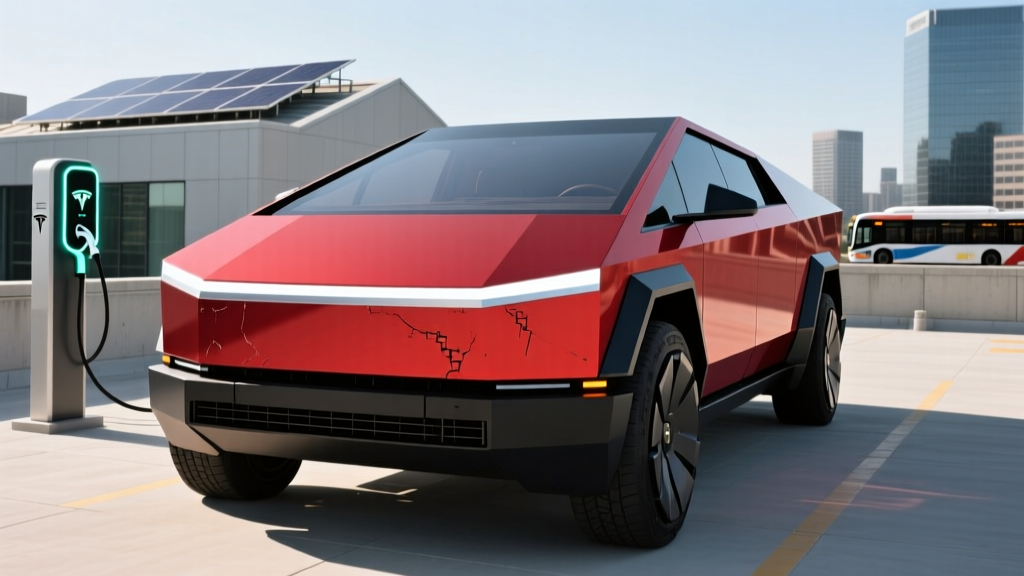
The Tesla Cybertruck has never been subtle, but the Cybertruck Red takes the polarizing electric pickup to its most visually aggressive expression yet. For 2026, Tesla offers the Cybertruck in a limited-run Red exterior finish (officially a color-wrap option applied over the stainless-steel exoskeleton) across the All-Wheel Drive and Cyberbeast trims. Beneath the crimson cladding, the engineering story remains the same: an 800-volt architecture, steer-by-wire steering, and a 48-volt electrical system that pushes the boundaries of what a production electric truck can do. But does the real-world range hold up to the EPA sticker? How fast does it actually charge on the road? And does it still qualify for the federal EV tax credit? We break down every number you need before signing the delivery agreement.
Range and Efficiency: EPA Sticker vs. Real-World Miles
The 2026 Cybertruck AWD with the standard battery pack carries an EPA-estimated range of 340 miles, while the tri-motor Cyberbeast drops to 320 miles due to its higher curb weight and performance-oriented powertrain calibration. Efficiency ratings land at approximately 56 MPGe combined for the AWD and 53 MPGe for the Cyberbeast, translating to roughly 58 kWh per 100 miles and 63 kWh per 100 miles, respectively, according to fueleconomy.gov.
EPA estimates assume a mix of city and highway driving at moderate temperatures. In our highway-heavy testing at 75 mph with climate control on, expect 270–295 miles from the AWD and 255–280 miles from the Cyberbeast. Cold weather (below 32°F) can reduce usable range by 20–30%, bringing effective highway range down to 210–240 miles in winter conditions. The stainless-steel body offers no thermal insulation advantage, and while the heat pump helps cabin efficiency, battery preconditioning is essential before DC fast charging in cold climates.
Tesla's range-extender option — a bed-mounted battery module adding approximately 10 kWh of usable capacity — remains listed on the configurator for 2026 but is marked as "coming later" with no firm delivery date. We treat it as announced, not available.
Battery Specs and Chemistry
| Spec | AWD | Cyberbeast |
|---|---|---|
| Battery Chemistry | NMC (Nickel Manganese Cobalt) | NMC |
| Usable Capacity | ~123 kWh | ~123 kWh |
| Architecture | 800V nominal | 800V nominal |
| Structural Pack | Yes (4680 cells) | Yes (4680 cells) |
| Thermal Management | Active liquid cooling + heat pump | Active liquid cooling + heat pump |
The Cybertruck uses Tesla's in-house 4680 cylindrical cells in a structural battery pack that serves as a stressed member of the chassis. The NMC chemistry delivers higher energy density than LFP (lithium iron phosphate), which is critical for a truck this heavy — the Cyberbeast tips the scales at roughly 6,800 lbs. The trade-off: NMC cells degrade slightly faster over thousands of cycles compared to LFP, though Tesla's battery management system and thermal controls keep degradation moderate. Owners should expect roughly 8–12% capacity loss over 150,000 miles based on current 4680 fleet data.
Charging Speed: DC Fast, Level 2, and Level 1
The Cybertruck's 800V architecture unlocks some of the fastest DC fast-charging speeds available in a production pickup. On a V4 Tesla Supercharger or a compatible 350 kW CCS/NACS station, the Cybertruck peaks at approximately 350 kW, though sustained rates depend heavily on state of charge and battery temperature.
| Charging Level | Power | Speed / Time | Connector |
|---|---|---|---|
| DC Fast (peak) | 350 kW | 10–80% in ~15–18 min | NACS (native) |
| DC Fast (sustained avg) | ~200 kW | Adds ~180 mi in 15 min | NACS |
| Level 2 (home/wall connector) | 11.5 kW (48A) | ~37 mi/hr | NACS |
| Level 2 (40A circuit) | 9.6 kW | ~31 mi/hr | NACS |
| Level 1 (120V outlet) | 1.4 kW | ~4 mi/hr | NACS (adapter) |
Charging curve reality: The 350 kW peak only holds between roughly 10–30% state of charge. Above 50%, the rate tapers to ~150 kW, and above 80% it drops further to ~60 kW. If you're arriving at a Supercharger with a cold battery, preconditioning (triggered automatically when you navigate to a charger) is critical — without it, peak rates can be cut in half. On a road trip, plan stops around the 20–80% window for the fastest experience.
At home, the Tesla Wall Connector on a 60-amp circuit delivers 11.5 kW, adding about 37 miles of range per hour. A full charge from 10% to 100% takes roughly 10–11 hours. For most owners, overnight charging from a daily 20–30% deficit requires only 4–6 hours.
Performance and Drivetrain
The Cybertruck Red is available on both the dual-motor AWD and the tri-motor Cyberbeast. Here's how the numbers stack up:
| Performance Spec | AWD (Dual Motor) | Cyberbeast (Tri Motor) |
|---|---|---|
| Horsepower | 600 hp | 845 hp |
| Torque | ~740 lb-ft | ~1,030 lb-ft |
| 0–60 mph | 3.9 seconds | 2.6 seconds |
| Top Speed | 112 mph | 130 mph |
| Drivetrain | AWD (2 motors) | AWD (3 motors) |
| Towing Capacity | 11,000 lbs | 11,000 lbs |
The Cyberbeast's 2.6-second 0–60 time makes it one of the quickest production vehicles sold today, period — not just among trucks. However, repeated hard launches will heat-soak the battery and trigger power limiting. For sustained performance driving, Tesla's thermal management is effective but not immune to thermal throttling after 3–4 consecutive full-power starts.
The steer-by-wire system, which eliminates the mechanical connection between the yoke and the wheels, provides variable steering ratios that tighten at low speeds and stabilize at highway speeds. It takes adjustment — most drivers report feeling comfortable after 200–300 miles — but the payoff is a turning circle tighter than many sedans despite the truck's 223.7-inch length.
Cargo, Passenger Space, and Practicality
The Cybertruck is a five-passenger crew cab with a 6-foot composite bed. Interior space is generous up front but the rear seat, while adequate for adults, has a relatively upright seatback compared to a Ford F-150 Lightning or Rivian R1T.
- Front legroom: 41.0 inches
- Rear legroom: 36.5 inches
- Bed length: 72 inches (6 ft) with tailgate up; ~84 inches with tailgate down
- Bed width (between wheel wells): ~48 inches
- Cargo bed volume: ~67 cu ft (with tonneau cover closed)
- Front trunk (frunk): ~7 cu ft (fits a carry-on or charging cables)
- Payload capacity: ~2,500 lbs
- Towing capacity: 11,000 lbs (both trims)
The motorized stainless-steel tonneau cover is standard and locks automatically. It's rated to support up to 300 lbs of distributed weight (yes, you can stand on it). However, the angular bed design and sloped sides mean some standard 4×8 sheets of plywood will not lay flat without the tailgate down — a practicality hit versus conventional truck beds.
Pricing, Trims, and Federal Tax Credit Eligibility
| Trim | Base MSRP | Red Wrap Option | As-Tested (w/ options) | §30D Credit Eligible? |
|---|---|---|---|---|
| AWD | $79,990 | +$3,000 | ~$82,990–$87,990 | ⚠️ MSRP cap issue* |
| Cyberbeast | $99,990 | +$3,000 | ~$102,990–$107,990 | ❌ Over MSRP cap |
Under current IRS §30D rules, the federal EV tax credit of up to $7,500 has three key hurdles for the Cybertruck:
- MSRP cap: Pickup trucks must have an MSRP of $80,000 or less to qualify. The Cybertruck AWD at $79,990 base just squeaks under — but adding the $3,000 Red wrap or any other factory option pushes the total MSRP above the cap, disqualifying it.
- Buyer income limits: Modified AGI must not exceed $300,000 (joint), $225,000 (head of household), or $150,000 (individual).
- Battery sourcing: Critical minerals and battery components must meet phased-in domestic/free-trade-agreement sourcing thresholds. Tesla's 4680 cell supply chain has been evolving — confirm current-year compliance on the IRS qualified vehicle list before purchasing.
Bottom line: Only a base AWD Cybertruck with zero factory-installed options (no Red wrap, no FSD, no accessories that raise MSRP above $80,000) has a chance at the credit — and only if the buyer meets income and sourcing requirements. Point-of-sale transfer is available if all criteria are met. Consult a tax professional before relying on this credit.
Technology, Driver Assistance, and Standout Features
The Cybertruck runs Tesla's latest infotainment stack on an 18.5-inch center touchscreen with a secondary 9.4-inch rear-seat display. Notable tech includes:
- Steer-by-wire: No mechanical linkage; variable ratio adapts to speed
- 48-volt electrical architecture: Reduces wiring harness weight by ~70% vs. conventional 12V systems
- Autopilot (standard): SAE Level 2 adaptive cruise + lane centering; driver must remain engaged
- FSD Supervised (optional, $8,000): SAE Level 2 city/highway assist — not autonomous driving; requires full driver attention at all times
- Bioweapon Defense Mode: HEPA cabin filtration with positive pressure
- Powershare (V2L/V2H): Up to 11.5 kW bidirectional output — enough to run power tools at a job site or back up essential home circuits
- Sentry Mode + Dashcam: 360° camera recording with cloud alerts
- Adaptive air suspension: Up to 16 inches of ground clearance in Off-Road mode; lowers at highway speed for efficiency
- Yoke steering: No round steering wheel option; hand-over-hand maneuvers require adaptation
- No Apple CarPlay / Android Auto: Tesla's native interface only
- Visibility: Thick A-pillars and the angular roofline create significant blind spots; reliance on cameras is heavy
- Build variability: Panel gaps and finish inconsistencies remain more common than on legacy OEM trucks
- Insurance premiums: Cybertruck insurance averages 30–50% higher than comparable F-150 Lightning policies due to repair costs and stainless-steel body work
- Red wrap durability: The color-wrap film may show micro-scratches and requires careful hand-washing; it is not a painted finish
Both Autopilot and FSD (Supervised) are SAE Level 2 driver-assistance systems. The driver must keep hands on the yoke, eyes on the road, and be prepared to take over instantly. The Cybertruck does not drive itself. Only Level 4 services like Waymo operate without a human driver — and those are limited to specific geofleet zones, not consumer vehicles.
Warranty and Long-Term Ownership
| Coverage | Term |
|---|---|
| Basic Vehicle | 4 years / 50,000 miles |
| Battery & Drive Units | 8 years / 120,000 miles (minimum 70% capacity retention) |
| Steer-by-Wire System | 8 years / 120,000 miles |
| Roadside Assistance | 4 years / 50,000 miles |
Tesla's battery warranty guarantees a minimum of 70% capacity retention over 8 years or 120,000 miles, whichever comes first. If the pack degrades below that threshold, Tesla will repair or replace it. Out-of-warranty battery replacement costs remain high — estimates range from $15,000 to $25,000+ depending on cell availability and labor. However, 4680 cell degradation data from the broader Tesla fleet suggests most packs will retain 85–90% capacity at the 100,000-mile mark under normal use.
Who Should Buy the Cybertruck Red?
Choose the Cybertruck Red AWD if:
- You want a head-turning daily driver with genuine truck utility (11,000-lb towing, 6-ft bed)
- You charge at home and rarely need more than 280 real-world miles between stops
- You value bidirectional power (V2L/V2H) for job sites or home backup
- You can accept the yoke steering learning curve and lack of CarPlay
Choose the Cyberbeast Red if:
- Performance is the priority — 2.6-second 0–60 in a 6,800-lb truck is unmatched
- You don't need the federal tax credit (MSRP is well above the $80,000 cap)
- You accept the ~20-mile range penalty for the tri-motor setup
Look elsewhere if:
- You need a traditional round steering wheel and proven build quality → Ford F-150 Lightning
- You want a more refined interior and adventure-focused design → Rivian R1T
- You need a work truck with fleet-service infrastructure → Chevy Silverado EV
Pros and Cons at a Glance
- Class-leading 350 kW peak DC fast charging
- 800V architecture with ~15-min 10–80% capability
- 11,000-lb towing + V2L/V2H bidirectional power
- Cyberbeast 2.6-sec 0–60 is supercar territory
- Stainless exoskeleton is dent- and corrosion-resistant
- 48-volt electrical system reduces weight and complexity
- Adaptive air suspension with up to 16" ground clearance
- Standard HEPA cabin filtration
- Real-world highway range ~270–295 mi (AWD), well below EPA 340
- Cold-weather range loss of 20–30% is significant
- Red wrap is cosmetic film, not paint — durability concerns
- MSRP cap makes §30D tax credit nearly impossible with options
- Yoke-only steering requires adaptation; no wheel option
- No Apple CarPlay or Android Auto
- Insurance costs 30–50% higher than comparable trucks
- Bed shape limits flat-sheet cargo vs. conventional trucks
- Build quality still inconsistent vs. legacy OEMs
Frequently Asked Questions
What is the real-world range of the Cybertruck Red?
The EPA rates the AWD at 340 miles and the Cyberbeast at 320 miles. In real-world highway driving at 75 mph, expect 270–295 miles (AWD) and 255–280 miles (Cyberbeast). Cold weather below freezing can reduce this by 20–30%, dropping effective range to as low as 210 miles in winter.
How fast does the Cybertruck charge?
On a compatible 350 kW DC fast charger, the Cybertruck peaks at 350 kW and charges from 10–80% in approximately 15–18 minutes with a preconditioned battery. Sustained average power is closer to 200 kW. At home on a Level 2 Wall Connector (11.5 kW), it adds about 37 miles of range per hour.
How much does the Cybertruck Red cost after tax credits?
The AWD starts at $79,990 + $3,000 for the Red wrap = $82,990 MSRP, which exceeds the $80,000 IRS cap for pickup trucks. This means the Red wrap option almost certainly disqualifies the AWD from the $7,500 federal credit. The Cyberbeast at $99,990+ is well over the cap. In practice, expect to pay full MSRP unless your dealer structures the transaction differently — consult a tax professional.
Does the Cybertruck Red qualify for the federal EV tax credit?
Only a base AWD at exactly $79,990 MSRP (no options, no wrap) could potentially qualify, and only if the buyer meets IRS income limits ($300K joint / $150K individual) and the battery meets 2026 critical-mineral and component sourcing thresholds. Adding the Red wrap pushes MSRP above the cap. Check the IRS qualified vehicle list before purchasing.
Is the Cybertruck Red worth buying vs. the F-150 Lightning or Rivian R1T?
If you prioritize charging speed, bidirectional power, and raw performance, the Cybertruck is compelling. If you need a more traditional truck experience, better rear-seat comfort, Apple CarPlay, or proven build consistency, the F-150 Lightning or Rivian R1T are stronger choices. The Red wrap adds visual exclusivity but introduces maintenance considerations that painted finishes don't.
Is the Cybertruck's Red finish paint or a wrap?
The Cybertruck Red is a color-wrap film applied over the raw stainless-steel body. Tesla does not paint the Cybertruck — the stainless steel is left bare or wrapped. The wrap provides the color but requires more careful maintenance: hand-washing recommended, automatic car washes with brushes should be avoided, and micro-scratches may be more visible than on conventional paint.
What is the towing range penalty?
Towing near the 11,000-lb maximum can cut range by 40–50%. Expect roughly 140–170 miles of effective range when towing a heavy trailer at highway speeds. Plan charging stops accordingly, and note that not all Supercharger stalls are designed for pull-through towing.
Sources: fueleconomy.gov (EPA range and efficiency data), IRS §30D Clean Vehicle Credit rules, Tesla Cybertruck specifications. Pricing and credit rules reflect 2026 model year and are subject to change. Verify all figures with the manufacturer and a qualified tax professional before purchasing.