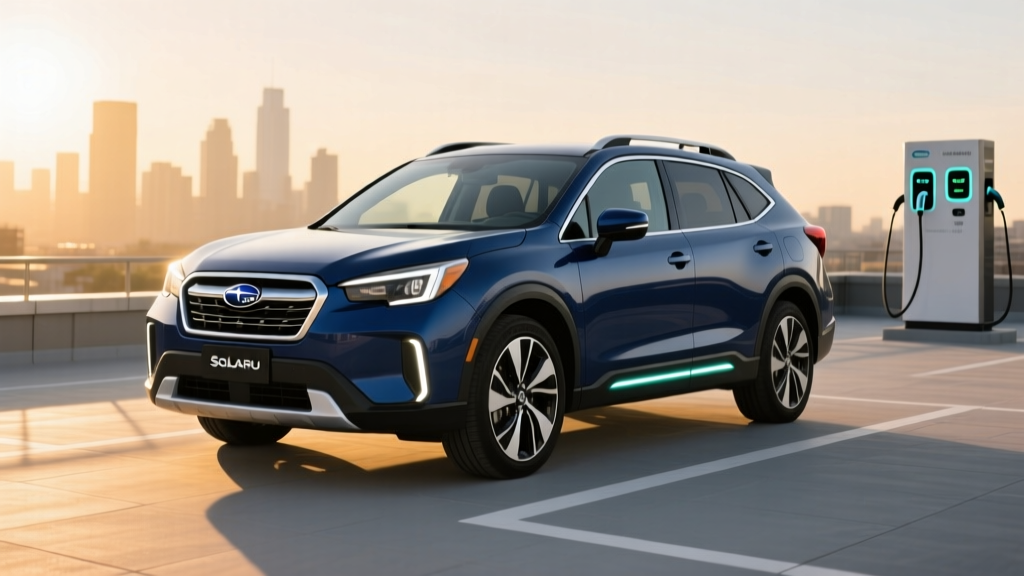
If you have been searching for the 2025 Subaru Solterra MSRP and wondering whether Subaru's all-electric SUV justifies its sticker price, you are not alone. The Solterra — developed jointly with Toyota on the e-TNGA platform shared with the bZ4X — occupies a specific niche: a compact electric crossover with standard all-wheel drive, genuine off-road credibility, and Subaru's trademark safety focus. But with a modest EPA range and middling DC fast-charging speeds, the 2025 Solterra demands a careful cost-benefit analysis before you sign the paperwork.
This review dissects every number that matters: pricing by trim, real-world range versus the EPA sticker, charging speeds at home and on the road, federal tax credit eligibility under IRS §30D rules, and how the Solterra stacks up against competitors like the Hyundai Ioniq 5, Ford Mustang Mach-E, and Toyota bZ4X. We write from a 2026 market perspective, reflecting current pricing and incentive structures.
2025 Subaru Solterra MSRP by Trim Level
Subaru simplified the Solterra lineup for 2025 with three trims, all featuring the same dual-motor all-wheel-drive powertrain and 72.8 kWh (usable) battery pack. Here is the manufacturer's suggested retail pricing before any incentives, destination charges, or dealer adjustments:
| Trim | Base MSRP | Est. w/ Destination ($1,395) | EPA Range | Key Additions Over Base |
|---|---|---|---|---|
| Premium | $38,495 | $39,890 | 228 mi | Base AWD, 8" touchscreen, heated seats, EyeSight |
| Limited | $41,995 | $43,390 | 222 mi | 12.3" display, SofTex seats, power liftgate, 360° camera |
| Touring | $45,495 | $46,890 | 222 mi | Harman Kardon audio, ventilated seats, panoramic roof, Digital Key |
The 6-mile range drop on Limited and Touring trims comes from larger 20-inch wheels and increased weight from premium features. All trims qualify under the IRS §30D MSRP cap for SUVs ($80,000), but federal tax credit eligibility depends on several additional factors we detail below.
Real-World Range vs. EPA Estimates
EPA Estimated: 228 mi (Premium) / 222 mi (Limited & Touring)
Real-World Highway (70 mph, mild weather): ~190–205 mi
Real-World City/Mixed: ~210–225 mi
Cold-Weather (below 32°F): ~155–185 mi (20–30% reduction typical for NMC packs without a heat pump optimization strategy)
The Solterra's EPA range figures are among the lowest in the compact EV SUV segment. The 72.8 kWh usable battery — a lithium-ion NMC (nickel manganese cobalt) pack — delivers an efficiency rating of approximately 104 MPGe combined (roughly 30–32 kWh/100 mi) according to fueleconomy.gov.
In practice, the Solterra's boxy shape and all-wheel-drive system create meaningful highway drag. On a 70-mph cruise in 65°F conditions, expect to use about 320–340 Wh/mi, which translates to roughly 195–210 miles before the buffer warning. In winter conditions, particularly below freezing where cabin heating and battery thermal management draw additional power, range can dip to 155–185 miles. If your daily commute exceeds 80 miles round-trip and you live in a cold climate, the Solterra's range becomes a genuine limitation rather than a minor inconvenience.
Subaru does include a heat pump on the 2025 Solterra, which helps mitigate cold-weather losses compared to resistance-based heating systems. However, the gains are incremental — expect 5–10% better cold-weather range than an EV without a heat pump, not a transformation.
Charging Speed: DC Fast Charging and Home Level 2
Charging performance is where the Solterra requires the most careful expectation management. The 2025 model carries over the charging hardware from the launch year, and it does not lead the pack.
| Charging Level | Power / Rate | Time / Speed | Connector |
|---|---|---|---|
| Level 1 (120V household) | ~1.2 kW | ~3–4 mi/hr added | J1772 |
| Level 2 (240V home/public) | Up to 7.2 kW | ~21–23 mi/hr; full charge ~10.5 hrs | J1772 |
| DC Fast Charge | Peak ~150 kW | 10–80% in ~56 min (est.) | CCS1 |
The headline disappointment is the DC fast-charging curve. While Subaru rates the Solterra at a peak of approximately 150 kW, real-world testing at Electrify America and other CCS networks shows the vehicle sustains peak power for only a brief window. The charge curve tapers aggressively: you may see 100–130 kW between 10–40% state of charge, then a significant step-down above 50%, and a crawl from 80–100%. A realistic 10–80% session takes roughly 50–60 minutes — substantially longer than competitors like the Hyundai Ioniq 5 (18 minutes on a 350 kW charger) or the Kia EV6.
For home Level 2 charging at 7.2 kW (a 32-amp circuit on a 40-amp breaker), a full overnight charge from near-empty takes about 10–11 hours. This is adequate for daily replenishment if you drive under 150 miles per day. Installation of a Level 2 home charger typically runs $500–$2,000 depending on your electrical panel capacity and the distance from panel to charging location — a licensed electrician should evaluate your 200-amp panel headroom before committing to hardware.
Notably, the 2025 Solterra still uses the CCS1 connector. Subaru has announced future adoption of the NACS (Tesla) standard for upcoming models, but for 2025, CCS1 is what you get. This means access to Electrify America, EVgo, ChargePoint, and other CCS networks — but no native Tesla Supercharger access without an adapter (and Subaru has not officially endorsed a third-party adapter for the Solterra as of early 2026).
Performance and Drivetrain
Every 2025 Solterra comes with Subaru's dual-motor Symmetrical All-Wheel Drive system — there is no single-motor, front-wheel-drive variant. This is a deliberate positioning choice: Subaru's brand identity is built on AWD capability, and the Solterra delivers on that promise.
| Specification | Value |
|---|---|
| Powertrain | Dual-motor AWD (e-TNGA platform) |
| Total Horsepower | 215 hp |
| Total Torque | 248 lb-ft |
| 0–60 mph | ~6.5 seconds |
| Top Speed | ~110 mph (electronically limited) |
| Ground Clearance | 8.3 inches |
| Towing Capacity | Not rated for towing |
| X-MODE | Standard (Snow/Dirt, Deep Snow/Mud) |
The 215 hp and 6.5-second 0–60 time place the Solterra firmly in "adequate but unexciting" territory. It is not quick by EV standards — the Ford Mustang Mach-E Select hits 60 in about 5.1 seconds, and the Ioniq 5 AWD does it in roughly 5.0 seconds. However, the Solterra's X-MODE traction management system, 8.3 inches of ground clearance, and Subaru's hill descent control give it genuine competence on unpaved roads, light trails, and snowy conditions that would unsettle most competitors.
Regenerative braking is adjustable via paddle shifters, but the Solterra does not offer true one-pedal driving with a full stop. You will still need the brake pedal at low speeds — a choice that frustrates some EV veterans but feels natural to drivers transitioning from gas vehicles.
Tax Credit Eligibility and Ownership Cost
The federal EV tax credit under IRS §30D is one of the most complex aspects of buying a 2025 Solterra. Here is the eligibility checklist as it stands for the current tax year:
- MSRP Cap: Vehicle MSRP must not exceed $80,000 for SUVs — ✅ All Solterra trims qualify
- Buyer Income Cap: Modified AGI ≤ $150,000 (single) / $225,000 (head of household) / $300,000 (joint) — varies by filer
- Battery Component Sourcing: Battery components must be manufactured or assembled in North America (phased percentages increase annually) — ⚠️ Solterra's battery sourcing has been a point of uncertainty; verify current-year compliance on the IRS qualified vehicles list
- Critical Minerals: A percentage of critical minerals must be sourced from the U.S. or free-trade agreement countries — ⚠️ Confirm current-year compliance
- Point-of-Sale Transfer: Eligible buyers can transfer the credit to the dealer at purchase for an immediate price reduction (up to $7,500)
- Final Assembly: Must occur in North America — ✅ Solterra is assembled at Subaru's Gunma plant in Japan — ❌ This disqualifies the Solterra from the new-vehicle §30D credit
This is the critical detail many buyers miss: the 2025 Subaru Solterra is assembled in Japan, and the §30D new-vehicle credit requires North American final assembly. As of the current IRS rules, this means the Solterra does not qualify for the $7,500 federal new EV tax credit. This is a significant financial disadvantage compared to U.S.-assembled competitors like the Ford Mustang Mach-E, the Tesla Model Y (Fremont/Austin), and the Volkswagen ID.4 (Chattanooga).
However, the Solterra may still qualify for certain state-level incentives, utility rebates, and the used EV tax credit (up to $4,000 under §25E) if you purchase a qualifying pre-owned Solterra from a dealer. Check your state's incentive database and consult a tax professional before making purchase assumptions.
| Cost Factor | 2025 Solterra Premium | 2025 Ioniq 5 SEL AWD | 2025 Mach-E Select AWD |
|---|---|---|---|
| MSRP (w/ destination) | $39,890 | $48,595 | $44,490 |
| Federal Tax Credit | $0 (Japan assembly) | Up to $7,500 | Up to $7,500 |
| Effective Purchase Price | $39,890 | ~$41,095 | ~$36,990 |
| Est. 5-Yr Charging (home) | ~$3,600 | ~$3,400 | ~$3,500 |
| Est. 5-Yr Insurance | ~$9,500 | ~$10,200 | ~$10,800 |
| Est. 5-Yr Maintenance | ~$1,800 | ~$1,600 | ~$1,700 |
| Est. 5-Yr Total Cost | ~$54,790 | ~$56,295 | ~$52,990 |
The Solterra's lower base MSRP partially offsets the lack of a federal tax credit, but the gap narrows considerably once you compare effective purchase prices. The Mach-E Select AWD, after the credit, can undercut the Solterra Premium by roughly $3,000 — and offers significantly more range and faster charging.
Interior, Cargo, and Technology
The Solterra's cabin reflects its shared platform with the Toyota bZ4X, though Subaru adds its own design language and material choices. Interior space is competitive for the segment:
- Front legroom: 42.1 inches
- Rear legroom: 35.7 inches
- Cargo volume (behind rear seats): 23.8 cu ft
- Cargo volume (rear seats folded): 56.9 cu ft
- Frunk (front trunk): Not available — the e-TNGA platform does not provide a front storage compartment
The lack of a frunk is a notable omission. Competitors like the Ioniq 5 (0.85 cu ft frunk), Mach-E (4.7 cu ft frunk), and Rivian R1S offer front cargo space that adds meaningful utility. The Solterra's 23.8 cu ft rear cargo area is adequate for a family of four's weekend luggage but falls short of the Mach-E's 29.9 cu ft and the Ioniq 5's 27.2 cu ft.
Technology highlights include:
- Infotainment: 8.0" touchscreen (Premium) or 12.3" touchscreen (Limited/Touring) with wireless Apple CarPlay and Android Auto
- Driver assistance: Subaru EyeSight with adaptive cruise control, lane centering, pre-collision braking, and blind-spot monitoring — all standard
- Unique features: Standard X-MODE AWD terrain management, hill descent control, Starlink connected services, available Digital Key (Touring)
- Notable gap: No hands-free driving system comparable to Ford BlueCruise or GM Super Cruise; EyeSight is a solid Level 2 system but requires hands on the wheel at all times
Warranty Coverage
Subaru backs the 2025 Solterra with its standard warranty package, which is competitive but does not lead the segment:
- Basic (bumper-to-bumper): 3 years / 36,000 miles
- Powertrain: 5 years / 60,000 miles
- EV Battery: 8 years / 100,000 miles (capacity retention warranty — Subaru guarantees the battery will retain a minimum threshold of capacity, typically around 70% state of health, though confirm the exact percentage in your purchase documentation)
- Roadside Assistance: 3 years / 36,000 miles
- Complimentary Maintenance: None included (unlike Hyundai's 3-year/36,000-mi complimentary program)
The 8-year/100,000-mile battery warranty aligns with the industry standard and matches the federal mandate for emissions-related components. However, Hyundai and Kia offer 10-year/100,000-mile battery coverage, which provides additional peace of mind for long-term owners. NMC battery degradation for the e-TNGA platform is expected to follow typical patterns: roughly 5–8% capacity loss in the first two years, then a slower linear decline of about 1–2% annually. Most owners should expect 85–90% state of health at the 8-year mark under normal usage patterns.
Pros and Cons
- Standard dual-motor AWD on every trim — no FWD penalty model
- Class-leading 8.3" ground clearance and X-MODE for dirt/snow
- Subaru EyeSight safety suite standard across all trims
- Competitive base MSRP under $40,000 (Premium trim)
- Comfortable ride quality and quiet cabin at highway speeds
- Strong resale value reputation (Subaru brand equity)
- EPA range of 222–228 mi trails most competitors by 40–80+ miles
- DC fast charging is slow (~56 min 10–80%) with aggressive taper
- No federal §30D tax credit due to Japan assembly
- No frunk; cargo volume below segment leaders
- 215 hp is modest for an EV; 0–60 time trails rivals
- No hands-free highway driving system available
- CCS1 only — no native NACS/Supercharger access
Who Should Buy the 2025 Subaru Solterra?
Choose the Solterra if:
- You live in a snowy or mountainous region where AWD and ground clearance matter daily
- Your commute is under 80 miles round-trip and you charge at home nightly
- You value Subaru's safety reputation and EyeSight system
- You want an EV that can handle light off-road trails, ski-area access roads, or unpaved driveways
- Your state offers a meaningful EV rebate that offsets the lack of the federal credit
- You regularly drive 200+ miles between charges (road trips will be painful with 56-min charge stops)
- You need maximum cargo space or a frunk for gear
- Federal tax credit eligibility is essential to your budget
- You want the fastest-charging EV in the segment for highway travel
- You want hands-free highway driving (BlueCruise, Super Cruise)
Frequently Asked Questions
What is the real-world range of the 2025 Subaru Solterra?
The EPA rates the Solterra Premium at 228 miles and the Limited/Touring at 222 miles. In real-world mixed driving at moderate temperatures, expect 200–220 miles. Highway driving at 70+ mph drops this to roughly 190–205 miles, and cold-weather driving (below freezing) can reduce range to 155–185 miles depending on cabin heating demand and driving style.
How fast does the 2025 Solterra charge?
On a DC fast charger, the Solterra peaks at approximately 150 kW but sustains that rate only briefly. A 10–80% charge takes roughly 50–60 minutes due to an aggressive charge-curve taper above 50% SoC. At home on a Level 2 charger (7.2 kW), a full charge from near-empty takes about 10–11 hours, adding roughly 21–23 miles of range per hour.
Does the 2025 Subaru Solterra qualify for the $7,500 federal EV tax credit?
No. The Solterra is assembled in Gunma, Japan, and the IRS §30D credit requires final assembly in North America. This is one of the Solterra's biggest financial disadvantages versus U.S.-built competitors. However, a used Solterra may qualify for the §25E used EV credit (up to $4,000), and various state and utility incentives may apply.
Is the 2025 Solterra worth buying versus the Hyundai Ioniq 5 or Ford Mustang Mach-E?
It depends on your priorities. If AWD capability, ground clearance, and winter competence are paramount, the Solterra is the most capable choice. If range, charging speed, and federal tax credit eligibility matter more, the Ioniq 5 (303 mi EPA, 18-min fast charge, U.S. assembly) and the Mach-E (250+ mi EPA, BlueCruise availability, U.S. assembly) are objectively stronger EVs. The Solterra wins on trail and snow; it loses on road trips and economics.
What is the battery chemistry, and how long will it last?
The Solterra uses an NMC (nickel manganese cobalt) lithium-ion battery with 72.8 kWh of usable capacity. NMC chemistry offers higher energy density than LFP but is more sensitive to prolonged 100% state of charge and extreme heat. Subaru warranties the battery for 8 years/100,000 miles. Based on e-TNGA platform data, expect 85–90% capacity retention at the 8-year mark with normal charging habits (keeping SoC between 20–80% for daily use).
Does the Solterra have a frunk?
No. The e-TNGA platform does not accommodate a front trunk. All cargo must go in the rear cargo area (23.8 cu ft behind the rear seats, 56.9 cu ft with seats folded).
Sources: U.S. Department of Energy / fueleconomy.gov, IRS §30D Clean Vehicle Credits, Subaru of America official specifications.