The Tesla Cybertruck polarizes on the outside, but the real questions for buyers surface once you open the doors—especially the rear ones. Families, road-trippers, and anyone planning to regularly carry rear passengers need to know whether the Tesla Cybertruck interior back seat actually delivers usable space, comfort, and practicality, or whether the angular stainless-steel shell compromises the cabin. This review breaks down the rear-seat experience in detail, then contextualizes it with the Cybertruck's range, charging performance, pricing, and ownership economics so you can decide if it fits your household.
Tesla Cybertruck Interior Back Seat: Dimensions and Real-World Comfort
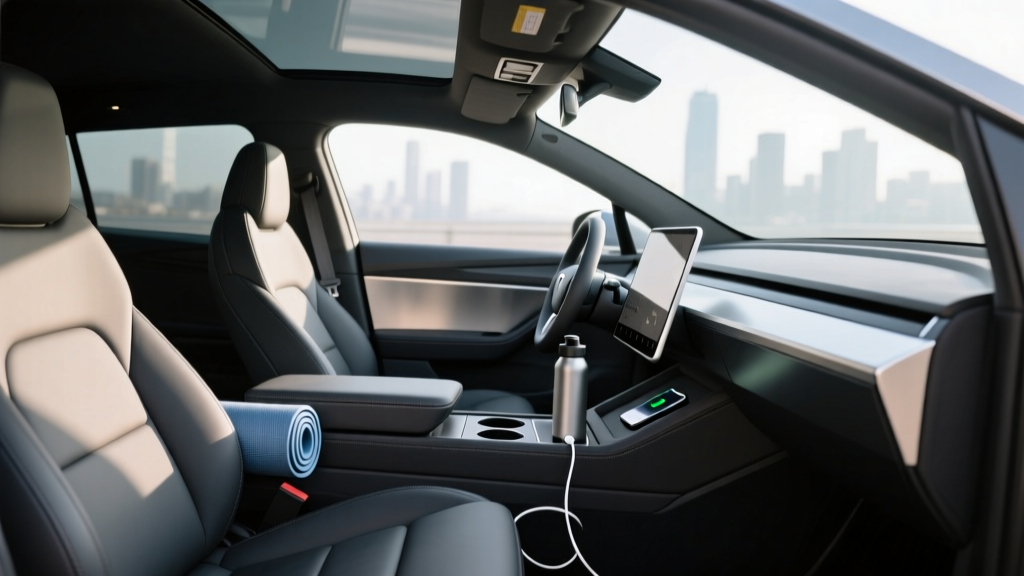
The Cybertruck seats five across two rows. Tesla does not publish official rear legroom or headroom figures in the traditional SAE J1100 format that legacy automakers use, but independent measurements and owner reports place rear legroom at approximately 38.5 inches and rear headroom around 37.0 inches. The rear bench is a flat, three-across design with a fixed 60/40 split-fold capability.
The seat cushion sits relatively flat and low, which benefits headroom given the Cybertruck's sloping roofline but means thigh support is moderate for taller passengers—those over 6 feet may find their knees slightly elevated on longer trips. The rear seatback angle is fairly upright (roughly 22 degrees from vertical), and unlike some full-size pickups, there is no recline adjustment. On the positive side, the flat floor (no transmission tunnel) makes the middle seat genuinely usable for an adult on short trips, a meaningful advantage over trucks with a pronounced driveshaft hump.
Rear Cargo Access and Behind-Seat Storage
Behind the rear bench, there is no traditional in-cabin storage area—the cabin ends abruptly at the rear wall, which is the front of the bed. This means all cargo goes into the 6-foot composite bed (approximately 67 cu ft of bed volume with the tonneau closed) or the front trunk (7.1 cu ft). The rear seats fold flat to extend bed-level cargo pass-through for longer items, though this eliminates rear passenger capacity.
For child-seat installation, the Cybertruck uses standard LATCH anchors on the two outboard rear positions. The upright seatback and relatively low cushion height can make rear-facing car-seat installation tight—a 6-foot driver may need to slide forward more than expected to accommodate a rear-facing infant seat.
Cybertruck Interior & Cargo Dimensions
| Measurement | Specification |
|---|---|
| Seating Capacity | 5 passengers (2 front + 3 rear) |
| Rear Legroom (approx.) | 38.5 in |
| Rear Headroom (approx.) | 37.0 in |
| Rear Shoulder Room | ~57 in |
| Bed Length | 72 in (6 ft) with tonneau |
| Bed Volume (closed) | 67 cu ft |
| Frunk Volume | 7.1 cu ft |
| Rear Seat Fold | 60/40 split, flat-fold |
Range, Battery, and Efficiency: What You Actually Get
The 2026 Tesla Cybertruck is offered in two main trims: the Dual Motor AWD and the Cyberbeast (tri-motor AWD). Both use a structural battery pack with an estimated usable capacity of approximately 123 kWh (gross pack capacity is higher). Tesla has not publicly confirmed the exact cell chemistry for the Cybertruck pack, but industry reporting and supply-chain evidence point to NMC (nickel manganese cobalt) cells, consistent with the energy density required for a vehicle of this mass.
EPA Range vs. Real-World Expectations
EPA Estimated Range:
- Dual Motor AWD: 340 miles (with range extender option: up to 470 miles)
- Cyberbeast (tri-motor): 320 miles (with range extender: up to 440 miles)
Real-World Caveats: The Cybertruck's brick-like aerodynamics (despite the angular design, its Cd is roughly 0.38) and 6,600–6,800 lb curb weight take a toll at highway speeds. Expect 270–300 miles on sustained 75 mph highway runs in moderate temperatures. In cold weather (below 32°F), range can drop 20–30%, bringing effective highway range to 220–250 miles without preconditioning. City driving with regenerative braking recovers some efficiency, often matching or slightly exceeding EPA estimates in stop-and-go traffic.
Efficiency is rated by the EPA at approximately 56 MPGe combined for the Dual Motor, translating to roughly 56–60 kWh per 100 miles—among the least efficient EVs on the market, a direct consequence of the truck's weight and frontal area. For comparison, the Ford F-150 Lightning achieves around 66–70 MPGe combined depending on trim.
Charging Speed: DC Fast Charging and Home Level 2
The Cybertruck uses the NACS (North American Charging Standard) connector natively—no adapter needed for Tesla Superchargers. It supports a peak DC fast-charge rate of up to 250 kW at V3 and V4 Supercharger stalls.
Cybertruck Charging Specifications
| Charging Level | Power / Rate | Speed / Time |
|---|---|---|
| DC Fast Charge (Supercharger V3/V4) | Peak 250 kW | 10–80% in ~25–30 minutes |
| Level 2 (Home Wall Connector, 48A) | 11.5 kW | ~37 miles of range per hour |
| Level 2 (Public, typical 7.2 kW) | 7.2 kW | ~23 miles of range per hour |
| Level 1 (120V household outlet) | ~1.4 kW | ~4–5 miles of range per hour |
Charging-curve reality check: The Cybertruck does not sustain 250 kW for the entire 10–80% window. Peak rate holds roughly from 10–35% SoC, then tapers progressively. Expect the final 60–80% segment to average closer to 100–120 kW, which is why the 10–80% time stretches to around 25–30 minutes rather than the ~18 minutes you might calculate from peak rate alone. The large 123 kWh battery means even moderate C-rates deliver substantial miles, but patience is required for the top half of the pack.
For home charging, Tesla's Wall Connector at 48 amps on a 240V/60A circuit adds roughly 37 miles per hour—enough to fully replenish a depleted pack overnight in about 10–12 hours. The Cybertruck's onboard charger supports up to 11.5 kW (48A); earlier reports of 80A capability have not materialized in production vehicles.
Performance and Drivetrain
The Cybertruck's performance is genuinely supercar-adjacent in the Cyberbeast trim, while the Dual Motor is still briskly quick for a 6,700-lb truck.
| Spec | Dual Motor AWD | Cyberbeast (Tri-Motor) |
|---|---|---|
| Drivetrain | Dual-motor AWD | Tri-motor AWD (torque vectoring rear) |
| Horsepower | 600 hp | 845 hp |
| 0–60 mph | 3.9 seconds | 2.6 seconds |
| Top Speed | 112 mph | 130 mph |
| Towing Capacity | 11,000 lbs | 11,000 lbs |
| Payload Capacity | 2,500 lbs | 2,500 lbs |
The tri-motor Cyberbeast uses a torque-vectoring rear axle (two independent rear motors) for sharper cornering and traction control. Both trims feature rear-wheel steering, adaptive air suspension with up to 12 inches of ground clearance in Off-Road mode, and a 48-volt electrical architecture (a first for a production Tesla) that enables steer-by-wire and reduces wiring harness weight.
Pricing, Tax Credit Eligibility, and Ownership Cost
The Cybertruck's pricing has been volatile since launch. As of the 2026 model year, approximate MSRPs are:
| Trim | Base MSRP (approx.) | As-Tested Typical |
|---|---|---|
| Dual Motor AWD | $79,990 | $85,000–$92,000 (with options) |
| Cyberbeast | $99,990 | $105,000–$115,000 (with options) |
Does the Cybertruck Qualify for the Federal EV Tax Credit?
This is where the Cybertruck faces significant headwinds under IRS §30D rules:
- MSRP Cap: The §30D credit caps eligibility at $80,000 MSRP for pickups, SUVs, and vans. The Dual Motor AWD at $79,990 technically squeaks under this cap, but any dealer-installed options or destination charges that push the MSRP above $80,000 will disqualify it.
- Cyberbeast: At $99,990 base, the Cyberbeast exceeds the MSRP cap and does not qualify for the $7,500 federal credit.
- Buyer Income Limits: Even for the Dual Motor, buyers must have modified adjusted gross income below $150,000 (single), $225,000 (head of household), or $300,000 (joint filing).
- Battery Sourcing: The credit also requires that critical minerals and battery components meet domestic-sourcing thresholds that tighten annually. Tesla's supply chain has largely met these requirements for its US-built vehicles, but buyers should verify current-year compliance via the IRS portal or fueleconomy.gov.
Point-of-sale transfer: If eligible, the $7,500 credit can be applied at the point of sale as a down-payment reduction, rather than waiting for a tax refund. This requires dealer registration with the IRS Energy Credits Online system.
Technology, Driver Assistance, and Standout Features
The Cybertruck interior is dominated by an 18.5-inch central touchscreen with a secondary 9.4-inch rear touchscreen for back-seat passengers—a notable feature for family use, giving rear riders control over climate and entertainment. The cabin uses a minimalist design language with vegan leather upholstery, acoustic glass, and a HEPA air filtration system (Bioweapon Defense Mode).
Key tech features include:
- Steer-by-wire: No physical connection between the yoke and the wheels; variable ratio steering adjusts with speed.
- Rear-wheel steering: Up to 10 degrees for a tighter turning radius (34.8 ft curb-to-curb, surprisingly compact for a full-size truck).
- Autopilot (standard): SAE Level 2 driver assistance with adaptive cruise control and lane-keeping. Full Self-Driving (Supervised) is a $8,000 add-on (or subscription), also Level 2—despite the name, the driver must remain fully engaged.
- Powershare: Vehicle-to-load (V2L) capability with up to 11.5 kW of onboard power output (two 120V bed outlets, two 120V cabin outlets, one 240V bed outlet)—enough to run power tools, a campsite, or partial home backup.
- Armor glass: Ultra-hard stainless-steel exoskeleton with shatter-resistant laminated glass.
⚠️ Driver Assistance Limitations
Neither Autopilot nor FSD (Supervised) is "self-driving." Both are SAE Level 2 systems requiring continuous driver supervision, hands-on-wheel (or torque detection), and eyes-on-road monitoring. The Cybertruck does not offer hands-free driving on mapped highways like GM's Super Cruise or Ford's BlueCruise. Misuse of FSD has been linked to NHTSA-investigated incidents. Treat these as advanced cruise-control and lane-centering aids, not autonomous systems.
Notable Drawbacks
The Cybertruck's angular design and stainless-steel panels create real ownership friction. The bed's composite material and tonneau mechanism are complex. The steer-by-wire system, while innovative, has a learning curve and limited feel feedback. Visibility out the rear is poor (the bed walls and tonneau block the rear window entirely), making the backup camera essential. The yoke-style steering wheel is polarizing and not adjustable for reach in all trims. Insurance costs run 20–40% higher than comparable full-size pickups due to repair complexity and parts cost.
Warranty Coverage
| Coverage | Term |
|---|---|
| Basic Vehicle Limited Warranty | 4 years / 50,000 miles |
| Battery & Drive Unit Warranty | 8 years / 120,000 miles (min 70% retention) |
| Rear-Wheel Steering / Steer-by-Wire | Covered under basic warranty (4yr/50k) |
| Roadside Assistance | 4 years / 50,000 miles |
Tesla's battery warranty guarantees at least 70% capacity retention over 8 years or 120,000 miles, whichever comes first. This is competitive with the industry standard (most automakers offer 8 years / 100,000 miles with a 70% threshold). Full battery-pack replacement out of warranty is estimated at $15,000–$20,000+ based on the large pack size, though real-world degradation data for the Cybertruck's specific pack is still maturing given the vehicle's late-2023 launch.
Who the Cybertruck Is For (and Who Should Look Elsewhere)
✅ Pros
- Supercar-level acceleration (2.6s Cyberbeast 0–60)
- 11,000-lb towing, 2,500-lb payload
- Excellent V2L / Powershare capability (11.5 kW output)
- Rear touchscreen for back-seat passengers
- Tight turning radius via rear-wheel steering
- Stainless-steel exoskeleton durability
❌ Cons
- Poor efficiency (56 MPGe, ~60 kWh/100mi)
- Real-world highway range falls well short of EPA
- Cyberbeast ineligible for $7,500 tax credit (MSRP cap)
- Rear-seat comfort is adequate, not exceptional—no recline, flat cushion
- High insurance premiums and repair complexity
- No rear visibility without camera; yoke steering is divisive
- 250 kW peak charge rate lags some competitors (Rivian R1T: 300+ kW on 2025+ models)
The Cybertruck suits: Tech-forward buyers who prioritize performance, V2L utility, and design statement over traditional truck practicality. It works as a commuter and light-towing vehicle for households that can charge at home and don't need best-in-class rear-seat luxury. The Cyberbeast variant is a performance toy that happens to have a bed.
Look elsewhere if: You need maximum rear-seat comfort for adults on long trips (the Rivian R1T or even a Ford F-150 Lightning Lariat offer more refined rear quarters), you want the lowest cost-per-mile efficiency, or you need guaranteed tax-credit eligibility regardless of options.
Competitor Comparison: Cybertruck vs. F-150 Lightning vs. Rivian R1T
| Spec | Cybertruck Dual Motor | F-150 Lightning (Ext. Range) | Rivian R1T Dual-Motor Max |
|---|---|---|---|
| EPA Range | 340 mi | 320 mi | 410 mi |
| 0–60 mph | 3.9 sec | ~4.0 sec | ~3.5 sec |
| Peak DC Charge | 250 kW | 150 kW (CCS) | 300+ kW (NACS) |
| Towing | 11,000 lbs | 10,000 lbs | 11,000 lbs |
| Rear Legroom | ~38.5 in | 43.6 in | 38.2 in |
| Base MSRP | $79,990 | $59,995 | $87,000 |
| Tax Credit Eligible | Yes (Dual Motor, if under $80k MSRP) | Yes (select trims) | Partial (sourcing dependent) |
The F-150 Lightning wins on rear-seat space (a true full-size crew cab), pricing, and traditional truck ergonomics. The Rivian R1T leads on range and charging speed but costs more. The Cybertruck's advantages are raw acceleration, V2L output, and the steer-by-wire turning circle—but its rear-seat comfort and efficiency lag behind.
Frequently Asked Questions
What is the real-world range of the Tesla Cybertruck?
The EPA rates the Dual Motor at 340 miles and the Cyberbeast at 320 miles. In real-world highway driving at 70–75 mph in moderate temperatures, expect 270–300 miles. Cold weather (below freezing) can reduce this to 220–250 miles without preconditioning. The optional range extender (a secondary battery pack in the bed) adds roughly 100+ miles to either trim but consumes bed space.
How fast does the Cybertruck charge at home and on the road?
On a Tesla Supercharger (V3/V4), the Cybertruck peaks at 250 kW and charges from 10–80% in approximately 25–30 minutes, though sustained rate tapers significantly above 50% SoC. At home on a 48-amp Level 2 Wall Connector, it adds about 37 miles of range per hour, taking roughly 10–12 hours for a full charge from near-empty.
Does the Cybertruck qualify for the $7,500 federal EV tax credit?
The Dual Motor AWD at $79,990 base MSRP may qualify if the final MSRP (including options and destination) stays at or below $80,000 and the buyer meets income limits ($150k single / $300k joint). The Cyberbeast at $99,990 does not qualify due to the MSRP cap. Battery-sourcing and critical-minerals requirements must also be met. Always verify current-year eligibility at IRS.gov or via the point-of-sale dealer portal.
Is the Cybertruck back seat comfortable for adults on long trips?
Adequate but not exceptional. The ~38.5 inches of legroom accommodates average-height adults, but the flat, low cushion provides limited thigh support, and the upright seatback lacks recline. For 2+ hour highway trips, passengers may shift frequently. It falls short of the F-150 Lightning's 43.6-inch rear legroom and more contoured bench. The rear 9.4-inch touchscreen is a nice distraction for passengers, though.
Is the Cybertruck worth buying vs. the F-150 Lightning or Rivian R1T?
It depends on priorities. Choose the Cybertruck if you want maximum performance, V2L capability, cutting-edge steer-by-wire tech, and design differentiation. Choose the F-150 Lightning if rear-seat space, traditional truck ergonomics, and lower pricing matter most. Choose the Rivian R1T if range (410 mi Max pack) and faster DC charging are your top concerns, and you're willing to pay a premium. For families specifically, the Lightning's superior rear-seat comfort and lower entry price make it the pragmatic choice.
What is the Cybertruck's battery warranty?
Tesla covers the Cybertruck battery and drive unit for 8 years or 120,000 miles, whichever comes first, with a minimum 70% capacity retention guarantee. The basic vehicle warranty is 4 years / 50,000 miles. Out-of-warranty battery replacement is estimated at $15,000–$20,000+ given the pack size.