Quick Verdict: The Cybertruck Dual Motor AWD at a Glance
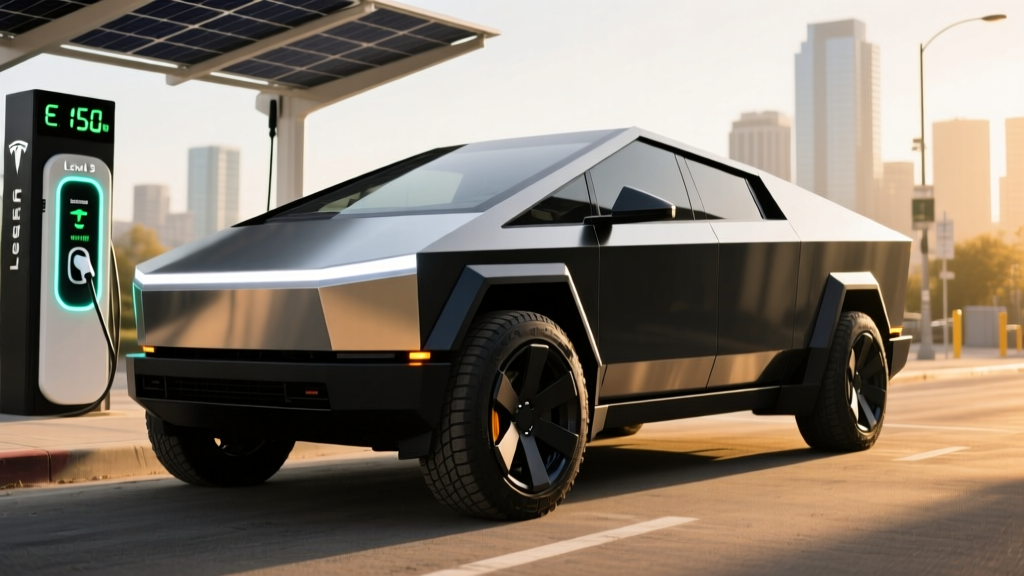
The Tesla Cybertruck Dual Motor All-Wheel Drive occupies a strange space in the 2026 electric truck market. It is simultaneously the most angular vehicle on American roads, one of the quickest pickups ever sold, and a daily-driver EV that largely delivers on its range promise — provided you understand the physics working against a 6,800-pound stainless-steel wedge. For buyers who need a full-size truck bed, want dual-motor traction in snow and rain, and can charge at home, the Dual Motor AWD trim is the volume play in the Cybertruck lineup. It undercuts the Cyberbeast on price while retaining the core 800-volt architecture, adaptive air suspension, and steer-by-wire system that define the platform.
But the Cybertruck Dual Motor AWD is not without compromise. Its efficiency drops noticeably at sustained highway speeds, rear-seat headroom is tighter than a Ford F-150 Lightning or Rivian R1T, and public charging compatibility still depends on whether you carry the included NACS-to-CCS adapter for non-Tesla networks. Below, we break down every spec that matters to a real buyer — not just the press-release highlights.
| Spec | Value |
|---|---|
| EPA Range | 340 miles |
| Battery (usable) | ~123 kWh (NMC) |
| Drivetrain | Dual Motor AWD |
| Horsepower | 600 hp (combined) |
| 0–60 mph | 3.9 seconds |
| Peak DC Fast Charge | 250+ kW (800V architecture) |
| 10–80% DC Charge Time | ~24 minutes |
| Level 2 Home Charge Rate | 11.5 kW / ~34 mi/hr |
| Efficiency | 58 MPGe / 58 kWh/100 mi |
| Towing Capacity | 7,500 lbs |
| Bed Length | 6 ft (72 in) |
| Cargo Volume (bed) | 67 cu ft |
| Base MSRP | $79,990 |
| Battery/Drive Unit Warranty | 8 years / 120,000 miles |
Range and Efficiency: EPA Sticker vs. Real-World Reality
The EPA rates the 2026 Cybertruck Dual Motor AWD at 340 miles of combined range. That figure is derived from the standard 5-cycle testing procedure on fueleconomy.gov, which blends city, highway, and temperature-adjusted loops. For a vehicle this heavy with a frontal area north of 40 square feet, 340 miles is a credible result — but it requires understanding where those miles come from.
- City / suburban mixed driving (65°F): 320–350 miles — regenerative braking recovers energy in stop-and-go traffic, and the low-speed aero penalty is minimal.
- Highway sustained at 75 mph (65°F): ~260–280 miles. The Cybertruck's flat-panel stainless steel body has a higher drag coefficient than a rounded unibody SUV, and at freeway speeds, aerodynamic drag dominates energy consumption.
- Cold weather (20°F, highway + city mix): ~220–260 miles. Lithium-ion batteries lose available capacity in the cold, the heat pump draws additional energy, and cabin heating loads are significant in a large cab. Tesla's heat pump is efficient, but physics is physics.
- Towing (5,000 lb trailer, 65 mph, flat terrain): ~150–180 miles. Expect to plan charging stops aggressively when towing near the truck's capacity.
Efficiency lands at approximately 58 MPGe (or 58 kWh per 100 miles), which trails the Rivian R1T Dual Motor (~70 MPGe) and the Ford F-150 Lightning Extended Range (~66 MPGe). The Cybertruck's weight and aerodynamics are the primary culprits. If your commute is mostly suburban at 45 mph, you'll beat the EPA number. If you drive 80 mph on I-70 across Kansas, you'll fall well short.
Charging Speed: 800V Architecture in Practice
The Cybertruck Dual Motor AWD uses an 800-volt electrical architecture, which allows higher charge power at lower current, reducing heat buildup and enabling thinner, lighter wiring harnesses. On a Tesla V4 Supercharger or any compatible 800V DC fast charger, the truck peaks above 250 kW and sustains strong charge rates through the middle of the battery's state-of-charge window.
| Charging Level | Max Power | Rate / Time | Notes |
|---|---|---|---|
| Level 1 (120V household) | ~1.4 kW | ~4 mi/hr | Emergency/trickle only; full charge takes 4+ days |
| Level 2 (240V, 48A home charger) | 11.5 kW | ~34 mi/hr / ~10 hrs for full | Standard Tesla Wall Connector; requires NEMA 14-50 or hardwired 60A circuit |
| DC Fast Charge (Tesla Supercharger V4) | 250+ kW | 10–80% in ~24 min | Peak rate held to ~60% SoC, then tapers; precondition battery via nav for best results |
| DC Fast Charge (CCS network w/ adapter) | Up to 250 kW | 10–80% in ~26–30 min | Requires included NACS-to-CCS adapter; speeds vary by Electrify America, EVgo station capability |
A critical ownership note: the Cybertruck uses the NACS (North American Charging Standard) connector natively. This means seamless plug-and-charge at all Tesla Supercharger stations — still the most reliable and geographically complete DC network in North America. For non-Tesla networks like Electrify America or EVgo, Tesla ships a NACS-to-CCS adapter, though charge initiation may require the station's app and can be slower due to handshake protocols.
The charge curve matters. The Cybertruck will pull its peak rate between roughly 10% and 55% state of charge. Above 80%, charging slows significantly to protect battery longevity — a 10–80% stop is ~24 minutes, but 80–100% adds another 30+ minutes. On road trips, plan to charge to 80% and move on.
Performance and Drivetrain: Dual Motor AWD Dynamics
The Dual Motor AWD pairs a permanent-magnet motor on the rear axle with an induction motor up front. Combined output is 600 horsepower, and Tesla's torque-vectoring system can shift power between axles in milliseconds. The result is a 0–60 mph time of 3.9 seconds — remarkable for a vehicle with a 6-foot bed and a gross weight approaching 9,000 pounds when loaded.
The steer-by-wire system eliminates the mechanical connection between the yoke (or optional round wheel) and the front wheels. Instead, sensors detect your input and electric actuators turn the wheels. The ratio is variable: at low speeds, the yoke requires less than a full turn lock-to-lock, making parking maneuvers manageable despite the truck's 223-inch length. At highway speeds, the ratio firms up for stability. Most owners adapt within a few days, though it remains a polarizing feature for traditional truck buyers.
Adaptive air suspension provides up to 16 inches of ground clearance in Off-Road mode and drops the ride height at highway speeds for improved aerodynamics. The system also enables self-leveling under load — useful when the bed is carrying 1,500+ pounds of payload. Towing capacity is rated at 7,500 pounds, competitive with the Rivian R1T but below the F-150 Lightning's 10,000-pound max when properly equipped.
Interior, Cargo, and Technology
The Cybertruck's cabin is minimalist in the extreme. A single 18.5-inch center touchscreen handles infotainment, climate, vehicle settings, and camera feeds. There is no traditional instrument cluster — speed and range data appear on the left third of the main display. The rear passengers get a 9.4-inch touchscreen for climate and media control.
Front legroom is generous at 41.5 inches, but rear legroom comes in at 34.7 inches — noticeably tighter than the F-150 Lightning (43.6 inches rear) and slightly behind the Rivian R1T (36.2 inches). Rear headroom is also compromised by the sloping roofline; taller passengers will notice it on longer trips. Seating is for five, though the rear bench is best suited for two adults and a child.
Cargo capacity breaks down as follows:
- Bed: 67 cu ft (6 ft long, 4 ft wide between wheel wells)
- Frunk (front trunk): 7.1 cu ft — lockable, drainable, useful for charging cables and groceries
- Sail pillars / vault: The powered tonneau cover rolls into the bed structure; the triangular sail pillars behind the cab house the 120/240V bed outlets and are not cargo-accessible
The bed features a powered ramp-style tailgate, integrated bed lighting, two 120V outlets and one 240V outlet (30A), and tie-down points. Tesla's "Vault" designation refers to the lockable, sealed bed with the tonneau deployed — it can hold gear securely, though it is not a traditional enclosed trunk.
On the technology front, the Cybertruck includes Tesla's latest hardware (HW4/AI4) for its Autopilot and Full Self-Driving (Supervised) driver-assistance systems. FSD Supervised remains a SAE Level 2 system — the driver must remain attentive with hands on the yoke and eyes on the road at all times. It is not autonomous driving. Autopilot with Traffic-Aware Cruise Control and Autosteer is standard; FSD Supervised is a $8,000 option or available as a monthly subscription.
Pricing, Trims, and Federal Tax Credit Eligibility
The 2026 Cybertruck Dual Motor AWD starts at $79,990 before options and destination. With common additions — FSD Supervised, Full-Width Light Bar, all-weather floor mats — an as-tested price of $88,000–$92,000 is typical. The Cyberbeast (tri-motor, 845 hp) starts at $99,990 and is a separate proposition for performance-focused buyers.
| Item | Amount |
|---|---|
| Base MSRP (Dual Motor AWD) | $79,990 |
| Destination Fee | $1,990 |
| FSD Supervised (optional) | $8,000 |
| Typical As-Tested Price | $88,000–$92,000 |
| IRS §30D Federal Tax Credit (max) | Up to $7,500* |
| Effective Price After Max Credit | ~$72,490 (base, before options) |
*Federal tax credit critical details: Under current IRS §30D rules (see irs.gov), the $7,500 credit requires meeting all of the following:
- MSRP cap: The vehicle's MSRP must not exceed $80,000 for pickups, vans, and SUVs. The base Dual Motor AWD at $79,990 clears this threshold, but adding options that push the MSRP above $80,000 may disqualify the credit. Confirm the final MSRP on the window sticker.
- Buyer income cap: Modified adjusted gross income must not exceed $150,000 (single), $225,000 (head of household), or $300,000 (joint filing).
- Battery sourcing: A percentage of critical minerals and battery components must be sourced from the U.S. or free-trade-agreement countries. These percentages increase annually. Verify current-year compliance on the manufacturer's disclosure or IRS guidance.
- Point-of-sale transfer: As of 2024, buyers can transfer the credit to the dealer at purchase, reducing the out-of-pocket cost immediately rather than waiting for tax filing.
The MSRP cap is the tightest constraint for the Cybertruck. The base Dual Motor AWD squeaks under the $80,000 pickup cap, but any factory-installed option package that pushes MSRP above that threshold will eliminate credit eligibility. Always confirm the final MSRP — not the negotiated price — on the Monroney label before assuming credit qualification. Consult a tax professional for your specific situation.
Pros, Cons, and Who Should Buy
- 340-mile EPA range is competitive for a full-size electric pickup
- 800V charging architecture delivers fast 10–80% stops (~24 min)
- 3.9-second 0–60 mph with dual-motor AWD traction
- Tesla Supercharger network remains the most reliable DC charging option
- Stainless steel exoskeleton requires no paint — no chips, no clear-coat failure
- 240V bed outlet enables job-site and camping power tools
- Adaptive air suspension with self-leveling under load
- Efficiency drops sharply at highway speeds (~260 mi real-world at 75 mph)
- Rear-seat legroom and headroom are below F-150 Lightning and Rivian R1T
- Steer-by-wire yoke is polarizing; optional round wheel costs extra
- MSRP barely clears the §30D $80,000 pickup cap — options can disqualify the credit
- Towing range is limited (~150–180 mi at 5,000 lbs) — plan charging carefully
- No Apple CarPlay or Android Auto; Tesla's native infotainment only
- Panel gaps and early build-quality issues have improved but remain a discussion point in owner forums
Who this EV suits best: The Cybertruck Dual Motor AWD is ideal for the tech-forward truck buyer who charges at home, commutes 40–80 miles daily, and values acceleration and design statement over traditional truck refinement. It works well as a daily driver with weekend adventure capability — kayaks, bikes, and camping gear fit the 6-foot bed and frunk. It is less suited for buyers who regularly tow heavy trailers long distances (range while towing is the Achilles' heel of every electric truck, and the Cybertruck's aero makes it worse) or those who prioritize rear-seat comfort for adult passengers on long trips.
Warranty and Long-Term Ownership
Tesla covers the Cybertruck's battery and drive units for 8 years or 120,000 miles, whichever comes first, with a minimum 70% capacity retention guarantee during that period. The limited vehicle warranty is 4 years / 50,000 miles. These terms are in line with the broader EV industry — Ford, Rivian, and GM offer similar 8-year battery coverage.
The Cybertruck uses NMC (nickel-manganese-cobalt) battery chemistry, which offers higher energy density than LFP (lithium iron phosphate) but is more sensitive to sustained high states of charge. Tesla recommends daily charging to 80–90% for NMC packs and reserving 100% charges for road trips. Long-term degradation data for the Cybertruck's specific pack is still accumulating as the earliest 2024 deliveries approach their second anniversary, but Tesla's historical fleet data across Model 3/Y suggests ~10–12% capacity loss at 100,000 miles with normal use.
Maintenance costs are low relative to internal-combustion trucks: no oil changes, no transmission fluid, no spark plugs. The primary consumables are tires (the Cybertruck uses 35-inch all-terrain tires that run $350–$500 each), wiper blades, cabin air filters, and brake fluid checks. Regenerative braking significantly extends brake pad life.
Frequently Asked Questions
What is the real-world range of the Tesla Cybertruck Dual Motor AWD?
The EPA rates it at 340 miles combined. In real-world driving, expect 320–350 miles in city/suburban conditions, 260–280 miles at sustained 75 mph highway speeds, and 220–260 miles in cold weather (below freezing). Towing a 5,000-pound trailer reduces range to approximately 150–180 miles.
How fast does the Cybertruck Dual Motor charge at home and on the road?
On a Level 2 home charger (11.5 kW), it adds about 34 miles per hour, with a full charge taking roughly 10 hours. On a DC fast charger (Tesla V4 Supercharger), it peaks above 250 kW and charges from 10–80% in approximately 24 minutes. Charging slows considerably above 80% SoC.
Does the Cybertruck Dual Motor AWD qualify for the federal EV tax credit?
The base MSRP of $79,990 falls just under the IRS §30D $80,000 cap for pickups, making it potentially eligible for up to $7,500. However, eligibility also depends on buyer income limits ($150K single / $300K joint), battery-critical-mineral sourcing requirements, and whether factory options push the MSRP above $80,000. Always verify on the Monroney label and consult IRS guidance or a tax professional.
Is the Cybertruck Dual Motor AWD worth buying over the F-150 Lightning or Rivian R1T?
It depends on priorities. The Cybertruck offers the quickest acceleration (3.9s 0–60), the most distinctive design, and access to the native Tesla Supercharger network. The F-150 Lightning offers more rear-seat space, higher towing capacity (up to 10,000 lbs), and a more conventional truck experience. The Rivian R1T delivers better efficiency, a more refined interior, and a quad-motor option for off-road enthusiasts, though at a higher price point. Choose the Cybertruck if design, performance, and Tesla's software ecosystem matter most.
What is the biggest drawback of owning the Cybertruck Dual Motor?
Highway efficiency is the most common complaint. The truck's angular shape and 6,800-pound curb weight mean real-world highway range falls well short of the 340-mile EPA figure. If your driving is predominantly long-distance highway, you'll plan more charging stops than a Model Y or even an F-150 Lightning owner. Secondary concerns include the polarizing steer-by-wire system and tight rear-seat packaging.
Is Tesla's Autopilot or FSD self-driving on the Cybertruck?
No. Both Autopilot and Full Self-Driving (Supervised) are SAE Level 2 driver-assistance systems. The driver must remain fully engaged, with hands on the yoke and eyes on the road, at all times. The system can manage steering, acceleration, and braking under supervision, but it does not make the Cybertruck autonomous. Only Level 4 services like Waymo operate without a human driver — and those are geofenced robotaxis, not consumer vehicles.