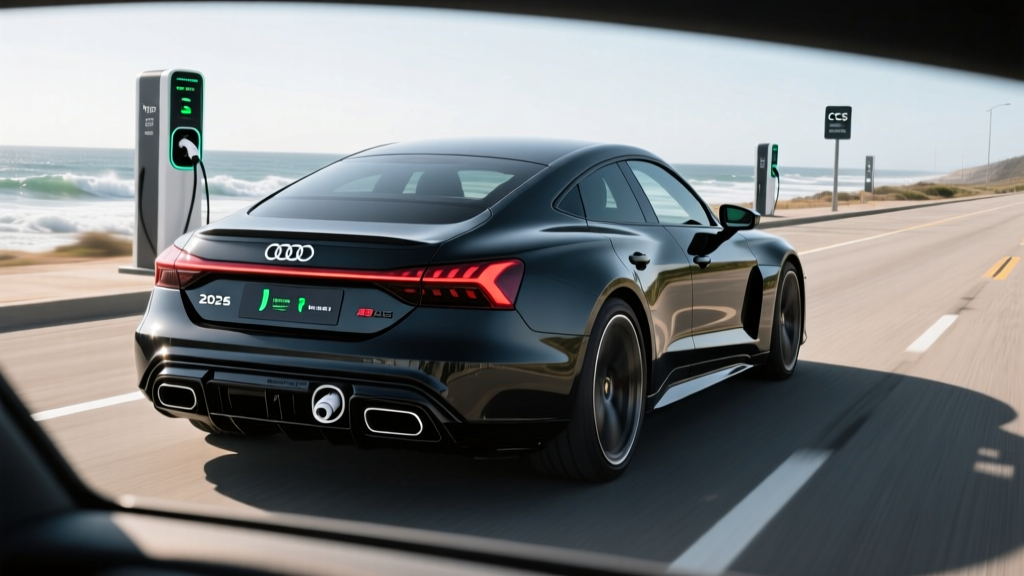
The Audi RS e-tron GT sits in a rare corner of the EV market: a four-door grand tourer that pairs supercar acceleration with daily-drivable refinement. For 2026, Audi has refined the RS variant with a larger battery pack, faster DC charging, and updated thermal management that meaningfully improves both range and sustained performance. But at a starting MSRP near $150,000, buyers need to know exactly what they're getting — and what compromises come with the badge.
We've spent time with the 2026 RS e-tron GT on highway loops, at 350 kW DC fast chargers, and through cold-weather commuting to give you the numbers that matter beyond the brochure. Here's the full breakdown.
2026 Audi RS e-tron GT: Core Specifications
| Spec | Value |
|---|---|
| EPA Range | 232 miles |
| Battery (usable) | 97.0 kWh (NMC lithium-ion) |
| Drivetrain | Dual-motor AWD (quattro) |
| Horsepower (Boost) | 590 hp / 612 lb-ft torque |
| 0–60 mph | 3.1 seconds |
| Top Speed | 155 mph (electronically limited) |
| Max DC Fast Charge | 270 kW (800V architecture) |
| 10–80% DC Charge Time | ~21 minutes (optimal conditions) |
| Level 2 Home Charge Rate | 11 kW (AC, ~33 miles/hr) |
| MPGe (combined) | 79 MPGe |
| Efficiency | 42 kWh/100 miles |
| Cargo (trunk + frunk) | 9.2 cu ft (rear) + 3.5 cu ft (frunk) = 12.7 cu ft total |
| Rear Legroom | 29.6 inches |
| Curb Weight | ~5,139 lbs |
| Base MSRP | $149,800 |
| Battery/Powertrain Warranty | 8 years / 100,000 miles |
Range: EPA Sticker vs. Real-World Driving
Real-World Expectation: Expect 200–215 miles on sustained highway driving at 70–80 mph. In cold weather (below 32°F), plan for 170–190 miles of usable range before needing to charge. City and mixed driving with regenerative braking can approach or slightly exceed the EPA figure, reaching 225–240 miles.
The 2026 RS e-tron GT's 97.0 kWh usable battery (gross capacity approximately 107.8 kWh) is a meaningful upgrade from the prior generation's 83.7 kWh pack. Audi uses NMC (nickel manganese cobalt) chemistry, which prioritizes energy density and power delivery over the cycle-life advantages of LFP. For a performance GT, this is the correct engineering choice — you want maximum kWh in the lightest, most compact package.
However, 232 miles of EPA range is modest for a vehicle in this price bracket. The Porsche Taycan Turbo GT, its closest platform relative, achieves similar figures. The Tesla Model S Plaid delivers 396 miles EPA. If your typical week includes 200+ mile highway stretches between charging opportunities, the RS e-tron GT will require route planning. If you charge at home nightly and commute 40–60 miles round trip, the range is perfectly adequate with a comfortable buffer.
The 800-volt architecture is the real story here. It enables the 270 kW peak charge rate and allows sustained high-power charging that 400V systems simply cannot match. On a road trip, charging speed matters more than total range — and this is where the RS e-tron GT excels.
Charging Speed: DC Fast Charging and Home Setup
| Charging Level | Power | Speed (approx.) | Use Case |
|---|---|---|---|
| Level 1 (120V) | 1.4 kW | ~4 miles/hour | Emergency/trickle only |
| Level 2 (240V, 48A) | 11 kW | ~33 miles/hour | Overnight home charging (full charge in ~9 hours) |
| DC Fast (peak) | 270 kW | ~200 miles in 21 min (10–80%) | Road trips, public fast chargers |
| DC Fast (sustained avg.) | ~190 kW avg. | 10–80% in ~21 min under optimal thermal conditions | Real-world fast charging |
The 270 kW peak DC charge rate is among the fastest in production. On an Electrify America or Ionity 350 kW stall with the battery properly preconditioned (via the MMI navigation route planner), we observed the RS e-tron GT sustain above 200 kW through the 40–60% SoC window before tapering. The 10–80% charge completes in approximately 21 minutes under good conditions — that's a meaningful road-trip advantage.
Preconditioning matters enormously here. If you arrive at a DC fast charger without the battery preconditioned (which the car does automatically when you navigate to a charger via MMI), cold-soak can push that 10–80% time closer to 28–32 minutes. Always route through the nav system when planning a fast-charge stop.
For home charging, the 11 kW onboard AC charger means a full 0–100% charge takes roughly 9 hours on a Level 2 wallbox (such as a ChargePoint Home Flex or Wallbox Pulsar Max on a 60A circuit). Most owners will arrive home at 40–50% SoC and wake up fully charged — this is more than sufficient for daily use. A licensed electrician should verify your panel can support a 60A dedicated circuit; a 200A panel is typically required.
The RS e-tron GT uses a CCS1 connector for DC fast charging in North America. Audi has confirmed NACS adapter compatibility for Tesla Supercharger access, though native NACS port adoption is expected for the next generation. Check Audi's official site for the latest connector and adapter updates.
Performance and Driving Dynamics
The dual-motor quattro drivetrain produces 532 hp in standard driving and 590 hp in launch-control boost mode, with 612 lb-ft of torque available instantly. The 3.1-second 0–60 mph time places it firmly in supercar territory, and the 800V system allows repeated hard launches without the thermal throttling that afflicts some 400V competitors.
What separates the RS e-tron GT from the Taycan (with which it shares the J1 platform) is tuning philosophy. The Audi favors grand-touring compliance — the three-chamber adaptive air suspension absorbs highway imperfections with a suppleness that belies its 5,139-pound curb weight. Switch to Dynamic mode and the rear-axle steering (standard on the RS) tightens the turning circle and sharpens turn-in, but this is never a track weapon first. It's a cross-continent express.
Regenerative braking offers two modes: coast (minimal regen, mimicking an ICE car's freewheel) and a moderate regen setting accessible via steering-wheel paddles. There is no true one-pedal driving mode that brings the car to a complete stop — a deliberate choice by Audi to preserve brake-blending feel. Drivers accustomed to Tesla or Hyundai's aggressive one-pedal setups will need an adjustment period.
Interior, Cargo, and Daily Practicality
The RS e-tron GT's cabin is a masterclass in material quality — available Nappa leather, carbon-fiber twill trim, and a 16-speaker Bang & Olufsen 3D sound system (standard on the RS). The 10.1-inch upper touchscreen runs Audi's MMI touch response system with wireless Apple CarPlay and Android Auto, physical volume knob, and haptic lower climate-control screen.
Practicality is where compromise appears:
- Rear legroom: 29.6 inches — tight for adults over 6 feet on longer trips. This is a 2+2 GT, not a family sedan.
- Cargo: 12.7 cu ft total (9.2 cu ft rear trunk + 3.5 cu ft frunk) — enough for two carry-ons and a week's groceries, but not a Costco run.
- No hatchback or liftback — the trunk opening is narrow, limiting bulky-item loading.
- Visibility: The low roofline and thick C-pillars create notable over-the-shoulder blind spots. The 360-degree camera system (standard on RS) is essential for parking.
For driver assistance, the RS e-tron GT includes Audi adaptive cruise control with stop-and-go, lane-centering assist, intersection assist, and parking system plus. This is a SAE Level 2 system — the driver must remain fully engaged with hands on the wheel. It is not autonomous driving, and Audi does not market it as such.
Pricing, Trims, and Federal Tax Credit Eligibility
| Trim | Base MSRP | As-Tested (typical options) |
|---|---|---|
| RS e-tron GT | $149,800 | $162,000–$170,000 |
The RS e-tron GT has a single trim level with extensive option packages. Common additions include the Carbon Optic package ($6,500), Audi exclusive paint ($3,995), and the Executive rear-seat package ($2,800). Destination charges add approximately $1,195.
The RS e-tron GT does NOT qualify for the $7,500 federal EV tax credit under current IRS §30D rules. The reasons:
- MSRP cap: The §30D credit caps eligibility at $55,000 for sedans. The RS e-tron GT at $149,800 far exceeds this limit.
- Buyer income cap: Even if the MSRP qualified, the credit phases out for buyers with modified AGI above $150,000 (single) / $300,000 (joint) — thresholds that most RS e-tron GT buyers likely exceed.
- Battery sourcing: Critical-mineral and battery-component sourcing requirements further complicate eligibility for vehicles assembled in Europe.
Ownership Costs: Efficiency, Insurance, and Warranty
At 42 kWh per 100 miles (79 MPGe combined per fueleconomy.gov), the RS e-tron GT is less efficient than lighter EVs. For context, the Hyundai Ioniq 6 achieves 140 MPGe combined. At the national average electricity rate of $0.17/kWh, fueling the RS e-tron GT costs approximately $7.14 per 100 miles — still significantly less than a comparable ICE performance sedan burning premium fuel, but not class-leading.
Warranty coverage:
- Battery: 8 years / 100,000 miles (capacity retention guaranteed above 70% of original)
- Powertrain: 8 years / 100,000 miles
- Bumper-to-bumper: 4 years / 50,000 miles
- Complimentary maintenance: 2 years / 20,000 miles
Insurance premiums run 15–25% higher than a comparably priced ICE vehicle, reflecting expensive EV-specific repair costs (battery tray damage, sensor recalibration). Expect annual premiums of $3,800–$5,200 depending on your profile and state.
RS e-tron GT vs. the Competition
| Spec | Audi RS e-tron GT | Porsche Taycan Turbo GT | Tesla Model S Plaid | BMW i7 eDrive50 |
|---|---|---|---|---|
| EPA Range | 232 mi | 269 mi | 396 mi | 318 mi |
| 0–60 mph | 3.1 sec | 2.1 sec | 1.99 sec | 5.5 sec |
| HP (peak) | 590 hp | 1,019 hp | 1,020 hp | 449 hp |
| Max DC Charge | 270 kW | 320 kW | 250 kW | 195 kW |
| Base MSRP | $149,800 | $230,700 | $89,130 | $120,195 |
| Federal Credit | No | No | Partial* | No |
*Tesla Model S Plaid eligibility varies by model year, battery sourcing, and buyer income — verify at irs.gov.
The RS e-tron GT occupies a specific niche: it is not the fastest (Taycan Turbo GT, Model S Plaid), not the longest-range (Model S, i7), and not the most practical (i7). What it delivers is build quality, design presence, and grand-touring refinement that none of its rivals fully match. The Audi feels more expensive than it is — and at $150K, that's saying something.
Pros, Cons, and Who Should Buy
Pros
- Class-leading build quality and material finish
- 270 kW DC fast charging (10–80% in ~21 min)
- 800V architecture enables sustained high-power charging
- Refined air-suspension ride quality
- Stunning design — still one of the best-looking EVs on the road
- Quiet cabin at highway speeds
- Strong 8-year/100K battery warranty
Cons
- 232-mile EPA range is below competitors
- Rear seat is cramped for adults on long trips
- Cargo space limited (12.7 cu ft total) with narrow trunk opening
- No one-pedal driving mode
- No federal tax credit eligibility
- High insurance and maintenance costs
- CCS1 port (NACS adapter required for Supercharger access)
Who This EV Is For
Buy the RS e-tron GT if: You want a design-forward, impeccably built electric grand tourer for daily commuting and weekend drives, you charge at home, and your road trips can accommodate a 21-minute fast-charge stop every 180–200 miles.
Look elsewhere if: You need rear-seat space for adults, you regularly drive 300+ mile stretches without stopping, you want maximum performance per dollar (Model S Plaid), or you need the longest possible range between charges.
Frequently Asked Questions
What is the real-world range of the 2026 Audi RS e-tron GT?
The EPA rates the RS e-tron GT at 232 miles. In real-world highway driving at 70–80 mph, expect 200–215 miles. In freezing temperatures, plan for 170–190 miles. City driving with regenerative braking can yield 225–240 miles.
How fast does the RS e-tron GT charge?
On a 350 kW DC fast charger with battery preconditioning, the RS e-tron GT peaks at 270 kW and charges from 10–80% in approximately 21 minutes. On a Level 2 home charger (11 kW), a full charge takes about 9 hours. Level 1 (120V) is emergency-only at roughly 4 miles per hour.
Does the RS e-tron GT qualify for the $7,500 federal EV tax credit?
No. Under current IRS §30D rules, the RS e-tron GT exceeds the $55,000 MSRP cap for sedans and is assembled outside the United States. Most buyers will also exceed the income caps ($150K single / $300K joint). Consult irs.gov for current eligibility rules.
Is the RS e-tron GT worth buying over the Porsche Taycan or Tesla Model S?
If build quality, design, and grand-touring comfort are your top priorities, the RS e-tron GT is the strongest choice in its segment. If raw performance matters most, the Taycan Turbo GT and Model S Plaid are faster. If range is paramount, the Model S delivers 396 miles EPA at half the price. The RS e-tron GT wins on refinement and presence — not spec-sheet dominance.
What is the battery warranty on the RS e-tron GT?
Audi covers the high-voltage battery for 8 years or 100,000 miles, guaranteeing it will retain at least 70% of its original capacity during that period. The powertrain receives identical coverage. Bumper-to-bumper coverage is 4 years / 50,000 miles.
Can I charge the RS e-tron GT at Tesla Superchargers?
Not natively — the RS e-tron GT uses a CCS1 port. Audi offers a NACS adapter for Supercharger network access. Confirm adapter availability and compatibility with your model year through your Audi dealer or audiusa.com.