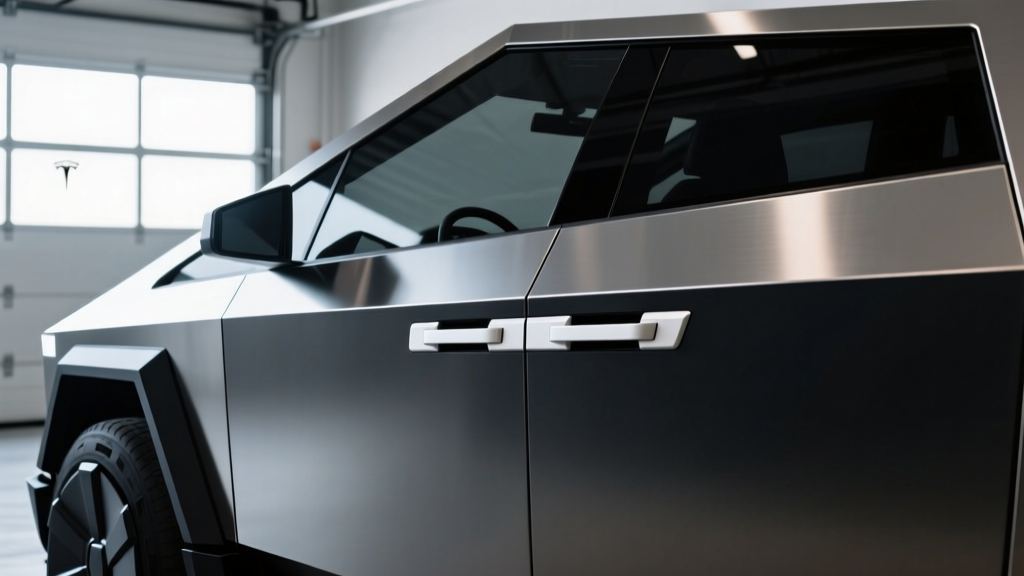
The Tesla Cybertruck has drawn attention for its angular stainless-steel exoskeleton, but one of the most debated design details is surprisingly small: the Cybertruck's door handles. Unlike traditional grab handles or even the pop-out handles on the Model S, the Cybertruck uses flush-mounted pull handles integrated into the window trim — a design choice that affects aerodynamics, usability, and cold-weather ownership in ways buyers should understand before signing a purchase agreement.
This review covers the Cybertruck's door-handle engineering in detail, then expands into the full ownership picture: EPA range, real-world efficiency, DC fast-charging performance, pricing, and federal tax-credit eligibility under current IRS §30D rules.
How Tesla Cybertruck Door Handles Actually Work
The Cybertruck eliminates conventional protruding door handles entirely. Instead, each door features a recessed pull handle built into the gap between the door panel and the window glass. To open a door:
- Press the top of the handle recess with your thumb
- Slide your fingers into the exposed channel
- Pull outward to unlatch and swing the door open
This flush design serves Tesla's aerodynamic priorities. The Cybertruck's sharp-edged stainless-steel body already pushes the boundaries of EV truck styling, and eliminating door-handle drag contributes to a lower coefficient of drag than a conventional truck with exposed handles. Tesla has not published an official Cd figure for the Cybertruck, but the flush handles, sealed bed gap, and flat underbody all work together to reduce air resistance at highway speeds.
Cold-Weather and Usability Considerations
The recessed handle design introduces a practical trade-off in freezing conditions. Ice can accumulate in the handle channel, particularly where the window meets the door panel. Tesla addresses this with the Tesla app's "Defrost Doors" feature, which activates the window heaters and handle-area warming to melt ice buildup. Owners in northern climates report that preconditioning the truck while plugged in largely mitigates handle-freezing issues, but it requires planning — you can't simply yank the door open if you forgot to precondition.
For buyers in regions with harsh winters, this is a genuine usability factor. The handles work well in dry, temperate conditions, but they demand more intentionality than a traditional truck handle when temperatures drop below 25°F.
Child Safety and Passenger Familiarity
First-time passengers often need instruction on how to open the Cybertruck's doors. The handle mechanism is intuitive once demonstrated, but it's not immediately obvious to someone approaching the vehicle. For families with young children, the recessed pull requires enough grip strength and coordination that smaller kids may need assistance — a minor but real consideration for school-dropoff duty.
Cybertruck Range, Battery, and Efficiency
The door handles are just one piece of the Cybertruck's design philosophy. The powertrain and battery are where ownership satisfaction gets determined. Here's what Tesla offers across the current Cybertruck lineup:
| Spec | Rear-Wheel Drive | All-Wheel Drive | Cyberbeast |
|---|---|---|---|
| EPA Range | 250 mi (est.) | 340 mi | 320 mi |
| Battery Capacity | ~100 kWh (usable est.) | ~123 kWh (usable est.) | ~123 kWh (usable est.) |
| Battery Chemistry | NMC | NMC | NMC |
| 0-60 mph | ~6.5 sec (est.) | 4.1 sec | 2.6 sec |
| Horsepower | ~350 hp (est.) | 600 hp | 845 hp |
| Drivetrain | Single motor RWD | Dual motor AWD | Tri-motor AWD |
| MPGe (Combined) | TBD (est. ~65) | ~64 MPGe | ~61 MPGe |
| Efficiency (kWh/100mi) | TBD | ~52 kWh/100mi | ~55 kWh/100mi |
The Cybertruck uses nickel-manganese-cobalt (NMC) battery chemistry, which offers higher energy density than lithium iron phosphate (LFP). This allows Tesla to pack more range into the truck's structural battery pack, but NMC cells are more sensitive to sustained high states of charge. Tesla recommends daily charging to 80–90% for NMC packs and 100% only before long trips.
Charging Speed: DC Fast and Home Level 2
Charging infrastructure is a make-or-break factor for truck owners who tow or road-trip regularly. The Cybertruck supports the North American Charging Standard (NACS) natively — no adapter needed — giving it direct access to Tesla's Supercharger network, which remains the most reliable DC fast-charging ecosystem in the U.S.
| Charging Level | Power / Rate | Speed | Notes |
|---|---|---|---|
| Level 1 (120V) | ~1.4 kW | ~3 mi/hr | Emergency/trickle only |
| Level 2 (240V, 48A) | 11.5 kW | ~28 mi/hr | Full charge in ~11-12 hours |
| DC Fast (peak) | 250 kW | 10–80% in ~30 min | Peak rate not sustained; tapers above 60% |
| DC Fast (sustained avg.) | ~150 kW avg. | ~130 mi in 30 min | Real-world average across the curve |
The Cybertruck peaks at 250 kW on V3 Superchargers, but that peak rate is short-lived. The large ~123 kWh battery pack means charging sessions take longer than smaller-battery EVs like the Model 3. Expect the charge curve to taper noticeably above 60% SoC. For road trips, the practical pattern is 15–20 minute stops at 10–60% rather than waiting to fill to 80%. Preconditioning the battery via navigation routing to a Supercharger is essential for achieving peak charge rates — skip preconditioning and you may see peak rates closer to 120–150 kW, especially in cold weather.
At home, a Level 2 Tesla Wall Connector at 48 amps delivers roughly 28 miles of range per hour of charging, or a full overnight charge in about 11–12 hours. Installation costs for a 240V/60A circuit typically range from $800 to $2,500 depending on panel proximity and whether a panel upgrade is needed (source: Tesla Home Charging).
Pricing, Trims, and Federal Tax Credit Eligibility
The Cybertruck's pricing has shifted since its initial announcement, and the current lineup reflects Tesla's adjustment to market demand. Here's where the trims stand for the 2025/2026 model year:
| Trim | Base MSRP | Federal Tax Credit (§30D) | Effective Price |
|---|---|---|---|
| Rear-Wheel Drive | $60,990 (est.) | Eligibility varies | Varies by buyer |
| All-Wheel Drive | $79,990 | Up to $7,500 | ~$72,490 |
| Cyberbeast | $99,990 | Up to $7,500 | ~$92,490 |
- MSRP Cap: Trucks/vans/SUVs must be under $80,000 MSRP. The AWD trim qualifies; the Cyberbeast ($99,990) does NOT qualify.
- Income Cap: Modified AGI ≤ $150,000 (single), ≤ $225,000 (head of household), ≤ $300,000 (joint filers).
- Battery Sourcing: Critical minerals and battery components must meet escalating domestic-content thresholds. Tesla's U.S. battery production generally satisfies current requirements, but always verify at fueleconomy.gov before purchasing.
- Point-of-Sale Transfer: Buyers can transfer the credit to the dealer at purchase for an immediate price reduction, or claim it on their tax return via Form 8936.
Consult a tax professional and the IRS clean vehicle credits page for your specific eligibility.
Cargo Space, Interior, and Daily Practicality
The Cybertruck is a full-size pickup, and its dimensions reflect that role:
- Bed length: 6 feet (72 inches)
- Bed cargo volume: ~67 cu ft (with tonneau cover closed)
- Frunk (front trunk): ~7 cu ft — lockable, drainable, useful for groceries or charging cables
- Rear-seat legroom: ~41 inches — adequate for adults on longer drives
- Seating capacity: 5 passengers (2 front, 3-across rear bench)
- Towing capacity: Up to 11,000 lbs (AWD and Cyberbeast)
- Payload capacity: Up to 2,500 lbs
The powered tonneau cover (called the "sail" by Tesla) is standard and locks automatically, providing secure enclosed storage. The stainless-steel bed doesn't require a liner, though Tesla offers an optional bed mat. The exoskeleton design eliminates a traditional B-pillar between the front and rear doors, creating a wide opening that makes loading car seats and gear easier than in conventional trucks.
Driver Assistance, Tech, and Standout Features
Tesla's Autopilot and Full Self-Driving (Supervised) are Level 2 driver-assistance systems. The driver must remain fully attentive, keep hands on the steering yoke, and be prepared to take over at any moment. These systems are NOT self-driving. Only Level 4 services like Waymo operate without a human driver.
The Cybertruck's technology suite centers on a 18.5-inch front touchscreen and a 9.4-inch rear touchscreen for passengers. Key features include:
- Autopilot: Standard adaptive cruise control and lane-keeping assist
- Full Self-Driving (Supervised): $8,000 option or $99/month subscription — adds automatic lane changes, traffic-light recognition, and navigate-on-autopilot. Still requires active driver supervision.
- Steer-by-wire: The Cybertruck uses a fully electronic steering system with no mechanical connection between the yoke and wheels. This enables variable steering ratios — less than one full turn lock-to-lock — but takes adjustment for drivers accustomed to traditional steering.
- 48-volt electrical architecture: An industry-first for a production vehicle, reducing wiring harness weight and enabling higher-power accessories.
- Bioweapon Defense Mode: HEPA air filtration system
- Powershare: Vehicle-to-load (V2L) capability — power tools, appliances, or a home during outages via bed outlets and the charge port adapter.
Pros and Cons
- Stainless-steel exoskeleton resists dents and eliminates paint maintenance
- 340-mile EPA range (AWD) is competitive for a full-size truck
- Native NACS access to Tesla Supercharger network — best charging reliability
- 11,000-lb towing and Powershare V2L make it a genuine work truck
- Steer-by-wire provides remarkably tight turning radius for a large truck
- Cyberbeast's 2.6-second 0-60 is supercar territory in a pickup
- Flush door handles are problematic in ice without preconditioning
- Highway efficiency is poor — ~52 kWh/100mi means frequent stops on road trips
- Cyberbeast trim exceeds the $80,000 §30D MSRP cap — no tax credit
- Steer-by-wire and yoke steering require a steep learning curve
- Rear visibility is limited; relies heavily on camera feeds
- Stainless-steel panels show fingerprints and are difficult to repair if dented
- No Apple CarPlay or Android Auto — Tesla's ecosystem only
Who Should Buy the Cybertruck?
- You need a full-size truck for towing (up to 11,000 lbs) and want EV operating costs
- You have home Level 2 charging and use the truck primarily within 200 miles of home
- You value the Supercharger network for road trips over CCS-based competitors
- You want Powershare V2L for job-site power or home backup
- Performance is the priority and budget allows a ~$100,000 truck
- You accept that the $80K+ MSRP disqualifies it from the federal tax credit
- You live in a region with harsh winters and can't always precondition (door-handle ice buildup)
- You need proven long-term reliability data — the Cybertruck is still early in its production lifecycle
- You prefer conventional steering feel over steer-by-wire
Cybertruck vs. Key Competitors
| Spec | Cybertruck AWD | Ford F-150 Lightning (Ext. Range) | Rivian R1T (Dual-Motor Max) |
|---|---|---|---|
| EPA Range | 340 mi | 320 mi | 410 mi |
| Base MSRP | $79,990 | ~$76,995 | ~$99,000 |
| §30D Credit Eligible | Yes (AWD) | Yes | Varies by MSRP |
| Max DC Charge kW | 250 kW | 150 kW | 200+ kW |
| Towing Capacity | 11,000 lbs | 10,000 lbs | 11,000 lbs |
| Bed Length | 6 ft | 5.5 ft | 4.5 ft (+ Gear Tunnel) |
The F-150 Lightning remains the most conventional truck-to-EV transition, with familiar ergonomics and traditional door handles. The Rivian R1T offers superior range with the Max Pack and a more refined interior, but at a higher price. The Cybertruck wins on Supercharger network access, steer-by-wire maneuverability, and the stainless-steel body's durability — but loses on highway efficiency and first-passenger usability.
Frequently Asked Questions
What is the real-world range of the Cybertruck?
The AWD Cybertruck carries a 340-mile EPA rating. Real-world highway driving at 75 mph yields approximately 270–290 miles. In cold weather below 30°F, expect 220–250 miles of practical range. The truck's heavy stainless-steel body and large frontal area hurt highway efficiency compared to lighter EVs.
How fast does the Cybertruck charge?
On a V3 Supercharger, the Cybertruck peaks at 250 kW and charges from 10–80% in roughly 30 minutes, though the sustained average is closer to 150 kW due to charge-curve taper. At home on a Level 2 Tesla Wall Connector (48A/11.5 kW), a full charge takes about 11–12 hours. Always precondition via navigation routing for optimal DC charge speeds.
Does the Cybertruck qualify for the federal EV tax credit?
The AWD trim ($79,990 MSRP) qualifies for up to $7,500 under IRS §30D, provided the buyer meets income caps (≤$150K single, ≤$300K joint) and the battery sourcing requirements are met. The Cyberbeast ($99,990) exceeds the $80,000 MSRP cap for trucks and does NOT qualify. Verify current eligibility at fueleconomy.gov and with a tax professional.
Are the Cybertruck's door handles a problem?
In normal conditions, the flush pull handles work well and contribute to the truck's aerodynamic profile. In freezing weather, ice can accumulate in the handle channel, requiring preconditioning via the Tesla app to clear. This is the most common usability complaint from cold-climate owners and a real consideration for buyers in northern states.
Is the Cybertruck worth buying vs. the F-150 Lightning or Rivian R1T?
It depends on your priorities. The Cybertruck wins on Supercharger access, unique design, and V2L Powershare capability. The F-150 Lightning offers a more familiar truck experience with traditional door handles and strong dealer support. The Rivian R1T provides the longest range (410 mi with Max Pack) and a more premium interior. If you value the Tesla charging ecosystem and can accept the door-handle trade-offs, the Cybertruck AWD is a compelling choice.
What is the Cybertruck's warranty coverage?
Tesla provides a 4-year/50,000-mile limited vehicle warranty and an 8-year/120,000-mile battery and drive unit warranty with a minimum 70% capacity retention threshold. This is competitive with the Ford F-150 Lightning's 8-year/100,000-mile battery warranty and the Rivian R1T's 8-year/175,000-mile battery warranty (for Max Pack). Always confirm current warranty terms with Tesla at purchase.