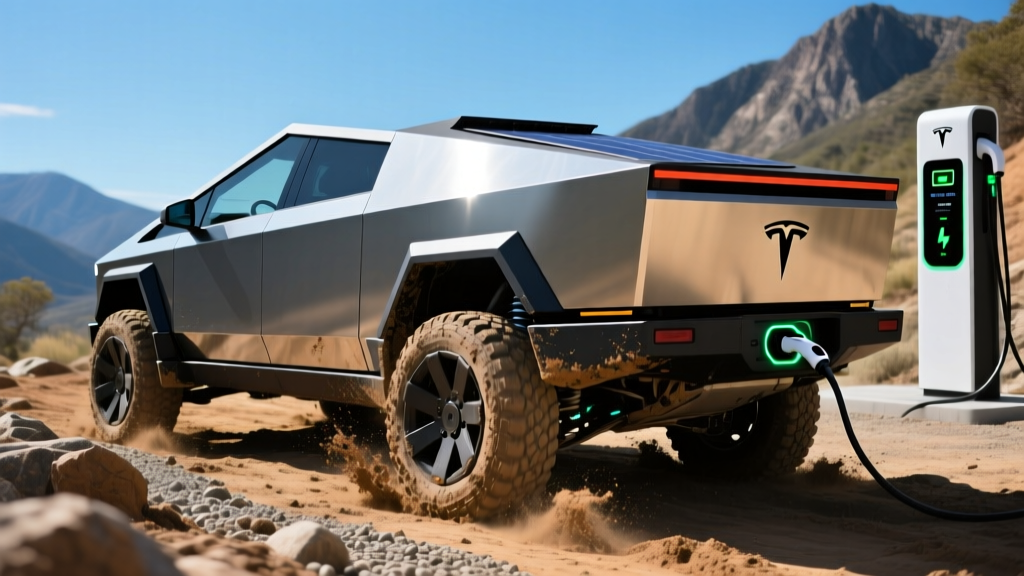
The Tesla Cybertruck Cantrail is the off-road-oriented trim in Tesla's electric pickup lineup, adding adaptive air suspension with extended ride height, all-terrain tires, underbody armor, and a rear locker-style torque-vectoring setup to the dual-motor AWD platform. For buyers who plan to take their EV truck beyond pavement — overlanding, forest service roads, or winter mountain passes — the Cantrail attempts to answer whether a stainless-steel electric pickup can actually handle trail duty without sacrificing the daily-driver efficiency and charging speed that make EVs practical.
This review breaks down the Cybertruck Cantrail's real-world range (which differs meaningfully from the EPA sticker once you add all-terrain rubber and elevation), its 800-volt charging architecture, towing and cargo practicality, and whether the federal EV tax credit applies to this specific trim under current IRS §30D rules.
Cybertruck Cantrail Specs at a Glance
| Spec | Value |
|---|---|
| EPA Estimated Range | 325 miles |
| Battery Capacity (Usable) | ~123 kWh (NMC, 4680 cells) |
| Drivetrain | Dual-Motor AWD |
| Horsepower | 600 hp (combined) |
| 0–60 mph | 3.9 seconds |
| Peak DC Fast Charge | 250 kW (V3 Supercharger); up to 350 kW on compatible 800V networks |
| 10–80% DC Charge Time | ~28 minutes (V3 Supercharger) |
| Level 2 Home Charge Rate | 11.5 kW (~37 miles/hr) |
| Efficiency (EPA Combined) | 2.4 kWh/mi (~42 MPGe) |
| Towing Capacity | 11,000 lbs |
| Payload | 2,500 lbs |
| Bed Length | 6 ft (72 in) |
| Cargo Volume (Bed) | ~67 cu ft |
| Ground Clearance (Max) | 17.4 in (Extract Mode) |
| Base MSRP | $99,990 |
| Battery/Drive Unit Warranty | 8 years / 120,000 miles |
Real-World Range: What the EPA Sticker Doesn't Tell You
The EPA rates the Cybertruck Cantrail at 325 miles of combined range. That figure is derived from the standard dual-motor AWD Cybertruck platform, but the Cantrail's all-terrain tires, increased ride height, and added underbody armor introduce real-world penalties that buyers should budget for.
EPA Sticker: 325 miles
Highway (70 mph, mild weather): ~270–285 miles
Mixed driving (city + highway): ~290–305 miles
Cold weather (below 32°F, highway): ~220–250 miles
Off-road/trail driving (low speed, high torque, elevation): ~180–240 miles depending on terrain
While towing (7,000+ lb trailer, flat terrain): ~150–180 miles
The Cybertruck's angular stainless-steel exoskeleton creates a high drag coefficient (estimated ~0.38–0.40 Cd), which hits highway efficiency harder than a more aerodynamic EV like the Rivian R1T. At 70 mph, you'll see roughly 2.6–2.8 kWh/mi on the energy display — well above the EPA combined rating. Add cold-weather battery preconditioning overhead and cabin heating, and a winter road trip requires planning around 220–250 miles of usable range per charge.
For trail use specifically, the Cantrail's low-speed, high-torque crawling draws significant current. On a moderate forest service road with elevation gain, expect to consume energy at 3.0–3.5 kWh/mi. This isn't a range-crisis scenario if you're doing 20 miles of trail and returning to a charger — but it means a 60-mile out-and-back trail run will consume roughly 30–40% of your battery.
The Cantrail uses Tesla's 4680-format NMC (nickel manganese cobalt) cells manufactured at Giga Texas. NMC chemistry offers higher energy density than LFP (lithium iron phosphate), which is critical for fitting ~123 kWh of usable capacity into the Cybertruck's structural battery pack. The trade-off: NMC degrades slightly faster over high-mileage use and is more sensitive to sustained 100% state-of-charge storage. Tesla recommends daily charging to 80–90% and only charging to 100% before long trips.
Charging Speed: 800V Architecture and the Supercharger Network
The Cybertruck Cantrail supports Tesla's 800-volt electrical architecture, which enables faster charging on compatible infrastructure. Here's what that translates to in practice:
| Charging Level | Power (kW) | Miles Added per Hour | Notes |
|---|---|---|---|
| Level 1 (120V household) | ~1.4 kW | ~3–4 mi/hr | Emergency/top-up only; full charge takes days |
| Level 2 (240V, 48A home charger) | 11.5 kW | ~37 mi/hr | Full charge in ~11 hours; overnight ready |
| DC Fast (Tesla V3 Supercharger) | 250 kW peak | ~180 mi in 15 min | 10–80% in ~28 min; tapers above 80% |
| DC Fast (800V-capable stations) | Up to 350 kW peak | ~210 mi in 15 min | Requires NACS-equipped 350 kW charger; limited availability |
| DC Fast (CCS via adapter) | Up to 150–250 kW | Varies | Tesla CCS adapter sold separately; useful for Electrify America, EVgo |
A critical detail for real-world charging: the Cybertruck's charge curve peaks early and tapers aggressively. You'll hit 250 kW between 10–30% state of charge, then the rate steps down to ~180 kW through 50%, ~120 kW at 70%, and drops below 50 kW past 85%. This means the 10–80% time of ~28 minutes is realistic, but charging from 80–100% adds another 25–30 minutes. On road trips, plan to charge in the 10–80% window and skip topping off unless you need the final miles.
For home charging, a 48-amp Level 2 wall connector on a 60-amp circuit delivers 11.5 kW — enough to add ~37 miles per hour or fully recharge overnight. If your electrical panel is 100 amps, you may need a panel upgrade (typically $1,500–$3,000) to support a dedicated 60-amp EV circuit alongside existing household loads. Consult a licensed electrician for a load calculation before installation.
Performance, Towing, and Trail Capability
The Cantrail's dual-motor AWD powertrain produces 600 hp and delivers a 3.9-second 0–60 mph time — quick for a 6,800+ lb pickup. The instant torque delivery (no transmission lag) makes it feel faster than the number suggests, particularly in stoplight-to-stoplight driving and trail crawling where low-end grunt matters more than top speed.
The Cantrail-specific upgrades over the standard AWD trim include:
- Adaptive air suspension: Adjustable from 10.1 inches (standard) to 17.4 inches (Extract Mode) for rock crawling or deep snow
- All-terrain tires: 35-inch Goodyear Wrangler Territory AT on 20-inch wheels (standard Cybertruck uses 20/22-inch all-season)
- Underbody armor: Full-length stainless steel skid plates protecting battery pack and drive units
- Rear electronic locker: Torque-vectoring rear differential for low-traction scenarios
- Approach/departure/breakover angles: 35°/33°/25° in Extract Mode
- Wade depth: Up to 33 inches (with caution — EV battery sealing is rated IP67 but repeated submersion isn't recommended)
Towing capacity is rated at 11,000 lbs, matching the standard dual-motor Cybertruck. However, towing at or near max capacity cuts range roughly in half — expect 150–180 miles on a full charge with a 7,000+ lb trailer on flat terrain, less with elevation gain. The integrated trailer brake controller and Tesla's trailer sway mitigation software work well, but the Cybertruck's steer-by-wire system can feel overly sensitive when trailering at highway speed. Allow time to adapt to the steering ratio before towing long distances.
Pricing, Tax Credits, and Total Cost
| Item | Amount |
|---|---|
| Base MSRP (Cantrail AWD) | $99,990 |
| Destination Fee | $1,995 |
| As-Tested (with Full Self-Driving, armor package) | ~$109,485 |
| Federal Tax Credit (§30D) | See eligibility below |
| Estimated Annual Insurance | $2,800–$3,600 (varies by state/driver) |
The Cybertruck Cantrail's $99,990 base MSRP places it above the IRS §30D MSRP cap for trucks, which is $80,000. This means the Cantrail trim does not qualify for the $7,500 federal new EV tax credit under current rules. The lower-priced Cybertruck AWD (base MSRP ~$79,990) may qualify, but only if the buyer meets income thresholds and the vehicle's battery components and critical minerals satisfy domestic-sourcing requirements.
For reference, §30D eligibility requires:
- MSRP cap: ≤$80,000 for trucks/vans/SUVs; ≤$55,000 for sedans
- Buyer income cap: AGI ≤$300,000 (joint), $225,000 (head of household), $150,000 (single)
- Battery sourcing: Increasing percentages of critical minerals and battery components must be sourced from the US or FTA-partner countries (percentages escalate annually through 2032)
- Point-of-sale transfer: Eligible buyers can transfer the credit to the dealer at purchase, reducing the out-of-pocket price immediately
Always verify current-year eligibility on IRS.gov §30D guidance and consult a tax professional before relying on credit availability. Rules change annually, and battery-sourcing compliance varies by production batch.
On the ownership-cost side, the Cantrail's efficiency of ~2.4 kWh/mi translates to roughly $0.09–$0.12 per mile at the US average residential electricity rate of $0.16/kWh. Compare that to a gas truck averaging 18 mpg at $3.50/gallon ($0.19/mile), and the per-mile fuel savings are meaningful — approximately $1,000–$1,500 annually for a 15,000-mile driver. However, insurance premiums for the Cybertruck run 30–50% higher than comparable gas pickups due to repair costs for the stainless-steel body and specialized parts availability.
Interior, Tech, and Daily Livability
The Cybertruck Cantrail's interior is minimalist in the way Tesla products tend to be — a single 18.5-inch front touchscreen handles infotainment, climate, vehicle settings, and off-road telemetry. A rear 9.4-inch screen serves passengers. There are no physical buttons for climate or audio; everything routes through the touchscreen, which is a love-it-or-hate-it design choice.
Cargo and passenger space:
- Front legroom: 41.5 inches
- Rear legroom: 38.2 inches (adequate for adults on shorter trips; tight for 6-foot+ passengers on long drives)
- Bed length: 72 inches (6 ft) with the motorized tonneau cover closed
- Bed cargo volume: ~67 cu ft
- Frunk (front trunk): ~7.1 cu ft — useful for charging cables and small gear
- Sail-pillar constraint: The Cybertruck's angular C-pillars create a narrow bed opening; loading wide items (plywood, ATVs) requires measuring carefully before purchase
The Cantrail's standout tech features include:
- Off-road telemetry display: Real-time pitch/roll angles, individual wheel torque distribution, suspension travel, and compass/altimeter on the main screen
- Wade mode: Seals battery ventilation and raises suspension for water crossings
- Camp mode with Powershare: The Cybertruck's 120V/240V bed outlets (up to 9.6 kW continuous output) can power camp appliances, tools, or even provide backup home power during outages via a Tesla Powerwall integration
- Autopilot (standard): SAE Level 2 adaptive cruise and lane centering; requires continuous driver supervision
- Full Self-Driving Supervised (optional, ~$8,000): Still SAE Level 2 — not autonomous. Handles highway on/off-ramps and some city streets but demands full driver attention. Do not confuse with Level 4 robotaxi services like Waymo.
Notable drawbacks specific to the Cantrail trim:
- Ride quality: The all-terrain tires generate noticeable road noise at highway speed, and the stiffer off-road suspension tuning transmits more road imperfections than the standard AWD trim
- Visibility: The angular greenhouse and thick sail pillars create significant blind spots; the camera-based mirror system (if equipped) helps but has a learning curve
- Washer fluid access: The frunk-mounted fill port is awkward to reach — a minor but recurring annoyance
- Service network: Cybertruck body repairs require specialized Tesla service centers; rural owners may face 100+ mile tows for collision damage
- Genuine off-road capability with 17.4" ground clearance and locking rear diff
- 9.6 kW Powershare vehicle-to-load for tools, camping, backup power
- 11,000-lb towing with integrated trailer brake controller
- Over-the-air updates continuously add features
- Stainless steel body resists dents and corrosion
- Access to Tesla Supercharger network (most reliable DC fast-charging in the US)
- $99,990 MSRP exceeds §30D tax credit cap — no $7,500 federal credit
- Real-world range drops to 150–180 mi while towing
- All-terrain tire noise on highway; stiffer ride than standard trim
- Narrow bed opening limits wide cargo loading
- Steer-by-wire sensitivity takes adaptation, especially while towing
- Insurance premiums 30–50% higher than comparable gas trucks
Who the Cybertruck Cantrail Is For
The Cantrail makes sense for a specific buyer: someone who wants a daily-drivable electric pickup that can handle genuine off-road duty on weekends — overlanding trips, forest service roads, ski-area access roads, or rural property maintenance. It's not a dedicated rock crawler, and it's not the most efficient highway cruiser. It's a compromise that leans into capability.
If your primary use case is highway commuting and occasional light gravel roads, the standard Cybertruck AWD (lower MSRP, better range, potential tax credit eligibility) is a more rational choice. If you need maximum towing range for commercial use, a diesel truck still outperforms any EV on long-haul towing. But if you want to tow a camper 120 miles to a trailhead, spend the weekend off-grid with Powershare running your camp, and drive home on a single charge — the Cantrail occupies a niche no other EV currently fills.
Cybertruck Cantrail vs. Rivian R1T Tri-Motor
The direct competitor is the Rivian R1T in its Tri-Motor Adventure or Ascend configuration. The R1T offers comparable off-road hardware (adaptive air suspension, quad-motor torque vectoring, ~14.9 inches of ground clearance), a more conventional pickup bed design (wider opening, 54-inch bed with gear tunnel), and a slightly lower starting price for equivalent performance trims. The R1T's real-world range with the Max Pack (~410 miles EPA) exceeds the Cybertruck Cantrail, and Rivian's build quality and interior materials are generally regarded as more refined.
Where the Cybertruck wins: Supercharger network access (still the most reliable DC fast-charging network in the US, though Rivian now has NACS adapter access), the 9.6 kW Powershare output (Rivian offers ~3.5 kW), and the stainless steel body's dent resistance. If you prioritize charging infrastructure reliability and vehicle-to-load power output, the Cybertruck has the edge. If you prioritize range, interior quality, and bed practicality, the R1T is the stronger pick.
Frequently Asked Questions
What is the real-world range of the Cybertruck Cantrail?
The EPA rates it at 325 miles, but real-world highway driving yields 270–285 miles, cold-weather highway driving drops to 220–250 miles, and off-road trail use can reduce range to 180–240 miles depending on terrain and elevation. Towing a 7,000+ lb trailer cuts range to 150–180 miles.
How fast does the Cybertruck Cantrail charge?
On a Tesla V3 Supercharger (250 kW peak), expect 10–80% in approximately 28 minutes. On compatible 800V stations, peak rates can reach 350 kW, reducing 10–80% to ~22 minutes. At home on a 48-amp Level 2 charger (11.5 kW), a full charge takes ~11 hours, adding ~37 miles per hour of charging.
Does the Cybertruck Cantrail qualify for the federal EV tax credit?
No — the Cantrail's $99,990 MSRP exceeds the IRS §30D cap of $80,000 for trucks. The lower-priced Cybertruck AWD trim (~$79,990 MSRP) may qualify, subject to buyer income limits, battery-sourcing requirements, and annual rule changes. Verify on IRS.gov before purchasing.
Is the Cybertruck Cantrail worth buying over the Rivian R1T?
It depends on priorities. The Cantrail wins on Supercharger network access, Powershare output (9.6 kW vs ~3.5 kW), and stainless steel durability. The R1T wins on real-world range (especially with the Max Pack), interior refinement, and bed practicality. Test-drive both before deciding.
Can the Cybertruck Cantrail tow a travel trailer long distances?
Yes, with planning. At 11,000 lbs max capacity, it can handle most travel trailers. However, towing at 7,000+ lbs reduces range to 150–180 miles per charge. For 300+ mile towing trips, you'll need multiple Supercharger stops — and not all Supercharger stalls are configured for pull-through towing. Use Tesla's in-navigation trip planner with the trailer profile enabled.
What is the battery warranty on the Cybertruck Cantrail?
Tesla covers the battery pack and drive units for 8 years or 120,000 miles (whichever comes first), with a minimum 70% capacity retention threshold. If the battery degrades below 70% within the warranty period, Tesla will repair or replace it at no cost. NMC chemistry typically retains 85–90% capacity at 100,000 miles under normal use (daily charging to 80–90%, avoiding prolonged 100% storage).
Is Full Self-Driving (FSD) actually self-driving?
No. Tesla's FSD (Supervised) is an SAE Level 2 driver-assistance system. It can handle highway lane changes, on/off-ramps, and some city streets, but the driver must remain fully attentive and ready to take over at any moment. It is not autonomous. Only Level 4 services like Waymo (operating in limited metro areas) qualify as driverless. Never treat FSD as a substitute for active driving.
Sources: Tesla Cybertruck specifications, IRS §30D Clean Vehicle Credit guidance, EPA Fuel Economy.