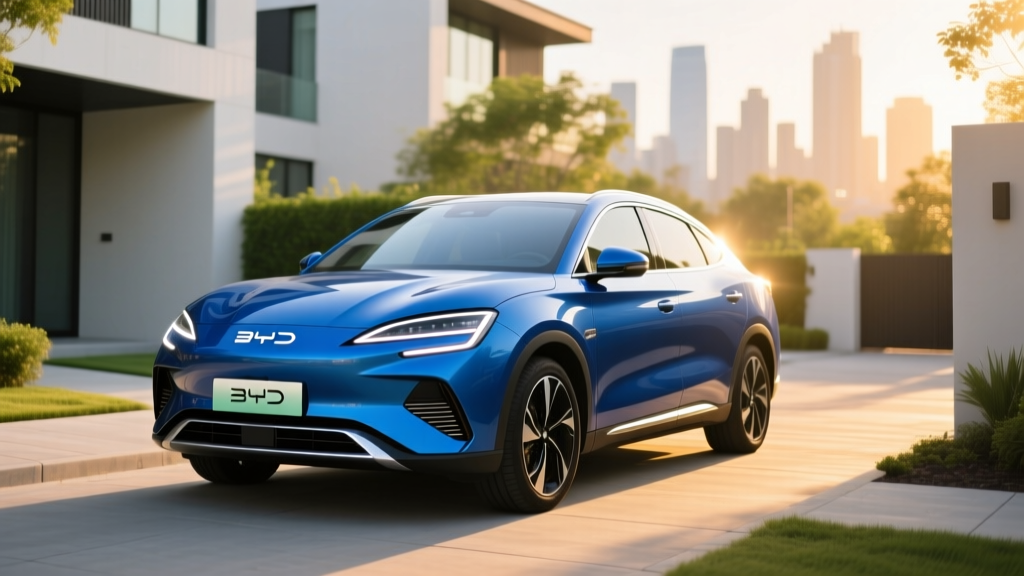
The BYD Yuan Plus — sold outside China as the Atto 3 — became one of the most talked-about compact electric crossovers after a breakout year. If you've been searching for BYD Yuan Plus 2023 sales units, the headline number is striking: BYD reported over 412,000 global deliveries of the Atto 3/Yuan Plus nameplate across 2023, making it the brand's single best-selling BEV that year and one of the top-selling EVs worldwide. But sales volume alone doesn't tell you whether this car fits your driveway, your commute, or your budget — especially as a 2026 buyer navigating a shifting landscape of availability, pricing, and tax-credit rules.
This review breaks down the Yuan Plus (Atto 3) with the exact numbers EV shoppers need: real-world range versus the sticker, charging speeds across Level 2 and DC fast charging, battery chemistry trade-offs, and whether it can compete against rivals you can actually buy in the U.S. today.
Global Sales Context: What Drove the Yuan Plus Numbers
Understanding BYD Yuan Plus 2023 sales units requires separating the Chinese domestic market (where it's badged Yuan Plus) from export markets (where it's the Atto 3). In China, the Yuan Plus consistently moved 30,000–40,000 units per month through much of 2023, buoyed by aggressive pricing starting around ¥135,800 (roughly $19,000 USD at the time). Export markets — particularly Thailand, Australia, Israel, Brazil, and parts of Europe — added substantial volume.
Several factors converged: the BYD Blade Battery (LFP chemistry) earned strong safety perceptions, the e-Platform 3.0 delivered competitive efficiency, and BYD's vertical integration (they make their own cells, semiconductors, and motors) let them price aggressively. For 2026 buyers, the question isn't whether the Yuan Plus sold well — it did — but whether it's available to you and how it stacks up against established U.S.-market alternatives.
EPA-equivalent range: ~260 miles (based on 60.48 kWh battery, WLTP-rated at 420 km / 261 mi; note that the Yuan Plus has not been officially EPA-certified for U.S. sale as of early 2026).
Real-world expectation: Plan for ~210–230 miles in mixed highway driving at 70 mph, and as low as ~170–190 miles in sub-freezing winter conditions. LFP chemistry holds up better than NMC in cold, but resistive cabin heating still saps range. City/regenerative driving can push closer to the 260-mile mark.
Battery, Powertrain, and Efficiency Specs
The Yuan Plus rides on BYD's e-Platform 3.0 with a front-mounted permanent-magnet synchronous motor producing 201 horsepower (150 kW) and 229 lb-ft of torque. It's a front-wheel-drive configuration — no AWD option is offered.
| Spec | Value |
|---|---|
| Battery (usable) | 60.48 kWh — LFP (Blade Battery) |
| Drivetrain | FWD, single motor |
| Horsepower / Torque | 201 hp / 229 lb-ft |
| 0–60 mph | ~7.3 seconds |
| WLTP Range | 420 km (~261 mi) |
| Efficiency (WLTP) | ~15.6 kWh/100 km (~25.1 kWh/100 mi) |
| Max DC Fast Charge | 88 kW peak |
| 10–80% DC Charge | ~29 minutes |
| Level 2 AC Charge | 7 kW (onboard charger) — ~23 mi/hr |
| Cargo Volume | 15.6 cu ft (rear seats up) / 47.0 cu ft (folded) |
| Rear Legroom | ~35.6 inches |
| Curb Weight | ~3,770 lbs |
The LFP Blade Battery is a defining feature. Lithium iron phosphate chemistry trades some energy density for superior thermal stability — BYD's nail-penetration test demonstrations showed no thermal runaway, a meaningful safety differentiator. LFP also tolerates repeated 100% charging better than NMC, meaning daily full-charge commuters won't accelerate degradation as quickly. The trade-off: slightly heavier pack for the same kWh, and somewhat reduced range in extreme cold versus a comparable NMC pack with preconditioning.
Charging Speeds: Home, Public, and the 88 kW Ceiling
The Yuan Plus's charging profile is where U.S.-market buyers should pay close attention. At 88 kW peak DC fast charging, it trails competitors that now hit 150–250+ kW. On a road trip, 10–80% takes roughly 29 minutes under ideal conditions — but real-world charging curves tell a more nuanced story.
| Level | Power / Rate | Miles Added per Hour | Notes |
|---|---|---|---|
| Level 1 (120V) | ~1.4 kW | ~4–5 mi/hr | Overnight trickle; full charge in ~40+ hours |
| Level 2 (240V, 32A) | 7 kW (onboard limit) | ~23 mi/hr | Full charge in ~9 hours; overnight-friendly |
| DC Fast Charge | 88 kW peak | ~150 mi in 30 min (ideal) | Tapers significantly above 80% SoC |
The 7 kW onboard AC charger is the bottleneck at home — even if you install a 48-amp (11.5 kW) Level 2 station, the car can only accept 7 kW. That's adequate for overnight charging (9 hours from empty covers most commutes easily), but it means you won't benefit from upgrading to a higher-amperage home charger.
On DC fast charging, the 88 kW peak is the bigger concern for road-trippers. Competitors like the Hyundai Kona Electric (100+ kW), the Chevrolet Equinox EV (~150 kW), and the Tesla Model Y (~250 kW peak) will get you back on the road faster. The Yuan Plus charge curve holds near peak until about 55–60% SoC, then tapers — so a 10–80% session is reasonable at ~29 minutes, but 10–90% stretches past 45 minutes.
Interior, Tech, and the Rotating Screen
Step inside and the Yuan Plus makes a strong first impression. The cabin features a guitar-string-inspired door trim design, a muscle-fiber-patterned center console, and — most prominently — a 12.8-inch rotating touchscreen (15.6-inch on higher trims) that pivots between landscape and portrait orientation. The infotainment system runs BYD's DiLink platform with wireless Apple CarPlay and Android Auto on export-spec models.
Driver assistance includes adaptive cruise control, lane-keeping assist, blind-spot monitoring, and automatic emergency braking — a solid Level 2 ADAS suite. Note: this is driver-assist, not autonomous driving. You must keep hands on the wheel and eyes on the road at all times (SAE Level 2).
Notable drawbacks: the driver instrument cluster is a small 5-inch display that some reviewers have found difficult to read in bright sunlight. Rear visibility is compromised by thick C-pillars. And the tire selection from the factory (often Atlas or similar budget rubber) limits grip in wet conditions — an aftermarket tire swap is a common owner recommendation.
Pricing, Availability, and U.S. Tax Credit Reality
Here's where the story gets complicated for American buyers. As of early 2026, BYD does not sell passenger vehicles in the United States. The company has cited U.S. tariffs on Chinese-made EVs (currently 100% under Section 301) as a primary barrier. This means there is no U.S. MSRP, no dealer network, and — critically — no federal §30D tax credit eligibility for the Yuan Plus.
For context on what the Yuan Plus costs in markets where it's available:
| Market | Trim | Approx. Price (Local) | USD Equivalent |
|---|---|---|---|
| China (Yuan Plus) | 510 km Leading | ¥135,800 | ~$18,800 |
| Australia (Atto 3) | Extended Range | A$47,900 | ~$30,500 |
| UK (Atto 3) | Design | £37,695 | ~$47,200 |
| Thailand (Atto 3) | Extended Range | ฿1,199,900 | ~$33,500 |
For U.S. shoppers, the Yuan Plus serves more as a benchmark for value than a purchasable option. It demonstrates what a well-executed compact EV crossover can cost when a vertically integrated manufacturer prices aggressively. If BYD ever enters the U.S. (perhaps through a non-China factory in Mexico, Brazil, or Southeast Asia — though tariff and trade-policy uncertainty remains), the Yuan Plus/Atto 3 would compete directly against:
- Hyundai Kona Electric — ~$33,000 base, 261 mi EPA, 100+ kW DC charging
- Chevrolet Equinox EV — ~$33,000 base, 319 mi EPA, ~150 kW DC charging
- Nissan LEAF (discontinued after 2025 MY) — was ~$28,000, 212 mi EPA, CHAdeMO
- Tesla Model Y — ~$44,000 base, 310+ mi EPA, 250 kW peak DC
If you're a U.S. buyer evaluating these alternatives, the IRS §30D clean vehicle credit remains a decisive factor. As of 2026, qualifying new EVs can receive up to $7,500 — but eligibility depends on MSRP caps ($55,000 for SUVs, $50,000 for sedans), buyer income limits ($300,000 joint / $150,000 single), and stringent battery-component and critical-mineral sourcing requirements. Always verify current eligibility on fueleconomy.gov before purchasing.
Pros and Cons at a Glance
- LFP Blade Battery — excellent thermal safety, tolerates daily 100% charges
- Aggressive global pricing (under $20K in China)
- Competitive 261-mi WLTP range for the segment
- Spacious cabin for a compact crossover (35.6" rear legroom)
- Distinctive interior design with large rotating display
- Standard heat pump on most markets (efficiency in cold)
- Not available in the U.S. — no dealer network, no §30D credit
- 88 kW peak DC charging is slow vs. 2026 competitors
- 7 kW onboard AC charger limits home charging upgrade benefit
- Small 5-inch instrument cluster, hard to read in sunlight
- Budget factory tires compromise wet-weather grip
- No AWD option for snow-belt buyers
Warranty and Long-Term Ownership
BYD's warranty coverage varies by market. In Australia, the Atto 3 carries a 6-year/150,000 km vehicle warranty and an 8-year/160,000 km battery warranty (with a capacity-retention threshold typically set at 70%). In China, the original purchaser often receives a lifetime battery warranty (non-transferable). European terms are similar to Australia's.
The LFP chemistry is a long-term ownership advantage: LFP cells typically degrade more slowly than NMC at equivalent cycle counts, and BYD's Blade cell format (long, thin prismatic cells that double as structural members) has demonstrated strong calendar-life performance in early fleet data. Real-world degradation for LFP packs is often in the 5–8% range over the first 100,000 miles — though individual results depend heavily on charging habits, climate, and thermal management.
Who Should Consider the Yuan Plus — And Who Should Look Elsewhere
Choose the BYD Yuan Plus (Atto 3) if: You live in a market where it's sold, you want an affordable compact EV crossover with strong battery safety credentials, your daily commute is under 80 miles round-trip, and you rarely take road trips longer than 200 miles between charging stops.
Look at competitors if: You're a U.S. buyer (it's not sold here), you need fast DC charging for frequent road trips, you want AWD for snowy climates, or you need to maximize federal/state tax incentives only available on vehicles assembled in North America with compliant battery sourcing.
Frequently Asked Questions
How many BYD Yuan Plus units were sold in 2023?
BYD reported approximately 412,000 global deliveries of the Yuan Plus / Atto 3 across 2023, making it the brand's best-selling all-electric model that year. China accounted for the majority, with significant export volumes to Thailand, Australia, Israel, Brazil, and Europe.
What is the real-world range of the BYD Yuan Plus?
The WLTP rating is 420 km (~261 miles). In real-world mixed driving at highway speeds, expect 210–230 miles. In cold weather (below 32°F), range can drop to 170–190 miles due to cabin heating demands and reduced battery efficiency, though the standard heat pump helps mitigate this.
Does the BYD Yuan Plus qualify for the U.S. federal EV tax credit?
No. As of 2026, BYD does not sell passenger vehicles in the United States, so the Yuan Plus is not eligible for the IRS §30D clean vehicle credit. Even if imported, it would not meet battery-component and critical-mineral sourcing requirements, and 100% Section 301 tariffs on Chinese-made EVs make importation economically impractical.
How fast does the Yuan Plus charge at home and on DC fast chargers?
At home on Level 2 (240V), the 7 kW onboard charger adds about 23 miles of range per hour — a full charge takes roughly 9 hours. On DC fast charging, it peaks at 88 kW, achieving 10–80% in approximately 29 minutes. This is slower than most 2026 competitors.
Is the BYD Yuan Plus worth buying versus key competitors?
In markets where it's available, yes — it offers exceptional value, strong battery safety, and competitive range. For U.S. buyers, the Hyundai Kona Electric, Chevrolet Equinox EV, and Tesla Model Y are more practical choices with U.S. dealer support, faster charging, and potential tax-credit eligibility.
What battery chemistry does the Yuan Plus use?
The Yuan Plus uses BYD's LFP (lithium iron phosphate) Blade Battery with a 60.48 kWh usable capacity. LFP offers superior thermal stability and longer cycle life versus NMC, at the cost of slightly lower energy density and reduced cold-weather performance.