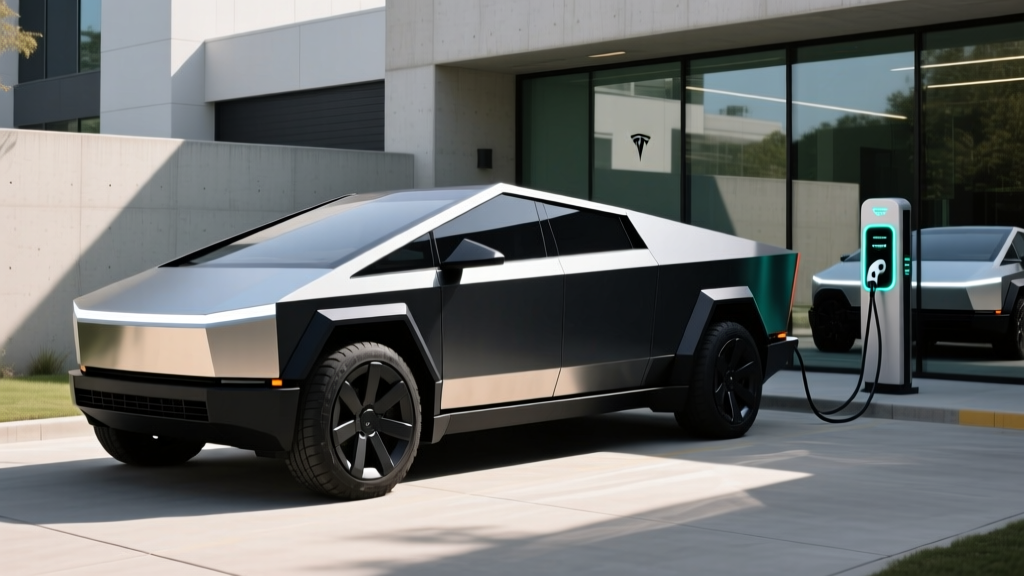
If you've been searching for big huey Tesla, you're likely looking for Tesla's largest, most imposing electric vehicle — the Cybertruck. Whether the nickname comes from its massive stainless-steel exoskeleton, its 845-horsepower tri-motor Cyberbeast variant, or viral videos of the truck dwarfing traffic, the Cybertruck is undeniably the biggest statement in Tesla's current lineup. This 2026 profile breaks down every spec that matters: real-world range versus the EPA sticker, charging-curve behavior, §30D tax credit eligibility, and whether it makes sense against rivals like the Ford F-150 Lightning and Rivian R1T.
2026 Tesla Cybertruck: Quick Verdict
The 2026 Cybertruck is a polarizing, angular electric pickup that prioritizes performance and tech over conventional truck practicality. The dual-motor AWD trim offers the best blend of range and value, while the tri-motor Cyberbeast delivers supercar-rivaling acceleration in a 6,800-pound body. However, buyers should weigh its below-average range against competitors, a steep starting price, and the reality that its angular bed sacrifices some cargo utility. It's an EV for tech-forward buyers who want attention and acceleration, not a fleet workhorse.
Range, Battery, and Real-World Efficiency
The 2026 Cybertruck lineup uses a structural battery pack with a 4680-cell architecture. Tesla does not publish official usable kWh figures, but independent teardowns and EPA filings estimate approximately 123 kWh usable in the AWD and Cyberbeast trims, utilizing NMC (nickel-manganese-cobalt) chemistry for high energy density.
| Trim | EPA Range | Battery (est.) | MPGe (combined) | kWh/100 mi |
|---|---|---|---|---|
| AWD (Dual-Motor) | 340 mi | ~123 kWh NMC | 72 MPGe | 47 kWh |
| Cyberbeast (Tri-Motor) | 320 mi | ~123 kWh NMC | 68 MPGe | 50 kWh |
Charging Speed: DC Fast, Level 2, and the Curve
Tesla's 4680 cells and 800V-class architecture enable strong DC fast-charging throughput on the Supercharger network. Here's what to expect:
| Charging Type | Max Rate | Speed / Time |
|---|---|---|
| DC Fast Charge (Supercharger V4) | ~250 kW peak | 10–80% in ~30 min; adds ~150 mi in 15 min |
| Level 2 (Home Wall Connector, 48A/11.5 kW) | 11.5 kW | ~37 mi/hr; full charge in ~11 hours |
| Level 1 (120V household outlet) | ~1.4 kW | ~4 mi/hr; emergency/trickle only |
Charging-curve reality: Peak 250 kW is only sustained at low state-of-charge (SoC), typically 10–30%. Above 50% SoC, the rate tapers significantly — often dropping below 100 kW past 80%. Plan road-trip stops around 10–80% sessions for the best time-to-mile ratio. The Cybertruck also supports NACS natively (it is a Tesla, after all), giving full access to the Supercharger network — the most reliable DC network in the US as of 2026.
Performance: 0–60, Horsepower, and Drivetrain
The Cybertruck's performance credentials are where Tesla flexes hardest. Both trims feature all-wheel drive with independent motors per axle.
- AWD (Dual-Motor): 600 hp combined, 0–60 mph in 3.9 seconds. This is quick enough to gap most sports cars at a stoplight — in a pickup.
- Cyberbeast (Tri-Motor): 845 hp, 0–60 mph in 2.6 seconds. For context, that's Lamborghini Huracán territory in a truck that weighs nearly three and a half tons.
Towing capacity is rated at 11,000 lbs (AWD and Cyberbeast), though real-world range drops sharply when towing — expect a 40–60% range reduction with a heavy trailer. The 6.5-foot bed is shorter than a standard F-150 5.5-foot bed but features a motorized tonneau cover and built-in 120V/240V outlets for job-site or campsite power (V2L capability).
Pricing, Trims, and Federal Tax Credit Eligibility
The 2026 Cybertruck carries a premium price tag. Here's the current trim breakdown:
| Trim | Base MSRP | As-Tested (typical) | §30D Credit Eligible? |
|---|---|---|---|
| AWD (Dual-Motor) | $79,990 | $85,000–$92,000 | No — exceeds $80,000 truck MSRP cap |
| Cyberbeast (Tri-Motor) | $99,990 | $105,000–$115,000 | No — exceeds $80,000 truck MSRP cap |
Tax credit reality: Under IRS §30D rules, new electric trucks must have an MSRP at or below $80,000 to qualify for the up-to-$7,500 federal tax credit. The Cybertruck AWD's $79,990 base MSRP technically squeaks under the cap, but any added options, destination fees, or packages push the final MSRP above the threshold. The Cyberbeast is well over the limit. Additionally, buyers must meet income caps ($300,000 joint / $150,000 single modified AGI) and the vehicle must satisfy critical-mineral and battery-component sourcing requirements that shift annually. Always verify current eligibility at IRS.gov and consult a tax professional before relying on the credit.
- Vehicle MSRP ≤ $80,000 for trucks/vans/SUVs
- Buyer MAGI ≤ $300K (joint) / $150K (single)
- Battery critical minerals & component sourcing thresholds (updated annually)
- Vehicle assembled in North America
- Point-of-sale transfer available at participating dealers if eligible
Interior, Cargo, and Tech Features
The Cybertruck cabin follows Tesla's minimalist ethos: a single 18.5-inch front touchscreen, an 9.4-inch rear touchscreen for passengers, and a yoke-style steering wheel (a conventional round wheel is now a no-cost option). The glass roof provides an airy feel but no physical shade — Tesla relies on electrochromic dimming.
Cargo dimensions:
- Bed length: 72 inches (6 feet) with tailgate up; motorized retractable tonneau cover
- Bed volume: 67 cu ft
- Front trunk (frunk): 7.1 cu ft — useful for charging cables and groceries
- Max payload: ~2,500 lbs
- Front legroom: 41.0 in / Rear legroom: 38.5 in
Standout tech:
- Steer-by-wire with variable ratio (no mechanical connection between wheel and rack)
- Adaptive air suspension with up to 16 inches of ground clearance in Extract Mode
- Tesla Autopilot (Level 2 driver assist) with optional FSD (Supervised) — requires continuous driver attention
- 240V bed outlet for power tools, welders, or campsite appliances
- Armor glass (laminated) with improved shatter resistance over the 2019 demo
Notable drawbacks: The yoke steering and steer-by-wire require a learning curve. Visibility is hampered by thick A-pillars and the angular roofline. The bed is shorter than most full-size trucks, and the tonneau cover mechanism eats into bed-wall thickness. Panel-gap consistency has improved since the 2024 launch but still draws scrutiny. Insurance premiums run 20–40% higher than comparable F-150 Lightning models due to repair costs for stainless-steel body panels.
Warranty and Long-Term Ownership
Tesla provides the following warranty coverage for the 2026 Cybertruck:
- Basic Vehicle: 4 years / 50,000 miles
- Battery & Drive Unit: 8 years / 120,000 miles (whichever comes first), with a minimum 70% capacity retention threshold over the warranty period
- Restraint System: 5 years / 60,000 miles
The 8-year/120,000-mile battery warranty is competitive with the industry standard. Per fueleconomy.gov, NMC batteries of this generation typically retain 85–92% capacity after 100,000 miles under normal use. The 4680 cell design with dry-electrode manufacturing is intended for longevity, though long-term fleet data beyond two years is still accumulating.
Cybertruck vs. F-150 Lightning vs. Rivian R1T
The "big huey Tesla" competes in a tight segment. Here's how it stacks up against key rivals:
| Spec | Tesla Cybertruck AWD | Ford F-150 Lightning Lariat | Rivian R1T Dual-Motor |
|---|---|---|---|
| EPA Range | 340 mi | 320 mi (Std Range) / 400 mi (Max) | 352 mi (Standard) / 420 mi (Max) |
| 0–60 mph | 3.9 sec | 3.8 sec (ERange AWD) | 4.5 sec |
| Base MSRP | $79,990 | $62,995 | $75,900 |
| Towing | 11,000 lbs | 10,000 lbs | 11,000 lbs |
| Bed Length | 6 ft | 5.5 ft | 4.5 ft (standard bed) |
| §30D Credit | Likely ineligible | Eligible (select trims) | Eligible (select trims) |
- Best-in-class acceleration (Cyberbeast)
- Supercharger network access (NACS native)
- Steer-by-wire precision and tight turning radius
- 240V bed outlet and V2L capability
- Head-turning design and build presence
- Likely ineligible for $7,500 federal tax credit
- Highway range drops significantly due to aero drag
- Short 6-ft bed vs. full-size truck norms
- Steep price premium over F-150 Lightning
- Insurance costs 20–40% above segment average
Who Should Buy the Cybertruck?
The Cybertruck suits tech-enthusiast truck buyers who prioritize acceleration, Supercharger convenience, and design statement over traditional truck utility. It's a strong fit for:
- Daily commuters who want a truck image with sedan-rivaling acceleration
- Campsite and job-site users who benefit from the 240V bed outlet
- Tesla ecosystem loyalists already invested in home Powerwalls and Solar Roofs
It's a weaker fit for fleet buyers, budget-conscious shoppers, or anyone who needs a full 8-foot bed or the lowest cost-per-mile. If tax-credit eligibility matters, the F-150 Lightning or Rivian R1T will likely net you $7,500 back.
Choose the F-150 Lightning if: You want a conventional truck experience, a lower price, and likely §30D eligibility.
Choose the Rivian R1T if: You prioritize adventure features (gear tunnel, camp kitchen) and want a more refined interior at a similar price point.
Frequently Asked Questions
What is the real-world range of the Tesla Cybertruck?
The EPA rates the AWD Cybertruck at 340 miles and the Cyberbeast at 320 miles. In real-world highway driving at 75 mph, expect 260–290 miles. In freezing weather, that can drop to 210–240 miles due to battery resistance and cabin heating demands.
How fast does the Cybertruck charge at home and on the road?
On a Tesla Supercharger V4, the Cybertruck peaks at approximately 250 kW and charges from 10–80% in about 30 minutes. At home on a 48-amp Level 2 Wall Connector (11.5 kW), it adds roughly 37 miles of range per hour, with a full charge taking about 11 hours.
Does the 2026 Cybertruck qualify for the $7,500 federal EV tax credit?
Most likely not. The §30D tax credit caps truck MSRP at $80,000. While the AWD base MSRP is $79,990, any options or destination charges push it over the threshold. The Cyberbeast at $99,990 is well above the cap. Always check IRS.gov for current-year rules and consult a tax professional.
Is the Cybertruck worth buying over the F-150 Lightning or Rivian R1T?
It depends on priorities. The Cybertruck wins on raw acceleration and Supercharger network reliability. The F-150 Lightning wins on price, tax-credit eligibility, and conventional truck usability. The Rivian R1T wins on adventure versatility and interior refinement. Test-drive all three before committing.
What are the biggest Cybertruck pros and cons?
Pros: blistering acceleration, native NACS/Supercharger access, steer-by-wire agility, 240V bed outlet. Cons: likely no tax credit, poor highway efficiency from aero drag, short bed, high insurance premiums, and polarizing design that isn't for everyone.