The Cybercab Reality Check: What Tesla Actually Promises
Ever since Tesla unveiled the Cybercab concept in late 2024, search interest around how to buy Cybercab has steadily climbed. But before you start configuring one on Tesla's website, here's the essential context: the Cybercab is not a conventional vehicle you purchase and drive yourself. It is Tesla's purpose-built, steering-wheel-free robotaxi designed to operate within a ride-hailing network — closer in concept to a Waymo vehicle than a Model Y. As of mid-2026, Tesla has begun limited pilot operations in select US markets, but consumer ownership and broad availability remain in early rollout phases.
This profile breaks down every confirmed specification, the real-world operating constraints, the economics of Tesla's robotaxi vision, and what you actually need to know before committing money or expectations to the Cybercab platform.
The Cybercab is engineered for SAE Level 4 autonomy — meaning it operates without a human driver, but only within predefined geographic zones and conditions. This is fundamentally different from Tesla's consumer FSD (Supervised), which is Level 2 and requires active driver engagement. The Cybercab has no steering wheel, no pedals, and no manual override.
Range, Battery, and Efficiency: The Numbers Behind the Pod
Tesla has confirmed the Cybercab uses a next-generation, smaller battery platform derived from its upcoming compact vehicle architecture. The production-spec battery is a structural lithium iron phosphate (LFP) pack, chosen for cost reduction and cycle-life durability under heavy daily use — a logical choice for a vehicle expected to log 50,000+ miles annually in fleet service.
| Spec | Value |
|---|---|
| EPA Est. Range | ~250 miles |
| Battery Capacity | ~50 kWh (usable), LFP chemistry |
| Drivetrain | Rear-wheel drive, single motor |
| Horsepower | ~200 hp (est.) |
| 0–60 mph | ~6.5 seconds (est.) |
| Efficiency | ~130 MPGe / ~26 kWh/100 mi |
| Seating | 2 passengers |
| Cargo Volume | ~15 cu ft (rear compartment) |
| Base MSRP (Fleet/Operator) | ~$30,000 (projected, pre-incentives) |
The ~250-mile EPA estimate assumes moderate-speed urban driving in temperate conditions — exactly the robotaxi use case. In real-world fleet operation, expect effective range closer to 200–220 miles when factoring in HVAC use, stop-and-go traffic with frequent acceleration, and battery-buffer reserves. In cold climates (below 32°F), LFP chemistry is more susceptible to range loss than NMC — plan for a 20–30% reduction, bringing winter range to roughly 150–175 miles. Tesla's thermal management system and heat pump help mitigate this, but LFP's cold-weather behavior is a known trade-off.
The 50 kWh LFP pack is a deliberate choice. LFP (lithium iron phosphate) cells offer a longer cycle life — typically 3,000+ full charge cycles before significant degradation — compared to NMC's ~1,500–2,000 cycles. For a fleet vehicle charging daily, this translates to an estimated 8–10 years of service before the pack falls below 80% state of health. The trade-off: lower energy density means the pack is heavier for its capacity, and cold-weather performance suffers. For a geofenced urban robotaxi, that trade-off is acceptable.
Charging Speed: Designed for Fleet Turnaround, Not Road Trips
The Cybercab is not designed for cross-country road trips. It's engineered to operate within a metro area, return to a fleet depot, and charge rapidly for the next shift. Tesla has confirmed wireless inductive charging capability for depot use, alongside standard NACS (North American Charging Standard) port access for Supercharger compatibility.
| Charge Level | Power (kW) | 10–80% Time | Miles Added/Hour |
|---|---|---|---|
| Level 1 (120V) | ~1.4 kW | N/A (not practical) | ~4 mi/hr |
| Level 2 (240V / 11.5 kW) | 11.5 kW | ~3.5 hours | ~33 mi/hr |
| DC Fast Charge (NACS) | Peak ~170 kW | ~20 minutes | N/A |
| Wireless Inductive (Depot) | ~19 kW | ~2 hours | ~55 mi/hr |
The ~170 kW peak DC charge rate is respectable for a 50 kWh pack, representing roughly a 3.4C charge rate. However, as with all EVs, that peak is not sustained. Expect the charge curve to taper significantly above 60% state of charge, with the 60–80% portion taking roughly as long as the 10–60% portion. For fleet operators, the strategy is to charge between 20–80% during shift changes, avoiding the slow taper entirely.
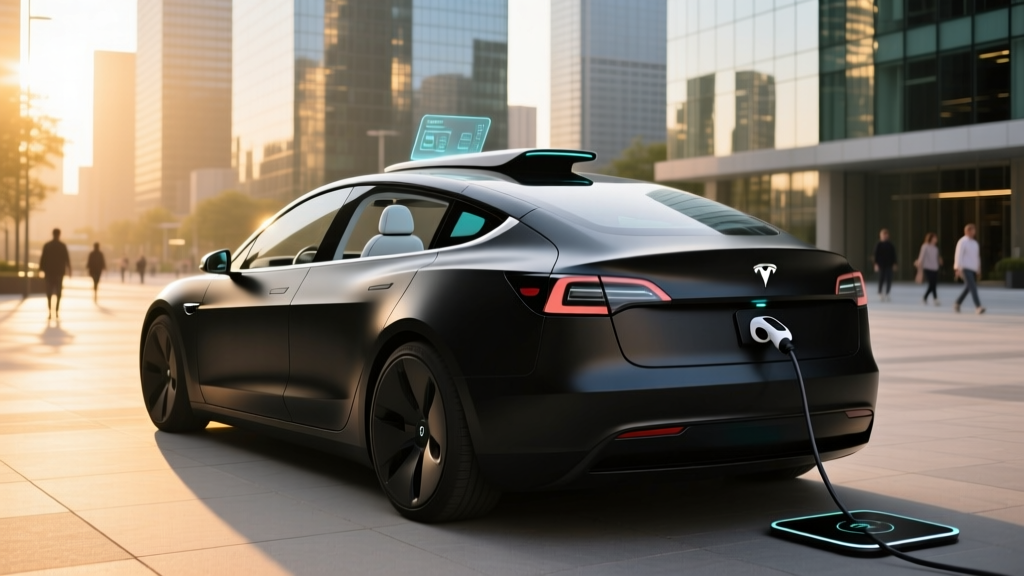
The wireless inductive charging pad is the headline feature. Vehicles autonomously position themselves over a ground pad at the depot and begin charging without any physical connection. This eliminates connector wear, reduces maintenance, and allows fully unattended charging — critical for a driverless fleet. According to Tesla's engineering updates, the inductive system operates at ~90–93% efficiency, only marginally lower than a wired connection.
Autonomy, Sensors, and the FSD Hardware Stack
The Cybercab runs on Tesla's latest AI hardware (Hardware 5 / AI5), which Tesla claims delivers a 5x compute improvement over the HW4 chip used in current Model 3 and Model Y vehicles. The sensor suite is a Tesla-vision-only approach — no lidar, no radar — relying on a multi-camera array (estimated 8–10 cameras) with enhanced low-light and wide-dynamic-range capabilities.
- Operate outside its approved geofenced zone — if you need to travel beyond the mapped service area, the vehicle will not proceed.
- Handle unmapped construction zones, severe weather (heavy snow, flooding), or off-road conditions without remote human teleoperation intervention.
- Carry more than 2 passengers or accommodate wheelchair access in the initial production version.
- Function as a personal vehicle you can drive manually — there is no steering wheel, no pedals, and no manual override of any kind.
Tesla's vision-only approach contrasts sharply with Waymo's multi-sensor stack (lidar + radar + cameras). Waymo's published safety data shows its 6th-generation driver operating across Phoenix, San Francisco, and Los Angeles with a strong safety record. Tesla's approach relies on neural-network generalization — the idea that enough training data from millions of Tesla consumer vehicles can compensate for the absence of lidar. This remains the central debate in autonomous vehicle engineering, and the Cybercab's real-world safety record in its pilot markets will be the definitive test.
For context on how federal regulators view these systems, the NHTSA automated vehicle safety page maintains standing general orders requiring crash reporting from all Level 2+ and Level 4 operators, providing transparency into incident rates across platforms.
Pricing, Ownership Model, and Tax Credit Reality
This is where the "buy Cybercab" question gets complicated. Tesla CEO Elon Musk has stated a target vehicle cost of approximately $30,000, but this figure refers to the production cost to Tesla, not necessarily the retail purchase price for an individual. More importantly, Tesla's stated business model positions the Cybercab primarily as a fleet-owned asset operating on the Tesla Network (Tesla's planned ride-hailing platform), not as a consumer-owned vehicle.
| Scenario | Est. Price |
|---|---|
| Fleet/Operator Purchase (projected) | $30,000–$35,000 per unit (volume) |
| Individual Consumer Purchase (if offered) | TBD — not yet confirmed for retail sale |
| §30D Federal Tax Credit (if eligible) | Up to $7,500 — subject to MSRP, income, and battery-sourcing caps |
| Estimated Ride Cost (Tesla Network) | ~$0.20–$0.30/mile (projected, below Uber/Lyft rates) |
If the Cybercab becomes available for individual retail purchase, the following IRS §30D rules would apply:
- MSRP Cap: Vehicle must have an MSRP at or below $55,000 (sedans/coupes) — Cybercab likely qualifies.
- Buyer Income Cap: Modified AGI must not exceed $150,000 (single) / $300,000 (joint) / $225,000 (head of household).
- Battery Sourcing: Critical minerals and battery components must meet escalating domestic/free-trade-agreement percentages — Tesla's LFP sourcing from CATL (China) may complicate eligibility depending on 2026 FEOC (Foreign Entity of Concern) enforcement.
- Point-of-Sale Transfer: Eligible buyers can transfer the credit to the dealer at purchase, reducing the upfront price rather than waiting for a tax refund.
- Commercial Clean Vehicle Credit (§45W): Fleet operators purchasing Cybercabs for business use may qualify for up to $7,500 under this separate provision, with different rules.
Tax credit eligibility is subject to change. Consult a tax professional and verify current rules at irs.gov before making a purchase decision.
Interior, Passenger Experience, and Tech
Without a driver's seat, steering wheel, or dashboard instrumentation, the Cybercab's interior is essentially a compact lounge for two. Tesla has shown renderings of a bench-style seat with a large central touchscreen for ride information, entertainment, and climate control. The butterfly doors open upward for dramatic entry, though their practicality in tight urban parking structures remains to be seen.
Passenger space is designed for two adults with modest luggage. The ~15 cu ft cargo area behind the seats accommodates a few carry-on bags or grocery runs — adequate for airport transfers and daily errands, but not for family hauling. There is no frunk (front trunk) in the traditional sense, as the front section houses compute hardware and HVAC components.
The infotainment experience centers on a single large display (~21 inches based on concept renderings) running a custom Tesla OS interface for ride status, route visualization, media streaming, and video calls. Expect Tesla's standard over-the-air update capability, meaning the software experience will evolve continuously post-launch.
Cybercab vs. Waymo vs. Zoox: The Robotaxi Landscape
If you're researching how to buy Cybercab, you're likely also evaluating alternatives in the autonomous ride-hailing space. Here's how the three major US robotaxi platforms compare as of 2026:
| Feature | Tesla Cybercab | Waymo 6th-Gen | Amazon Zoox |
|---|---|---|---|
| SAE Level | Level 4 | Level 4 | Level 4 |
| Sensor Approach | Vision-only (cameras) | Lidar + radar + cameras | Lidar + radar + cameras |
| Vehicle Platform | Purpose-built (Tesla) | Modified Zeekr/Jaguar I-PACE | Purpose-built (bidirectional) |
| Passenger Capacity | 2 | 3–4 | 4 |
| Operational Markets (mid-2026) | Limited pilot (Austin, select cities) | Phoenix, SF, LA, expanding | Las Vegas, Foster City (limited) |
| Consumer Purchase Option | Not confirmed | No (fleet only) | No (fleet only) |
| Est. Ride Cost | ~$0.20–0.30/mi (projected) | ~$0.35–0.50/mi | TBD (free pilot currently) |
Consider the Cybercab (as a rider) if: You live in a Tesla Network launch city, your trips are primarily urban/suburban under 30 miles, you travel solo or as a pair, and you want the lowest per-mile autonomous ride cost.
Look at Waymo now if: You need a robotaxi today in Phoenix, San Francisco, or Los Angeles, you regularly travel with 3–4 passengers, or you prefer the redundancy of a lidar-equipped sensor suite.
Don't plan to "buy" a Cybercab if: You want a personal vehicle you own, drive manually, take on road trips, or use for family transport. The Cybercab is not a consumer car — it's a fleet asset. If you want a Tesla you can own and drive today, the Model Y or Model 3 with FSD (Supervised) remains the path, understanding that FSD is Level 2, not autonomous.
Warranty, Durability, and Fleet Maintenance
Tesla has not published final Cybercab warranty terms for consumers, but fleet-oriented warranties are expected to differ from Tesla's standard consumer coverage. For reference, Tesla's current consumer battery warranty covers 8 years / 100,000–120,000 miles (depending on model) with a minimum 70% capacity retention threshold.
For fleet Cybercabs, the relevant metric is cycle life. The LFP pack's ~3,000+ cycle rating, combined with a 50 kWh battery and ~250-mile range, suggests the pack could endure roughly 750,000 miles of cumulative driving before hitting end-of-life degradation thresholds — assuming Tesla's thermal management keeps cell temperatures within optimal range. This is a significant advantage over NMC packs in high-utilization service.
The vehicle's simplified mechanical design — no steering column, no pedal assembly, no driver-facing instrumentation — reduces parts count and should lower long-term maintenance costs compared to a conventional vehicle. The primary wear items will be tires, suspension components, cabin filters, and the HVAC system.
Pros and Cons: An Honest Assessment
- Purpose-built robotaxi design — no compromise from a consumer vehicle platform
- LFP battery offers exceptional cycle life for fleet duty
- Wireless inductive charging enables fully unattended depot operations
- Projected low per-mile ride cost undercuts current ride-hailing
- Tesla's massive real-world driving dataset trains the vision system
- No driver means lower operating cost per vehicle-mile
- Cannot be purchased as a personal vehicle (as of 2026)
- Vision-only autonomy lacks lidar redundancy — debated safety approach
- Only 2-passenger capacity limits group/family use
- Limited geofenced service areas — not available in most US cities
- LFP cold-weather range loss is significant in northern climates
- No manual override — passengers are fully dependent on the system
- Regulatory approval varies by state and municipality
Frequently Asked Questions
Can I actually buy a Cybercab for personal use in 2026?
As of mid-2026, Tesla has not confirmed a retail purchase option for individual consumers. The Cybercab is designed as a fleet vehicle for the Tesla Network ride-hailing platform. Tesla has hinted at a future "fleet owner" model where individuals could purchase Cybercabs and add them to the network for revenue, but specific terms, pricing, and availability have not been finalized. If you want a Tesla vehicle you can buy and own today, the Model 3, Model Y, and upcoming compact platform are your options.
What is the real-world range of the Cybercab?
The EPA-estimated range is approximately 250 miles under ideal conditions. In real-world urban fleet operation with HVAC use and frequent stop-and-go driving, expect 200–220 miles of usable range per charge. In cold weather (below freezing), LFP chemistry loses more capacity than NMC — plan for 150–175 miles in winter conditions. For a geofenced city robotaxi that returns to a depot between shifts, this range is sufficient for most operational profiles.
How fast does the Cybercab charge?
On a DC fast charger (NACS connector), the Cybercab peaks at approximately 170 kW, achieving a 10–80% charge in roughly 20 minutes. The charge curve tapers above 60% SoC, so fleet operators typically charge in the 20–80% window to minimize turnaround time. Wireless inductive depot charging operates at ~19 kW, fully replenishing the pack in about 2 hours — designed for overnight or between-shift top-ups without physical plugging.
Does the Cybercab qualify for the federal EV tax credit?
If and when the Cybercab becomes available for individual purchase, it would likely fall under the IRS §30D Clean Vehicle Credit rules. The projected ~$30,000–$35,000 price would clear the $55,000 MSRP cap for sedans. However, buyer income limits ($150K single / $300K joint) and battery-sourcing requirements (critical minerals and component sourcing from approved supply chains) could affect eligibility. Tesla's LFP cells, historically sourced from CATL in China, face scrutiny under FEOC (Foreign Entity of Concern) rules. Fleet buyers may qualify under the separate §45W Commercial Clean Vehicle Credit instead. Always verify current eligibility with a tax professional.
Is the Cybercab safer than a human driver?
Tesla has not yet published Cybercab-specific safety data at scale, as the vehicle is in limited pilot operation. Waymo's published data — based on tens of millions of driverless miles — shows a lower rate of police-reported crashes compared to human benchmarks in comparable urban environments. Tesla's vision-only approach remains unproven at Level 4 scale compared to Waymo's lidar-redundant system. NHTSA's standing general order requires all Level 4 operators to report crashes, which will provide comparative transparency as Cybercab miles accumulate. Definitive safety conclusions require more operational data.
How is the Cybercab different from Tesla's FSD on a Model Y?
Fundamentally different. Tesla's Full Self-Driving (Supervised) on a Model Y or Model 3 is an SAE Level 2 driver-assistance system — the driver must remain alert, hands on or near the wheel, and legally responsible for the vehicle at all times. The Cybercab is an SAE Level 4 driverless vehicle with no steering wheel or pedals, operating autonomously within a defined zone. FSD is a feature you buy for your personal car; the Cybercab is a ride you hail. They share underlying neural-network technology but serve entirely different use cases and regulatory frameworks.
When will the Cybercab be available in my city?
Tesla launched its initial Cybercab pilot in Austin, Texas, with expansion planned to additional markets throughout 2026 and 2027. Regulatory approval is required at the state and municipal level, so availability depends on local autonomous vehicle legislation. States like Arizona, Texas, and Nevada have been more permissive; California's regulatory environment (through the CPUC and DMV) involves a more structured permitting process. Check your state's DMV or public utilities commission for current AV operator permits.
Specifications and availability details in this article are based on Tesla's published announcements and pilot program data as of mid-2026. Final production specs, pricing, and market availability may differ. Always verify with Tesla directly and consult official IRS guidance for tax credit eligibility.