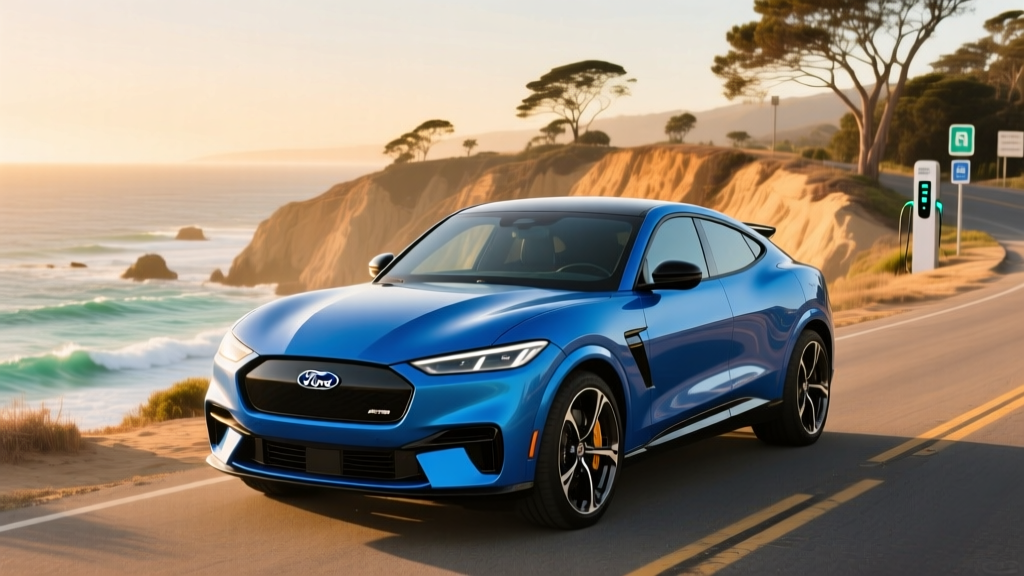
The Ford Mustang Mach-E California Special returns for 2026 as a West Coast-inspired appearance and technology package layered onto Ford's proven electric crossover platform. It slots between the Premium and GT trims, trading outright performance for a curated blend of styling, comfort, and extended-range capability. With the EV market more crowded than ever, the question isn't whether the Mach-E is a competent electric vehicle — it is — but whether the California Special's unique mix of features justifies its position in Ford's 2026 lineup.
We spent time analyzing the 2026 California Special's specs, charging behavior, and ownership economics to give you the numbers that matter before you walk into a dealership.
2026 Mach-E California Special: Key Specs at a Glance
| Spec | Value |
|---|---|
| EPA Range (Extended RWD) | 320 miles |
| EPA Range (Extended AWD) | 305 miles |
| Battery (Usable / Gross) | 91 kWh / 98 kWh (NMC) |
| Powertrain | RWD (single motor) or AWD (dual motor) |
| Horsepower | 290 hp (RWD) / 365 hp (AWD) |
| Torque | 317 lb-ft (RWD) / 428 lb-ft (AWD) |
| 0–60 mph | 6.1 sec (RWD) / 5.1 sec (AWD) |
| Max DC Fast Charge | 150 kW |
| 10–80% DC Charge Time | ~36 minutes |
| Level 2 Home Charging | 10.5 kW (~30 mi/hr) |
| Efficiency (Combined) | 101 MPGe / 33 kWh/100mi (RWD) |
| Cargo (Behind Rear Seats) | 29.7 cu ft |
| Cargo (Seats Folded) | 59.7 cu ft |
| Frunk | 4.7 cu ft (drainable) |
| Battery Warranty | 8 years / 100,000 miles |
| Base MSRP | $48,995 (before destination) |
Real-World Range: What to Actually Expect
The EPA rates the 2026 Mach-E California Special with the Extended Range battery and rear-wheel drive at 320 miles. That's a competitive figure in the mid-size electric crossover segment, trailing the Tesla Model Y Long Range (330 mi) but ahead of the Hyundai Ioniq 5 (303 mi) and Volkswagen ID.4 Pro S (291 mi).
EPA sticker: 320 miles (Extended RWD) / 305 miles (Extended AWD)
Expect in practice: 260–290 miles on sustained highway driving at 70–75 mph; 230–260 miles in freezing temperatures with cabin heat active. City driving with regenerative braking recovers closer to the EPA estimate or slightly above. The AWD model's real-world highway range drops to roughly 245–275 miles under similar conditions.
Source: fueleconomy.gov
Ford equips the California Special with the Extended Range battery pack, which uses NMC (nickel manganese cobalt) lithium-ion chemistry across 98 kWh gross (91 kWh usable). Ford maintains a conservative top/bottom buffer — roughly 7 kWh — to protect long-term battery health, which is a smart trade-off for longevity even if it slightly reduces advertised capacity versus some competitors.
The NMC chemistry in this pack delivers strong energy density and consistent power delivery but is more sensitive to sustained high-state-of-charge storage than LFP (lithium iron phosphate) packs. If you regularly charge to 100% and let the car sit for days, expect slightly more degradation over a 5-year horizon. Ford recommends an 80% daily charge limit for NMC packs, which aligns with best practices across the industry.
Charging Speed: DC Fast Charging and Home Setup
Charging remains one of the most practical concerns for EV buyers, and the Mach-E California Special's charging profile is adequate but not class-leading.
| Charging Level | Power | Speed (Approx.) | Connector |
|---|---|---|---|
| Level 1 (120V household) | 1.4 kW | ~3 miles per hour | J1772 / NACS adapter |
| Level 2 (240V home) | 10.5 kW | ~30 miles per hour | J1772 / NACS (2025+ models) |
| DC Fast Charge | 150 kW peak | 10–80% in ~36 min | CCS1 / NACS (via adapter) |
The 150 kW peak DC fast-charge rate is the Mach-E's most notable competitive limitation. The Hyundai Ioniq 5 peaks at 240 kW (10–80% in ~18 minutes), and Tesla's Model Y on V3 Superchargers achieves 250 kW (10–80% in ~15 minutes). In practice, the Mach-E's charge curve is relatively flat — it holds close to peak rate longer than some competitors — but the 36-minute 10–80% window is meaningfully slower than the segment's best.
On a road trip, plan for roughly 35–40 minute stops at 150 kW-capable Electrify America or EVgo stations. The Mach-E's built-in route planner with Ford's Intelligent Range system does a competent job predicting charge needs and preconditioning the battery before arrival at a DC charger, which helps maximize that charge curve.
For home charging, the onboard 10.5 kW Level 2 charger is strong. A full overnight charge from 20% to 80% takes roughly 5–6 hours on a 48-amp Level 2 home station. Ford's Mobile Power Cord is included and supports both 120V and 240V outlets, though most owners will want a dedicated hardwired Level 2 station. Budget $500–$1,500 for a quality Level 2 charger (ChargePoint Home Flex, Emporia Level 2) plus $800–$2,500 for professional electrician installation depending on your panel capacity and run length.
For 2026, Ford has transitioned the Mach-E to the NACS (North American Charging Standard) port natively on new-production vehicles, granting direct access to Tesla's Supercharger network without an adapter. This is a significant infrastructure advantage over the Mach-E's CCS-equipped competitors that still rely on adapter solutions. Verify with your dealer whether a specific VIN has the NACS port, as transition-period inventory may vary.
Performance, Ride, and Drivetrain
The California Special is available in both rear-wheel-drive and all-wheel-drive configurations. The RWD model's 290 hp and 317 lb-ft of torque deliver a 6.1-second 0–60 mph time — brisk enough for confident highway merging and passing. The AWD dual-motor setup bumps output to 365 hp and 428 lb-ft, dropping the sprint to 5.1 seconds.
Neither configuration matches the GT's 3.5-second 0–60 time, but the California Special isn't trying to. Ford has tuned this trim for ride comfort over outright performance, and the result is a compliant, quiet cruiser that absorbs highway expansion joints and rough pavement without the harshness some sport-tuned EVs exhibit.
The single-pedal driving mode is well-calibrated, allowing near-complete stops in city traffic without touching the brake pedal. The Mach-E's brake-blending between regenerative and friction braking is seamless — one of the better implementations in the segment.
Interior, Tech, and Cargo
The California Special distinguishes itself with unique interior trim: perforated ActiveX seating surfaces with contrast stitching, a heated steering wheel, and California Special badging on the door scuff plates. The centerpiece remains Ford's SYNC 4A infotainment system displayed on a 15.5-inch vertically oriented touchscreen.
SYNC 4A supports wireless Apple CarPlay and Android Auto, over-the-air updates, and Ford's cloud-connected navigation. The interface is responsive and logically organized, though the heavy reliance on touchscreen controls (climate settings are buried in menus) remains a common complaint among Mach-E owners.
On the driver-assistance front, the California Special includes Ford Co-Pilot360 2.0 as standard, which bundles:
- Pre-Collision Assist with Automatic Emergency Braking
- Blind Spot Information System (BLIS) with Cross-Traffic Alert
- Lane-Keeping System with Lane Centering
- Rear View Camera with washer
- Evasive Steering Assist
Ford Co-Pilot360 and the available BlueCruise hands-free highway driving system are SAE Level 2 driver-assistance features. The driver must remain attentive and ready to take over at all times. BlueCruise allows hands-off operation on pre-mapped divided highways (~130,000 miles of qualified roads in the U.S.), but it is not autonomous driving. Only SAE Level 4 services like Waymo operate without a driver in the loop.
BlueCruise 1.2 is available as a $2,100 option (or included in certain packages) and remains one of the more refined Level 2 systems on the market. Its driver-monitoring camera is less intrusive than GM's Super Cruise IR system, and lane-change assist executes smoothly when activated via turn signal.
Cargo space is practical for the segment: 29.7 cu ft behind the rear seats and 59.7 cu ft with the 60/40 split seats folded. The 4.7 cu ft front trunk (frunk) includes a drain plug — useful for tailgating as an ice chest. Rear legroom measures 38.9 inches, adequate for adults on longer trips, though the Tesla Model Y's 41.6 inches is noticeably roomier.
Pricing, Trims, and Federal Tax Credit Eligibility
The 2026 California Special starts at $48,995 (RWD Extended Range) before the $1,395 destination charge. Adding AWD raises the price to approximately $51,995. A well-equipped AWD model with BlueCruise, premium paint, and the panoramic roof can approach $56,000–$58,000.
| Configuration | MSRP (incl. dest.) | Est. After §30D Credit |
|---|---|---|
| California Special RWD | $50,390 | $42,890 (if eligible) |
| California Special AWD | $53,390 | $45,890 (if eligible) |
| AWD + BlueCruise + Pano Roof | $57,485 | $49,985 (if eligible) |
Federal tax credit eligibility under IRS §30D is not guaranteed and depends on several factors that change periodically:
- MSRP cap: SUVs/crossovers must have an MSRP at or below $80,000 — the Mach-E clears this easily.
- Buyer income cap: Modified AGI must not exceed $150,000 (single), $225,000 (head of household), or $300,000 (joint).
- Battery sourcing: A percentage of critical minerals and battery components must be sourced from the U.S. or free-trade-agreement countries. These thresholds increase annually, and eligibility can shift mid-year.
- Point-of-sale transfer: As of 2024, qualifying buyers can transfer the credit to the dealer at purchase, reducing the purchase price directly rather than waiting for a tax refund.
Ford's battery supply chain for the Mach-E has historically met partial or full credit requirements, but the specific credit amount ($3,750 or $7,500) depends on the current critical-minerals and battery-component thresholds. Always verify eligibility at fueleconomy.gov or with your tax professional before relying on the credit in your purchase math.
Ownership Costs and Warranty
Ford covers the Mach-E's battery and electric powertrain components for 8 years or 100,000 miles, whichever comes first. The battery warranty guarantees that capacity will not fall below 70% of original capacity during the warranty period — a standard threshold shared with most competitors. The limited vehicle warranty runs 3 years / 36,000 miles.
Running costs favor the Mach-E over a comparable gas crossover. At a national average electricity rate of $0.16/kWh and the RWD model's 33 kWh/100mi efficiency, fuel cost runs approximately $0.053 per mile. A comparable gas crossover at 26 MPG combined and $3.40/gallon costs roughly $0.131 per mile. Over 15,000 miles annually, that's a fuel savings of approximately $1,170 per year.
Insurance is the offset: EV insurance premiums tend to run 15–25% higher than equivalent gas vehicles due to repair costs and parts pricing. Budget an additional $200–$400 annually depending on your profile and state.
Pros, Cons, and the Verdict
- 320-mile EPA range (RWD) is competitive and practical
- NACS port grants native Tesla Supercharger access (2026 production)
- Comfortable, compliant ride quality for daily commuting
- BlueCruise is a polished Level 2 system on mapped highways
- Drainable frunk and 59.7 cu ft max cargo are versatile
- Distinctive styling without GT price premium
- 150 kW peak DC charging lags Ioniq 5 (240 kW) and Model Y (250 kW)
- Climate controls buried in touchscreen — no physical knobs
- Rear legroom (38.9 in) trails Model Y (41.6 in)
- NMC battery requires 80% daily charge limit discipline
- Starting price near $50K before options adds up quickly
- Real-world highway range drops noticeably in cold weather
Who Should Buy the Mach-E California Special?
- You want a comfortable, stylish EV commuter with strong range and don't regularly road-trip more than 250 miles between stops.
- You value access to Tesla's Supercharger network via NACS without an adapter.
- You want BlueCruise hands-free driving on your highway commute.
- You prefer a traditional dealership purchase and service experience over Tesla's direct-to-consumer model.
Look elsewhere if:
- Fastest possible DC charging is a priority (consider the Ioniq 5 or Kia EV6 at 240 kW).
- You need maximum rear-seat space for tall passengers (Model Y wins here).
- You want a sub-$40,000 entry point (consider the base Mach-E Select or Chevrolet Equinox EV).
The 2026 Ford Mustang Mach-E California Special occupies a specific niche: the buyer who wants a well-equipped, distinctive electric crossover with proven reliability and doesn't need the fastest charging in the segment. Its 320-mile EPA range and NACS Supercharger access remove most practical barriers to EV ownership. Its 150 kW charge rate and $49K starting price are the trade-offs. For daily commuting, weekend trips under 250 miles, and buyers who value comfort over outright performance, the California Special is a compelling package — just go in with realistic expectations about charging time and cold-weather range.
Frequently Asked Questions
What is the real-world range of the 2026 Mach-E California Special?
The EPA rates it at 320 miles (RWD) or 305 miles (AWD). In real-world highway driving at 70–75 mph, expect 260–290 miles for the RWD model. In freezing weather with cabin heat, that can drop to 230–260 miles. City driving with regenerative braking often matches or slightly exceeds the EPA estimate.
How fast does the Mach-E California Special charge?
On a DC fast charger, it peaks at 150 kW, delivering a 10–80% charge in approximately 36 minutes. At home on a Level 2 (240V, 48-amp) station, it charges at 10.5 kW, adding roughly 30 miles of range per hour. A full overnight charge from 20% to 80% takes about 5–6 hours.
Does the 2026 Mach-E California Special qualify for the $7,500 federal EV tax credit?
It may qualify for the full $7,500 or the partial $3,750 credit under IRS §30D, depending on current battery-sourcing and critical-minerals thresholds. The MSRP ($50K–$58K) is well under the $80,000 SUV cap. Buyer income must not exceed $150K (single) / $300K (joint). Verify current eligibility at fueleconomy.gov and consult a tax professional before purchase.
Is the Mach-E California Special worth buying over the Tesla Model Y?
It depends on priorities. The Model Y Long Range offers slightly more range (330 mi), faster Supercharging (250 kW), and more rear legroom. The Mach-E California Special counters with a more comfortable ride, a traditional dealer service network, BlueCruise hands-free driving, and a more distinctive design. If charging speed and interior space are paramount, the Model Y wins. If ride quality and design matter more, the Mach-E is compelling.
What is the battery warranty on the 2026 Mach-E?
Ford covers the high-voltage battery and electric powertrain components for 8 years or 100,000 miles. The battery is warranted to retain at least 70% of its original capacity during this period. The standard vehicle limited warranty covers 3 years or 36,000 miles.
Does the 2026 Mach-E have a NACS charging port?
Yes — 2026-production Mach-E vehicles are built with the NACS (Tesla-style) charging port natively, granting direct access to Tesla's Supercharger network without an adapter. Confirm with your dealer that the specific vehicle you're considering has the NACS port, as some early-transition inventory may vary.