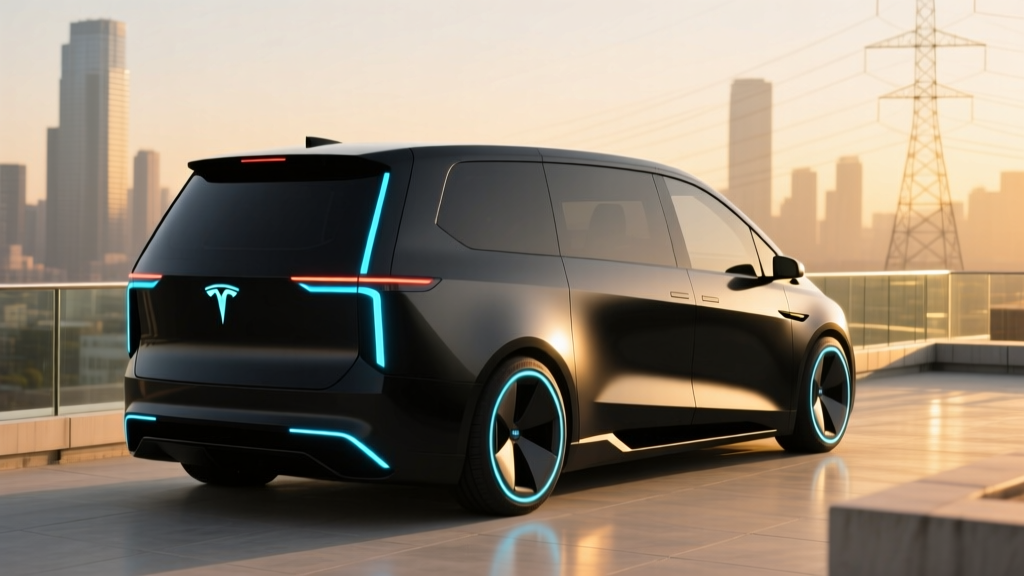
Tesla's electric commercial vehicle ambitions have a new focal point. Following the Cybertruck's polarizing but successful launch, the company has been developing a van platform — widely referred to as the Tesla Cyber Van — aimed at last-mile delivery fleets, tradespeople, and potentially a consumer passenger variant. As of early 2026, Tesla has not officially unveiled a production-spec Cyber Van, but patent filings, supply-chain reports, and statements from Elon Musk confirm the program is active and targeting a late-2026 or 2027 production start.
This preview synthesizes what we know from credible reporting, Tesla's existing platform architecture, and the competitive commercial-EV landscape. All specifications are preliminary or estimated based on available evidence and will be updated when Tesla publishes official data.
Projected Specs: Tesla Cyber Van at a Glance
| Attribute | Estimated / Projected | Basis |
|---|---|---|
| EPA Range (est.) | 250–320 mi | 4680 pack sizing, van aero profile |
| Battery Capacity (est.) | 100–123 kWh usable | Cybertruck AWD pack baseline |
| Battery Chemistry | NMC (4680 cells), LFP variant possible | Tesla Giga Texas production |
| DC Fast Charge (peak) | ~250–350 kW | 800V architecture expected |
| 10–80% DC Time (est.) | ~20–28 min | 4680 charge-curve modeling |
| Level 2 Home Charge | 11.5 kW (~30–34 mi/hr) | Tesla Wall Connector spec |
| 0–60 mph (est.) | 4.5–6.5 sec (AWD) | Dual/Tri-motor Cybertruck comparison |
| Horsepower (est.) | 500–845 hp | Cybertruck AWD/Cyberbeast outputs |
| Drivetrain | Dual-motor AWD (tri-motor possible) | Platform shared with Cybertruck |
| Cargo Volume (est.) | 250–450 cu ft (cargo variant) | Competitor benchmarking (E-Transit, BrightDrop) |
| Base MSRP (est.) | $55,000–$75,000 | Cybertruck pricing + commercial van market |
| Federal Tax Credit (§30D) | Up to $7,500 (consumer variant, if MSRP <$80k) | IRS rules — commercial vans may use §45W instead |
| Battery Warranty (est.) | 8 yr / 120,000 mi (min 70% retention) | Tesla's standard EV warranty baseline |
Range & Efficiency: What to Expect in Real-World Use
The Cyber Van's boxy profile is a significant aerodynamic penalty compared to the Cybertruck's angular-but-sculpted body. We project a drag coefficient around 0.38–0.42, which directly impacts highway efficiency. Based on a likely 100–123 kWh usable battery pack and Tesla's 4680 cell energy density:
EPA Range (projected): 250–320 miles depending on battery pack and drivetrain
Real-World Highway (70 mph): Expect ~210–270 miles — the van's flat front and tall roof create substantial drag at speed
Cold-Weather Impact (below 32°F): Plan for 20–35% range reduction, yielding ~170–220 miles in winter conditions without preconditioning
Loaded/Cargo Impact: A fully loaded cargo variant (2,000+ lb payload) could reduce range by an additional 10–15%
Efficiency will likely land in the 55–65 MPGe range (combined), or approximately 50–60 kWh per 100 miles — comparable to the Ford E-Transit's EPA-rated 2.0–2.2 kWh/mile but with Tesla's powertrain efficiency advantage.
Charging: 800V Architecture and the Supercharger Advantage
Tesla's next-generation platforms are expected to adopt 800V electrical architecture, enabling faster DC charging than the current 400V systems in the Model 3/Y. The Cyber Van should benefit directly.
| Charging Level | Power | Miles Added per Hour | Notes |
|---|---|---|---|
| Level 1 (120V) | ~1.4 kW | ~3–4 mi/hr | Emergency/trickle only |
| Level 2 (240V, 48A) | 11.5 kW | ~30–34 mi/hr | Tesla Wall Connector; overnight fill |
| DC Fast (V3 Supercharger) | 250 kW peak | ~150 mi in 15 min | Existing network; 400V compatible |
| DC Fast (V4 / 800V capable) | ~350 kW peak | ~200 mi in 15 min | Requires V4 stall; 10–80% in ~20 min |
Charging-curve reality: As with all lithium-ion packs, peak kW is not sustained. The 4680 cells are expected to hold above 200 kW through ~50% SoC, then taper progressively. Expect the 10–80% session to average around 180–220 kW on a V4 Supercharger, yielding a realistic 20–28 minute charge time. Above 80%, charging slows dramatically — plan for an additional 20+ minutes to reach 100% if needed.
Tesla's NACS connector is now the North American standard, and the Cyber Van will ship with NACS natively. Access to the full Supercharger network — over 6,000 V3/V4 stalls in the US as of 2026 — remains Tesla's strongest charging moat. Fleet operators should also note Tesla's Megacharger program for depot-based high-power charging.
Performance, Platform & Drivetrain
The Cyber Van is expected to share its underpinnings with the Cybertruck, leveraging Tesla's structural battery pack with 4680 cells, stainless-steel exoskeleton elements, and steer-by-wire capability. This gives it a significant platform advantage over purpose-built commercial EVs like the Ford E-Transit (which uses a modified ICE chassis) and the BrightDrop Zevo (a clean-sheet but lower-volume platform).
Drivetrain options (projected):
- Dual-Motor AWD: ~500 hp, 0–60 in ~5.5–6.5 sec — the volume variant for fleet and cargo use
- Tri-Motor AWD ("Cyberbeast" variant): ~845 hp, 0–60 in ~4.5 sec — likely reserved for a premium consumer passenger version
- Rear-Wheel Drive: Possible base variant for cost-sensitive fleet buyers; ~350 hp, 0–60 in ~7.5 sec
Towing capacity is projected at 6,000–8,000 lbs for AWD variants, though the van's primary mission is cargo volume and payload rather than towing. Payload capacity should target 2,500–3,500 lbs to compete with the E-Transit's 3,880-lb rating.
Pricing, Trims & Federal Tax Credit Outlook
Pricing is speculative until Tesla makes an official announcement, but we can triangulate based on Cybertruck pricing and the commercial EV van market:
| Trim (Projected) | Est. MSRP | §30D Credit (Consumer) | §45W Credit (Commercial) |
|---|---|---|---|
| Cargo Van (RWD base) | $55,000–$62,000 | Up to $7,500 (if MSRP ≤$80k) | Up to $7,500 (GVWR <14,000 lbs) |
| Cargo Van (AWD) | $62,000–$70,000 | Up to $7,500 | Up to $7,500 |
| Passenger Van (AWD) | $68,000–$78,000 | Up to $7,500 | N/A (personal use) |
Tax credit caveats (2026 IRS §30D rules):
- MSRP cap: Vans and SUVs qualify up to $80,000 MSRP; if the Cyber Van is classified as a truck/van, this higher cap applies (source: IRS §30D)
- Income cap: Modified AGI must not exceed $150,000 (single), $225,000 (head of household), or $300,000 (joint)
- Battery sourcing: Critical minerals and battery component requirements phase in more strictly each year — Tesla's shift to US-based 4680 production at Giga Texas improves eligibility odds
- Point-of-sale transfer: Buyers can transfer the credit to the dealer at purchase, reducing the upfront price directly
- Commercial alternative (§45W): Fleet buyers who don't qualify for §30D may claim the Commercial Clean Vehicle Credit instead — consult a tax professional
Cargo, Interior & Technology
The Cyber Van's primary selling proposition for commercial buyers is cargo volume. Based on competitive benchmarking and patent renderings:
- Cargo volume: 250–350 cu ft (standard wheelbase), up to 450 cu ft (extended wheelbase) — targeting the Ford E-Transit's 246.7 cu ft and BrightDrop Zevo 600's 412 cu ft
- Cargo floor length: Estimated 120–155 inches depending on wheelbase
- Roof height: Low, medium, and high-roof variants likely — the high-roof targeting 72+ inches of interior standing height
- Passthrough/load floor: Flat load floor with integrated tie-downs and likely a rear roll-up or barn-door option
Technology highlights (expected from Tesla's current platform):
- 15.4-inch central touchscreen running Tesla's vehicle OS
- Tesla Autopilot (SAE Level 2) standard — adaptive cruise, lane centering, automatic emergency braking
- Full Self-Driving (Supervised) available as a paid option — still Level 2, driver must remain engaged
- Fleet management API for commercial operators (telematics, geofencing, remote diagnostics)
- Over-the-air updates for continuous feature improvement
- Heat pump HVAC standard (critical for range preservation in cold climates)
Competition: How Does the Cyber Van Stack Up?
The commercial electric van market is already contested. Here's how the Cyber Van projects against established and upcoming rivals:
| Spec | Tesla Cyber Van (est.) | Ford E-Transit | BrightDrop Zevo 600 | Rivian EDV |
|---|---|---|---|---|
| EPA Range | 250–320 mi | 126 mi | ~250 mi | ~150 mi |
| Battery (kWh) | 100–123 | 68 | 140 | ~90 |
| DC Fast Charge | 250–350 kW | 115 kW | ~150 kW | ~150 kW |
| Cargo Volume | 250–450 cu ft | 246.7 cu ft | 412 cu ft | ~650 cu ft (large) |
| Starting Price | $55,000–$62,000 | ~$55,000 | ~$75,000+ | Fleet-only (Amazon) |
| Charging Network | Supercharger (NACS) | CCS (public networks) | CCS | CCS / Rivian Adventure |
The Cyber Van's projected advantages are clear: substantially more range, faster DC charging via 800V architecture, and access to the Supercharger network. Its risks include Tesla's history of production delays, the stainless-steel body's repair complexity, and the absence of an established commercial-service network that Ford and GM dealers already provide.
Pros, Cons & Who Should Wait for the Cyber Van
✅ Projected Pros
- Best-in-class range (250–320 mi projected) crushes E-Transit's 126 mi
- 800V fast charging at 250–350 kW — fastest in the segment
- Supercharger network access eliminates public-charging headaches
- Structural battery pack lowers center of gravity, improves handling
- OTA updates and Tesla's software ecosystem
- Heat pump standard for cold-climate efficiency
- Potential consumer passenger variant (no direct competitor offers this)
⛔ Projected Cons
- Not yet officially unveiled — production timeline uncertain
- Stainless-steel body panels may complicate collision repair
- No established commercial-fleet service infrastructure (vs. Ford/GM dealers)
- Premium pricing likely above E-Transit base models
- Boxy aero hurts highway efficiency and real-world range
- FSD (Supervised) subscription adds cost without Level 4 capability
- Tesla's history of delayed production ramps (Cybertruck was 2+ years late)
🎯 Who the Tesla Cyber Van Suits Best
- Last-mile delivery fleets needing 200+ miles of daily range and fast depot charging
- Tradespeople and contractors who want a single vehicle for job-site hauls and daily commuting
- Tech-forward commercial operators who value telematics, OTA updates, and Autopilot for driver fatigue reduction
- Adventure/passenger buyers if a consumer variant launches — a high-range electric van for road trips and family hauling with no direct rival
Consider alternatives if: You need a van now (E-Transit is available today), require an established dealer service network, or operate routes under 120 miles where the E-Transit's lower price suffices.
Frequently Asked Questions
What is the real-world range of the Tesla Cyber Van?
Based on projected battery sizing and the van's aerodynamic profile, we estimate 210–270 miles at highway speeds (70 mph) in moderate temperatures. In cold weather (below 32°F), expect 170–220 miles. These are estimates — official EPA data will not be available until Tesla homologates the vehicle.
How fast does the Cyber Van charge?
Projected peak DC fast-charging is 250–350 kW on Tesla V3/V4 Superchargers, with a 10–80% session taking approximately 20–28 minutes. Home Level 2 charging at 11.5 kW adds roughly 30–34 miles of range per hour, meaning a full overnight charge (8–10 hours) replenishes 240–340 miles.
How much does the Tesla Cyber Van cost after tax credits?
Estimated MSRP starts at $55,000–$62,000 for a cargo variant. If eligible for the full $7,500 federal §30D credit (subject to income, MSRP, and battery-sourcing rules), the effective price could drop to ~$47,500–$54,500. Commercial fleet buyers may use the §45W credit instead. Final pricing is not confirmed.
Is the Cyber Van worth waiting for vs. buying a Ford E-Transit now?
If your daily routes exceed 130 miles or you need DC fast charging for multi-shift operations, the Cyber Van's projected 250+ mile range and 250–350 kW charging make it worth the wait. If your routes are under 100 miles and you need a van immediately with established dealer service, the E-Transit is a proven, available option today.
Does the Tesla Cyber Van qualify for the federal EV tax credit?
It's projected to qualify for up to $7,500 under IRS §30D for consumer buyers, provided the MSRP stays under $80,000 (van/truck cap), buyer income is within limits, and battery sourcing requirements are met. Tesla's US-based 4680 cell production improves sourcing compliance. Commercial buyers may qualify under §45W instead. Always verify current rules at irs.gov and consult a tax professional.
When will the Tesla Cyber Van be available?
Tesla has not announced an official release date. Industry reporting and supply-chain indicators suggest a reveal in late 2026 or 2027, with production beginning 6–12 months after reveal. Given Tesla's track record with the Cybertruck (announced 2019, delivered late 2023), a conservative estimate puts customer deliveries in 2028 at the earliest.
Will there be a consumer passenger version?
Tesla has hinted at a passenger variant, which would position the Cyber Van as a rival to vehicles like the VW ID. Buzz and the Mercedes EQV — but with significantly more range. No official confirmation exists. If it launches, expect pricing in the $68,000–$78,000 range with 7–9 passenger seating.