Quick Verdict: The Silicon Under Your Tesla's Dashboard
When shoppers search for "Tesla computers," they're usually asking one of three things: How capable is the hardware running Autopilot and Full Self-Driving (FSD Supervised)? Will today's onboard computer support future autonomous features? And does the infotainment processor actually affect daily driving? This guide answers all three — with hard specs, not marketing gloss — using the current 2026 Model 3, Model Y, Model S, and Model X lineup as our reference points.
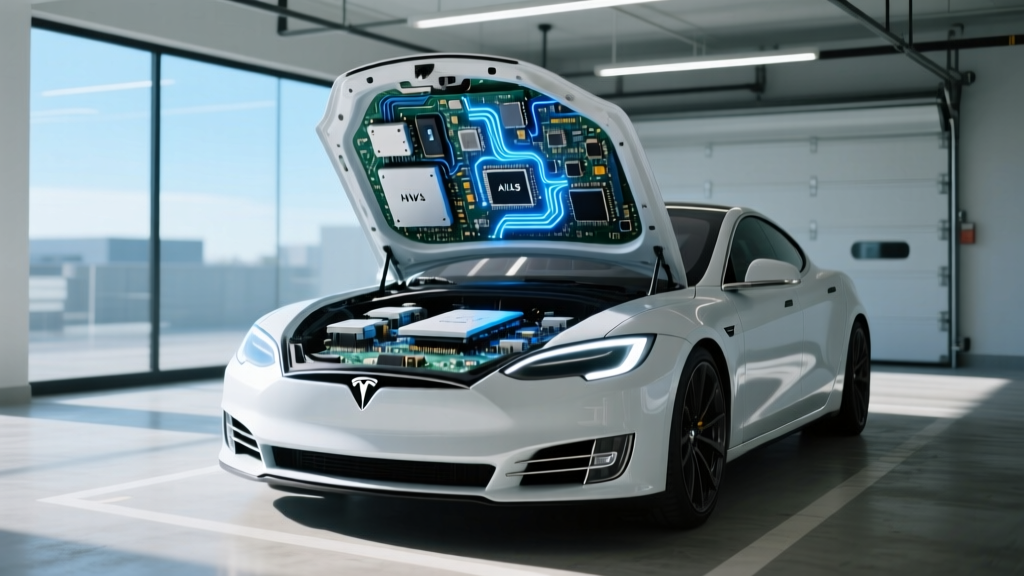
Tesla currently ships two generations of its driving computer across its fleet: Hardware 4 (HW4), introduced in 2023, and the newer AI5 computer, which began appearing in refreshed Model S/X vehicles and Cybertruck in late 2024 and is expected to roll across the full lineup through 2026. The infotainment side runs on a separate AMD Ryzen-based processor that has been standard since 2022. Understanding which silicon your Tesla carries matters for FSD capability, over-the-air update longevity, and even energy efficiency.
Tesla's Driving Computers: HW4 vs. AI5 Compared
Tesla's custom-designed driving computer processes input from the vehicle's camera suite (Tesla abandoned radar and ultrasonic sensors in its "Tesla Vision" approach) to run neural networks for Autopilot lane-keeping, adaptive cruise, automatic emergency braking, and FSD Supervised features like city-street navigation and traffic-light recognition.
| Specification | Hardware 3 (Legacy) | Hardware 4 (HW4) | AI5 (Current/New) |
|---|---|---|---|
| Camera Resolution | 1.2 MP (front) | 5 MP (front + sides) | 5+ MP, improved low-light ISP |
| Neural Net Processor | Dual NPU, ~144 TOPS | Dual NPU, ~300+ TOPS (est.) | Next-gen NPU, ~4-5x HW4 throughput |
| Camera Count Supported | 8 | 8–11 (higher-res feeds) | 8–11 with enhanced processing |
| Manufacturing Node | 14 nm (Samsung) | 7 nm (Samsung) | 4 nm (TSMC, reported) |
| Power Draw (est.) | ~72 W | ~50–60 W | ~40–50 W (better perf/watt) |
| Vehicles Equipped | 2019–early 2023 | 2023–present (Model 3/Y/S/X) | Late 2024+ (Cybertruck, refreshed S/X, expanding) |
| OTA Update Longevity | Limited — aging out of newest FSD builds | Full support through 2026+ | Designed for next-gen autonomy stack |
What this means for buyers: If you're purchasing a new 2026 Tesla, you'll receive at minimum HW4, which fully supports the current FSD (Supervised) neural-network stack. AI5-equipped vehicles are beginning to appear in the refreshed Model S and X and Cybertruck; these units offer significantly more headroom for future FSD iterations that demand heavier inference loads. Hardware 3 vehicles (2019–early 2023 builds) are increasingly limited — Tesla has confirmed that the newest FSD v13+ builds require HW4 or later, meaning HW3 owners face a functional ceiling unless they pay for a retrofit (historically offered at ~$1,000–$2,000 for FSD-purchased owners).
Infotainment Computer: AMD Ryzen Under the Screen
Separate from the driving computer, Tesla's infotainment system runs on an AMD Ryzen Embedded processor paired with an RDNA 2-based GPU (similar architecture to a Radeon RX 6000 series chip). This replaced the older Intel Atom E3950 that powered pre-2022 vehicles and was widely criticized for sluggish map rendering and slow app load times.
The Ryzen-based unit delivers:
- Near-instant map panning and zoom with full 3D building rendering
- In-car gaming capable of running titles like Cyberpunk 2077 and Stardew Valley at playable frame rates on the center display
- Netflix, YouTube, and Twitch streaming at full resolution while parked
- Sub-2-second cold boot to drivable interface
This processor does not affect Autopilot or FSD performance — it handles only the UI, navigation, media, and climate controls. But for daily usability, the AMD upgrade is one of the most impactful quality-of-life changes Tesla has made in the last five years.
Real-World Vehicle Specs: 2026 Model 3 Long Range as Reference Platform
To ground this discussion in a specific vehicle, here are the full specs for the 2026 Tesla Model 3 Long Range AWD — currently Tesla's highest-volume HW4-equipped sedan and a representative benchmark for how Tesla's computer stack integrates with the overall vehicle.
| EPA Range | 363 miles |
| Battery Capacity | ~79 kWh usable (NMC chemistry, LG M50 cells) |
| Efficiency | 132 MPGe combined / 25 kWh/100 mi |
| Drivetrain | Dual-motor AWD (induction front / permanent magnet rear) |
| Horsepower | ~384 hp combined |
| 0–60 mph | 4.2 seconds |
| Max DC Fast Charge | 250 kW (CCS via NACS adapter or native NACS at V3/V4 Superchargers) |
| 10–80% DC Charge Time | ~25 minutes (with preconditioning) |
| Level 2 Home Charge Rate | 11.5 kW (~44 mi/hr on a 48A circuit) |
| Cargo Volume | 23 cu ft trunk + 3.1 cu ft frunk |
| Rear Legroom | 35.3 inches |
| Driving Computer | HW4 (all 2026 Model 3 production) |
| Infotainment | AMD Ryzen Embedded + RDNA 2 GPU |
| Battery/Drive Unit Warranty | 8 years / 120,000 miles (min 70% retention) |
The EPA rates the 2026 Model 3 Long Range at 363 miles. In real-world highway driving at 70–75 mph with climate control active, expect approximately 290–320 miles in mild weather (55–75°F). In cold conditions (below 30°F), range can drop to 240–270 miles due to battery chemistry limitations and cabin heating load. Tesla's heat pump (standard since the Highland refresh) mitigates this somewhat compared to resistive heating, but a 20–30% winter reduction is physics, not a defect. City driving with regenerative braking can match or slightly exceed the EPA figure.
Source: EPA Fuel Economy
Charging Speed: How Tesla's Computers Optimize the Charge Curve
Tesla's onboard computer doesn't just handle driving — it actively manages battery thermal preconditioning for charging. When you navigate to a Supercharger, the system begins heating or cooling the battery pack to its optimal charge-acceptance temperature (typically 35–45°C at the cell level), which is critical for hitting peak charge rates.
| Level | Power (kW) | Speed (miles/hr) | Notes |
|---|---|---|---|
| Level 1 (120V) | ~1.4 kW | ~3–4 mi/hr | Emergency/trickle only |
| Level 2 (240V, 48A) | 11.5 kW | ~44 mi/hr | Full overnight charge in ~7 hrs |
| DC Fast (V3 Supercharger) | Peak 250 kW | ~1,000+ mi/hr (peak) | 10–80% in ~25 min |
| DC Fast (V4 Supercharger) | Peak 250 kW (Model 3 limited) | Same as V3 for this vehicle | V4 cabinet supports higher, but vehicle-side limit applies |
Charging curve reality: The 250 kW peak only holds from roughly 10–30% State of Charge (SoC). The rate then tapers progressively — approximately 175 kW at 50%, 100 kW at 65%, and below 50 kW past 80%. This is why Tesla (and all EV analysts) quote 10–80% times rather than 0–100%. Charging from 80–100% at a DC fast charger can take as long as the 10–80% session. For road trips, plan to charge to 80% and move on.
Pricing, Tax Credits, and Which Trim Gets Which Computer
Here's how the 2026 Tesla lineup breaks down by price, computer hardware, and federal tax credit eligibility under IRS §30D rules.
| Model / Trim | Base MSRP | Driving Computer | §30D Credit Eligibility |
|---|---|---|---|
| Model 3 RWD | $38,990 | HW4 | Up to $7,500 (income & sourcing dependent) |
| Model 3 Long Range AWD | $44,990 | HW4 | Up to $7,500 (income & sourcing dependent) |
| Model 3 Performance | $52,990 | HW4 | Up to $7,500 (income & sourcing dependent) |
| Model Y Long Range AWD | $46,990 | HW4 | Up to $7,500 (income & sourcing dependent) |
| Model S Long Range | $79,990 | AI5 (2026 refresh) | Not eligible — exceeds $55,000 sedan MSRP cap |
| Model X Long Range | $84,990 | AI5 (2026 refresh) | Not eligible — exceeds $80,000 SUV MSRP cap |
| Cybertruck AWD | $79,990 | AI5 | Eligible (truck cap $80,000) — sourcing dependent |
- Income caps: Modified AGI ≤ $150,000 (single), $225,000 (head of household), $300,000 (joint)
- MSRP caps: $55,000 for sedans; $80,000 for SUVs, vans, and pickup trucks
- Battery sourcing: Credit is split into two halves ($3,750 each) — one for critical minerals, one for battery component manufacturing. Sourcing requirements tighten annually; check IRS.gov §30D guidelines for current-year eligible vehicles
- Point-of-sale transfer: Eligible buyers can transfer the credit to the dealer at purchase, reducing the purchase price directly rather than waiting for a tax refund
Always confirm eligibility with a tax professional before purchase. Rules and eligible vehicle lists change quarterly.
Driver Assistance: What Tesla's Computers Actually Enable
Tesla offers three tiers of driver-assistance capability, all of which depend on the onboard driving computer:
Basic Autopilot (included): Traffic-Aware Cruise Control and Autosteer (lane centering) on highways. Runs on HW4 or AI5 without issue. SAE Level 2.
Enhanced Autopilot ($6,000 option): Adds Navigate on Autopilot (highway on/off-ramp navigation), Auto Lane Change, Autopark, Summon, and Smart Summon. Requires HW4 or later for full functionality.
Full Self-Driving (Supervised) ($8,000 option or $99/mo subscription): Adds traffic light and stop sign recognition, city-street autosteer, and automated turns in complex intersections. The most compute-intensive Tesla feature. FSD v13+ requires HW4 minimum; AI5 provides substantially more inference headroom for future versions. Still SAE Level 2 — full driver supervision required at all times.
- It does not drive autonomously — you are the responsible driver at all times
- It does not handle all road conditions — construction zones, faded lane markings, and unmapped roads can cause disengagement
- It does not replace attentive driving — NHTSA requires active supervision for all Level 2 systems
- It does not guarantee future "robotaxi" capability — Tesla's proposed unsupervised FSD remains unapproved by regulators as of 2026
Pros, Cons, and Competitive Position
- HW4 and AI5 are among the most capable consumer driving-computer platforms available, with continuous OTA improvement
- AMD Ryzen infotainment is fast, responsive, and supports genuine gaming-grade graphics
- Supercharger network remains the most reliable DC fast-charging ecosystem in North America (now open to other brands via NACS)
- Class-leading efficiency — 25 kWh/100 mi beats most competitors
- Over-the-air updates continuously add features without dealer visits
- Strong resale value relative to most EV competitors
- HW3 vehicles are being left behind by newest FSD builds — retrofit cost is an unwelcome surprise for used buyers
- FSD (Supervised) is expensive ($8,000) and still requires full driver attention — value proposition debated
- Tesla Vision (camera-only, no radar/ultrasonic) can struggle in heavy rain, fog, and low-visibility scenarios
- Build quality and panel gaps, while improved, still lag legacy automakers at similar price points
- Model S/X pricing puts them well above §30D credit caps
- No Apple CarPlay or Android Auto — Tesla's closed ecosystem is a dealbreaker for some
Who Should Buy — and Who Should Look Elsewhere?
- You want the most mature public fast-charging network (Superchargers) for road trips
- You value continuous OTA feature updates and the longest software-support runway in the EV market
- You're interested in the most advanced Level 2 driver-assist system available (with the caveat that it's still Level 2)
- Efficiency matters — Tesla's energy consumption per mile is among the best in the industry
- You prefer Apple CarPlay/Android Auto (Hyundai Ioniq 5, Ford Mustang Mach-E, BMW i4)
- You want radar-backed adaptive cruise for inclement weather confidence (most legacy OEMs still use radar + camera fusion)
- You need a luxury interior at Model S pricing — the BMW i7 and Mercedes EQS offer more traditional luxury with competitive tech
- You're buying used and the vehicle has HW3 — verify retrofit availability before committing
Frequently Asked Questions
Can Tesla's onboard computers be upgraded after purchase?
Yes, with caveats. Tesla has historically offered HW3-to-HW4 retrofits for owners who purchased FSD, typically for $1,000–$2,000. Availability and pricing vary. Infotainment upgrades (Intel Atom to AMD Ryzen) were also offered for older Model S/X vehicles. Check with Tesla service for current retrofit programs — they are not universally available for all model years.
Does the Tesla computer affect energy efficiency and range?
Marginally, yes. AI5's more efficient 4nm manufacturing process draws less power than HW4 for equivalent or better compute throughput. In practice, the difference is small — perhaps 1–3 miles of range — but it compounds over the vehicle's lifetime. The larger efficiency gains come from Tesla's powertrain, aerodynamics, and thermal management, not the computer alone.
Will HW4 vehicles support future Tesla robotaxi features?
Tesla has stated that HW4 is sufficient for its planned unsupervised FSD features. However, no unsupervised Tesla system has received regulatory approval from NHTSA or state agencies as of 2026. AI5 provides more headroom, but there is no guarantee that any consumer Tesla will operate as a Level 4 robotaxi in the near term. Treat any "robotaxi-ready" claims as speculative.
How does Tesla's driving computer compare to competitors?
Most competitors (Ford, Hyundai, BMW, GM) use supplier-provided ADAS chips from Mobileye, Qualcomm, or NVIDIA. Tesla's vertical integration — designing its own silicon optimized specifically for its neural network architecture — gives it a unique advantage in iteration speed. NVIDIA's DRIVE Orin (used in Mercedes and others) offers comparable or higher raw TOPS, but Tesla's tight hardware-software coupling often delivers better real-world results per watt.
Does FSD work better on AI5 vs. HW4?
Current FSD (Supervised) v13 runs on both HW4 and AI5. On AI5, Tesla can run larger, more complex neural networks with higher-resolution camera inputs and faster inference. In practice, AI5-equipped vehicles may show slightly smoother and more confident behavior in complex scenarios (unprotected left turns, dense urban traffic), but the core feature set is identical. The bigger advantage of AI5 will be in future FSD versions that demand more compute than HW4 can provide.
Does the 2026 Model 3 qualify for the federal EV tax credit?
The 2026 Model 3 (all trims under $55,000 MSRP) is potentially eligible for up to $7,500 under §30D, subject to buyer income limits, battery critical-mineral sourcing requirements, and point-of-sale transfer rules. Verify your specific eligibility on the IRS clean vehicle credits page and with a qualified tax professional before purchasing.